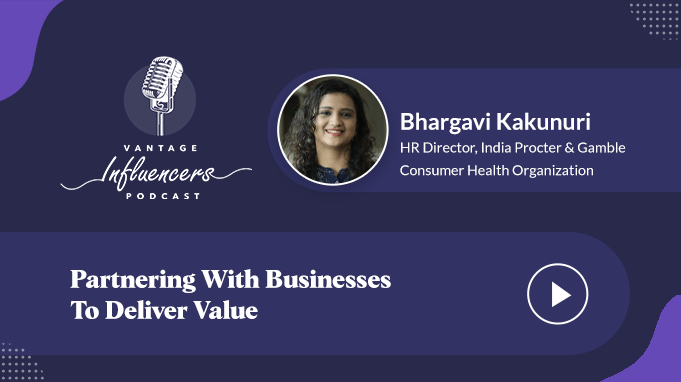
Partnering With Businesses To Deliver Value
Episode Overview
Bhargavi Kakunuri opens this episode with a reframing that immediately raises the stakes of the conversation. Business partnering, done well, is not a support role sitting on the sidelines. Borrowing the imagery of Theodore Roosevelt's "Man in the Arena" speech, she argues that partnering with the business means striving, stumbling, and taking real risks alongside the leaders you support, not critiquing from a safe distance. From there, she breaks the work into three concrete outcome areas: deliberately growing diverse business leaders, designing organizations built for what comes next, and building a culture where performance and engagement reinforce each other.
She also makes a case for why this function is uniquely positioned to do this kind of work, describing a vantage point that comes from seeing an entire organization as one connected system rather than a set of isolated departments. The conversation closes with practical advice for anyone earlier in their career: learn the business before diving into day-to-day tasks, take smart risks instead of playing it safe, and treat stakeholder relationships as a skill built deliberately, not something that happens on its own.
Episode Highlights
- Business partnering means being "in the arena," not standing on the sidelines. Real business impact is earned through effort and risk, not policy compliance.
- Three outcome areas define business partnering: deliberately growing diverse business leaders, designing organizations built for what's next, and building a high-performance, engaged culture.
- A wider view of the organization is the real advantage. Seeing how strategy, structure, processes, and mindsets fit together makes it easier to spot what's broken and which levers move results.
- Anyone new to this work should learn the business first. Sign up for a business project, talk to colleagues across functions, and understand the value chain before jumping into daily tasks.
- Taking smart risks matters more than staying safe. Questioning the status quo opens doors that people inside a system often can't see for themselves.
- Stakeholder management is a skill, not an instinct. It has to be built deliberately from day one, not left to develop by accident.
About the Guest
Bhargavi Kakunuri, HR Director, India, Procter & Gamble Consumer Health
Bhargavi Kakunuri has close to 18 years of work experience, with a career path that started far from HR. She began as a booking clerk with Indian Railways at 17, then spent several years in a government audit role before an MBA in human resources led her to Procter & Gamble, where she has spent the last decade. In that time, she has held seven different roles spanning HR business partnering, HR operations, divestiture management, and sales and supply network leadership, and now serves as HR Director, India, for P&G's Consumer Health organization. She has also researched gender equality in the workplace and is a strong advocate for diversity and inclusion at work.
Connect with Bhargavi on LinkedIn
Host
Gautam, Vantage Influencers Podcast Host
What You Will Learn
- Why business partnering means being "in the arena," not a bystander to business outcomes
- The three outcome areas that define effective business partnering
- Why HR has a unique vantage point compared to other business functions
- Practical tips for building business partnering skills early in your career
- How business partnering connects directly to company performance and culture
Key Topics & Timestamps
| Timestamp | Topic |
|---|---|
| 00:57 | Introduction to the host and episode topic |
| 01:14 | Meet Bhargavi Kakunuri and her career journey |
| 05:16 | Defining business partnering and its three outcome areas |
| 08:41 | Why HR holds a unique vantage point in business partnering |
| 10:03 | Advice for building business partnering skills |
| 12:43 | How business partnering drives company performance |
| 13:23 | Closing thoughts and where to connect with Bhargavi |
Full Transcript
Click to read the full episode transcript
Welcome to the Vantage HR Influencers podcast. This podcast is sponsored by Vantage Circle, the simple and AI-powered rewards and recognition platform for employee engagement.
Over the last couple of decades, the business partner concept has dramatically evolved from roles and outcomes to a logic of how HR delivers value. Business partners have more opportunities than ever to impact business success. Especially during the pandemic and post-pandemic world, we have seen immense opportunities and various ways in which businesses and HR functions are evolving to meet employee needs in a unique way.
In today's episode, we shall know what the key tenets of business partnering are and how this has evolved over a period of time. Let's get started.
Gautam: Hello listeners. Welcome to Vantage Influencers podcast. I am your host, Gautam. We are back with yet another exciting and enlightening episode, and the topic for today's discussion is partnering with business to deliver value. To give us detailed insights on this topic, we have with us Bhargavi Kakunuri. Bhargavi Kakunuri is the HR Director, India, Procter & Gamble Consumer Health organization. Hello, Bhargavi. Welcome to the show.
Bhargavi Kakunuri: Hi, Gautam. Thank you for inviting me to this podcast.
Gautam: We are surely delighted to have you with us today. But before we can go ahead with the discussion of the topic for today, would you please brief us about yourself? We want our listeners to know more about you, what you do, what your strengths are, what your weaknesses are, what you are as a person. So we would love to listen to that from you.
Bhargavi Kakunuri: Sure, Gautam. I have close to 18 years of work experience, although not all of that has been in HR. It's a very interesting story that I'd like to share. I started working at the age of 17. My first job was in Indian Railways as a booking clerk, in a small town on the border of Karnataka. I used to work in shifts and study. I completed my distance education in commerce, and I'm also a cost accountant. I then decided to apply for a position in a government audit office, and I got selected as a section officer. It was an interesting role too. I audited the performance and accounts of many government companies. It was a hardcore finance role, which I did for about four years. At that point in time, I wanted to pursue an MBA, and I got admission at a business school in Jamshedpur for their HR course. Switching from finance to HR was a complete leap of faith for me. I interned at P&G and have been with P&G for 10 years now. It's an amazing company that provides a lot of opportunities to learn and grow while being able to make an impact. I have done close to seven roles in the last 10 years, right from working as an HR business partner at a plant, to managing HR operations, to managing a divestiture for the company, leading sales and supply network HR for P&G India, and my current role as HR Director for P&G's health organization. I do think that I finally found a path with a heart. Personally, there are many things I'm really passionate about in HR, but two things particularly stand out to me. One is the opportunity to work on really complex problems. Simple problems get resolved at individual, management, or policy and process levels. But the most complex problems, like crises, difficult employee situations, team effectiveness challenges, or org design challenges where there's no simple, straightforward solution that a spreadsheet could give you, usually bubble up to HR, and it's very satisfying to work on some of those problems with the teams. That's one, and the second is definitely the ability to have an impact on the organization and the business. There are several ways you can make a difference to the people and the business you work with. When I look back on my career, I had so many opportunities to work on programs that really touched people's lives and created business value. I find this a meaningful purpose that really makes my work less of a job and more of a passion for me, and makes me come to work every day. I hope that covers a lot of it.
Gautam: I think that was a truly impressive part of you. I was looking at your LinkedIn profile and I didn't find much of a bio there, so this was a genuine surprise, to hear the story from you, and I think it truly inspires many people. We are truly delighted to have you with us today. So, to kickstart our conversation, we have taken up the topic of partnering with business and how it delivers value. I have very little knowledge about this topic myself, and I think you'll be a much better person to enlighten me on it. So what is business partnering, and how would you like to describe it?
Bhargavi Kakunuri: Business partnering reminds me of the poem "Man in the Arena," or "The Woman in the Arena," from the famous speech by Roosevelt. Maybe I can repeat part of it for effect. It says that it is not the critic who counts, not the man who points out how the strong man stumbles, or where the doer of deeds could have done them better. The credit belongs to the man who is actually in the arena, whose face is marred by dust and sweat and blood, who strives valiantly, who errs, who comes short again and again, because there is no effort without error and shortcoming. But who does actually strive to do the deeds, who knows great enthusiasms, the great devotions, who spends himself in a worthy cause, who at the best knows in the end the triumph of high achievement, and who at the worst, if he fails, at least fails while daring greatly. So you are never a bystander. You are in the arena when you are a business partner. And I know I make business partnering sound like going to a battle, but I can tell you that if you do it well, you have exactly the same feeling as the woman in the arena. But in concrete terms, if I have to explain what business partnering is for me, I can pick up three broad outcome areas on how you can operate and serve business better. One, I think, is partnering with business for deliberately growing outstanding, diverse business leaders. That is the first outcome to work on, and it encompasses activity systems which include talent development, deliberate staffing efforts to build a leadership pipeline, equality and inclusion efforts of the organization, building effectiveness in leadership teams, and driving data-based decisions to build across your talent metrics. So all of this comes under how you build outstanding, diverse business leaders. That is the first area. The second area of business partnering will focus on designing future-ready organizations, and here, identifying what your core capabilities are for your organization, for example, if it is innovation or consumer centricity, and building on those core capabilities, or identifying emerging capabilities that serve the business need. So that's one part of it, and secondly, how would you bring those capabilities to life, whether you will build, borrow, or buy those capabilities, how you redefine your organization structure, how do you make roles multifunctional, multidimensional, so that you can bring some of these capabilities to life. That's the second area of work. And the third, and the most, I think, widely known area of work, is how do you build a high-performance and engaged organization and culture. The right culture and employee engagement solutions that can really bring long-term business success are the third area of work that we do in business partnering, broadly defining it that way.
Gautam: I think that was a great part of it. I got to learn something more about business partnering, because I used to think that it's more or less how two or three businesses can partner with each other and work together. But your insights have truly given me more insight as to what business partnering can really do, and how it helps employee engagement as well. So, being the HR Director at P&G, how is HR better placed to partner with business than other functions?
Bhargavi Kakunuri: I do think that every function has a role to play in the overall business setup, especially in the current scenario. But actually, work doesn't happen in silos, but more broadly, in multifunctional teams and function-agnostic roles. However, I see that HR, just by virtue of the role, has a wider lens or canvas, that you're responsible for the organization or the business unit. This, in my mind, provides us with a better vantage point. You're able to view the entire organization as a system, like a jigsaw puzzle, on how everything fits together, the strategic priorities, the activity systems, the structure, the business processes, the management habits, and the mindset of individuals, how all of this fits together so that you see delivering results. You're better able to see where things are broken and what some of the levers are that you could use to make changes in the organization. Your ability to see what's broken, what the root cause is, and how things interact with each other is much better than anyone else's in the organization, I think, and hence our ability to create a better impact.
Gautam: So, considering you have so many years of experience in HR and business partnering, do you have any tips for those new to HR on how they can build the skills for effective business partnering?
Bhargavi Kakunuri: I think the first one will be to understand the business first. I would say don't fall into the trap of jumping right away into the day-to-day work. Try to learn the business first, then define how you, as an HR professional, can make the biggest impact. This will not be part of your standard onboarding program, so you will have to be curious. You have to set up some time with colleagues across all work groups to understand their work, the key metrics they're responsible for, how the value chain works, the business model, and how the business works. In fact, I would say sign up for yourself for a business project and do it for a deeper understanding of the business. So, in order to break the rules, you must first master them. So I would say understand first. The second, and this I learned from one of my business partner stakeholders, is that you have to be courageous and bold. In my company, it's called taking smart risks. So don't be afraid to question the status quo. Believe me, those who are in the system are often very blind to possibilities, and your question may open some new doors and new perspectives. And it's not always easy, you will make mistakes, but don't be afraid to make mistakes, and don't be afraid to be in the good books of everybody all the time. I would say have a growth mindset, and don't settle in without disrupting something, is what I would say. Third, I think, understand your stakeholders. Influencing is a critical skill for HR, and it's important that you understand your stakeholders and try to build this skill deliberately from the beginning. So those were my tips.
Gautam: I think so. Maybe a trial-and-error method can really work in this matter, right? So, how is business partnering really important for company culture or company performance? How does it help enhance businesses, basically?
Bhargavi Kakunuri: I do think that HR business partners can be huge value creators and drivers of change for business, through a partnership of art and science. We can bring the right balance between the what and the how of business, balancing the interests of individuals and the organization with the interests of the business. You can do this in the most harmonious and symbiotic way, and HR business partners can enable this to happen.
Gautam: Thank you, Bhargavi. And with this, we are slowly approaching the end of this conversation. So, in the end, how would you like to conclude your thoughts on business partnering and how it improves company performance?
Bhargavi Kakunuri: Sure. I think, finally, every business is made of people. Every organization has its employees at its core, and this is where HR plays a pivotal role, to ensure the core is intact and the policies and processes are humane. And the ones impacted by them are humans as well, like all of us. So I would say, enjoy the ride.
Gautam: So, Bhargavi, in case our listeners would want to reach out to you, or if they want to contact you for further assistance, how can our listeners reach out to you?
Bhargavi Kakunuri: You can reach out to me on my LinkedIn, at Bhargavi.
Gautam: Thank you so much, Bhargavi. It was great having you with us today, and we really had some amazing responses from you on business partnering, because this topic is something that I think a lot of people think is very general, very generic, and they do not want to know much about it. But your insights truly changed my perception, and I think it will change our listeners' perception as well. Thank you so much for joining us today.
Bhargavi Kakunuri: Thank you. It was great speaking with you.
Gautam: And with this, we have come to the end of today's episode. Stay tuned for more such engaging and enlightening conversations, only on Vantage Influencers Podcast. Thank you.
Thanks for listening to the Vantage HR Influencers podcast. Please do subscribe to the Vantage HR Influencers podcast on Apple Podcasts, Spotify, and our YouTube channel for new episodes.
FAQ
What does business partnering mean, according to Bhargavi Kakunuri?
Business partnering means being actively involved in the business rather than observing from the sidelines. Bhargavi describes it through three outcome areas: growing diverse business leaders, designing organizations that are ready for what comes next, and building a high-performance, engaged culture.
Why is HR well positioned to partner with the business?
Because HR touches every part of an organization, from strategy to structure to individual mindsets, it has a wider view of how the pieces fit together. That vantage point makes it easier to identify what's broken and which levers actually drive results.
What advice does she give to HR professionals building business partnering skills?
Learn the business before diving into daily tasks, take smart risks instead of playing it safe, and treat stakeholder management as a skill worth building deliberately from day one, rather than something that develops on its own.
How does business partnering affect company performance?
Bhargavi argues that HR business partners create value by balancing the interests of individuals with the needs of the business, combining the art and science of people management to drive results in a sustainable, symbiotic way.
Related Reading
Also listen on