Crafting A People-First Culture
Episode Overview
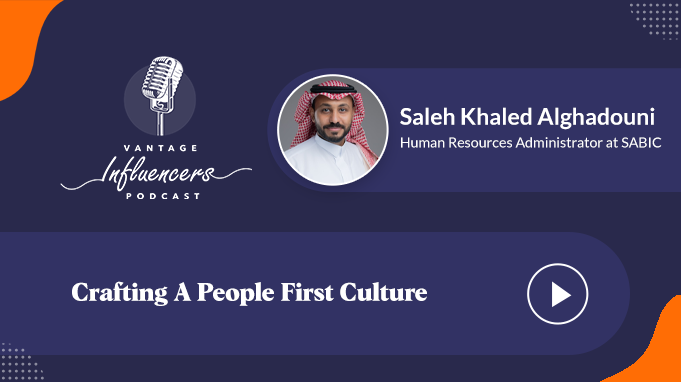
In this episode of the Vantage Influencers Podcast, host Sanjeevani Saikia talks with Saleh Khaled Alghadouni about what actually separates a people first culture from a slogan on a careers page. Saleh starts by defining culture itself, the shared values and behaviors that shape how people work together, before narrowing in on his own definition of a people first culture: a deliberate business strategy that aligns employee growth and satisfaction with organizational goals, rather than a simple claim that people matter more than profit. He argues this distinction matters because organizations are now competing to become an employer of choice, and the ones that treat culture as a strategy rather than a feeling see the payoff in productivity, retention, and employees who go beyond their job description.
The conversation then turns to leadership, where Saleh makes an unusual point: before leaders can shape a people first culture in their teams, they need to audit whether they hold those values themselves, since many leaders who came up in command and control environments never developed them in the first place. He walks through the tension between flexibility and structure that surfaced heavily during the shift to remote and hybrid work, arguing that leaders should set clear expectations and hold people accountable while still listening to how employees want to customize their own way of working. Saleh also names the barriers that stall these efforts, from employees who see wellbeing initiatives as a waste of resources to leaders who never link new values to how work actually gets done, and he closes with a four pillar framework built around employee voice, leader behavior, organizational goals, and future readiness, along with a case for measuring progress through surveys, benchmarking, and open communication rather than guesswork.
Episode Highlights
- Saleh defines a people first culture as a business strategy that aligns employee growth and satisfaction with organizational goals, not simply a claim that people matter more than profit.
- He argues people first culture has become urgent post pandemic, as organizations compete to be an employer of choice and see the payoff in productivity, retention, and innovation.
- Leaders need to assess whether they personally hold people first values before trying to instill them in their teams, since some leaders never developed these values in command and control environments.
- Balancing flexibility with structure requires clear expectations and accountability, paired with room for employees to customize how they work.
- Common barriers include employees who see wellbeing initiatives as a waste of resources and leaders who fail to connect new values to day to day work.
- Saleh closes with a four pillar framework, employee voice, leader behavior, organizational goals, and future of work, plus surveys and benchmarking to measure progress.
About the Guest
Saleh Khaled Alghadouni, HR Administrator, SABIC
Saleh Khaled Alghadouni is an HR professional whose work spans talent acquisition, employee onboarding and offboarding, performance management, and employee relations. He started his HR career in the healthcare industry as a talent acquisition specialist before moving into the chemical industry, where he now works within a global HR business partner team focused on aligning HR strategy with organizational goals. He holds a CIPD (Chartered Institute of Personnel and Development) certification and a degree in English language and translation from Qassim University.
Connect with Saleh on LinkedIn
Host
Sanjeevani Saikia, Vantage Influencers Podcast Host
What You Will Learn
- How to define a people first culture as a business strategy rather than a set of feel good values.
- Why organizations are under more pressure than ever to build a people first culture after the pandemic.
- Why leaders need to assess their own values before trying to shift their team's culture.
- How to balance flexibility and structure without giving employees unchecked freedom.
- What barriers commonly derail people first culture initiatives, and how to address them.
- A four pillar framework for building and sustaining a people first culture.
Key Topics & Timestamps
| Timestamp | Topic |
|---|---|
| 01:36 | Saleh's journey into HR, from a healthcare talent acquisition role to a global HR business partner team |
| 03:04 | Defining a people first culture and why it's become essential in today's business landscape |
| 07:34 | How leaders can demonstrate commitment to building an inclusive, people centric workplace |
| 09:53 | Balancing flexibility and structure to empower teams without giving up accountability |
| 13:02 | Common barriers that stall people first culture initiatives, and how to overcome them |
| 15:40 | How organizations can measure the success of their people first culture efforts |
| 18:17 | Practical first steps and Saleh's four pillar framework for building the culture |
Full Transcript
Click to read the full episode transcript
Welcome to the Vantage HR Influencers Podcast. This podcast is sponsored by Vantage Circle, the simple and AI-powered rewards and recognition platform for employee engagement. Based on decades of employee engagement research, Gallup confirms that engaged employees produce better business outcomes than other employees across industry, company size, nationality, and in good economic times and bad. That statement is a powerful testament to the impact of crafting a people-first culture to foster increased employee engagement, a culture where employees feel engaged and cared for. In fact, a people-first culture is about prioritizing the well-being and fulfillment of employees, recognizing them as the heart and soul of any business.
Sanjeevani Saikia: So, welcome to another episode of the Vantage Influencers Podcast. In this podcast, we navigate an array of HR-centric discussions. I'm your host, Sanjeevani Saikia. Today, we have Saleh Khaled Alghadouni, Human Resources Administrator at SABIC, with us, who will help us understand the people-first culture in depth. Hi, Saleh, welcome to the conversation. Thank you very much for joining me. First of all, I want to convey my heartfelt appreciation for your valuable time in joining us for this episode. Before we begin today's podcast on crafting a people-first culture, could you kindly walk us through your corporate journey so far?
Saleh Khaled Alghadouni: Sure. As I say, the pleasure is to be with you, and I'm very happy to discuss this interesting subject. I'll be brief about my previous experience. I started my career in HR back in 2018, in the healthcare industry, where I was working as a talent acquisition specialist. It was my first job in HR, and I got hooked immediately after that job and developed a strong interest in pursuing a career in HR. I spent about a year and a half there, then I moved to one of the leading companies in the chemical industry. Currently, I'm working in the global HR business partner team. This is a brief introduction about my background, and right now I've been working, let's say, around six years, mainly in HR.
Sanjeevani Saikia: Wonderful. Thank you for sharing your journey with us. It's a pleasure to have you today. With your permission, I'd like to begin today's conversation.
Saleh Khaled Alghadouni: Go ahead.
Sanjeevani Saikia: I think you'll agree if I say that a people-first culture is no longer a buzzword, but it's an important strategy in itself. Recognizing that people are the company's most valuable asset and taking care of their needs, I believe, has profound implications for overall success. Now, as we embark on this discussion, it's important to first of all understand people-first culture. So how would you like to define people-first culture, and why do you think it has become so crucial in today's business landscape?
Saleh Khaled Alghadouni: Yes, sure. People-first culture is very crucial actually today in today's business landscape. But let me first take a broad look at what we mean when we say culture. I'll start by defining culture in general, and then we'll dive deep into the people-first culture, and we'll take a closer definition of people-first culture. Let me say that organizational culture in general is a system of shared values and beliefs which governs how we behave in that organization. So every organization has certain ways of doing things that reflect their culture. Sometimes when you're dealing with people in a certain organization, you can feel their culture; it always affects their beliefs and their interaction with each other and with their customers. This is a brief definition of culture in general, or organizational culture, and there are many organizations that may have certain cultures, let's say schools, universities, private sector, government sector; you can always feel their culture.
A people-first culture definition: many people have defined it in a very simple and direct way. Many people say that an organization's culture is one where the organization values its employees over profit. But I would say my personal definition is a business strategy that aligns employee growth and satisfaction with the organization's goals. So it is a strategy that an organization needs to work on in today's landscape, as it is a crucial part of an organization's success. That's why I want to define it as a strategy that an organization needs to follow, and of course, it's crucial in today's landscape.
It is crucial for several reasons, and it affects both the well-being of employees and the organization's success itself. Organizations now are competing to create a culture that makes their employees happy, to attract top talent, and to be an employer of choice. Especially after the pandemic, organizations are now focusing more on their employees, and by promoting a people-first culture, they will also benefit from increased productivity. Engaged and satisfied employees will be more productive and perform better. They will also be more likely to go the extra mile and contribute innovative ideas. Many companies now are working to promote this culture. I've gone through some of the studies Google had done before, a series of surveys to figure out how to improve the productivity of their employees.
Sanjeevani Saikia: True, that's well defined. So moving on, as we explore the significance of putting people at the forefront, the conversation naturally shifts to how leaders can actively demonstrate their commitment to fostering an inclusive team environment. I believe it's more about embodying the values through tangible actions. So in cultivating a people-centric workplace, how can leaders actively demonstrate their commitment to fostering an inclusive team environment?
Saleh Khaled Alghadouni: Yeah, sure. Leaders play a huge part in demonstrating a people-centric workplace. If leaders have these values rooted in themselves, I think it will have a huge effect on their employees and their team environment. But some leaders don't have these values in themselves because of the way they were working previously; before the pandemic, there was no focus on employee culture. So some leaders find it difficult to work on these values after the pandemic, and that affects the team overall.
I had a discussion with one of my colleagues, and he was talking about a vice president in another organization. The discussion with him was, why don't you value the people-first culture that people are promoting? Why don't you focus more on the people on your team? That will also benefit your organization. His main reason was that he did not want to grow like that, so he did not have these values with him. That's why some leaders now find it difficult to focus on their employees. But leaders need to adopt these values, and they will feel the difference in their team once they implement them.
Sanjeevani Saikia: Building upon that, crafting a people-first culture presents leaders with a delicate balancing act, since it's again a challenge to provide flexibility to employees while maintaining organizational structure, and obviously it requires thoughtful navigation. So it would be great if you could tell us how leaders can strike the right equilibrium to empower teams while ensuring operational efficiency and goal achievement.
Saleh Khaled Alghadouni: Sure. Finding the right balance between flexibility and structure in a people-first culture is definitely a hard challenge. Many companies offer flexible working schedules and give their employees a chance to work remotely, but they struggle with these new ways of working for several reasons. One of them is how they communicate these changes. After the pandemic, many organizations tried to promote working from home and flexibility, but some teams struggled because employees thought of it as a kind of occasion, an escape from the office. I know some people were out hiking or attending meetings from unusual places, and that was an issue many organizations struggled with. Leaders need to define core processes and expectations, but also leave room for individuals to customize the way they work, to ensure consistency while fostering ownership and innovation. They also need to hold their team and themselves accountable, setting clear expectations from the team while keeping the flexibility, and also trying to keep the balance, not giving employees complete freedom when working remotely.
Sanjeevani Saikia: Correct. Touching on what you've just mentioned, I think you've made a very significant point, that the process must be customizable by employees. So in a way, you're saying that employees must have the freedom to customize the policies or processes according to themselves, right?
Saleh Khaled Alghadouni: Yes, of course. This is what every organization should do: they need to hear from their employees, not just set a rule and wait for them to follow it. These new rules and policies might not suit their employees' work or personal lives. So actually hearing from employees is very essential to creating this flexibility and achieving the goal of that flexibility.
Sanjeevani Saikia: Okay, perfect. Although there are undeniable benefits, organizations striving to prioritize people often face common challenges, from resistance to change to communication barriers. These hurdles can impede the seamless implementation of a people-first culture. Since this discussion aims to equip organizations with actionable strategies, please help us identify these barriers and also suggest some solutions or approaches that can be employed to overcome them.
Saleh Khaled Alghadouni: Sure. I think one of the challenges organizations face today is that many employees don't understand why the organization is doing what it's doing in order to create a people-first culture. I know some of my colleagues in my organization are promoting a people-first culture in a very positive way, but we had some challenges with employees. Many of them think it's just a waste of the organization's resources, and they complain about it: why do they organize activities for employees to engage in, why do they promote things like working from home? I think some of us don't understand the purpose of these initiatives. Secondly, employees also don't want to adapt to change, and some of them are stuck to the idea that this kind of work only happens during certain times, or certain hard times for the organization.
That's one of the challenges. Another challenge organizations face is how to link these new values with how people actually work, and I think this also depends on the industry; each industry needs its own way of doing things and promoting a people-first culture based on its needs and its employees' needs. These are some of the challenges that I think many organizations will face.
Sanjeevani Saikia: Correct. Again, you've highlighted some critical barriers there, so thank you. As we explore the intricacies of fostering a people-first culture, it becomes imperative for organizations to gauge the effectiveness of their initiatives. Understanding how to measure success in building such a culture is vital for continual improvement. Even after such a culture is in place, it's important to understand if it's doing well and benefiting the organization and its employees. So the question naturally emerges: how can companies measure the success of their efforts in building a people-first culture? Saleh, do you find any metric or indicator particularly insightful?
Saleh Khaled Alghadouni: Yes, I think this is a very important point for organizations, to see how they're doing in terms of promoting and crafting a people-first culture. If it's not measurable, you can't know where you're going, what's working, and what's not working. I would say there's no specific metric that works for every organization, but of course, the organization needs to work with their employees, as we mentioned before. Internal surveys that examine how satisfied employees are about the organizational culture in general, and communication channels between leadership and employees, such as discussions with executive leadership, can help. Benchmarking, comparing metrics with industry standards or similar organizations, can also help assess relative progress. Personally, I find the combination of employee engagement surveys and open communication platforms particularly insightful; they not only track overall satisfaction and loyalty but also provide valuable insight into specific areas for improvement, and the difference in communication between employees and their executive leadership.
Sanjeevani Saikia: Perfect. As we near the conclusion of today's episode, there's one final insight we're eager to hear from you before we wrap up. For our listeners who are leaders or aspiring leaders, what practical steps or actions can they start taking today to cultivate a people-first culture within their teams or organizations? Your insights will empower leaders with tangible strategies, so how would you like to go about it?
Saleh Khaled Alghadouni: Yeah, I believe the first thing that leaders in today's business landscape need to do, which is something very difficult for some leaders, is to assess themselves and understand whether they are effective in terms of their communication with employees, promoting well-being, satisfaction, growth, and career advancement within their teams. That needs to be assessed, and from that position, after the assessment, they can work on certain initiatives to improve their organization.
I have a simple framework that I think some of our listeners may need to implement to craft their people-first culture. A people-first culture, I would say, is a four-pillar framework. Number one is employee voice and needs: active listening during meetings and one-on-ones, and seeking feedback through surveys and suggestions from employees. The second pillar is leader behavior: leadership plays an important role in creating the culture, so leaders need to lead by example and be the champion of their employees. The third pillar is organizational goals, and the final pillar is the future of work. A people-first culture needs to be aligned with the organization's goals and also with the future direction of that organization.
Sanjeevani Saikia: Interestingly, you've mentioned that leaders must analyze themselves first before they shift their focus. We don't get to hear that very often, so that's a very interesting take, I must say.
Saleh Khaled Alghadouni: Good, yes.
Sanjeevani Saikia: Yeah. So as we draw the curtains on today's podcast, is there a message you'd like to share directly with our listeners? We'd love to hear it from you. Additionally, for those keen on staying connected with you beyond this episode, could you please share how they can reach out to you?
Saleh Khaled Alghadouni: Good. I would say thank you for having me, and I hope we shed some light on some of the beneficial things we discussed today. I would say building a people-first culture is an ongoing journey, not a destination. These actions or key points that we discussed need consistency; leaders need to be consistent when working on them, and they also need to understand that people are their most valuable assets. People can reach out to me through LinkedIn, through my email; you may mention it in your broadcast.
Sanjeevani Saikia: Wonderful. Saleh, having you as our guest today has truly been our pleasure. Your insights and expertise have added immense value, and we appreciate the time you've dedicated to sharing your knowledge with our listeners. So a big thank you for your valuable contribution.
Saleh Khaled Alghadouni: Thank you very much.
Welcome to the Vantage HR Influencers podcast. This podcast is sponsored by Vantage Circle, the simple and AI-powered rewards and recognition platform for employee engagement.
FAQ
How does Saleh Khaled Alghadouni define a people first culture?
Saleh defines a people first culture as a business strategy that aligns employee growth and satisfaction with an organization's goals, rather than a simple claim that a company values its people over profit. He frames it as a deliberate strategy that organizations need to work on, not an inherited trait.
Why do leaders need to assess themselves before trying to build a people first culture?
Saleh argues that many leaders who came up in command and control environments before the pandemic never developed people first values themselves, so they struggle to model them for their teams. His recommendation is that leaders audit their own communication, focus on employee well-being, and support for growth before shifting attention to their teams.
How can organizations balance flexibility and structure in a people first culture?
Saleh suggests leaders define clear core processes and expectations while still leaving room for employees to customize how they work. He warns against giving employees complete, unchecked freedom, and stresses that leaders need to hold both their teams and themselves accountable to keep flexibility from tipping into a lack of structure.
How can companies measure the success of a people first culture?
Saleh says there is no single metric that works for every organization, but he points to a combination of internal surveys, open communication channels between leadership and employees, and benchmarking against industry standards or similar organizations as particularly useful for tracking satisfaction, loyalty, and areas for improvement.