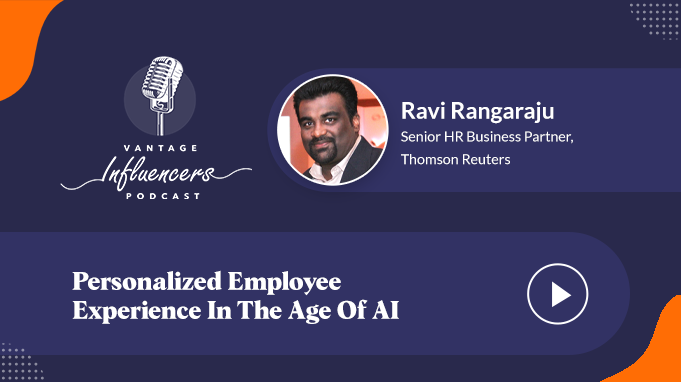
Personalized Employee Experience In The Age Of AI
Episode Overview
Ravi Rangaraju leads the HR business partner function for Thomson Reuters' technology business in India, a group of roughly 2,500 people, after a 16-and-a-half-year run at the company that started when it was still Reuters, before the 2008 merger. He opens with a food-delivery-app analogy — an app that remembers his last order and nudges him toward a repeat purchase — to explain personalization, then extends it to a hospital blood test: AI's role in employee experience is to establish a "baseline" of skills and performance data, the same way a blood test establishes a health baseline before treatment.
Ravi's most direct point is on the limits of this shift: organizations can realistically only give their top 5–10% of staff room to work on new, high-visibility skills, while the majority still need to be motivated to do the "plain vanilla" work that keeps the business running. He's equally direct on ethics — data security, bias in AI training, employee autonomy over what they share, and informed consent all have to hold, or "even if you have the best of systems, it will fail" once trust breaks.
Episode Highlights
- Ravi uses a food-delivery app that remembers past orders, and a hospital blood test that sets a health baseline, as parallel examples of what AI-driven personalization does for employee experience.
- Organizations moving toward "skill-based" rather than "role-based" structures use AI to combine an employee's history, skills, and performance ratings into a profile that suggests lateral or vertical career moves.
- Service organizations with 100,000+ employees have led on AI career pathing because manually tracking that many people's skills is "humanely impossible" — smaller product organizations are still figuring this out.
- A real constraint on skill-based development: only the top 5–10% of staff can realistically chase new, high-visibility skills at once, while the rest need to stay motivated doing the "plain vanilla" work that runs the business.
- Ravi's four non-negotiable ethical guardrails for AI in HR: data security, bias and fairness in model training, employee autonomy over shared data, and informed consent — because broken trust breaks even the best system.
- The right balance between automation and human touch is that "technology should enhance, not replace" the human experience — Ravi points to companies reversing hybrid-work policies once new hires who'd never experienced the office culture struggled to connect with it.
About the Guest
Ravi Rangaraju — Senior HR Business Partner, Thomson Reuters
Ravi Rangaraju is an engineer turned HR professional, with an Electronics & Communications Engineering degree from RV College of Engineering, Bengaluru, an MBA in HRM from Wigan & Leigh College, UK, and a fellowship in Organizational HRM & OD from the Asian HR Board and Carlton Advanced Management Institute, USA. He has been with Thomson Reuters for over 16 years and currently heads the HR Business Partnering function for the company's technology business groups in India, spanning nearly 2,500 technologists. He is a Certified Master Coach, a Distinguished Toastmaster, and an award-winning public speaker and storyteller.
Host
Sanjeevani Saikia — Vantage Influencers Podcast Host
What You Will Learn
- How AI-driven personalization in employee experience mirrors consumer personalization, from food-delivery apps to hospital diagnostics
- Why AI is pushing organizations from role-based structures toward skill-based ones, and what that means for career pathing
- The practical limit on skill-based development: only a small percentage of staff can realistically chase new, high-visibility skills at once
- The core ethical guardrails for AI in HR: data security, bias and fairness, employee autonomy, and informed consent
- Why the right balance is "technology enhances, doesn't replace" the human touch — illustrated through companies walking back hybrid-work policies
- How to actually measure success for AI-driven personalization: it depends entirely on the problem statement you're solving for, with adoption rate as a universal signal
Key Topics & Timestamps
| Timestamp | Topic |
|---|---|
| 01:35 | Ravi's corporate journey so far |
| 06:15 | Exploring the evolution of employee experience in the AI-driven workplace |
| 12:28 | How AI facilitates alignment between individual aspirations and career trajectories |
| 17:26 | Ethical considerations in using AI to tailor employee experience |
| 21:07 | Maintaining balance between automation and the human touch |
| 27:27 | Metrics that demonstrate the success of tech-enabled personalized employee experiences |
| 31:00 | The future of personalized employee experience in the age of AI |
| 33:20 | End note |
Full Transcript
Click to read the full episode transcript
Sanjeevani Saikia: Welcome, listeners, to another enlightening episode of the Vantage Influencers Podcast. I'm your host, Sanjeevani Saikia. Together, we'll unravel the intricacies of HR's vibrant tapestry, diving into topics designed to pique your curiosity and fuel inspiration. Today, join us for an engaging discussion with Mr. Ravi Rangaraju, Senior HR Business Partner at Thomson Reuters. We'll explore how AI can shape personalized employee experiences beyond the usual. Hi Ravi.
Ravi Rangaraju: Hi Sanjeevani, how are you doing today?
Sanjeevani Saikia: Good evening, I'm fine, how are you?
Ravi Rangaraju: I'm doing fine, thank you so much.
Sanjeevani Saikia: Great, thank you so much for having you on our podcast, it's our pleasure, absolutely our pleasure. First of all, I'm absolutely thrilled to have you here today to talk about personalized employee experience in the age of AI. But before we dive in, I'd love to hear a bit about your journey — could you walk us through your corporate journey so far?
Ravi Rangaraju: Okay, sure. So I'm an engineer-turned-HR-professional. I did my Electronics & Communications Engineering from a very reputed college in Bangalore, RV College of Engineering — a true-blue Bangalore boy, one hundred percent product of that. When I was doing my engineering, close to 20-plus years ago, we had the big software services wave going on in the country, and during placement season we'd have the big software organizations — TCS, Infosys, Wipro, Cognizant, HCL — come and take people batch by batch and make them software engineers. I had this feeling that everyone was becoming a software engineer regardless of their actual specialization, and while I was good at coding, I felt the passion was missing. Because everyone was jumping onto that bandwagon, I wanted to do something different — so instead of getting into software, I thought, let me get into the side that manages the people who build the software. That's how I got introduced to Human Resource Management. I then did my MBA in HR from an institute in the UK, followed by a few certifications and a PhD-level program.
I started my career as an executive search consultant at an executive search firm for about two and a half years, and then an opportunity came my way to work for a company called Reuters — that's what it was called before the 2008 merger, when Thomson and Reuters were separate companies. I joined Reuters, a big brand in the news and media business, as an HR business partner for group functions — a combination of technology, finance, site management, and other functions. I joined in 2007, and it's been 16 and a half years now — Reuters became Thomson Reuters, and I've grown with the organization in both size and scope. I've moved around quite a bit and been lucky to work with fantastic managers. What I do currently at Thomson Reuters is lead the HR business partner function for our technology business in India.
Thomson Reuters is a content-driven, AI-enabled technology organization. If you're a lawyer, you need a lot of data to build your case — we provide that through our AI-enabled product, Thomson Reuters Westlaw. If you're a tax consultant helping a multinational file taxes, you use our data for that. We also help manage corporate and organizational risk through data, and have other business units including government and the Reuters news brand itself. Within Thomson Reuters India, we're close to 6,000 people, and the technology business is about 2,500 people strong. I'm based in Bangalore and lead a team of motivated HR business partners spread across the country, partnering with business leaders to help them succeed.
Sanjeevani Saikia: Great, thank you for sharing your journey with us, really appreciated. With your permission, I'd like to begin today's discussion. Ravi, I believe the notion of a personalized employee experience has undergone a profound transformation, notably with the integration of AI. This intriguing amalgamation of technology and human engagement is profoundly influencing how individuals perceive and navigate their work environments. So what does a personalized employee experience truly entail in today's workplace, particularly in light of AI's role in shaping it?
Ravi Rangaraju: That's an excellent question. Let me take a different example to explain this — I'm a foodie, so I love examples from the food domain. Take a food-delivery app, Swiggy or Zomato. I had this experience just last week — my daughter wanted a Subway sandwich, so I logged into one of these apps, customized the sandwich exactly how she wanted it, placed the order. Then, just yesterday, I logged in again, and it threw me a pop-up: "Hey, remember this Subway order you placed before, with these exact customizations — would you like to order it again?" I was amazed that it remembered. And along with that order, it showed other options — "people who ordered this also ordered this," a 30% discount, a combo package — hard-to-resist offers that make you spend more than you intended.
The same logic applies to personalized employee experience. When I started my career, when you joined an organization, you were shown a chart: this is where you are today, and this is your career progression — if you joined as an HR analyst, you'd become a senior analyst, then lead analyst, manager, senior manager, director, and everyone followed roughly the same path. But today we're living in an era of hyper-personalization — YouTube, podcasts like this one, everybody is hyper-personalizing content for a specific segment of their audience or customer base. So what does this mean for employee experience? It's about tailoring what the organization needs and wants, while bringing in tools and resources that marry individual needs — an employee's unique strengths, working style, and career aspirations — with organizational needs.
Now, how does AI fit in? When you go to a hospital, the first thing a doctor does is take a blood test — why? Because it gives you baseline data, so you know where various parameters currently stand, and a treatment plan can be built and measured against that baseline. Similarly, with AI, we look at all the different data sources across the organization that constitute the business, and bring that together for career planning and career management. From an organizational standpoint, HR professionals constantly grapple with unclear job descriptions — with AI, you can get a much clearer job description, so you know exactly what you're hiring for. That also ties back to organizations moving toward becoming skill-based rather than role-based, with technology helping bring that to the forefront. From an employee's perspective, post-hiring, the first thing they want to know is what role they've been hired for and what they need to do to succeed in it — that's the first level where AI can clarify expectations. Then comes the suggestion layer: looking at multiple variables — say, someone who's been with the organization 16-plus years, their skill sets, assignments, past performance ratings, and feedback — AI can combine all of that into a summary profile and suggest roles they could apply for, at the same level or the next one up. That's the kind of personalization AI has brought to the table.
Sanjeevani Saikia: When we think about AI in the context of career development, it's incredible how technology can assist in identifying opportunities that match an employee's strengths and aspirations. Could you share examples of how AI facilitates this alignment between an individual's aspirations and potential career trajectories?
Ravi Rangaraju: Sure, great question. The funny part is a lot of companies are talking about this, but not many have actually figured it out — we're all still learning what AI's true potential is. Broadly, in the technology space, organizations fall into two kinds: product organizations and services organizations. Services organizations have led the way on building skill-based organizations and leveraging technology for career paths, simply because their employee base is in the hundreds of thousands, and it's humanly impossible to track that manually — you need technology to bring the data together and spot trends. I was at an HR conference last month where a leading services organization shared how they built a skill-based structure using AI — a genuine case study other companies can learn from. What they do first is establish a baseline: what skills and competencies do my employees currently have for the roles I'm hiring for? Then they look at the business pipeline — what roles and skills will be needed for upcoming deals and future work — and map the gap: here's where I am, here's where I need to be, here's what I need to do to get there. That mapping is where technology genuinely helps. Employees get a clear roadmap: if you're at skill level X and you move to X-plus-20, you become eligible for a different role, a new account, or something you've been aspiring to — and once you demonstrate readiness, through certifications or otherwise, you get that opportunity laterally or vertically.
The flip side is that we're building all of this around the skills of the future — a few years ago it was cloud, now it's AI, ten years ago it was DevOps and other technologies. These skills are critical now but eventually become "plain vanilla," business-as-usual skills. And practically, an organization can only give its top 5–10% of staff the opportunity to work on these critical, niche, or new skills — you still need a lot of motivated employees doing the core work that keeps the lights on and actually runs the business, which isn't the niche skill but the plain-vanilla work generating the bulk of revenue. So the real challenge in building a skill-based organization with AI is managing the expectations and emotions of employees who want to work on something new, while retaining and motivating the people who need to keep doing the work that runs the engine.
Sanjeevani Saikia: The use of AI in personalized employee experiences raises some crucial ethical considerations — with the power of data, analytics, and predictive algorithms, there's a delicate balance between leveraging insights and ensuring privacy and fairness. What ethical considerations come to mind when we talk about using AI to tailor employee experiences?
Ravi Rangaraju: Of course. Every breakthrough technology comes with its own set of problems you have to be careful about. For AI specifically — it's a mechanism where you feed in data and it analyzes that data to give you an output, so it's very important to be clear about what data you're actually collecting about an employee. Data security becomes central here. Many companies now use HR bots to converse with employees — early on, these were transactional: find me this letter, what's my leave balance, is my task submitted. Now companies are using them to measure employee sentiment, which shifts into an entirely different ballgame, because you're now getting into emotional inputs. How you collect that data, where it's stored, and who has access to it all become critical.
Second, generative AI itself — even ChatGPT calls this out — doesn't always give the right response, so you have to be careful about relying on generative AI outputs, because there's always a risk of bias, depending on how the underlying model was trained. Bias and fairness have to be kept in mind. Third, and most important — while technology is a great enabler, employees should have autonomy to voluntarily choose how much to share and how much not to. Companies collect things like age, date of birth, gender, sexual orientation — this is what we call PII, personally identifiable information, and it's strictly confidential; nobody should have blanket access to it. That autonomy has to sit with the employee — when it doesn't, the system takes over, and that's a problem. And finally, consent is critical — employees should absolutely know what's being measured, with their consent, how it's being used, and for what purpose. All of this creates an environment of trust, and when trust is broken, even the best system will fail. So those are the ethical considerations companies need to think through when deploying AI for personalized career experience or anything else.
Sanjeevani Saikia: You've highlighted some really significant points, especially consent — I think that's very crucial. Ravi, maintaining that equilibrium between automation and the human touch in personalized employee experiences is quite the challenge. We have this influx of technology streamlining processes, yet we're striving to retain that personal connection. Where should this balance ideally lie when integrating AI into creating personalized experiences for employees? Where's the sweet spot?
Ravi Rangaraju: Well, it's like asking what's a good score in a T20 game — very difficult to say because it depends on a lot of factors: playing conditions, the pitch, the form of the player, whether you're batting first or second. Finding that sweet spot is genuinely difficult, but what I'd say is the guiding principle should be that technology enhances, and doesn't replace, the human experience at work. Let me give an example many companies are grappling with. When COVID hit, everyone said, please, work from home, your health and family matter most, and we all got used to working from home for two, three years. Slowly, after COVID, companies started resuming office in batches, and most started looking at hybrid working — some quoted bringing in only a certain percentage, mostly critical staff, and leaving the rest working from home, positioning this as the model going forward.
But over time, they realized employees working fully from home weren't feeling connected to the organization, so a lot of companies started pulling people back — many that had touted hybrid working as the winning model have completely reversed course, asking employees to come back close to five days a week, or transitioning toward at least three. Why? Because in these last couple of years, a lot of companies hired thousands of people, including many freshers or lateral hires, who never actually experienced the organization, the people, or the culture in person. I've been with my company 16 years — even if I chose to work from anywhere permanently, I'd still feel rooted, because I know my people, my manager, my colleagues, the value system, the culture. But someone who joined and never experienced any of that in person finds it very difficult to align with the organization. Hybrid working is genuinely new territory even for us as human beings, and there's a saying — out of sight is out of mind — a lot of unconscious bias creeps in: I see an employee more often in office, so I feel closer to them from a work perspective, while someone who's rarely there tends to fall out of mind.
That's where automation and AI come in — companies started deploying HR bot strategies to check in with employees on how they're doing, and started collecting that data. But what many companies realized is that even with the best available technology, it doesn't fully replace the human touch — so a lot of companies are now investing time and energy into bringing engaging activities back into the workplace, redefining what the office is for. Many companies, us included, now say office isn't the place to sit and do your coding alone — you can do that at home. You come to the office to have meaningful conversations with colleagues, water-cooler moments, participate in training and networking sessions, speak to leaders, and build your network. So the balance should be that technology is an enabler, not a hindrance, and it shouldn't replace the human touch.
Sanjeevani Saikia: Could it be inferred that individuals working remotely might not fully grasp the nuances of the work culture they're operating within — is there a potential gap in understanding for remote workers regarding the intricacies of their work culture?
Ravi Rangaraju: That's where the role of the manager becomes very important. There's nothing inherently wrong with working remotely — depending on the role, if it's people-facing and requires office presence, then yes, you need to be in office; but if it's a process-oriented role that doesn't require that, you can absolutely do it from home. That's where the employee's first-line or reporting manager matters — and that cannot be replaced by a bot or by technology. Only when two humans actually communicate can you understand feelings, emotions, what someone's going through. A bot might ask "how are you doing," and get "I'm doing fine" every time, but when you and I are talking, there's an emotional connect — a manager asking how the weekend went, how the family's doing, builds empathy, connection, and trust. Even with a certain percentage of people working from home, the role of the human manager remains something AI cannot replace.
Sanjeevani Saikia: Although providing value to employees is crucial, businesses still want to quantify the ROI to justify their investments. What methods help demonstrate the success of tech-enabled personalized employee experience — how do we gauge the impact?
Ravi Rangaraju: Absolutely, and rightly so — when you're making significant investment in deploying these technologies, you want to see success. How I'd frame it is: success depends entirely on your problem statement. What did you deploy AI for, and what are you actually measuring? For some organizations, the goal is fostering internal movement between roles. For others, it's increasing the percentage of women in leadership and using technology to drive that. In the case of personalizing employee experience specifically — are you measuring employee engagement with the organization, or role clarity, or whether an employee is finding sufficient career-pathing information, or well-being, or leadership competency development? It totally depends on your problem statement and your KPIs for it.
One measure I'd absolutely flag, especially with technology, is adoption rate — that's critical. You can release something new, but if nobody adopts it, even a breakthrough technology fails to make an impact. ChatGPT, for instance, saw sign-ups go into the millions within hours of launch — that's exactly how a successful technology makes its presence felt, and that's a real measure of success. Success also depends on not deploying AI just to plug one specific gap — many companies do that, and it becomes a problem because you're fixing one leaking hole instead of looking at the system end-to-end. This is especially true for career planning — service organizations do this well because they have continuous role pipelines and a bench of employees to move around; product organizations, without that same pipeline structure, are still figuring this out. If I give employees clarity on career paths and the tools to prepare for the next role, I also need a framework that can actually place them into those roles once they're ready. So enabling this end-to-end is critical, and success ultimately depends on how well you do that, whether employees adopt and like the technology, and whether it moves a metric like attrition in the right direction.
Sanjeevani Saikia: Ravi, we're arriving at the end of today's episode. As AI capabilities grow exponentially, how do you envision the future of curating employee experiences on an individual basis, say ten years from now?
Ravi Rangaraju: Honestly, I don't fully know, because we're still grappling with AI's actual potential — there's even talk now of artificial general intelligence, AI understanding human emotions, and there's a lot we still need to unravel. But for this specific question, I actually asked ChatGPT — it's become my crystal ball, I don't use Google as much anymore. It said the future will bring more interconnected, intelligent, and adaptive workplaces, and as companies embrace these developments, they'll have to keep grappling with balancing technology and human touch. There will be more prioritization of ethical considerations, giving autonomy back into employees' hands as a core part of the employee experience construct. Continuous collaboration between HR, IT leaders, and employees will be key to realizing AI's full potential. What I'd say is that AI will not replace the human, but a human with AI skills will definitely have an edge. So it's incumbent on all of us, especially HR professionals, to embrace AI, learn AI skills, learn prompt engineering, and make the best use of the tools available for the benefit of the organization and its employees. The future is always bright.
Sanjeevani Saikia: Hopefully so. We've reached the end of today's episode — do you have any message for our listeners? And how can they stay in touch with you beyond this episode?
Ravi Rangaraju: I'm on LinkedIn, and I'd love to connect with folks there, expand my professional network, and learn from the audience too. As a parting message — the future always brings hope and challenges, and we have to remain positive, because things tend to work out over time even when there's trouble; we need to ride the tide, not get pulled under by it. AI is a great tool that will enable us if we use it the right way, so take the time and energy to learn about it and use it for the benefit of society at large.
Sanjeevani Saikia: Ravi, it's been a pleasure having you as our guest today. Your insights and expertise have been invaluable, and we're grateful for the time you've taken to share your knowledge with our listeners. Thank you so much, thanks a lot, Ravi.
Ravi Rangaraju: Thank you, I'm truly grateful for you having me on your show — I really loved the conversation. Thank you very much.
Thanks for listening to the Vantage HR Influencers Podcast. Please subscribe to the Vantage HR Influencers Podcast on Apple Podcasts, Spotify, and our YouTube channel for new episodes.
FAQ
What does personalized employee experience mean in the age of AI?
Ravi Rangaraju describes it as tailoring career paths, role clarity, and development opportunities to individual employees using AI, the same way consumer apps personalize recommendations — with AI establishing a "baseline" of an employee's skills and performance to suggest next steps, comparable to how a blood test establishes a health baseline before treatment.
What are the ethical considerations of using AI for employee experience?
Ravi Rangaraju names four: data security around what's collected and who can access it, bias and fairness in how AI models are trained, employee autonomy over what personal data they choose to share, and informed consent about what's being measured and why.
How should companies balance automation and human touch in employee experience?
Ravi Rangaraju's principle is that "technology should enhance, not replace" the human experience — illustrated by companies reversing hybrid-work policies after realizing new hires who'd never experienced the office culture in person struggled to feel connected to the organization.
How do you measure the success of AI-driven personalized employee experience?
According to Ravi Rangaraju, it depends entirely on the problem statement you're solving for — whether that's engagement, role clarity, or leadership development — but adoption rate is a universal signal, since even breakthrough technology fails without real usage.
Related Reading
Also listen on