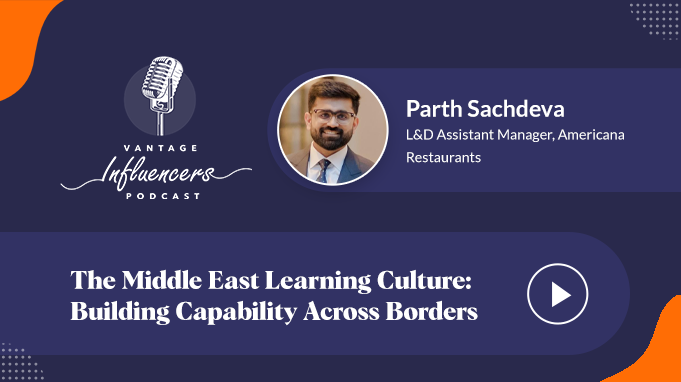
The Middle East Learning Culture: Building Capability Across Borders
Episode Overview
Parth Sachdeva opens this episode by breaking down what actually makes learning culture in the Middle East different from anywhere else he has worked. It is not the paperwork or the compliance checklists, he argues. It is that leadership treats learning as a core business strategy rather than an HR side project. With ten to fifteen nationalities often sitting on a single team, he walks through why organizations there have had to build training programs flexible enough to serve wildly different educational backgrounds and cultural expectations, while staying tightly bound to measurable business KPIs. He makes the case that structured, multi-month learning journeys, complete with graduation ceremonies and defined success metrics, have replaced the one-off classroom session as the region's default model.
The conversation then turns to what it actually takes to scale that kind of program across borders without losing quality. Parth lays out a three-part framework built on structure, people, and feedback, and explains how keeping roughly seventy percent of content standardized while localizing the rest lets a single program flex across different countries and languages. He also digs into how AI-powered platforms and content creation tools have cut module design time from months to days and turned once-dreaded compliance training into something employees actually ask for. The episode closes with his take on mentorship: why matching pairs on personality and career goals, not just job title, drives retention, and why he believes success in this region comes down to cultural intelligence as much as technical skill.
Episode Highlights
- Middle East learning culture treats L&D as a business necessity, not a support function, because teams often span 10 to 15 nationalities and educational backgrounds.
- A three-part framework, structure, people, and feedback, is what lets learning programs scale across countries without losing relevance.
- Keeping about 70% of training content standardized and localizing the remaining 30% is the key to running one program across multiple GCC markets.
- Language and regulatory differences mean a program built for the UAE audience needs real adaptation for other markets in the region, not just a translation.
- AI-powered LMS platforms and content creation tools have cut e-learning module design time from months to days while making compliance training more engaging.
- Mentorship programs succeed when pairs are matched on career aspirations and personality fit, not just job function, and when success is measured through retention and internal mobility.
About the Guest
Parth Sachdeva, Learning & Development Asst. Manager, Americana Restaurants
Parth Sachdeva is a Learning & Development Asst. Manager at Americana Restaurants, with over six years of experience transforming workplace learning across the UAE and India. Recognized as the "Most Influential HR Leader – 2025," he has driven leadership programs that boosted internal promotions by 60%, built more than 100 e-learning modules totaling over 10,000 learning hours, and launched mentorship programs that measurably improved engagement and retention. He specializes in leadership development, instructional design, and AI-powered learning, using tools like Articulate Storyline, Oracle LMS, Synthesia, and Coursera integrations to design business-aligned learning experiences at scale.
Connect with Parth on LinkedIn
Host
Shabana Shahnaz, Vantage Influencers Podcast Host
What You Will Learn
- Why learning culture in multi-national Middle East teams requires more than one-size-fits-all training
- How to balance standardized content with local customization across different markets
- A practical three-part framework, structure, people, and feedback, for scaling L&D programs
- How AI tools are changing the speed and quality of e-learning content creation
- What makes mentor-mentee matching effective, and how to measure mentorship success
- Which future skills Middle Eastern organizations should prioritize over the next decade
Key Topics & Timestamps
| Timestamp | Topic |
|---|---|
| 02:17 | What makes the Middle East's learning culture distinct from other regions |
| 04:15 | How organizational mindset and business alignment are reshaping capability building in the UAE |
| 07:05 | The biggest hurdles in scaling learning programs across borders: language, cultural sensitivity, and regulation |
| 09:44 | Scaling learning initiatives across a diverse, multi-country workforce without losing quality |
| 14:13 | How AI and digital tools are transforming L&D delivery and administration |
| 17:10 | Designing mentorship programs that measurably improve retention and engagement |
| 19:44 | The future skills Middle Eastern organizations need to prioritize |
Full Transcript
Click to read the full episode transcript
Welcome to the Vantage Influencers podcast. This podcast is sponsored by Vantage Circle, the simple and effective recognition platform for employee engagement.
The Middle East is changing fast. New industries are rising, global companies are expanding, and talent needs are shifting almost overnight. In this environment, one thing is clear: organizations that build a culture of learning will be the ones that thrive.
But here's the challenge. How do you create learning programs that work across different countries, cultures, and languages, while still being agile enough to meet tomorrow's skill gap?
That's exactly what we're exploring today in "The Middle East Learning Culture: Building Capability Across Borders."
Shabana Shahnaz: Hello everyone, welcome to the Vantage Influencers podcast. I'm your host, Shabana Shahnaz, and joining me today to unpack all of this is someone who has been at the forefront of this transformation, and who is also a Learning and Development Manager at Americana Restaurants. Let's please welcome Parth Sachdeva. To give you all a brief idea of our guest for today, Parth has been recognized as the "Most Influential HR Leader 2025." He has driven leadership programs that boosted internal promotions by 60%, designed over 100 cross-functional e-learning modules, and championed AI-powered learning across the UAE and India. Parth is passionate about building scalable, business-aligned learning journeys that deliver real impact. Parth, a very warm welcome to the show. Please tell us how you're doing today.
Parth Sachdeva: Thanks, Shabana. It's my pleasure to be here on the show today, and thank you very much for all the appreciation and the kind words you've said for me. It's going well, considering it's the middle of the week, just two more days to hit the weekend. So Shabana, like you've introduced me, I'd like to reiterate and tell you a bit more about my experience. I have a total of six years of experience. I worked in India for four years, and for the last two and a half years I've been working in the UAE.
Shabana Shahnaz: Amazing. So Parth, let's unwrap today's episode with the bigger picture. When we talk about learning culture in the Middle East, what is it that makes it unique compared to other regions?
Parth Sachdeva: When I shifted from India to UAE, the learning culture was, I would say, totally different. Over here, in whichever organization or industry you work, the best part is that learning is considered an important part of the organization's growth. Especially in retail, it's not just a support function, it's considered a mandatory function to have. Because in the Middle East, within one team, you might have 10 to 15 different nationalities who come from different educational backgrounds and different cultures. So organizations always look for training programs that fit diverse learning styles while staying completely aligned with business objectives. When I'm in meetings with leadership, they're always keen on how we can build up the learning culture, how we can encourage employees to come to the L&D team and ask what they can learn to grow themselves. And overall, this isn't just for the UAE. I'd say it's not just that your professional qualifications will help you give an outstanding performance in your job anymore. Considering the involvement of artificial intelligence, company expectations have changed drastically. This shift is happening in every organization, and to ensure it happens smoothly, L&D is playing a very big role.
Shabana Shahnaz: I'm sure it is. There's no doubt it's a very important department in every company. So, speaking of unique aspects, we also know that culture is often shaped by more than just geography. The UAE takes learning culture really seriously, so I think it's also about mindset. Have you seen organizational mindsets around capability building evolve in the UAE and the broader region over the past few years?
Parth Sachdeva: We're absolutely correct that learning mindset and organizational mindset play a very important role in ensuring the right learning culture is built. Companies here aren't just focusing on technical trainings, product trainings, or mandatory compliance and risk trainings. They're more strategic. There's a stronger link between learning and business KPIs. They don't just want a one-day classroom session on project management or any other particular skill. They want structured learning programs that run six or seven months long, with a proper graduation ceremony and everything else that keeps the employee engaged and actually brings about change. And there are proper measures of success set before launching any training program. Companies are also investing a lot of money in coaching platforms and in building interactive online courses using animations, gamification, and so on. They want structured programs based on a very well-known model we use in L&D, the 70-20-10 model, where it's not just about delivering a lecture in a knowledge-transfer format or reading off a presentation slide. They want something interactive: peer learning, shadowing of senior team members, mentorship, coaching, and assessments, all built into one training program. So they're more focused on structured programs that keep the employee engaged throughout the journey.
Shabana Shahnaz: Amazing, that's a very insightful evolution. But speaking of evolution, it often brings new challenges, especially when organizations operate across multiple countries. Parth, could you shed some light on some of the biggest hurdles in building learning programs that work across borders, and how you navigate language, cultural nuances, and different skill gaps?
Parth Sachdeva: One of the biggest hurdles I usually face is the language barrier. In these companies, as I mentioned, there are 10 to 12 different nationalities. People from British backgrounds, Indians, Pakistanis, and people from different regions of the GCC, Egypt, Morocco, Lebanon, all these people. And one of the biggest hurdles is the language barrier, because people assume it's just Arabic, but Arabic itself is different in each region of the GCC. There's cultural sensitivity as well. Every region has different compliance and regulatory requirements. If I design a program for a UAE target audience, it would look very different for a target audience in another part of the region, because cultural sensitivities are totally different. Plus, there are technology limitations in certain locations. Most companies have their head office in the UAE, and the way we adapt and overcome these hurdles is by keeping about 70% of the content standardized and customizing the remaining 30% or 20% for local reference. I also have training champions or HR business partners in each region or country, so "train the trainer" comes into the picture when planning training programs for the entire GCC area. I run train-the-trainer sessions for these training champions and HR business partners, and they convert that content to make it more relevant for their respective target audience.
Shabana Shahnaz: That's very insightful, thank you. I think adapting really means a lot here. But adapting is one thing, scaling successfully is another. You've led programs that have impacted thousands of learning hours. Can you share what strategies have helped you scale these initiatives without losing quality or relevance?
Parth Sachdeva: That's a tricky question. It actually depends on three things. One is the structure of the program. Second is the people, the target audience. And third is the feedback from the learners. First, the structure should be signed off by the C-suite or the executive leadership team, so it's completely aligned with business objectives. Once the executive leadership team is aligned with the program structure, they're in favor of it. They start setting the example, they keep talking about the program with employees, and when they visit different countries, they keep talking about it, which creates interest and curiosity among employees about wanting to participate. So the program should be designed in a way that it can be rolled out to other regions easily. Like I said, 70% of the content is standard and 30% is localized. I also make sure I'm investing in train-the-trainer programs to build internal capability, so we have local experts delivering the same quality. On the other hand, the learning management system, the LMS, also plays an important role. It helps track participation, completion percentage, assess understanding, run psychometric assessments, and do training needs analysis. Considering the company I work for right now has close to 50,000 employees, it's not easy to do face-to-face training for all of them, so the LMS helps us a lot in ensuring training is delivered properly. On the LMS, we have self-paced learning modules assigned to a large audience, which helps drive learning hours. The last thing is feedback. After every program, I gather feedback, analyze the learning data, and analyze the evaluation feedback forms. If there's any feedback related to a behavioral change in employees, for example, after a training on personal effectiveness, I ask the employee if they noticed any change in themselves, how confident they feel now in time management. Of course, employees will rate themselves highly, they won't underrate themselves, so I make sure I validate that feedback with their line managers to confirm the training program is actually impactful. Once I've taken feedback from employees, I take feedback from line managers as well. There are different levels of feedback, similar to Kirkpatrick's levels of evaluation, level one and level two, and which level to follow depends on the program structure. So to summarize: structure, people, and feedback. The structure should be properly signed off and aligned with business objectives, the content should be relevant to the target audience with real examples they can relate to, so it's not just people attending a session and going back with no impact, and then the feedback. That's how I scale without losing quality or relevance.
Shabana Shahnaz: So to reiterate, you've highlighted how structure, people, and feedback are the three strategies you've used to scale. Now, I also noticed you mentioned digital tools and L&D AI tools. Can you tell us more about how these have transformed the way learning is delivered and engaged with in your organization?
Parth Sachdeva: If we talk about AI and digital tools, one big shift we've seen is AI-powered LMS platforms that help create personalized learning paths based on the employee's role, performance, and career goals. From an L&D professional's point of view, there used to be a lot of administrative work in our team, and these platforms have reduced the time we spend on that. A lot of it is automated now, so we can focus on building the training strategy and designing the training frameworks. This has really helped in building the learning culture in our organization. We also have AI-based content creation tools, which are honestly incredible. When I started my L&D journey, it used to take two to three months to design one e-learning module using authoring software. Now, with these tools integrated into that software, it's so easy and quick to create gamified learning modules, which makes even compliance and mandatory trainings more engaging and interesting. Usually these topics are seen as boring, people used to dread receiving them, but now they're asking when the next training is coming. These AI tools are really helping make training more engaging and interactive, with a proper gamified structure where you go level by level, which creates excitement among employees compared to previous years.
Shabana Shahnaz: So it's not only boosted efficiency, it's also helped you gain more engagement among employees. Technology is powerful, of course, but people remain at the heart of learning. Your mentorship programs have improved retention and engagement. Can you share what made them so effective, and how you measured that success?
Parth Sachdeva: I've launched multiple mentorship programs across different industries. If we're launching these programs, the first step is to validate the need with the people, the mentors and the mentees, to confirm they actually want to take part in a mentorship, and then validate the same on the mentee side. Once that's done, the key to the success of this program was the criteria used to match mentors and mentees, pairing them not just based on job function or role, but also on career aspirations and personality fit. Before launching the program, I ran training sessions for both mentors and mentees to explain the role of a mentor, and it's equally important for a mentee to understand their own role. They can't expect their mentor to hand them everything; the mentor only guides them on how to work on their weaknesses. It was also well established with both mentors and mentees that the conversations stay confidential, and I gave them a framework with clear objectives, regular check-ins, and milestones. The program was quite successful. Success was measured based on retention rates, internal mobility, and engagement survey scores, which we run twice a year.
Shabana Shahnaz: That makes a lot of sense about the role of the mentor and mentee as that middle connection. Thank you for that. Let's end today's conversation with our last question, on a slightly more forward-looking note. What future skills should Middle Eastern organizations be prioritizing now to stay competitive over the next decade?
Parth Sachdeva: As I mentioned earlier about what's unique about L&D culture in the UAE, one thing is that it's not just companies, the government is also keen on building learning cultures within organizations. There's a target for each company to have a certain number of local national hires, and the government is quite keen that there should be a proper training program built around that, so that everyone is working toward the same leadership DNA. It's not a one-size-fits-all approach. We need to understand that culture changes even between GCC countries, the language is different from one country to another within the region. Building relationships and trust with stakeholders early is what opens the door for new initiatives. Always align your programs with business objectives so they're seen as essential, not optional, and use technology, but adapt it to local realities. Above all, be patient, because results come from strong relationships as much as from technical expertise. In this market, I'd say L&D success is 50% skill and 50% cultural intelligence.
Shabana Shahnaz: Amazing. I think what I'm taking away from this conversation is that building capability across borders isn't just about delivering training, it's about creating experiences that connect people while respecting cultural diversity. Parth, it was a great conversation, thank you so much for bringing such clarity to a rapidly evolving topic. It was a pleasure to have you on the show. And to everyone listening, the talent landscape in the Middle East is shifting fast, and the leaders who invest in continuous learning today will shape the success stories of tomorrow. Thank you, Parth, for your time and for sharing all these practical insights. And to all our listeners, thank you so much for tuning in. Keep learning, keep adapting, and keep building futures without borders.
Parth Sachdeva: Thank you so much, Shabana, and thank you everyone for listening.
FAQ
What makes the Middle East's learning culture different from other regions?
Leadership treats learning as a business necessity rather than an HR support function, largely because teams often bring together 10 to 15 nationalities with different educational backgrounds. That mix pushes organizations toward structured, multi-month learning journeys tied to measurable business KPIs, instead of one-off classroom sessions.
How do organizations build learning programs that work across multiple countries?
The common approach is to keep roughly 70% of training content standardized and localize the remaining 30% for language, cultural sensitivities, and local regulatory requirements. Training champions and HR business partners in each country then adapt that localized portion for their own teams through train-the-trainer sessions.
How is AI changing the way L&D teams design and deliver training?
AI-powered LMS platforms now build personalized learning paths based on an employee's role and career goals, cutting the administrative workload for L&D teams. AI content-creation tools have also shortened e-learning module design from months to days and made mandatory compliance training more gamified and engaging.
What makes a mentorship program actually effective?
Matching mentors and mentees on career aspirations and personality fit, not just job title or function, is the biggest driver of success. Programs also need a clear framework with defined objectives, regular check-ins, and confidentiality, with success measured through retention rates, internal mobility, and engagement survey scores.
Related Reading
Also listen on