Skills as a Strategic Asset in the Age of Workforce Disruption
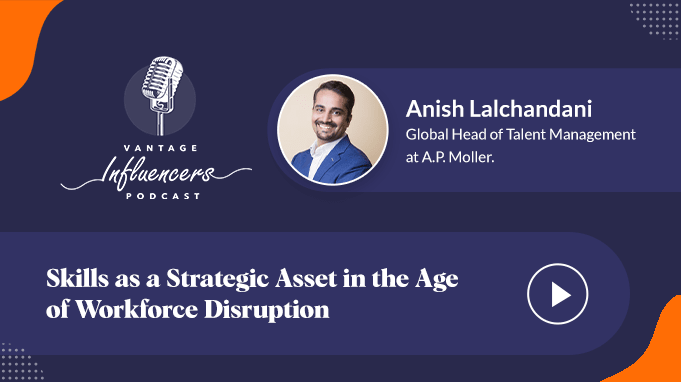
Episode Overview
When workforce disruption becomes the norm rather than the exception, most HR teams still manage skills the same way they always have: as a training line item buried under process improvement plans. Anish Lalchandani argues that this framing is exactly why so many skills initiatives stall before they move the needle on business performance. In this episode, he makes the case that skills have become the currency of business itself, not just the currency of work. Customers don't care about job titles or org charts. They care about who inside a company can actually solve their problem, and that is a question of skills, not roles. Anish walks through why treating skills as an HR program, rather than a strategic asset owned by the business, keeps organizations locked into compliance thinking instead of growth thinking.
The conversation moves quickly into how organizations actually make the shift from job-based structures to skills-based ones without breaking what already works. Anish lays out a deliberately unglamorous playbook: pick a handful of job families where skills-based thinking solves a real business problem, prove it there, then scale. He is candid about where these transformations typically go wrong, pointing to technology-first thinking, weak learning cultures, and the misconception that skills-based work means eliminating job titles altogether. He closes by naming the two leadership behaviors he sees as non-negotiable for sustaining any skills transformation: a genuine growth mindset in managers who are willing to let their best people move, and psychological safety that makes experimentation and failure survivable rather than punished.
Episode Highlights
- Skills are the currency of business, not just the currency of work; solving customer problems now depends on capabilities, not job titles.
- Treating skills as a strategic asset rather than an HR program keeps decisions tied to profitability and market growth, not just training compliance.
- The shift from job-based to skills-based models works best when organizations start with a few specific job families and prove value there before scaling company-wide.
- AI is reshaping which skills matter, but building real capability still requires deliberate practice, not just easier access to information.
- Most skills transformations fail from technology-first thinking, a weak learning culture, or the myth that skills-based work means eliminating jobs entirely.
- Growth mindset in leaders and genuine psychological safety on teams are the two behaviors that make a skills transformation stick long after launch.
About the Guest
Anish Lalchandani, Global Head of Talent Management, A.P. Moller
Anish Lalchandani is an award-winning global HR leader, best-selling author, and sought-after speaker on future skills, leadership, and the future of work. With more than 25 years of experience across Asia, the Middle East, Europe, and the U.S., he has held senior roles at Maersk, Standard Chartered, GE, and JLL, shaping talent and workforce strategies across banking, real estate, consulting, logistics, and supply chain. He is the author of The Skills Advantage, a best-seller and Business Book Awards finalist that introduces his human-centered Skills Advantage Framework, and his insights have appeared in The Economic Times, CLO Magazine, HRD Magazine, and other leading platforms. Based in Singapore for 20 years and raised across more than 15 cities, he advises Fortune 500 organizations and speaks globally on reskilling in the age of AI and future-proofing the workforce.
Connect with Anish on LinkedIn
Host
Riha Jaishi, Vantage Influencers Podcast Host
What You Will Learn
- How to reframe skills as a strategic business asset instead of an HR program
- Why AI is changing which skills organizations need, and why deliberate practice still matters
- How to move from job-based roles to skills-based career pathways without breaking the organization
- The most common reasons skills-based transformations fail
- Which leadership behaviors sustain a skills transformation long after launch
Key Topics & Timestamps
| Timestamp | Topic |
|---|---|
| 04:48 | Turning Skills into a Strategic Business Asset |
| 07:48 | AI's Impact on an Organization's Skilling Strategy |
| 11:58 | From Job-Based Models to Skills-Based Career Pathways |
| 18:43 | Why Skills-Based Transformations Fail |
| 26:31 | Leadership Behaviors That Sustain Skills Transformation |
Full Transcript
Click to read the full episode transcript
Welcome to the Vantage Influencers Podcast. This podcast is sponsored by Vantage Circle, the simple and effective recognition platform for employee engagement.
Riha Jaishi: Hello, everyone. Welcome back to another episode of the Vantage HR Influencers Podcast. I'm your host, Riha, and today we're diving into a topic that's critical for the future of HR leadership: skills as a strategic asset in the age of workforce disruption.
Now, as we navigate through an era of rapid change, the skills within our workforce are becoming more valuable than ever before. Workforce disruption is no longer just a buzzword. It's a reality that demands HR professionals to rethink how we develop, manage, and utilize skills at every level of the organization.
The question we must ask ourselves is, how can HR leaders position skills not just as a resource, but as a core strategic asset to drive business growth? And to help us explore this, I'm joined by Anish Lalchandani, Global Head of Talent Management at A.P. Moller. Welcome to the show, Anish. It's a pleasure to have you with us today.
Anish Lalchandani: Thank you. Thank you, Riha. Thank you for having me.
Riha Jaishi: Okay. We're equally delighted. So, to kick things off, Anish, can you briefly take us through your professional journey so far? We are eager to learn about your journey.
Anish Lalchandani: Sure, sure. Happy to. So, you know, I think over the last two and a half decades, I've had the privilege of working with some amazing organizations and leaders. I work with A.P. Moller Maersk now. In the past, I've worked with Standard Chartered, GE, JLL, and a few other organizations.
I think for me, what stood out was the kind of approach in terms of being progressive and also being purpose-led, and that's kind of shaped my career overall, if you ask me. And if I give you a very quick summary of my career, I usually see this in three phases.
The first phase for me was really getting exposed to business processes, speaking to customers, solving their problems, and I also learned things like Six Sigma and Lean, how do you start to look at improving our processes. So quite an interesting focus on customer processes and the financial aspect as well. But what always intrigued me was, even if you have the best process, how does it work, and sometimes why does it even fail? And that kind of helped me to start learning more about people's behavior. I started studying organizational behavior and pivoted into HR.
So the second phase was quite a lot of work again focusing on transformation. How do we transform HR? I worked in various programs from M&A to process simplification to culture, OD, learning, leadership, various different aspects where we're trying to focus on how do we transform the entire HR or people function, which can help and support the business. So I got exposed to various interesting things, did lots of stuff across the region in Asia. I had different projects which made me travel around 20 countries and be based there for short periods of time.
And then the question for me was, what is it next for me, and where is my interest area? And because I was exposed to so many areas, talent and leadership was a space I was drawn towards. And almost the last decade I would have spent in different aspects around talent, leadership, culture, looking at CEO succession to high potential programs to learning academies and talent marketplace and skills kind of things as well. So yeah, it's been quite an interesting journey. And today at A.P. Moller Maersk, essentially I'm looking at how do we reimagine performance and talent and support our business growth.
Riha Jaishi: That's such an inspiring venture, Anish. Thank you for sharing your experience. Now, with your permission, I would like to delve into our topic further, shall we?
Anish Lalchandani: Yes, let's go ahead. Yeah.
Riha Jaishi: Okay, great. Okay. So, Anish, what does it actually mean to treat skills as a business asset rather than an HR program? What do you have to say?
Anish Lalchandani: Riha, I think that's a great question. And if I go and ask a business leader what support do they need from HR, the answer we're going to get is not like, we need a policy or we need another process or we need another training program. What essentially they're going to say is, how can you support us to be more profitable? How can you help us to win in the marketplace? How can you help us to solve our customer needs?
And if we talk about customer needs, again, customers are not bothered about who is serving, what's their job title. They're looking at who can solve my problem, who can help me through this organization, what skills are they using essentially to solve all of those aspects? So that's how it becomes. Skills are not just the currency of work. Skills have also become the currency of business. If you don't have the right skills, bringing them together, you'll not be able to win in the marketplace. And that is the reason I even wrote my book, which is The Skills Advantage, where we went into a number of case studies and examples and concepts of how organizations are doing this right and how they're treating skills as a strategic asset for them. It's not an HR process or a program because if you take that lens, then yes, we could do a few things, but it would still not address the business needs and the business problem. And if we take a very strategic lens, which is more business focused, it makes it more interesting as well as supports the business.
Riha Jaishi: First of all, Anish, that particular line which you emphasized on, that skills are the currency of business, I guess that's a very catchy line to begin with, and that itself emphasizes its importance. Okay. And I feel like treating skills as a business asset, through this, organizations are able to focus more on strategic growth rather than just compliance.
Anish Lalchandani: That's true. That's true. And I guess if we just take a very foundational approach, then putting processes, putting training programs, that is needed, I wouldn't say it's not, but if you start to look at growth, if you look at growing in markets, if you look at growing in customer segments, then we need to bring the right skills. And that is a strategic decision. And that is where HR leaders need to step in to say, how do we support our leaders in this journey using different levers such as skills.
Riha Jaishi: Yes, absolutely. Well said. Okay, so moving ahead, Anish, how is AI impacting an organization's skilling strategy? What do you have to say about this?
Anish Lalchandani: So, I think there are different perspectives we can take on how AI is impacting skilling strategy, and it is in many ways. First is the entire piece on AI coming in, and that has disrupted what kind of skills we need. People are not talking about green skills, they're not talking about prompt engineering kind of roles, there's less talk about even content creation, and that has changed quite a lot. So if you just broadly look at it, purely because of AI, there's a lot of different skills which are in the spotlight. So that's one perspective. But the other perspective to also take is, if AI is impacting all those skills, what does it mean for business, for employees, and how do we really understand this better?
GenAI makes it very easy for people to search stuff, write things, but that's purely knowledge. It's easy now to actually get access to information. But if we go a step further, which is how do you really build skills, and that comes from deliberate practice. Without practicing, you cannot really learn and build skills. So that is where it's shifting and changing, and that is where HR needs to be strategic to say, how do we approach this, and what does it mean?
I think the fundamental question they need to ask is, what skills do we have, what skills do we need, and what is the gap, and how are we going to address that gap? To me, even small to big organizations, we struggle to even understand what our current skills pool is, if I call it that. And it's very hard, because we say, yeah, it's a federated model, the leader knows it, but even the leader doesn't know it at times. And again, I talk about a concept called skills canvas in my book, which is all about emerging and declining skills, and how do you make sure you'll be able to pivot and actually help the organization and the workforce upskill and reskill.
Now, bringing back the point around AI, it's going to be hard if you have to just do this manually, or we have to crunch all of this data. And that is where there's a lot of AI-based technology tools which are available, which can help you to do some of this. But the key is, do you really need it? Is that your business context, and how do you need to operate? Which is where, to me, it gets very helpful, as AI impacts skilling, what skills do we need, but AI also supports in a way how we can actually support our organization to upskill and reskill as we go along in this journey as well.
Riha Jaishi: Those are some amazing perspectives, Anish, that you have shed light on, AI's role in boosting skilling strategy. So we see that AI is clearly transforming how organizations manage skills, right? And like you said, it's more about addressing the gap. So AI's ability to predict skill gaps, that's quite a game changer, don't you think?
Anish Lalchandani: It is. And I think if you're able to understand that, and if you have a very clear business problem, then actually it becomes imperative, there's not much choice for you not to do it. I guess what we at times do is we take a very tactical approach. So we say, fine, we're just going to hire this person, we look at their experience. Sometimes we go into skilling, we look at their skills, but not really. And later we possibly realize, oh, maybe there was a bit of a mismatch, because from a job point of view or from a culture point of view, and that could have longer, bigger implications, and sometimes we don't look at it that way. So yes, I think if you have to look at it longer term, sustainable, then we do need to take a skills-based approach.
Riha Jaishi: Yes, absolutely. Okay, going ahead. So Anish, how do you move from job-based models to skills-based career pathways without breaking the organization?
Anish Lalchandani: So I think, I'll be honest, there's lots going on in the space of skills-based process, organization, tech, and there's so much of it, people are like, okay, where do I start from? And at times it is confusing to many organizations and HR leaders, and how do we really approach it?
I think the fundamental thing I have seen is there are different ways to look at it. One, again, an analogy I use in my book, The Skills Advantage, is around a Lego brick. Imagine you have a small Lego brick. Is it really of use? Do we really understand it? Possibly not. Same as skills. But if you combine those different combinations of Lego bricks, you can actually create some shapes which are of utility. So skills are exactly the same approach. If you're able to combine them in different ways, you can actually address a business need, then it actually becomes very useful.
One thing I always say is you have to take a very systematic and structured approach. And the reason I say systematic is you cannot just say, oh, tomorrow we want to be the skills-based organization, and everyone's going to be moving on that path. I think that's really not the way to approach this. You have to be selective. You have to look at what are the job families where we would really add value to the business and start small. So that's where I have seen many organizations actually doing it well and scaling it later, because they've started with very specific business problems, very specific job families, and then proven the point that this is working, and then have gone beyond it as well.
So that's one. The other thing is also, you know, we can do a number of things with skills. You can look at, I talk about a skills-based life cycle rather than an employee-based life cycle. So hiring for skills to even retiring skills in that manner, you can do all of that. It is going to be too much, is the reality. So how do you focus on the minimum viable product, some people call it MVP, I usually say you need a minimum lovable product, actually, because you need some bells and whistles, because it's too basic at times, it doesn't work. So think about what's the minimum lovable product which you want to create through the skills-based approach, and then go after it.
And if you're able to do some of these, very structured, very selective, and business aligned, that is where I have seen a number of organizations being able to implement this successfully. Otherwise, there are also organizations which have burned their fingers doing all of this at one go as well.
Riha Jaishi: Anish, there is this particular point that struck me, okay, how you emphasized on starting small, right, that change from the job base to more skill-oriented, that small change that needs to come, it's all about starting small and providing the right tools to transition smoothly, right? Addressing those specific business problems.
Anish Lalchandani: Yes. That's true. Because if you think of this as, okay, tomorrow you need to become a skills-based organization, depending on the size of the organization, if you are a 5,000, 10,000 to 50,000 to 100,000-odd employee company, it is a lot of work. And not only to implement it, but also to drive this change. And there are a lot of skeptics. Let's be honest, it's still a very new approach to how you look at work and business problems. It's relatively newer. And there are a few really good use cases, but there are also people who have started this and stopped it.
So if people really start looking at this, it has to be systematic, it has to be smaller, baby steps, literally. And then you start to prove what is working, what is not working. Because there are also aspects, every organization's culture is different, context is different. And whatever you have seen as a best practice in company X may not work in your organization. That's why I always tell people that don't always look at best practices, because best practices mean that they are done well in that context, in that organization, and at times it may not be true for you. So it goes back again to the same aspect, if that's worked, it may not work in your organization.
So how do you bring the entire aspect around change management to approach this is critical. And you start small, you can pilot things, you can get feedback, you can actually go and ask employees and leaders and even HR practitioners, what do you think is working? Do you think it's not working? You know, apply, say, design thinking kind of skills, empathizing with the customer, in this case it could be a leader or colleague, and understanding from them what are their challenges, because it could be the most fancy stuff, the most shiny object in the HR landscape today, but it may or may not work for you. So I think context is very important.
And starting small and then scaling and then tweaking the approach, because at times you say, fine, this is how we're going to approach it, but you might have to change gears to say, oh, to make this work, we need to change gears. And that would mean we need to possibly go a different direction, take a different approach to how do we get people excited about this, and also really think of what is their problem. So get, I think, fall in love with the problem is the main thing rather than falling in love with the solution. So if you do that, and do it well, with applying a number of change management aspects, we've done a lot of stuff around design thinking to implement even performance and talent, where we've gone and asked leaders, interviewed them, got working groups running, to see what is going to work and what's not going to work, besides what we saw as best practices, but the best practices didn't work for us, for example, in that case. So it is about starting small and then scaling it and then making sure it's the right fit for your own culture and context.
Riha Jaishi: Anish, that's a great approach. Like all the leaders and HR professionals out there, they should really consider this and put that into practice, starting small, and then taking baby steps and stepping ahead steadily, right? Makes sense.
Anish Lalchandani: Yeah, definitely.
Riha Jaishi: Okay, so moving ahead, Anish, where do most organizations go wrong when they launch skills-based transformations? What do you think?
Anish Lalchandani: So I have seen all variety, I would say it's a spectrum, from people who have really done well, people who have struggled, if you ask me. In my previous organization, we've been doing quite a lot of that. But I've also been speaking to a number of people through my research around the book, I've gone out and actually done some of that work as well. And I've seen lots of stuff going on. Maybe there are a couple of lessons learned which might be useful to the audience, because I know some organizations will go on this path pretty soon, or they are thinking about it.
So maybe the first one is, don't think that technology is going to solve all your problems. And that is how a lot of partners and vendors also say, oh, if you put this tool, it is going to solve all of their problems. That's not true. And we know this from any technology. This is not going to be very different. Seems complex, yes, but only technology is not going to solve the problem. What we need to be making sure is we have the right business problem first, then comes the technology. So if you are very clear why we're doing it from a business point of view, what is it going to help them achieve, then only, I guess, you can start thinking about technology. Don't start with technology. This has to be, in my view, a business-led approach, not a technology-led approach.
So that's the first one. The second one, I think I alluded to earlier as well, is it's all about the culture. If you do not have a culture of growth, development, helping people to understand their skills, helping them to develop in their careers, helping them to go on programs to improve their skills and move even across different jobs, if you don't have that culture, again, any technology solution or skills-based approach is not going to work. That is the fundamental need, if you ask me. The culture needs to be really there, and if it's not there, and if you really want to go on that path, start focusing on building that culture, building the learning culture, building culture around even failing fast and learning from that as well, because a lot of this is also about experimentation. So that's where I've seen some organizations, great technology, even if they had the best kind of business need for it, the culture wasn't there and it didn't tick. So it failed there in many ways.
So that is one. The second, I guess, is also about, some people think if you are talking about skills-based organizations, tomorrow everyone would work in an open environment, in a very agile environment, we will have no job titles, it'll all be fluid and we'll figure it out. Now, it seems quite daunting if you take an employee lens to this, and I think we need to be thoughtful about it. And that's also not true in all cases. So when I talk about skills-based organization, there would be roles and positions which may not even change, which cannot change. In banking, there are regulatory positions which you cannot make agile, but there are also other roles and positions which could be agile. And there's a pool of people, and then we look at how do we allocate resources to that. That's one aspect of skills-based organization, not all, but I'm just giving that because that's the misconception a lot of people have, that this is all about no jobs and we're all going to be an agile model. That's not really true.
And there are also a number of other ways you can implement skills. Because the other misconception maybe to tackle here is people think, oh, it's going to be an open marketplace and we'll have projects to do and gigs to do. I think it kind of started with that because the technology was available for that. But most organizations don't see the highest value in that manner. There are a number of other use cases in terms of career pathing, skills-based learning, skills-based hiring, which have a higher impact and business need also. So I think we have to be thoughtful about where we focus it on, but it's not just going to be tomorrow everything changes altogether.
And maybe the last point to highlight would be a bit more inward focus, talking about HR. If you are in a big organization, the challenge with this approach is HR needs to be able to work together. It cannot be that the talent acquisition person doesn't speak to a talent management person, doesn't speak to L&D. And that's what I write also in the book, that you have to transform yourself. You have to drink your own poison. You possibly rather go and do all the skills stuff within the people function before you talk about doing it outside. And that is where I think there's a lot of change required. And some organizations have said, yeah, we'll do it, but if there isn't a strong leader who drives this, the alignment and collaboration within HR, it is going to fail, because this is not about one area leading this. It's not about only talent or talent acquisition or L&D or analytics. I think they all need to come together. So that again goes back to the approach and philosophy and culture aspect. And maybe these are some of the things I've seen, lessons learned, I would say, from research and consultation of what has really not worked and what could work on the other side as well.
Riha Jaishi: Anish, I must say you have highlighted some significant aspects here. Okay, some significant pointers about where skills-based transformations go haywire, they do not work particularly in the initial phase, right? So these pointers that you've given here really highlight that. And you have not only mentioned the things that might hinder the process, but also a solution to it, right, a solution to how you can counter them and work towards them. So those are very essential pointers you have given, which all the HR leaders out there should really consider.
Anish Lalchandani: I agree. I think the other way to look at it is, as I said, it's a crowded market. There are lots of tech partners, a lot of consultants, and they have all the right intention. But the context, the way it works, it's a lot of work. So I think they need to start speaking to some more practitioners who've really done it well. And again, it also depends, as I said, it's about transforming HR, but also HR using their own critical thinking skills, which is one of the future skills from the World Economic Forum as well, to say, will this really work, or is this the shiny object? Even if it's going to work, how do we take it to the next level? How do we make sure business understands it? How do we make sure this actually solves the business problem?
I think there has to be that discernment around approaching this and using different insights from partners to practitioners to research studies which are coming out, because that's going to help them really go behind the problem and make sure they're doing it in the right context and only that particular scope. Because otherwise, it can be very broad brush, and we possibly will never get the ROI or the benefits we perceive it would give us.
Riha Jaishi: Absolutely. Well said, Anish. Okay, so before we wrap up our session, Anish, what specific leadership behaviors make skill transformation sustainable?
Anish Lalchandani: So I think we've alluded to a number of those as we had the conversation, but one of the things I was reflecting on is there's a McKinsey research which talked about intangibles. And intangibles could be your IP, it could be your skills, it could be your leadership, etc. And they said organizations which invest in intangibles could possibly have an 80% higher impact on shareholder value. Which is where, to your question around behaviors, that actually stacks up there. And many times we talk about process, technology, all of the other stuff, but not about behaviors. And that is fundamental in terms of how you drive this cultural transformation, to me.
If I have to possibly pick a couple of them which could be helpful in sustaining and making sure it's a human-centered approach to reskilling and upskilling, the first one I will call out is growth mindset. You've seen a number of managers and leaders, they have all the right intention, they know who their best performers are, but they don't want to let them go to other jobs. If we're able to cultivate the growth mindset within our leaders, and they're able to make sure that as they're having career conversations, they are helping individuals learn and grow, and individuals be the asset for the organization, not only for them, that is going to be the fundamental difference. So if leaders don't change, and I think they always think, oh, this is the best person, what will I do if they leave, then that's going to be very limiting. That's where a lot of work needs to be done on leadership development and leadership effectiveness on how do we move towards a more open talent marketplace, move towards where people can move jobs and they don't need to leave organizations. So that's the fundamental, around not being a talent holder, but actually helping your colleagues and employees to grow and develop. So that's the first one.
But the second one also is around psychological safety. How can leaders cultivate psychological safety within their teams? And what I mean by that is people have to experiment in different ways. They only learn when they try this a couple of times, and at times they might fail. So if we have a blame culture, that's not going to help in sustaining this approach as well. So leaders have to start looking at how can they cultivate psychological safety, how can they help employees to understand and help them learn in terms of what they did and how could they do it next time. And if they start to look at this as celebration, celebrating failures and successes together, that's going to be a game changer. So focusing on growth, as well as having that kind of culture of psychological safety, I guess those are some of the core behaviors we need to see shifting. And to me, again, this is not optional. This has to be fundamental in terms of how you drive this.
Riha Jaishi: Anish, the two aspects that you mentioned about the importance of leadership in transformation, it's amazing. First of all, yes, like you said, leaders having a growth mindset and encouraging and helping employees to grow, that's one fundamental one. And definitely the other one, where leaders cultivate psychological safety so that employees can feel safe enough to express or be vocal or experiment with things, right? So everything comes down to that.
Anish Lalchandani: Yes. That's true. And I guess there's a lot of research on why people leave. They don't leave because of a bad manager exactly, they leave because the manager didn't have the tools to help them grow and develop as well. There's a lot of research from Culture Amp on this. So it goes back to these fundamental things. If you really want to cultivate and grow your workforce, you start by making sure your leaders have the right growth mindset and are cultivating psychological safety, and then helping them to be the talent for the enterprise, because they can really be great and a star in one team, but they could actually do 10x if you let them move into an organization more broadly, and their engagement will go higher, and they'll possibly be the best ambassadors for your organization as well. So that has a number of multiplying effects. But those two, to me, are the core. There are many more, but I think those two definitely are fundamental.
Riha Jaishi: Yes, definitely. Okay, so Anish, we have finally come to the end of our session. So thank you so much for joining us today and sharing your incredible insights. It's been more than a pleasure hearing your perspectives on utilizing skills as a strategic asset in this age of workforce disruption. We really appreciate your time and your expertise. And I'm sure everyone tuning into this session is inspired by your expertise and are walking away with a wealth of information to ponder.
Anish Lalchandani: Wonderful. Thank you, Riha. It was a great conversation. Thank you for having me.
Riha Jaishi: Thank you once again, Anish. And to everyone out there, thank you for tuning in. We hope you found today's conversation as enlightening as we did. Until next time, take care, and we'll see you soon.
Thanks for listening to Vantage Influencers Podcast. Be sure to subscribe on Apple Podcasts, Spotify, and our Vantage Circle YouTube channel for the latest episodes.
FAQ
What does it mean to treat skills as a business asset rather than an HR program?
Business leaders don't ask HR for another policy or training program. They ask HR to help them be more profitable and win in the marketplace, and that comes down to having the right skills. Treating skills as a strategic asset keeps decisions focused on business growth rather than compliance.
How is AI changing skilling strategy?
AI is putting new skills in the spotlight and making information far easier to access, but building actual capability still requires deliberate practice. HR's job is to identify the gap between the skills an organization has and the skills it needs, and use AI-based tools to help close that gap at scale.
How can organizations move from job-based roles to skills-based career pathways without disrupting the business?
Start selective rather than company-wide. Pick a few job families where a skills-based approach solves a real business problem, prove it works there, and scale gradually. It should be a systematic, business-led change rather than a single company-wide overhaul.
What leadership behaviors help sustain a skills transformation?
Growth mindset and psychological safety. Leaders need to be willing to let their best people move into new roles instead of holding onto talent, and teams need to feel safe experimenting and occasionally failing without a blame culture.
Related Reading
Also listen on