Practical Leadership Insights
Episode Overview
Michael F. Andrew opens this episode with a claim that cuts against how most leadership content gets written: leadership is made, not born. Some people may have a natural head start in sociability or emotional intelligence, but the practice of leading, consistently achieving results while developing the people around you, has to be built deliberately, the same way anyone builds mastery in a craft. He argues that titles and positions are a poor proxy for leadership, and that the real markers are simpler: integrity, treating people with dignity, and the discipline to keep giving honest, respectful feedback long after it stops feeling comfortable.
The conversation moves through what that discipline looks like in practice. He talks about communicating with humility instead of performing it, and about a principle he returns to more than once: treat the issue coldly, the person warmly, especially when the news is bad. He is equally direct about development, arguing it should follow results rather than precede them, and that the fastest way to stall someone's growth is to protect them from failure instead of letting them recover from it. On remote work, he pushes back on the idea that accountability only runs one way, insisting employees carry as much responsibility for staying visible and in touch as managers do for holding them to their goals.
Episode Highlights
- Leadership is made, not born; natural sociability might help, but the discipline itself has to be built and repeated until it becomes habit.
- Titles and seniority are a weak signal of who is actually leading; someone six levels down can be demonstrating more leadership than the person at the top.
- The most useful feedback is small and constant: catch people doing something right, and be just as quick to redirect them when they are not.
- Difficult news builds more trust than good news ever does, as long as you treat the issue coldly and the person warmly.
- Development happens after results, not before them; people learn the most by working through a hard task and then reflecting on how they got through it.
- In remote work, accountability has to run both ways: employees are as responsible for staying visible to their manager as managers are for holding them to their goals.
About the Guest
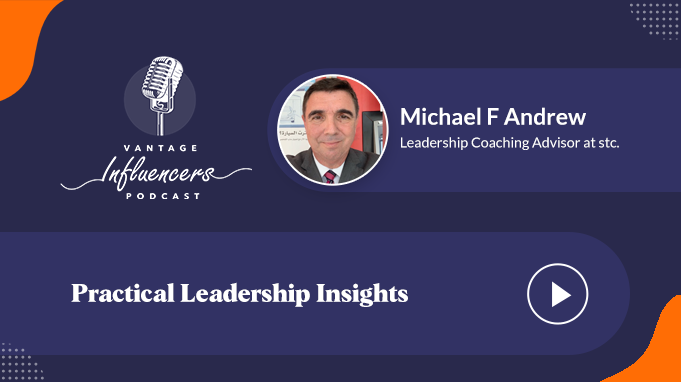
Michael F. Andrew, Succession Readiness, Executive Appointments, Leadership Coaching Advisor at stc
With a rich background spanning various leadership roles, including Chief Talent & Leadership Development Officer, Corporate Vice President, Executive Committee Member, and Board Advisor, Michael brings decades of experience to succession management and executive coaching. His tenure as a former business owner and coach, including work with McKinsey & Co., further shaped his approach to developing leaders. He is also an author, speaker, and publisher of a series called "Practical Business & Leadership Insights" on LinkedIn, where he shares insights to inspire and empower others in their professional journeys.
Connect with Michael on LinkedIn
Host
Sanjeevani Saikia, Vantage Influencers Podcast Host
What You Will Learn
- Why leadership is a built discipline rather than an inherited trait, and what "practicing" it actually looks like.
- The two-part definition of exceptional leadership: consistent results plus genuine investment in people.
- How to give feedback that actually changes behavior, not just checks a box.
- A simple rule for delivering difficult news without losing people's trust.
- Why letting people fail, without letting them become a failure, is the fastest path to real delegation.
- What makes remote work succeed or fail, and why it isn't only the manager's job to fix.
Key Topics & Timestamps
| Timestamp | Topic |
|---|---|
| 01:30 | Michael's path from the corporate ladder to entrepreneurship, executive roles, and coaching |
| 04:12 | What actually sets exceptional leaders apart |
| 07:54 | Why empathy has to become a habit, not a performance |
| 09:48 | Staying proactive instead of reactive when things are uncertain |
| 13:15 | Communicating authentically, especially under pressure |
| 16:02 | The hardest part of communication: delivering difficult news |
| 18:44 | Balancing guidance and autonomy while building a capable team |
| 24:06 | Leadership principles for the remote work era |
| 27:38 | Are leaders born or made? |
| 30:32 | Building trust and accountability on a team |
Full Transcript
Click to read the full episode transcript
Welcome to the Vantage HR Influencers Podcast. This podcast is sponsored by Vantage Circle, the simple and AI-powered rewards and recognition platform for employee engagement.
Have you ever heard these golden words on leadership: leadership is not about being in charge, it's about taking care of those in your charge. These words were relevant then, they are relevant now, and they will be relevant forever. After all, leadership is not about wielding authority, but rather about nurturing and supporting those entrusted to your care. But to embody this philosophy, we must first understand some of the practical leadership insights. We can transform these ideas into tangible actions by exploring actionable strategies and real-world examples.
Sanjeevani Saikia: So, listeners, welcome to another episode of the Vantage Influencers Podcast. I'm your host, Sanjeevani Saikia. Today we have Mr. Michael F. Andrew, an esteemed author, speaker, and seasoned leader with a rich background spanning various leadership roles. So let's begin a conversation with him. Hi, Michael. Thank you so much for joining in today's conversation. Before we dive into today's topic, practical leadership insights, I'd love to hear a bit about your professional journey so far.
Michael F. Andrew: Well, it's my pleasure to be here, Sanjeevani. My professional journey, it's many years, so I'm going to have to condense this very, very quickly. I actually have three degrees, all business degrees, and I started my career on the corporate ladder. I went off the corporate ladder and started my own global consulting firm, which was the most amazing experience in my life because I experienced the greatest success beyond my expectations, but also the greatest failure. I experienced both. After 9/11, a major recession occurred and I basically lost everything, lost all my business. So I went back on the corporate track, and it landed me in the Middle East, where one of my clients was. I've been a corporate executive, a group vice president for leadership and talent development for a large telecom in the United Arab Emirates. From there, I went to Saudi Arabia to work for a private company owned by members of a prominent family, where I was the chief talent officer, a member of the executive committee, and a board advisor. I created the nominations and remuneration committee for the board and brought the charter for it. From there, I took on a senior advisory role for a company in Riyadh, where I'm involved with executive appointments, promoting people to GM or VP levels, mostly internally and sometimes from the outside, and helping with the high-potential leadership program and succession management across our subsidiaries and internally in corporate. I led a group of internal coaches, and I do some coaching along the way. One of my clients when I had my own business was a firm where I coached a couple hundred consultants around the world.
Sanjeevani Saikia: Wonderful. Thank you so much for sharing your journey with us. Really inspiring. Thanks a lot, Michael. With your permission, I'd like to tell you today's topic: practical leadership insights.
Michael F. Andrew: Practical. Great, it should be practical. Thank you.
Sanjeevani Saikia: I think you'll agree if I say that in the world of business, it's not just about having a title or a position, it's about what you bring to the table as a leader. It's those standout qualities that really set exceptional leaders apart. Since today we'll be discussing leadership, it would be great to know from you what key qualities set exceptional leaders apart, and most importantly, how can individuals develop these traits?
Michael F. Andrew: That's a great question to start with, Sanjeevani. Thank you. If anyone listening were to Google leadership, or your question about exceptional leadership, they're going to get millions of replies, millions of perspectives. I think everybody in their own way is an expert in leadership because we've all personally experienced good leaders and poor leaders. But if you want my view of it in one sentence: a leader is a person who consistently achieves results while developing and growing his or her people, and does it all with integrity and treating people with dignity. There are other qualities that make up exceptional leaders, and then we'll get into the second part of your question, how do you develop them. But I think if you want to succeed as a leader, you can't do it alone, so you have to build a highly capable team. You have to keep enhancing not just your know-how, but your know-who, your network of relationships inside the company and outside it. It's also finding those opportunities to step up when no one else will. If we really pay attention, there are so many opportunities to step up, be proactive, and take the lead, and that's what distinguishes extraordinary leaders from the norm. They do so unselfishly, always looking out for the greater good. And finally, I'll say you've always got to be candid and honest, especially when giving feedback. Find ways to give quick, one-minute feedback, the kind a famous management book talks about: catch people doing something right, and catch people when they're doing something wrong and give them redirection and improvement feedback. Being able to give feedback, which I've found to be, other than on-the-job work experience, the number one method of development. But be honest, candid, and respectful with your feedback. To your question of how you do it, that's the hard part. I don't think it's training. I've seen so many people go through so much training and still not practice good leadership. I think you really have to personalize your leadership goals, decide who you want to be as a leader. If you want to be a great piano player or a great athlete, you keep focusing on it, you look at the good athletes or musicians and try to learn from what they do. You have to personalize it and keep focusing on it until it becomes a habit. They say excellence is not an act, it's a habit. If you really want to be a good leader, you can't just casually say you want to be one. You have to really believe and focus on it, and turn things like integrity, showing empathy, stepping up, and being candid with feedback into a habit.
Sanjeevani Saikia: True. I think you've touched upon something really important, and I heard you say empathy. Do you think in today's day and age, empathy is one of those qualities a leader has to have, almost a mark you need to hit first to become a leader?
Michael F. Andrew: Oh, yes, absolutely. I'm not perfect myself, and I fall short too, but as an executive I tried very hard, to the point where I hope it became a habit, to show empathy. Empathy is putting yourself in someone else's shoes. Here's an example: I work here in Riyadh, Saudi Arabia, and I look at the people on our floor whose entire job is cleaning the men's room, cleaning the toilets, cleaning the floor. Right beside that there's a place where they make coffee and serve it, and we come and get our coffee or tea for free, as much as we want, all day. These people don't make much money. They work hard, and they need to be treated with dignity and empathy, and that could be in the form of just a smile, a greeting, a hello, or a small tip at the end of the month as appreciation. The same goes for the people who work for you. Put yourself in their shoes. They have the same worries and concerns about their work and their career. They want to be accepted, and I think in the end, if you're always looking out for the greater good of the people working for you, they really appreciate it, and they'll do more for you as a manager, as a leader.
Sanjeevani Saikia: True. Wonderful. With everything changing at a rapid pace, it's easy to feel like we're constantly on shaky ground. But I believe effective leadership becomes crucial during times like these, because at the end of the day it's the leader who provides the stability and guidance the team needs to navigate uncertainty. So I'm curious, Michael, what leadership approaches have you found to be most effective for navigating uncertainties?
Michael F. Andrew: You know, Sanjeevani, how many years have we been hearing that term, that things are changing rapidly, that we're dealing with uncertainties? That's been going on my whole career, it's not anything new from the past few years. So I'll tell you what the certainty is: dealing with uncertainties every single day on the job is the certainty. I'm not expecting leaders to be these great visionaries who are looking outside and anticipating what the future looks like. Honestly, on a day-to-day basis, that's not what leaders do, that's what we read about in textbooks. I think the idea that you've got to be a visionary is overrated. People like well-known tech founders were visionaries, no doubt, but those are few and far between. It's the uncertainties we deal with every single day on the job. We have certain job goals, KPIs, or objectives we have to keep track of, but then unexpected things happen that disrupt them, and we have to deal with that. So if I could summarize it, the uncertainties are what we can expect every day throughout the year in our jobs. And I think it's just like in life: from the time we were children, uncertainties happen, things we didn't expect, and we learn to deal with them. If I had to zoom in and really answer your question, I'd say it's about always staying one step ahead of things, even in your job. Be proactive, don't always be reactive. Anybody can react and fix things; staying ahead and being proactive is how we deal with day-to-day uncertainties in our jobs. So the way I answered that question, I brought it down to the granular, practical level of how it affects us on the job, not about being some grand leader with incredible visions for the future. It really doesn't work that way.
Sanjeevani Saikia: True, the way you've tackled the question is very interesting, because uncertainty is really the main certainty here, we've always been uncertain.
Michael F. Andrew: That's so true. Unexpected things happen in our lives, unexpected things happen at work, and yet everything we read in literature is about rapid change and uncertainty. It took me a while in my career to realize that, but it's quite a thing.
Sanjeevani Saikia: Michael, I guess you'll agree with me if I say communication, again, is the cornerstone of effective leadership. When you think about it, how you communicate, particularly during challenging times, can make all the difference. So how do you recommend leaders communicate authentically and empathetically, especially when things get tough or when there's a big change on the horizon?
Michael F. Andrew: Well, you're coming up with really good questions, thank you. First of all, you hit it on the head: communication, if I had to pick the top two or three leadership skills to really distinguish yourself, communication would be one of them. There's a well-known line from a former GE chief executive's book about how important it is to communicate, and communicate, and communicate, and when you feel like you've done communicating, communicate more, you can never communicate enough. If we don't communicate enough, it's the people one, two, or three levels below us who wonder what we're up to. The other thing you hit on is doing it authentically, which to me means being yourself, showing up as yourself. There's a saying: be yourself, because everybody else is taken. If you're just yourself, and I'll put this big word with communication, it's showing humility. And I mean really showing it, not saying "I'm humbled that this happened to me." When someone says that, it doesn't tell me they're humbled. A person should never call themselves humbled, they should just display humility, and we know humility when we see it. So when we communicate, it goes hand in hand with demonstrating humility and empathy and being authentic. Don't try to communicate like someone you admire, it won't work, communicate in your own way. There's a saying in leadership I say a lot to our high-potentials: every time you speak, you're auditioning for leadership. That's a quote from a former speechwriter for several U.S. presidents. So speak in a way that's authentic, true to who you are, not imitating somebody else. You don't have to be this tough, bold person in the corporate world, you can be strong within and still demonstrate humility. But keep communicating as much as you can, because you can never overdo communicating.
Sanjeevani Saikia: Great. Is there any particular challenge you think leaders face while communicating, something very prevalent that they deal with regularly?
Michael F. Andrew: That's an interesting question. The first thing that comes to mind is communicating difficult news. It's easy to communicate good news, that's easy. I remember when I had my own business and a client would call with good news, saying we got the contract, that's an easy type of communication that anybody is willing to do. But what was difficult was when I had to pull things out of clients when I didn't get the contract, when it was difficult news, and I think that's why we call it work. Communicating difficult news, news we know isn't going to be pleasant, is one of the things you have to step up and do if you want to be a leader. The philosophy I've always used when delivering difficult news is: treat the issue coldly, the person warmly. In other words, be honest, candid, direct, and straightforward, and you can still do it respectfully. Here's the irony: when we deliver difficult news that way, eventually people see that you're honest, candid, and direct, and that you can do it in a respectful manner, and you build your credibility, your reputation as a person of integrity. So we have to deal with difficult news, we can't ignore it. If you ignore it, you're not really demonstrating your leadership responsibility. But the more you do it, the more you build the reputation that people can count on you to be honest and candid, yet respectful, and that when you give feedback, it will be honest and candid, and people really appreciate that. So the challenge is delivering difficult news, but there's a great opportunity around it too.
Sanjeevani Saikia: That's a really good answer, I wasn't expecting that, but you've hit the right note. Balancing guidance and autonomy within a team can be a real challenge too. On one hand you want to provide direction and support, but on the other hand you want to empower team members to take ownership of their work. It requires a deep understanding of team dynamics and individual strengths. So what methods have you found most effective for empowering and developing your team?
Michael F. Andrew: In my company, we have seven leadership competencies, and one we pay a lot of attention to, and it's the most challenging to be honest, is talent enablement, enabling your talent and building the capability of your team members. There's a lot you could say about delegating, delegating is very important, you have to know how to do it effectively, because when you delegate the right way, you're enabling talent and empowering people. I think the best way to do that, very simply, is to let people fail. I heard a quote the other day where someone was quoting a military general who said he allowed people to fail, but not be a failure. There's nothing more powerful, I mentioned earlier that the number one method of development is on the job, and number two is feedback, but giving people the autonomy, empowering them, delegating a major initiative or task to them, that's where development really comes in. Development, in my experience, doesn't happen by taking a training course and then deciding you're a better leader now, ready to go, it doesn't work that way. To me, development occurs on the job, by achieving results. When you achieve a result, you reflect back and learn from the roadblocks and barriers you went through and everything that enabled you to get there. So, in summary: results first, development second. Results lead to development, not the other way around. I'll give you an example. I worked for a company with about 30,000 people, and the CEO wanted to find out who the top 100 talents were, below the vice-president level, out of the whole workforce. I pushed back on it at first, because I said that's a dangerous thing to do, once we pick the 100, people are going to come into my office asking, what about me, because the next 200 or 300 are just as good as the first 100. But the CEO insisted, so I did it, and in the end I'm glad I did, because of what we found out. We went through a process of identifying the criteria, got the CEOs of all our subsidiaries and their chief HR officers involved, and filtered it down from about 800 people to 500, to 400, and finally to the top 100. Our next job was to meet individually with each of them, because we wanted to find out, other than congratulating them, what it would take to keep them. And the answers were amazing, and it had nothing to do with money, although two or three of them were genuinely underpaid and we fixed that. But here were the top two answers, consistently. One: keep recognizing my achievements, keep giving me recognition, a pat on the back. What does that cost the company? Zero. The second thing was that each of them had, at some point, been given a highly visible initiative and been responsible for seeing it through to completion, and they did, and the company never forgot that. So the second thing they asked for was more of that, more opportunity to take on a high-visibility project or initiative. What does that cost the company? Nothing. So the irony is those two things cost the company nothing, and I think that's a great way to answer your question about balancing guidance and autonomy while enabling talent: recognize people, and give them more opportunity. That's what they wanted, not money.
Sanjeevani Saikia: Great. With remote work rapidly becoming the norm, it's fundamentally changing how teams collaborate and operate. The traditional dynamics of face-to-face interaction are being replaced by virtual meetings, and I believe the role of leadership has become more crucial than ever. Given these shifts, what strategies do you believe leaders should employ to not just adapt but thrive in this new era of remote work?
Michael F. Andrew: Same thing, the same leadership principles apply remotely as when you see people face to face, and let me tell you why I say that. There's one part of the equation we tend to leave out, which is that employees also have a responsibility to be top-notch employees. In a remote environment, they have a responsibility to stay in touch with their management, not just say "I'm working from home today" and end up not communicating with anybody. They have a responsibility to manage the relationship with their manager, so I'm going to put the onus of remote-working success on the employee as much as on the manager. It's not always 100 percent on the manager or the leader, employees have a responsibility to manage their career, their performance, and their ability to keep delivering results. There's a saying: keep your boss's boss off your boss's back. So to all the employees out there, even if you're the CEO, you have a boss, and that's the chairman, we all have to keep communicating with our boss. I worked for a high-tech company in the United States a number of years ago, before the era of video calls, and we used to have conference calls because we were all over the country, so you could say we all worked remotely, I had an office at home. We communicated often through conference calls, not video calls, and what I noticed was that if a person prepared for that meeting, even just ten minutes of preparation, they were most likely more prepared than the next person. So there's opportunity for employees there too. I want to take a little of the load off the manager's back, not all of it, but put equal load on employees, they have a responsibility to make remote working work as much as the manager does. As for managers, they have to hold employees accountable, whether people are working in the office or remotely, for their work objectives, their KPIs, and everything else. So to summarize my long answer: managers have to hold their employees accountable, whether they work in the office or remotely, period, and employees have a responsibility to keep in touch and keep communicating with their colleagues and their manager. Otherwise, out of sight, out of mind.
Sanjeevani Saikia: Michael, I've had this question in mind for a long time, and I can't not ask it since I have you today. I've always noticed that there are people in top-level management who may not exhibit leadership as much as someone at a lower level in the organization. So do you think leadership is something inherent, that a person might be born with those qualities? I've been trying to figure this out but haven't gotten a satisfactory answer so far. Do you think people are born with leadership qualities, or how do they develop them, because someone with a leadership title may not exhibit it at times?
Michael F. Andrew: So it goes back to the old question that's often asked: are leaders born or made? They're made, not born, and they have to want to be a leader, they have to want to step up. Now, some people might be born naturally with the ability to be sociable, to have natural interpersonal skills, and those can still be developed further on an ongoing basis, but leaders, one hundred percent, are made, not born. And there's one word I hate whenever I hear someone describe what makes a leader, and that's "charisma," because charisma does a real disservice to the leadership field. If you want my definition of charisma, it's someone who's authentic in their own way, they could be the biggest introvert in the world but demonstrate incredible knowledge, incredible insight, and a great deal of empathy, that, to me, is what charisma should mean, not someone who's outgoing and looks like they're all style and not much substance. Leaders are definitely made, Sanjeevani. They may have a natural personality that gives them a higher level of emotional intelligence or social awareness, but even that can be developed. So no, they're not born.
Sanjeevani Saikia: So that might come down to the circumstances, the struggles, and the events in someone's life that eventually make them a great leader.
Michael F. Andrew: Everything in our life impacts who we eventually become, in any part of our life, including our career journey. And you touched on something else with your question: leadership isn't necessarily tied to a position or title. Somebody could be right out of college, stepping into a role, and you find that this person is stepping up, finding opportunities to take on more responsibility, following through on it, and showing that they're making an effort to work hard and get things done. There's a saying: if you treat your job as important, it's likely to return the favor. Leadership comes in a million different forms, but you don't have to be the top person to be the leader. You can be someone six levels below in the organization and still be demonstrating great leadership among your colleagues.
Sanjeevani Saikia: True. Michael, we're arriving at the end of today's episode, but before we go, there's one last thing both our listeners and I would love to know your take on: what key actions or initiatives are essential for fostering an environment where trust and accountability thrive?
Michael F. Andrew: I'll use some of the words you've thrown at me that we've already talked about. You have to be your true, authentic self, be truly humble, not act humble, but truly be humble. Keep communicating, including difficult messages, because when people see that they can count on you to deliver tough messages, but do it in a respectful manner, remembering to treat issues coldly and people warmly, and that they can count on you to be honest, candid, direct, and straightforward, yet respectful, that starts building not only credibility but, in my opinion, trust. So keep practicing that, keep doing it consistently, and eventually people will recognize you as someone they can trust.
Sanjeevani Saikia: So we've reached the end of today's podcast. Do you have any message for our listeners? They'd be delighted to hear it from you. Also, our audience might want to stay in touch with you after this podcast, so it would be great if you could tell them how they can reach out to you.
Michael F. Andrew: I actually have a YouTube channel with over 280 videos, many of them 60 seconds long, and some five to seven minutes. I also have a TikTok channel, and about 40,000 connections and followers on LinkedIn, so people can reach me on LinkedIn, YouTube, or TikTok. I wish everybody listening all the best in their leadership career journey. If you really want to distinguish yourself as a leader, you have to truly want to be a leader, because that way you'll pay attention, and everything you dreamed about being an effective leader will become a habit.
Sanjeevani Saikia: Great. Thank you so much, Michael, for joining in today's episode, it was truly a pleasure to have you. Thanks a lot, Michael.
Michael F. Andrew: My pleasure, Sanjeevani. Thank you.
FAQ
Are leaders born or made?
Michael F. Andrew argues they're made, not born. Some people have a natural head start in sociability or interpersonal skills, but leadership itself, consistently achieving results while developing people with integrity, has to be built and practiced deliberately until it becomes a habit.
What is the most effective way to give feedback as a leader?
Give it often, honestly, and respectfully. Catch people doing something right, and be just as quick to redirect them when they're not. Feedback, alongside on-the-job experience, is one of the most powerful development tools a leader has.
How should leaders deliver difficult news?
Treat the issue coldly and the person warmly, meaning be honest, direct, and straightforward, but always respectful. Leaders who consistently deliver hard news this way build more credibility and trust than those who avoid it.
What makes remote work succeed or fail?
Accountability that runs both ways. Managers have to hold employees accountable for their goals regardless of location, but employees also have to take responsibility for staying visible and in communication with their manager rather than waiting to be managed.
Related Reading
Also listen on