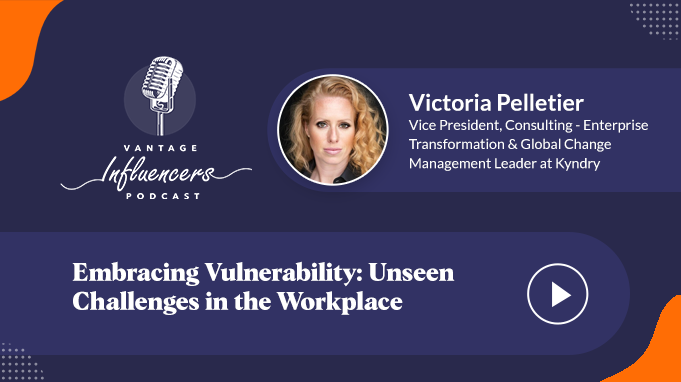
Embracing Vulnerability: Unseen Challenges in the Workplace
Episode Overview
Victoria Pelletier opens this conversation by unpacking the two words she signs off nearly every social post with: unstoppable and born to lead. For her, unstoppable is not about avoiding setbacks. It means refusing to let any obstacle stop her from reaching a goal she has set for herself, a philosophy she traces back to starting her first job at age 11 and taking her first leadership role, assistant manager of a shoe store, at 14. Born to lead, she explains, has nothing to do with hierarchy. It is about refusing to accept the status quo and choosing to challenge things that could be done better, whether that is inside an organization or outside of it.
From there, the conversation moves into the harder territory of resilience and vulnerability. Victoria describes how she overcame a difficult childhood and traumatic events by building walls of protection, a form of resilience that felt necessary at the time but was not healthy in the long run. Only when she began sharing her lived experiences openly, rather than guarding them, did she discover that vulnerability lifted a weight off her own shoulders while also helping others who had faced similar struggles. She and Susmita talk through why vulnerability still gets mistaken for weakness in the workplace, how leaders can start small when it feels uncomfortable, and what it actually takes to make every team member, new or long-tenured, feel seen and valued.
Episode Highlights
- Victoria explains the philosophy behind her "unstoppable" and "born to lead" hashtags and how they show up in her leadership style
- She traces her leadership journey back to her first job at age 11 and her first leadership role at 14
- Victoria distinguishes between the unhealthy resilience of building emotional walls and the healthy resilience of staying open
- She shares how sharing her own lived experiences publicly relieved personal weight and helped others facing similar struggles
- Victoria addresses the common misconception that vulnerability signals weakness rather than authenticity
- She and Susmita discuss practical, incremental steps leaders can take to make every team member feel seen, heard, and valued
About the Guest
Victoria Pelletier, Vice President, Consulting - Enterprise Transformation & Global Change Management Leader at Kyndryl
Victoria Pelletier's philosophy centers on doing the right thing: creating value for stakeholders, focusing on the big picture, and being accountable to employees, shareholders, and communities. She is known for building diverse teams that bring together varied skills, experiences, and perspectives, fostering continual growth across every role she has held, as a leader, peer, community member, friend, partner, or mother. At just 24, she became one of the youngest Chief Operating Officers and has since held roles as President and CEO, managing operations through periods of intense transformational change and participating in nearly 40 M&A transactions that re-engineered organizational structures, processes, and technology while driving revenue growth and multimillion-dollar cost savings. She is a contributing author to "Unstoppable" and the author of "Dynamic: Born to Lead" and "The Whole Human Leader," and she has been recognized as one of the 100 Global Outstanding LGBTQ Executive Leaders by INvolve, a 2023 Woman of Influence by the South Florida Business Journal, and a recipient of HSBC's Diversity & Inclusion in Innovation award in 2019. As a sought-after keynote speaker, she delivers talks on resilience, personal branding, empathetic leadership, and the transformative power of DEI in corporate cultures.
Connect with Victoria on LinkedIn
Host
Susmita Sarma, Vantage Influencers Podcast Host
What You Will Learn
- Why "unstoppable" and "born to lead" are less about titles and more about a personal philosophy toward obstacles and the status quo
- The difference between unhealthy resilience (building walls) and healthy resilience (staying open to being vulnerable)
- How sharing your own struggles publicly can relieve personal weight while motivating others facing similar challenges
- Why vulnerability is often mistaken for weakness, and how to reframe it as a tool for connection and trust
- Practical, incremental steps for leaders who are uncomfortable showing vulnerability
- How understanding a team member's lived experience and career goals, not just their resume, builds a genuine sense of belonging
Key Topics & Timestamps
| Timestamp | Topic |
|---|---|
| 1:20 | Embodying "Unstoppable" and "Dynamic: Born to Lead" qualities in leadership |
| 3:19 | The inspiration behind Victoria's books and the themes explored in her writing |
| 5:26 | How vulnerability has played a role in building resilience |
| 7:19 | Common misconceptions about vulnerability and reframing it as a strength |
| 8:04 | Encouraging vulnerability: advice for hesitant leaders |
| 9:25 | How leaders can ensure every team member feels seen, heard, and valued |
| 11:42 | The most important lesson in leading with authenticity and humanity |
Full Transcript
Click to read the full episode transcript
Welcome to the Vantage HR Influencers Podcast. This podcast is sponsored by Vantage Circle, the simple and AI powered rewards and recognition platform for employee engagement. Great leadership goes beyond strength. It's about vulnerability, resilience and authenticity. Embracing vulnerability can build trust, strengthen teams and inspire loyalty. So in this episode of the Vantage Influencers Podcast, we'll explore how leaders can harness vulnerability as a strength and ensure that all team members feel valued.
Susmita Sarma: So welcome back to another exciting episode of the Vantage Influencers Podcast. I'm your host, Susmita, and our guest today is Victoria Pelletier, the Vice President of Consulting at Kyndryl and a global leader in enterprise transformation. With a wealth of experience, Victoria will share her valuable insights on leading authentically and embracing vulnerability through change. Victoria, thank you so much for being here today. We are looking forward to this conversation, and I just have to say you have such an inspiring presence. So how are you doing today?
Victoria Pelletier: I'm good. Great. Thank you. I'm very happy to be here.
Susmita Sarma: Yes. And thank you once again for joining us today. So Victoria, you have described yourself as unstoppable and dynamic, born to lead. That's such a powerful phrase. So would you like to break down what that means to you and how do you channel that energy into your leadership approach?
Victoria Pelletier: Yeah, sure. It means a few things for me. So I sign a majority of my social media posts with two hashtags. One is no excuses and the other is unstoppable, and they're very connected. And so for me, being unstoppable, my sort of life's philosophy and motto, is about not letting any challenge or obstacle that comes my way prevent me from achieving the goal or the objective that I have set for myself. And so that's what unstoppable is. And the other one, around being born to lead, it doesn't mean I don't take direction and I don't follow others, but rather it means a couple of things. One, I do not sit well with the status quo. I like to challenge the status quo to do better, be better, to be innovative. So typically in organizations or outside of work as well, I'm trying to challenge things. And so normally in doing so, I'm taking a leadership position in doing that. And also, I have been a leader for a very long time. I first started working at age 11, and then my first leadership position was at age 14, where I was the assistant manager of the shoe store I worked at while I was in high school.
Susmita Sarma: Yeah. So you have come a long way, and I'm sure that what you exactly mean is for you leadership isn't about never falling, but about always getting back up, right?
Victoria Pelletier: Oh, absolutely. I mean, I think we should...
Susmita Sarma: Yeah, even with more determination.
Victoria Pelletier: Yeah, and learning from our failures.
Susmita Sarma: Yeah, very true. And talking about your journey as an author, you have written some incredible books that have inspired so many. So what was that spark that led you to start writing? Was there a specific moment or a challenge in your life that made you realize that you had stories to tell or ideas to share?
Victoria Pelletier: I think I started writing very, very early, although I do not write poetry anymore. That was an outlet for me when I was young, to write my thoughts and my feelings down through poetry. So I really enjoyed it. And then it evolved into the writing that I do from a work perspective. And I really talk to people around building a strong personal brand, becoming a thought leader. And it's not just about the subject matter expertise that you built your career around or in the industry, but around who you are as a human. So I've been writing for my own brand on LinkedIn and beyond for many years. And then when I was approached many years ago to be a contributing author to what is now my first book, one, it was serendipitous. The title for that book was called Unstoppable. So again, not my title at the time, even though that was my philosophy. So I'm like, it felt like serendipity, number one. And then I wrote two books that were published last year or this year, so still in, by the time this is released, it will be 2025. But in 2024, I wrote one on personal branding that was released in January, and then I wrote one around leadership and culture that came out in September. And those are things I speak about quite frequently as a public speaker, but I'm really passionate about and coach others. So I thought, even a little bit to your last question around failure, particularly in the leadership book, I share where I learned from failures in my leadership journey and how I challenged myself to evolve and be a better leader.
Susmita Sarma: Yeah. So you love to share things that you have learned the hard way, or even the easy way, throughout your journey of leadership.
Victoria Pelletier: Yes, absolutely.
Susmita Sarma: And Victoria, you have been very open about the role of resilience in your journey, especially during tough times. So how do you see vulnerability in that equation? Can you share an example where embracing vulnerability actually helped you grow stronger?
Victoria Pelletier: Yeah, I mean, resilience is foundational to me living that kind of unstoppable philosophy. And I personally had overcome some very traumatic events and a difficult childhood and beyond. And so I was resilient, but not in the most healthy way. So this protectionism and putting walls up to prevent further emotional damage or trauma or whatever it was. So I had to learn how to develop what I refer to as healthy resilience. And that's helped me tremendously in terms of leading in life and in business. And so now that'll be one thing I speak on. And you talked about vulnerability as well, and I think a lot of people, and this is the unhealthy version of resilience, they refuse to be vulnerable for fear of the pain or harm that comes from doing that. But I personally found that when I started to be vulnerable, when I shared my lived experiences and the stories that I'd had and how I recovered, one, it lifted a weight off of myself, but two, I realized how much it benefited others who might have experienced similar or related challenges or experiences, and it became somewhat motivational. So for me, weight lifted, but also felt great to be supporting others on their journey as well.
Susmita Sarma: Yeah, exactly. That's a very common myth, I think, that vulnerability is a weakness, especially in the workplace. But when leaders embrace it, it's more about showing authenticity and making the whole team stronger.
Victoria Pelletier: Exactly. And actually, in my last book, which I wrote around leadership and culture, it's called The Whole Human Leader, and that's a big part of it. We need to show our human selves, the humanity behind being a leader, and leader doesn't necessarily need to mean hierarchy. But one of the elements I talk about is vulnerability and how that creates a great leader.
Susmita Sarma: Yeah, and for those leaders, Victoria, who are hesitant to show vulnerability, what would you say to them? How can they shift their perspective to see vulnerability as a tool for connection and growth rather than something that undermines their authority?
Victoria Pelletier: I share my story and how my refusal to be vulnerable created an image of me and a perception by others that I knew wasn't me foundationally. So me sharing my failure as a leader, by refusing to be vulnerable and be authentic and share myself, so I share that. I hope that they see that in themselves. But then I also talk about how I did it. It didn't happen overnight. So as I would coach them to do that, I talk about getting comfortable in their discomfort of being vulnerable and starting with baby steps. Crawl before you walk, walk before you run. At some point, for many people, it will become much more natural and potentially innate in terms of how they show up.
Susmita Sarma: Exactly, like showing that you are a human, and that's what makes people want to follow you, isn't it?
Victoria Pelletier: Yeah, I mean, the adage around people don't quit companies, they quit leaders, right?
Susmita Sarma: Yes, exactly. True.
Susmita Sarma: And as teams grow, it's easy for some voices to get lost in the shuffle, especially as the dynamics shift. So how can leaders ensure that all the team members, whether they are new or longstanding, feel seen, heard and valued?
Victoria Pelletier: Oh, there's many, many ways. And I talk to a lot of executive leaders who are talking about culture or talk about diversity and inclusion, which is a big element of this sense of belonging in the workplace. And I say, there's no silver bullet, there's no one thing. It's a combination of many, many things. First of all, for me, going back to humanity, we need to understand the humanity of the people that work with us. So we see their resumes and it talks about what school they went to or where they've worked, and so, okay, that's fine, we can all read that. But who are they as a human? What are their lived experiences? One, that we can leverage in the workplace, but can contribute to who they are. Two is to understand their goals and desires, particularly from a career standpoint. Not all of them want to follow a linear path. Some of them will enjoy going linear upwards, potentially and hierarchical. That's not the path for everyone. And maybe they want to choose an alternate path. So ultimately, I want to hear from my team members what makes them tick. So lived experience, and where are they moving towards? And then it's my role to ensure their success in the role they're in, but also help them towards that journey. So creating this environment of belonging is a big element of making sure everyone feels seen and heard and has the ability to thrive.
Susmita Sarma: Yeah. Leaders actually have to be like those excellent hosts at a party, making sure everyone has a voice, has a moment to shine and a sense of belonging, even as the crowd grows. And it's less about managing and more about actively engaging with everyone on a human level.
Victoria Pelletier: Exactly. I 100% agree.
Susmita Sarma: Finally, Victoria, as someone who has been at the helm of your own leadership journey, what would you say is the most important lesson you have learned about leading from a place of authenticity and humanity?
Victoria Pelletier: Well, that is the lesson. To be an effective leader that people want to follow, not because they have to, because they want to. That lesson, that you need to be authentic, you need to be vulnerable, is the greatest lesson I've learned in my own leadership journey.
Susmita Sarma: Yeah. And people want to follow a real person, isn't it? Not a perfect robot, and authenticity and vulnerability are what actually build trust and loyalty. And that's where true leadership shines.
Victoria Pelletier: Exactly. People do business, whether that's buying from or wanting to work for and with, people that they like and they trust. And that only comes from showing our human side to others.
Susmita Sarma: True. Victoria, this has been an incredible conversation, and thank you so much for sharing your insights, your journey and your wisdom with us today. It's clear that your leadership philosophy is not only empowering, but also rooted in deep authenticity and resilience. I have learned so much, and I know our listeners have too.
Victoria Pelletier: Thanks for having me.
Subscribe to the HR Influencers podcast on Apple Podcast, Spotify, and our YouTube channel for new episodes.
FAQ
What does Victoria Pelletier mean by "unstoppable" and "born to lead"?
For Victoria, unstoppable means not letting any challenge or obstacle prevent her from reaching a goal she has set for herself. Born to lead is not about hierarchy. It reflects her refusal to accept the status quo and her drive to challenge things that could be done better, whether inside an organization or outside it.
What is the difference between healthy and unhealthy resilience, according to Victoria?
Unhealthy resilience, as Victoria describes it, involves building emotional walls to prevent further pain, a form of protectionism she relied on after a difficult childhood. Healthy resilience means staying open and vulnerable rather than guarding against every setback, which she found strengthened both her own wellbeing and her leadership.
Why do leaders hesitate to show vulnerability, and how can they overcome it?
Many leaders avoid vulnerability out of fear that it will be seen as weakness or that it undermines their authority. Victoria advises starting with small, incremental steps, getting comfortable with the discomfort of opening up rather than expecting it to happen overnight.
How can leaders make sure every team member feels valued?
Victoria says there is no single tactic. Leaders need to understand each team member's lived experience, not just their resume, and understand their individual career goals and desires rather than assuming everyone wants the same linear path upward.
Related Reading
Also listen on