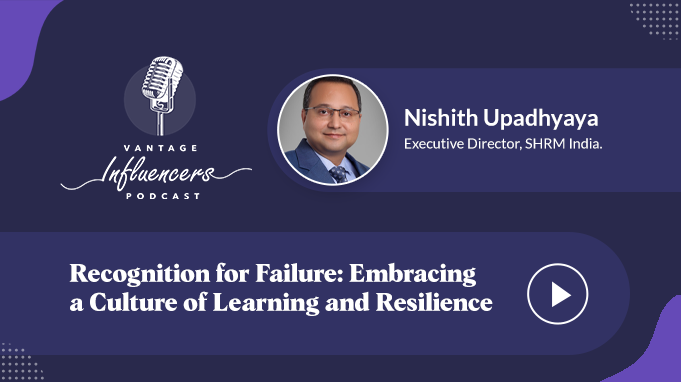
Recognition For Failure: Embracing A Culture Of Learning And Resilience
Episode Overview
Nishith Upadhyaya opens the conversation by turning a common assumption on its head: the projects that go wrong often teach far more than the ones that go right. Looking back across a career built almost entirely on client-facing consulting work, he points out that the assignments which sail through smoothly, and by his own estimate that is roughly 98 to 99 percent of the work, leave behind very little insight. It is the turnaround engagements, the ones that wobble or stall partway through, that end up reshaping how a consultant thinks about client relationships and problem-solving. For Nishith, that reframing is the starting point for any real conversation about failure at work: stop treating it as evidence of incompetence and start treating it as the raw material for growth.
From there, the discussion moves into what leaders can actually do about it. Nishith argues that psychological safety around failure starts at the goal-setting stage, long before anything goes wrong: deliberately over-ambitious targets, of the kind built through OKRs, create a built-in margin so that falling short of a stretch goal is not automatically treated as a crisis, while leaders still owe their teams a rigorous, honest review of what caused a setback. He also points to social media as an unexpected ally, describing a real example of a professional who publicly shared a failed certification attempt, was celebrated for the honesty, and returned nine months later to pass and post about it again. The conversation closes by looking ahead: hybrid work settling into a new balance, a growing sprawl of digital collaboration tools, and the need for managers to stay decisive and agile are, in his view, the forces that will keep reshaping how teams handle setbacks in the years to come.
Episode Highlights
- Nishith argues that the projects which stumble teach far more than the ones that succeed, since near-perfect engagements leave little room for reflection.
- He connects psychological safety to goal-setting itself: setting deliberately ambitious targets, like OKRs, builds in space to fall short without treating every miss as failure.
- Leaders who separate genuine effort-driven setbacks from failures caused by lack of effort or competence, he says, are the ones best equipped to coach their teams through both.
- He describes a real example of a professional publicly sharing a failed certification attempt on social media, being celebrated for it, and later posting again after passing on a second try.
- Encouraging open conversation about what went wrong, what was tried, and what was learned, he says, turns failure into a visible marker of growth rather than something to hide.
- Looking ahead, he flags hybrid work, the growing sprawl of digital collaboration tools, and decisive, agile leadership as the forces that will keep shaping how teams handle setbacks.
About the Guest
Nishith Upadhyaya, Executive Director, SHRM India
Nishith Upadhyaya leads the HR advisory practice at SHRM India, where he works with client organizations across India, the Middle East, North Africa, and Southeast Asia on goal setting, organization design, talent management, and learning and development. He also serves as SHRM's spokesperson on HR and workplace issues in the Indian media, and earlier in his career built his consulting practice at organizations including the Bharti Group, PwC, ECS, and Aon Hewitt.
Connect with Nishith on LinkedIn
Host
Sanjeevani Saikia, Vantage Influencers Podcast Host
What You Will Learn
- Why the projects that go sideways often teach more than the ones that succeed
- How ambitious goal-setting frameworks like OKRs build in room to fail without derailing a team
- The difference between failure caused by ambition and failure caused by lack of effort or competence
- How leaders can use open conversation to turn failure into a visible, positive part of a team's culture
- Why social media has made it easier for professionals to talk publicly about setbacks
- What hybrid work, digital tools, and leadership agility mean for the future of resilience at work
Key Topics & Timestamps
| Timestamp | Topic |
|---|---|
| 02:00 | Nishith's consulting journey across HR advisory work |
| 05:55 | A personal experience with failure and what it taught him |
| 09:30 | How leaders can create space for failure through ambitious goal-setting |
| 18:07 | Strategies for recognizing and encouraging learning from failure |
| 23:30 | Hybrid work, digital tools, and the future of resilient teams |
| 29:10 | Closing thoughts and where to connect with Nishith |
Full Transcript
Click to read the full episode transcript
Welcome to the Vantage HR Influencers Podcast. This podcast is sponsored by Vantage Circle, the simple and AI-powered rewards and recognition platform for employee engagement.
Failure is often perceived as a bumbling cloud in the ballroom of success, causing embarrassment and discouragement. However, by recognising failure, we spotlight its hidden beauty. It becomes a stepping stone, a canvas upon which we paint our greatest achievements. By discussing the significance of recognising failure and embracing a culture of learning and resilience, we infuse fresh air into our collective consciousness. We become a society of courageous learners, fearless explorers, and daring dreamers. We understand that failure is not the opposite of success, but an indispensable ingredient in the recipe for achievement. So, underscoring its significance, let's talk about recognition for failure, embracing a culture of learning and resilience.
Sanjeevani Saikia: Hello listeners, welcome to another episode of Vantage Influencers Podcast, where we explore a wide range of HR topics that are sure to grab your attention and inspire you. I'm your host Sanjeevani Saikia, and today we will be having a conversation with Nishith Upadhyaya, Executive Director, SHRM India. Hi Nishith.
Nishith Upadhyaya: Hi Sanjeevani.
Sanjeevani Saikia: First of all, I would like to thank you for giving your invaluable time and joining us in today's episode. Before we dive deeper into today's topic, recognition for failure, embracing a culture of learning and resilience, could you kindly walk us through your corporate journey so far?
Nishith Upadhyaya: Thank you, and at the outset, I would just say that speaking and learning from the previous experiences of corporate professionals is something which I have always found inspiring in my life, and which I'd like to contribute to this body of learning. I have around 17 to 18 years of experience, mostly within the domain of human resource consulting. I graduated with a Master's degree in 2006, and looking back, that's really been the start of my professional journey.
From campus, I always wanted to be in consulting. I had a stint at a fantastic organization in 2007, which was subsequently acquired by PricewaterhouseCoopers into their HR consulting practice. It was fabulous work around talent management, org structuring, and organization design, and any work that really involved enabling client organizations to align their people strategy with their organization strategy.
Later, I moved on in my corporate journey, and at that point in time, I always had a theory that with all the travel, consulting life would not be something sustainable. But when I moved on, I realized that my first love will always remain meeting with client organizations and understanding their needs. That's when SHRM also happened. Right now, I lead the HR advisory practice for SHRM in this region. As a practice, we offer human capital advisory solutions to clients across the region, and for us, the region includes the Middle East, North Africa, India, as well as Southeast Asia.
So, we do a lot of work, mostly in the space of learning and development consulting, along with some very interesting organization transformation and change management projects with clients, and some M&A work thrown into the mix as well. Our practice has seen fabulous growth over the last seven to eight years, and I'm very happy to say that I work with an excellent team, and every day that inspires me to come in and do the best for them so that they can go ahead and deliver the best value for our set of clients. So, that's really been my corporate journey.
Sanjeevani Saikia: Wonderful. Thank you for sharing your journey with us, Nishith. It has truly been remarkable. With that context in mind, can we now dive straight into the topic? Nishith, I'm sure you must have witnessed that failure in our society is often stigmatized and regarded as a source of embarrassment and inadequacy. Our prevailing mindset associates it with personal shortcomings, rather than recognizing its inherent value as a stepping stone to progress. But somewhere we are all aware that failure is an essential catalyst for growth and learning. So, our listeners would be interested to know how you view failure, and can you share an example from your personal or professional life where you have experienced a significant failure?
Nishith Upadhyaya: Yeah, so here's the thing. In the line of work that I do, and I believe this is true for almost every other line of work as well, you end up working on maybe five to six large projects in a year. And as I look back on my 17 to 18 years of consulting, I realize that it's the projects which have not gone off well, either from a client's perspective or from my own contribution to the project, that I have actually ended up learning the most from.
The projects that go well, or that we end up delivering almost flawlessly, which coincidentally is almost 98 or 99 percent of the work we do, the learning from there is very limited. But the projects that do not go off well, or at least do not go off well even partly, because there are also a lot of turnaround projects that don't start off very well, are the engagements that you end up deriving the most learning from. Looking back, those are the engagements I really welcome, because in some ways they end up shaking some of the core beliefs I've always had, and the core approaches or belief systems I had about client organizations get challenged during those projects. And when one reflects on those projects, one realizes that one derives the most learning from them. So, in many ways, as I look to take on more challenging engagements these days, I welcome the ability to learn from projects that may not go off well, or at least not for some of the parts, because that really helps me and my team expand our own capabilities. So, that's very exciting.
Sanjeevani Saikia: That's really interesting. Really appreciate you sharing that with us. In order to cultivate a culture that embraces failure, I think leaders must first challenge the prevailing notion that failure is a reflection of incompetence or weakness. By reframing failure as a valuable opportunity for growth and learning, leaders can create an environment where team members feel safe to openly acknowledge and share their setbacks. This includes debunking misconceptions and addressing fears that hinder individuals from embracing failure. So, I would like to know your take on how leaders can effectively promote accepting failures within their teams or organizations.
Nishith Upadhyaya: It starts with planning. If one ends up planning only for meeting goals that have already been set, or that are already expected of you within organizations, the margin of error you're building in for yourself and your team, right from the goal-setting stage, is very limited. Hence, the mentality also starts building in for leaders where there is no space for either them or their team members to fail.
As an alternative, if you look at how a lot of progressive organizations are approaching their goal-setting process today, and their ability to plan for what they're supposed to achieve, they follow a methodology that is popularly known as OKRs. One of the key focuses of OKRs is that you look at over-achieving, taking on goals that are, in many ways, almost scary and much beyond what the organization might expect, and then you plan for that in a very realistic manner.
So, during this whole process, right at the beginning, what you're doing as a leader is building in a margin so that even if, let's say, the ten-times goal that was set isn't fully achieved by the end of the year, and you end up with a good eight-times or six-times result instead, that's good enough, and you will have done so with a lot of lessons learned during the process. That's perhaps the most important part. So, the whole process of planning to set very ambitious goals is very crucial.
The second thing leaders must realize is that this frees up people to experiment and bring their best selves to the table, while still having a very clear idea of what's expected of them and how they can exceed it. So, the whole process of looking at goals and tracking progress toward them becomes something that's inspiring, and in many ways a celebration of the efforts put in, along with a clear understanding of which efforts have really led to what type of results. It's important for leaders to understand that if they're ambitious, that ambition trickles down to the rest of the team and enables them to bring their best selves to work, while still being clear about what's expected of them and giving them space to experiment.
At the same time, some of the best leaders in this space don't shy away from deeply reviewing and understanding the causes of failure. It's one thing if somebody has failed because they tried to achieve a lot more than expected. But this methodology shouldn't be misunderstood to mean leaders don't need to monitor, review, and understand what really caused a failure. So if the cause has been incompetence or lack of effort, the process of pushing for corrective action needs to be put in place very early. So while this methodology seems easy to implement, quite honestly, having worked with so many organizations on setting up their goal-setting process, it requires a very high degree of managerial capability as well as the team's drive toward achieving their goals. Without that, it's hard to follow through on it. So it's important to have that as a note of caution as I encourage organizations to plan and set ambitious goals.
Sanjeevani Saikia: Nishith, at the very beginning, you mentioned the importance of goal setting and OKRs. There are also other processes like planning poker or scrums. Do you think all these goal-setting techniques really help in the longer run when it comes to fostering a culture where we truly acknowledge and accept failure?
Nishith Upadhyaya: Yeah, see, very early on in my career, when I started off, I was, like anyone else, very keen to get certified in various tools and psychometric instruments and goal-setting processes. But during one of those learning programs, this was actually shared not by the facilitator but by one of the participants, who mentioned that there are so many tools to do something, but interestingly enough, a tool without a strategy is still just a tool.
So, if you're not aligned to the strategic direction of the organization, if you're not really sure about the end purpose of your client organization, it doesn't matter what methodology or process you bring into the picture. In many ways, a lot of these tools, if not implemented with the right intentions and the right fitment within the organization's culture and way of working, become more of a roadblock than anything else. So, to answer your question simply, yes, tools are important, but during the goal-setting process, what's more important is simplicity, the ability to drive clarity, and the basic discipline of regular follow-ups and looking for alignment with the bigger picture. Honestly, a lot of this cuts across tools. So, while I love tools and methodologies like setting big, hairy, audacious goals, it's important to do that with a lot of discipline and understanding of the organization's direction, and being able to align things with it. So, quite honestly, going back to the earlier analogy, a tool is still a tool, that's secondary. What's important is the alignment that needs to be brought in.
Sanjeevani Saikia: That was very well said, Nishith. Could you share your take on what strategies leaders can employ to effectively recognize and encourage individuals to embrace and learn from failure? Since I believe that when leaders publicly acknowledge and appreciate the efforts individuals have put into their endeavors, even if they ultimately fail, it creates a culture of psychological safety. Would you like to share some key strategies here for leaders?
Nishith Upadhyaya: I think, essentially, in your question itself, you've actually answered one of the reasons why it's important to look at failure in a different light. Once an organization puts in place the realization that it's okay to fail, that degree of psychological safety already kicks in within the organization. Now, what I've seen a lot of progressive organizations put in place is a process of almost celebrating the right type of failures. One of the leaders I knew would, the moment there was a recognized failure from which some learning could be derived, enable the person in charge of that particular project to talk about it, to talk about the methodology used, the client expectations, and the learnings derived from the whole process. So, this whole process of encouraging conversations around failure, and encouraging learning from failure, ensures that we're not making the same mistakes again and again, but perhaps making newer mistakes instead. And in many ways, that depicts growth. So, to my mind, that's a very successful strategy organizations can adopt, where we talk about failures very openly, talk about the opportunity to learn from them, and also talk about the turnaround that may have been achieved. That puts failure in a very positive light.
Sanjeevani Saikia: Yes, Nishith, I would actually like to know your perspective on whether you think social media platforms can help foster recognition for failure and create a supportive community, because nowadays we see a lot of posts where people are accepting failure and others are commenting that yes, failure will take place. So, do you think social media platforms have actually helped us accept it better?
Nishith Upadhyaya: Absolutely. And in fact, there are so many inspiring stories from within the SHRM universe itself. SHRM offers two of the most coveted certifications for HR professionals. These are two fairly rigorous examinations and credentials for HR professionals. Interestingly, an incident happened a couple of years back where the L&D head of a large organization took up the SHRM certification and didn't clear it. She put up a social media post about the whole incident, talking about the fabulous experience she had taking up the certification, the learning she derived from not clearing it, and how she would come back much stronger the next time she sat for the examination. That was such a fantastic, celebratory post that it even had her global CEO commenting on it, and it drew hundreds and thousands of reactions and likes. Interestingly, about nine months later, which is the minimum time you're allowed to reapply, the same person sat for the examination again and cleared it. And then again, there was a celebration. So, social media platforms are just another way for people to share their thoughts and feelings, and it's a very powerful medium. It also leaves us inspired, hearing other people's stories about their failures and how they overcame them. I think that's a source of inspiration for us as well.
Sanjeevani Saikia: Absolutely. Nishith, how do you see the future of work? Are there any emerging trends or technologies that can support this culture of learning and resilience?
Nishith Upadhyaya: Yeah, that's a very open-ended question. There are multiple directions an answer can take, but let me try with some of my core beliefs about where management is heading. There are things that are rapidly changing. We've all been participants in this massive social experiment called hybrid work, where people are working effectively in distributed teams on tasks that were once thought to be almost impossible to manage in a distributed environment. It's now being handled through various tools in a very effective manner. So, for managerial folks, this has been one of the biggest social experiments, and it's happened quite successfully, in my view, and it's a trend that will continue to redefine the future of work.
If I were to expand on this trend, while we've had this period where everything went hybrid, we now have a scenario where organizations are starting to pull back. Organizations are also realizing there's a significant benefit in having a good balance between face-to-face and hybrid work. Somewhere, maybe in the next six months to a year, we'll see this balance settle down effectively. There are many things a manager needs to be able to handle in this reality. If I'm honest, it's something I struggle with on a regular basis too, because it's so much easier to have everyone sit across the table in the same conference room every morning, as opposed to meeting them only twice a week. So, adapting to this reality of virtual work is definitely one aspect.
The second aspect is digital tools, and the prevalence of digital tools not just in communicating but also in monitoring and tracking work, which has really taken off and requires managers to be very well acquainted with it, and to decide which tool is most effective for them. Where communication used to be just email, these days you could have communication across chat channels, updates from project management tools, and people are very active on messaging apps as well. So, being on top of all the digital tools and being clear about which tool is useful for what is one way managers will really need to adapt. SHRM itself has developed a program to help managers stay on top of their digital tools and understand which one works best for what.
And the third thing I'd say is really crucial for a manager right now, which is the degree of agility, of working with options, working with backup plans, and scenario planning. That's very crucial because the world is changing at a fast pace, and you never know what's right around the corner, whether it's a disruption from another pandemic or something else that impacts your revenue flows. So, as a leader, you've got to anticipate some of these disruptions, and that requires you to be much more agile as you move forward. So, those are the three things I feel will impact the future of work and require every manager to be much more prepared. Quickly summarizing: one is the degree of agility required to be prepared for change, two is being more conscious about the digital tools one uses, and three is getting comfortable with achieving the right balance that suits your organization.
Sanjeevani Saikia: Yes, although it was an open-ended question, you've answered it very thoughtfully. Thank you, Nishith. We have reached the end of today's episode. Do you have any message for our listeners? Our listeners would be delighted to hear it from you. Also, our audience might want to stay in touch with you after this podcast, so it would be great if you could tell them how they can reach out to you.
Nishith Upadhyaya: So, for all the listeners, I would urge them to look at two things. One, of course, the things that are changing, the things that are rapidly shifting due to external forces. But at the same time, there are a few fundamentals about work that do not change. If I were to list them, one is that, regardless of how many digital tools or decision-making tools one has, managerial work is fundamentally about making decisions. It's about being decisive and choosing between alternatives, of which digital tools are just one input among many. So, having that judgment call is something that's absolutely not changing, and will not change, even in a generative AI-led world.
The second part, which is fundamental and will not change, is that your role as a manager keeps evolving as you grow within organizations. As you shift from being a first-time manager to a manager of managers to a business leader, there are some fundamental behavioral changes you need to bring in, and that's not going to be impacted by the next disruption or the next pandemic. So, are you equipping yourself to demonstrate the type of behaviors required at different levels in the organization? That's something one should ask oneself, and that's not going to change. So, those are a few beliefs I feel are not changing, and one needs to equip oneself accordingly.
As for where to reach me, I'm very active on LinkedIn through my organization, so just search for me, Nishith Upadhyaya, and you'll find me there. Of course, at all our shared conferences and events, we'd be very happy to catch up with everyone. So, looking forward to meeting up in person or connecting virtually on LinkedIn as well.
Sanjeevani Saikia: Wonderful. Nishith, it's been a pleasure to have you as our guest today. Your insights and expertise have been invaluable, and we are grateful for the time you've taken to share your knowledge with our listeners. So, thank you so much.
Nishith Upadhyaya: Thanks a lot. It was wonderful to be a part of this. Thank you.
Sanjeevani Saikia: Thanks for listening to the Vantage HR Influencers Podcast. Please do subscribe to the Vantage HR Influencers Podcast on Apple Podcasts, Spotify, and our YouTube channel for new episodes.
FAQ
Why does Nishith Upadhyaya say failed projects teach more than successful ones?
Because the projects that go smoothly, which he estimates at roughly 98 to 99 percent of the work, leave little room for reflection. It is the turnaround engagements, the ones that wobble or don't go as planned, that challenge core assumptions and force real learning about client work and problem-solving.
How can OKRs help build a culture that tolerates failure?
By setting deliberately over-ambitious targets, OKRs build in a margin from the start. Falling short of a stretch goal, say landing at six or eight times a ten-times target, isn't treated as failure, as long as leaders still review what caused the shortfall and push for correction where the cause was lack of effort or competence.
What role does social media play in normalizing failure at work?
Nishith points to real examples of professionals publicly sharing failed certification attempts, being celebrated for the honesty, and later posting again after succeeding on a second try. He sees this kind of open sharing as a powerful, inspiring way to destigmatize setbacks.
What does Nishith Upadhyaya see as the biggest shifts in the future of work?
Three things: hybrid work settling into a new balance between remote and in-person collaboration, the growing sprawl of digital tools that managers need to master, and the rising importance of agility and scenario planning as disruptions become harder to predict.
Related Reading
Also listen on






You might also like
 Employee Recognition
 Humanizing the Workplace Through Recognition
 Employee Recognition
 Scaling Culture Without Losing Its Soul as Recognition Drives Growth Inside and Out
 Employee Recognition