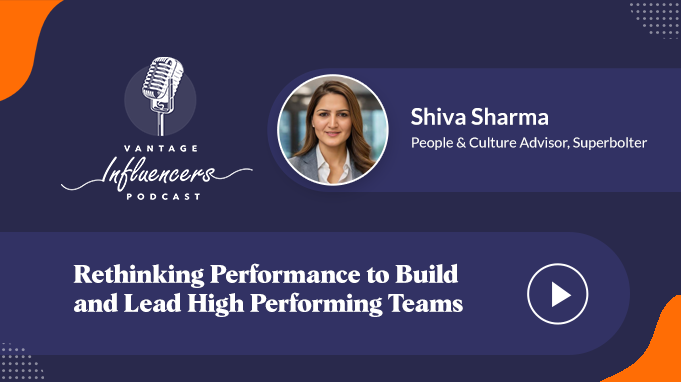
Rethinking Performance to Build and Lead High Performing Teams
Episode Overview
How do you measure a high-performing team without reducing people to spreadsheet metrics? That's the tension Shiva Sharma tackles in this episode of the Vantage Influencers Podcast, arguing that team success and individual contribution aren't competing priorities leaders must choose between, but two sides of the same coin. She lays out a practical path: setting shared team goals people can see themselves in, building a culture where collaboration is expected and rewarded, and using tools like Gallup CliftonStrengths so people work from their natural strengths instead of being forced into the same mold. Throughout, she brings in a neuroscience lens, from the SCARF model to the amygdala's threat response, to explain why people resist stepping outside their comfort zone and what leaders can do about it.
Shiva also takes on two of performance management's stickiest debates: the shift from annual reviews to real-time feedback, and where the line sits between healthy oversight and micromanagement. She argues real-time feedback only works when it comes with training, a clear "what's in it for me" for employees, and disciplined documentation, otherwise it collapses into constant check-ins that erode trust. On micromanagement, she pushes back on the idea that it's always harmful, framing effective leadership instead through Kim Scott's radical candor, a "why first" approach to delegation, and check-ins that ask what support someone needs rather than policing their every move. She closes by looking ahead to AI-augmented performance tools, skills-based growth, and coaching-trained managers as the next wave shaping how teams are led.
Episode Highlights
- Team success and individual contribution aren't competing priorities. Leaders should set shared goals people can see themselves in, build a culture where collaboration is expected and rewarded, and let tools like Gallup CliftonStrengths guide who does what.
- The SCARF model, status, certainty, autonomy, relatedness, and fairness, explains what motivates people and what triggers a threat response, giving leaders a way to shift a team from defensiveness toward real engagement.
- Psychological safety starts with leaders admitting they don't have all the answers, then building a challenge first culture where disagreement is invited rather than punished.
- Moving from annual reviews to real time feedback only works with training, a clear what's in it for me for employees, and disciplined documentation, skip these and the shift risks becoming micromanagement in disguise.
- Micromanagement isn't automatically the villain it's made out to be. What matters more is whether leaders lead with a why, give people room to decide how they reach a goal, and swap check-up questions for check-in ones like what support do you need.
- Kim Scott's radical candor, caring personally while challenging directly, is the framework Shiva keeps returning to, alongside AI-augmented insights and coaching-trained managers shaping performance management's next wave.
About the Guest
Shiva Sharma, People and Culture Advisor at Superbolter
Shiva Sharma is a seasoned HR leader with over two decades of experience driving organizational success across industries including EdTech, SaaS, healthcare, bioscience, and PropTech, with brands like Baxter and Pearson. She specializes in talent acquisition, talent management, people strategy, analytics, and building high-performance cultures, and in her most recent role as Director HR for Global Workforce Skills at Pearson, she led HR M&A integrations and change management for teams across the globe. As Head of HR for the Middle East, North Africa, and Turkey at Pearson, she devised retention strategies that helped deliver projects valued at $37 million and achieved an 88% in-house recruitment success rate, resulting in nearly 1,000 hires in two years at Pearson India. A certified brain-based coach, she is passionate about building thriving company cultures that prioritize employee engagement and development.
Connect with Shiva on LinkedIn
Host
Sanjeevani Saikia, Vantage Influencers Podcast Host
What You Will Learn
- How to balance team success with individual contribution without treating them as competing priorities
- What the SCARF model reveals about what motivates people and what triggers a threat response
- Practical ways to build psychological safety so people feel comfortable taking risks and challenging ideas
- The real do's and don'ts of shifting from annual performance reviews to real-time feedback
- Why micromanagement isn't automatically the enemy, and what actually separates it from supportive leadership
- How radical candor, a "why first" approach, and AI-augmented insights are shaping the next wave of performance management
Key Topics & Timestamps
| Timestamp | Topic |
|---|---|
| 01:38 | Shiva's journey into HR, from recruitment to global leadership roles at Pearson |
| 05:34 | Why team success and individual contribution aren't an either/or choice |
| 10:16 | Building psychological safety so people can take risks and challenge ideas |
| 14:58 | Moving from annual performance reviews to real-time feedback |
| 22:58 | Setting clear expectations without becoming a micromanager |
| 25:36 | Tailoring leadership with radical candor and a "why first" approach |
| 29:27 | Shiva's closing message on keeping people at the center of performance |
| 31:42 | Emerging trends: AI-augmented insights, skills-based growth, and coaching leaders |
Full Transcript
Click to read the full episode transcript
Welcome to the Vantage HR Influencers Podcast. This podcast is sponsored by Vantage Circle, the simple and AI-powered rewards and recognition platform for employee engagement.
We talk a lot about high-performing teams, but are we measuring performance the right way? KPIs, quarterly goals, and performance reviews have been around forever, but with shifting workplace dynamics and evolving employee expectations, the question is whether these traditional methods still reflect what truly drives success. Maybe it's time for a fresh approach, one that looks beyond numbers and focuses on culture, collaboration, and individual strengths. So how do we create teams that don't just hit targets, but actually thrive?
This is a vital question, and to break it all down, I'm joined by Shiva Sharma, People and Culture Advisor at Superbolter. Shiva has deep expertise in shaping workplace cultures that fuel both individual and team excellence. We'll explore what really makes a team high-performing, and the leadership mindset needed to make it happen.
Hey everyone, welcome back to the Vantage HR Influencers Podcast. I'm your host, Sanjeevani Saikia, and I can't wait to dive into this conversation. So let's get started.
Sanjeevani Saikia: Hi Shiva, thank you so much for being here with us today. It's great to have you on the show.
Shiva Sharma: Thank you so much for having me, Sanjeevani, and hello to everyone listening today. I'm really looking forward to our conversation. Thank you so much once again.
Sanjeevani Saikia: Before we dive into today's conversation, I'd love for you to share a bit about your journey so far. How did you get to where you are today, and what's been the most exciting part of your career?
Shiva Sharma: Sure, and I'll start with my favorite saying, one I recently shared on LinkedIn as well: I believe people are your greatest asset. I know it sounds cliched, but it's what I've lived by for the last 20 years. When I look at talent, I look at the individual and the potential they carry, and that's what has driven my career in HR. I've worked across various regional and global roles and touched on pretty much every aspect of HR, from talent acquisition to HR analytics to leading big M&A transformation projects, for example at Pearson.
It's actually kind of funny, Sanjeevani. I knew I wanted to be in HR way back in school. My mother's family runs schools and colleges in India, and they wanted me to follow in their footsteps as a school principal. I can't quite see myself as a school principal even now. But I realized my passion was really in helping people grow in a different way than traditional education, focusing on their career journey. So I started in recruitment 20 years ago. There's nothing like seeing someone land their dream job and get their first paycheck, that was incredibly meaningful for me, and it's one of the most important experiences I've had in my career.
After that, I spent almost a decade with Baxter Healthcare in talent acquisition and talent analytics across the US and APAC regions, before moving to Pearson India and then to Pearson Middle East in 2018 to head the region across the Middle East and GCC for Pearson. In my most recent role at Pearson, I was Director of HRBP and Employee Communications for the Global Workforce Skills division. We were selling skills solutions to enterprises, so it was a high-stakes environment. One interesting thing that happened there: I also spent a few months on the business side, which helped me work closely with our customers and connect the dots between business strategy and HR. That's something I'd advise every HR professional to do, spend some time on the business side.
Professionally, one of my proudest achievements was leading two HR M&A integrations at Pearson, Credly, a US company, and Fathom, an Australian company. I helped integrate them, aligning diverse teams and cultures to drive synergies and maximize operational excellence. Personally, I'm very proud of how I navigated my initial years in Dubai, back in 2018, all by myself. It wasn't easy, I'll be honest, but I'm a fighter, and I fought through it. I still give myself credit and pat myself on the back when I think of those early years.
I'm also a brain-based coach for mindset coaching, which grew out of the same purpose, helping people reach their full potential and make a difference in their lives. It's that same passion for people, Sanjeevani, combined with my experience driving performance and change, that brings me here today.
Sanjeevani Saikia: Wonderful. Shiva, thank you so much for sharing your journey with us, it was really great to know you more. Now, with your permission, I'd like to begin today's conversation.
Shiva Sharma: Sure, let's dive deep into the topic.
Sanjeevani Saikia: For the longest time, performance was all about individual KPIs, annual reviews, and ranking employees against each other. But we've observed that this approach doesn't always bring out the best in teams. I think it's safe to say that organizations at large, and even leaders themselves, want to know how well a team works together. Having said that, it's also obvious that individual performance matters a great deal. So, Shiva, how can leaders shift their mindset to focus on team success without sidelining individual contributions, because at the end of the day, even though the team matters, individual contribution can also have a big impact?
Shiva Sharma: That's a really important question, Sanjeevani. It's something I've seen leaders struggle with quite a bit, honestly. And you're right, it's not about choosing either team success or individual contributions, it's about recognizing how they're actually interconnected. In my experience, the key is for leaders to view performance more holistically. When performance is done right, it's not just about evaluating employees, it's about empowering them to reach their full potential, both as individuals and as a team. So it's a shift in mindset.
How do you make that shift? A few things, in my opinion. First, leaders need to set clear and compelling team goals that everyone understands and buys into. When people see how their individual work contributes to something bigger, it naturally fosters a sense of shared purpose, and at the same time, the individual is also able to see where they're contributing toward that north star, which makes them feel important too.
Second, it's about creating a culture where collaboration isn't just encouraged, but expected and rewarded. Leaders can do this in various ways: setting up cross-functional projects, creating opportunities for team problem-solving, and recognizing team achievements.
Third, and this is one of the most important things we usually forget because of how we're hardwired, and you'll see me bring a neuroscience perspective to a lot of these questions, we don't easily see the diverse perspectives individuals bring. So we need to acknowledge that individuals contribute to team success in very different ways. Not everyone needs to be the most vocal or the one taking the lead on every project. Some people are strong at analysis, others at execution, others at keeping team morale high, and others bring something else entirely, and that's okay. Leaders need to see and value those diverse contributions. One tool I've personally used is Gallup CliftonStrengths, which helps individuals identify their top talents. Once you've identified those, and have leaders allocate work based on people's individual strengths, you're setting up both the team and the individual for success.
The other point I'd bring in here is understanding the neuroscience behind this, which is also very helpful. This comes from my coaching experience, things like the SCARF model. I swear by the SCARF model, if you follow me on LinkedIn you'll see I post about it often. SCARF looks at status, certainty, autonomy, relatedness, and fairness. It gives leaders insight into what actually motivates people and what triggers their threat responses, helping leaders move employees from a threat state toward a state where they feel more open and engaged. We can talk more about SCARF if time allows.
And finally, celebrating both individual achievements and team success matters, both should be celebrated and recognized.
Sanjeevani Saikia: Absolutely. Speaking of team success, we hear a lot about fostering innovation and encouraging diverse perspectives, but that's easier said than done. The reality is people often hold back their ideas because they fear failure or backlash, and if employees don't feel safe speaking up, teams miss out on fresh thinking and growth. So what are some real, actionable ways leaders can create an environment where people feel comfortable taking risks and challenging ideas?
Shiva Sharma: I love that question, and I love it because I've had the opportunity to explore this at Pearson. It's absolutely essential for any team, or company, that wants to stay ahead to think about this. How do you build a culture where people aren't afraid to think outside the box, or in today's world, I'd say think as if there's no box at all? People won't take risks or challenge the status quo if they don't feel psychologically safe, so how do leaders build that safety? That's very important, in my opinion.
First and foremost, walk the talk. I've seen leaders talk about this, but I haven't seen many actually walk the talk. Leaders need to show they're not perfect, it's okay to accept mistakes, it's okay to say you don't know everything, it's okay to take feedback from your team, it's okay to accept that you're human. That sets the tone that it's okay to be imperfect, and your team will understand that learning is valued.
Second, build a challenge-first culture. I've seen many teams where people aren't comfortable pushing back, and those teams end up being just "yes" groups. Leaders need to invite challenge. What can they do? Make it safe to disagree, assign a devil's advocate in meetings to challenge assumptions, and highlight when someone challenges an idea and makes it better.
Third, and this is very important, create a fail-fast, learn-fast culture. This comes from my Pearson experience. At Pearson, we had a rewards and recognition category called Fail Fast, Learn Fast, to reward quick prototyping and innovation. It helped us reframe failure as a learning opportunity. Stop and think for a moment: when something goes wrong, the focus is on analyzing what happened, taking the lessons, and moving forward, not on blaming or punishing people. How powerful is that?
This is where I'd bring in a neuroscience perspective again. Our brains are wired to look out for danger, and there's a part of the brain called the amygdala whose job is to act as an alarm system. When it senses a threat, like feeling judged or unsure, it triggers a stress response, a threat response, which can instantly shut down our ability to think creatively. But the interesting thing about our brains is that they're always changing and adapting, that's called neuroplasticity. When we learn new things or face challenges, our brain actually creates new connections. This is where the idea of a growth mindset comes in. When leaders encourage people to see challenges as opportunities to learn and grow, they're tapping into that neuroplasticity and helping people build new skills and become more resilient.
Fourth, provide autonomy. How do you do that? It's so important. Leaders can help by giving clear goals, cascading them both top-down and bottom-up, but then letting people decide how to reach those goals, how to set short-term milestones, and trusting them to do it.
So I have a question for all the leaders listening to this podcast: are you truly creating a space where people feel safe to challenge, innovate, and grow, or are you just creating barriers? Think about that question, because the answer will actually determine the future of your team and your organization.
Sanjeevani Saikia: Well said, you've shared some really solid, actionable ways leaders can create that kind of environment. On a related note, Shiva, one of the biggest shifts we're seeing in performance management now is the move away from traditional performance reviews. A lot of companies are ditching the once-a-year review process in favor of real-time feedback, and while that sounds great in theory, the execution can be tricky, too much feedback can be overwhelming, and too little can leave employees in the dark. Have you seen this work well in practice, and what are some of the do's and don'ts for making this shift successful?
Shiva Sharma: Yes, we're seeing a huge shift, but in my opinion it's also something companies need to be smart about, because it's not just a process change they need to manage, it's much bigger than that, it's a culture change they need to address and focus on. And it's definitely not a one-size-fits-all approach, it needs to be aligned with your business goals and outcomes. Here in the Middle East and Gulf region, we're seeing a big push toward this too. To give some context, a regional survey found that 67% of HR leaders here are prioritizing improving employee experience, and this shift in performance management is a big part of that. Another report I'd point to is from KPMG, which found that organizations in the GCC are increasingly adopting AI-powered performance management technologies, with a projected market growth of 15% annually, so the momentum is definitely there.
To be honest, it's not exactly a new idea. If you look back, one of the earliest and most well-known companies to eliminate annual performance reviews and ratings was Adobe, back in 2012, and several other major companies followed suit.
I've seen it work well at Pearson too. A few years ago, we stepped back to take a look at our performance processes and asked ourselves what we were really getting out of them, were we supporting our employees, developing them, rewarding them properly? So we sent out surveys to employees, talked with leaders across the organization, researched what other companies in the space were doing, and set up a small innovation team specifically focused on this. What we heard was that we needed to make some big shifts and changes to our then-current annual performance review process. We were spending millions of hours just rating people, and managers and employees were spending millions of hours defending those ratings. That sounds crazy, but it was time for us to pause and make changes so managers and employees could spend that time on something more valuable, something that moves them forward instead of backward. There were no regular check-ins, feedback wasn't timely, and there was also rater bias creeping in. So we eliminated performance ratings and the annual review completely, and replaced it with quarterly feedback and coaching conversations. Those conversations focused on frequent check-ins between employees and managers around long-term ambitions, short-term wins, and whatever would have the biggest business impact, while also helping employees succeed in their careers. We were working on making performance more forward-looking and agile, employees would set goals, get feedback, discuss progress, and make routine adjustments throughout the year instead of just once a year. That meant they could shift gears more easily, course-correct more quickly, feel more supported, and stay focused on the right things. That worked pretty well at Pearson.
Now, for the second part of your question, about the do's and don'ts, it's not as simple as ditching the old system and expecting everyone to become a top performer overnight, you can't expect managers to do that either. So there are definitely some do's. Leaders and employees need to be trained on how to give and receive feedback, it doesn't come naturally to everybody, so that should be part of the change plan. You also need to clearly state what's in it for them, for employees specifically, they don't care if a new system reduces admin burden on HR, what they want to know is how it helps their career progress. That "what's in it for me" needs to be clear, and not just for employees, for all the other stakeholders too. Lastly, there are some great tools out there, like SuccessFactors or similar platforms, that can really facilitate real-time feedback and help track progress, so build a solid business case for how such tools can support the overall process.
As for the don'ts, I believe in saying it when you see it, so when I talk about feedback, positive or constructive, I'd usually say it in the moment. But sometimes that can tip into micromanagement, so it's very important that we don't let it become that. The other thing is, don't forget documentation, leverage those tools, especially around performance concerns, and keep documenting. And last but not least, while real-time feedback is fantastic, it doesn't solve problems caused by poor systems or processes, leaders still need to address those underlying issues. And as I said before, it's crucial that this shift stays tied to the organization's strategic goals. A performance management approach that works for a fast-growing startup might not be the right fit for a large, established company. It's also important to regularly evaluate whether it's actually working for you, because if you don't check periodically, you won't know if it's working, and you won't be able to make continuous improvements.
Sanjeevani Saikia: You've mentioned some really important points there, and since you've already brought up micromanagement, I'd like to extend that a little further. Another challenge that comes up a lot is setting performance expectations without micromanaging. Leaders obviously want to ensure high standards, but hovering over every little task kills motivation and trust, that's already well proven. So from your perspective, how can leaders set clear performance expectations without resorting to micromanagement?
Shiva Sharma: I'll say something controversial: micromanagement isn't always bad, I think it depends on the situation. One way to become a consciously effective leader is to identify the things you admire and respect in great leaders and imbibe and exhibit those qualities yourself. Let's pause here for a moment, Sanjeevani, think about a great leader you've worked with, and tell me three things that made them great in your eyes.
Sanjeevani Saikia: I think the first thing is that they appreciated me whenever I did something, they recognized me. The second is, like you said, micromanagement isn't always a bad thing, there were times I felt I needed some motivation and guidance, and while that sometimes came in a form that could look like micromanagement, it actually helped me feel more motivated. The second and third things, I'd say, are their work ethic, there's a lot to learn from how they worked, those are the things that really stand out for me.
Shiva Sharma: Right, so these are things you're really drawn to, and maybe things you want to imbibe and exhibit yourself, because that's what you admired in your favorite leader. I think of leadership as passing forward a baton, you give forward what you've received. Sometimes that means unconsciously passing on things you haven't admired yourself, which is exactly why it's so important to carefully curate yourself as a leader and live by that definition. This is actually something I'm exploring in more detail in a research paper I'm co-authoring with a colleague who's a VP at a large financial services company in the US. We're finding that the real key to effective leadership lies in tailoring your approach to each individual and team, and we're looking at a few factors: the maturity of the organization and its team, the maturity of the individual as a seasoned professional, and the maturity of that individual specifically in their role as a leader. There are subsets to each of these that we'll detail in the work, we'll be happy to share it once it's published.
For now, I'll share one of my favorite frameworks from recent years, one that really resonates with me: radical candor, or compassionate candor, by Kim Scott, who also has a book by that name. It talks about the importance of caring personally while also challenging directly. This means leaders should show people they care about them as individuals, and also challenge directly, be willing to give feedback, both positive and constructive, but do it in a way that's kind and helpful, not harsh or impersonal. That's something I've seen really picking up in recent years.
A few other quick pointers I've learned from great leaders I've worked with: they always started with a why. They never just told me what to do, they always explained why it mattered, so I could connect my work to the team goal, to the north star. They were always focused on the end goal, not worried about exactly how I got there, they gave me freedom in how to get there, and let me play to my strengths. It's interesting, this is actually coinciding today with a post I wrote about a former manager of mine, about how she led like what I'm calling, for the first time, "Ferrari leadership."
Doing check-ins, not check-ups, is also very important. If your team constantly feels like you're watching over their shoulder, they'll start second-guessing themselves. So instead of asking "did you do this, did you do that," reframe it to "what support do you need to achieve this," that small shift in language changes everything. And give people the tools they need, you can be doing everything right, but if they don't have the tools, the training, or the information, they won't be able to perform to their full potential, even with the best intentions. So it's holistic, it's really about empowering people to own their work while giving them the support they need.
Sanjeevani Saikia: Absolutely correct. Shiva, we've arrived at the end of today's episode, but before we wrap up, do you have any message for our listeners? And for those who want to connect with you after this episode, what's the best way for them to reach out to you?
Shiva Sharma: Sure. This has been a fantastic conversation, and I'm so grateful to have shared these insights with you and everybody listening. For me, it always comes back to the people, that's where I started when we began our conversation today, and that's where I land. Don't forget the people side of things, it's the human element, the genuine connection, that fuels shared success, proving that when we invest in people, we invest in extraordinary outcomes. So if there's one thing to remember, it's people, people, and people. For everyone listening, you can reach out to me on my LinkedIn profile, I believe Sanjeevani will share a link to that.
Sanjeevani Saikia: Yes, that's where I'd like to conclude our conversation, unless there's something else you'd like to ask. Although there's so many things I would love to ask, time has been a major limitation for us, but there's one more thing I cannot end the conversation without asking you: I want to know about the future of performance management. Looking ahead, what trends do you see? Are there any trends or approaches leaders should start paying attention to right now, since a lot of things are shifting in performance management and employee engagement overall?
Shiva Sharma: There's so much happening in this space, it's an exciting time for performance management and other aspects of HR, because it's really evolving. First and foremost, if I don't mention AI here, do I even exist? AI isn't just a buzzword or hype, it's actually giving us real insights and playing a huge role. We're seeing more AI-driven tools and platforms, like BetterWorks and Workday, that can analyze performance data, identify trends, and give more personalized insights to both employees and managers. One thing I always say is that AI isn't replacing personalized conversations, let's be intentional about combining these insights with leadership conversations, the insights alone aren't enough, they augment the process, they don't replace the crucial conversation.
Second, as we've already talked about, performance management is becoming less rigid, replaced by continuous feedback systems. Another important shift we're seeing is moving from just evaluating or rating employees to developing them, a real move toward skills-based growth and internal mobility. At Pearson, I worked briefly on this, we used Fathom, the Australian company I mentioned earlier, whose tool uses AI to analyze labor market and internal workforce data to predict future skills needed. That kind of technology helps companies align talent development with the future of work, which is exactly where performance management needs to go.
And bringing in a neuroscience perspective again, I think managers as coaches is a big one, where leaders are trained in coaching techniques like brain-based coaching and mindset coaching to create a more supportive, less threatening environment for employees. These are a few things I'm noticing that are coming up, or that leaders should be paying attention to.
Sanjeevani Saikia: Shiva, well said, thank you so much for joining us for this episode, it's been a pleasure having you on our show. Thank you so much once again.
Shiva Sharma: Thank you so much for having me, and thank you so much for being here, it means a lot.
FAQ
How can leaders support team success without sidelining individual contributions?
By setting shared team goals people can see their own work reflected in, building a culture where collaboration is expected and rewarded, and recognizing that people contribute in different ways, whether that's analysis, execution, or keeping morale up. Tools like Gallup CliftonStrengths help leaders assign work based on natural strengths rather than forcing a single mold.
What is the SCARF model and why does it matter for performance management?
SCARF, a framework used in neuroscience-based coaching, stands for status, certainty, autonomy, relatedness, and fairness. It explains what motivates people and what triggers a threat response, giving leaders a way to understand why teams resist change or hold back ideas, and how to shift them from a defensive state toward genuine engagement.
Is switching from annual reviews to real-time feedback always the right move?
It can work well, but only with the right groundwork. Leaders and employees need training on giving and receiving feedback, a clear answer to what's in it for employees, and disciplined documentation. Without that, the shift risks becoming inconsistent or sliding into micromanagement, and it still won't fix problems rooted in poor systems or processes.
Is micromanagement always a bad leadership trait?
Not necessarily. Whether it helps or hurts depends on the situation. What matters more is whether leaders lead with a clear "why," give people the freedom to decide how they reach a goal, and check in by asking what support someone needs rather than checking up on their every move.
Related Reading
Also listen on