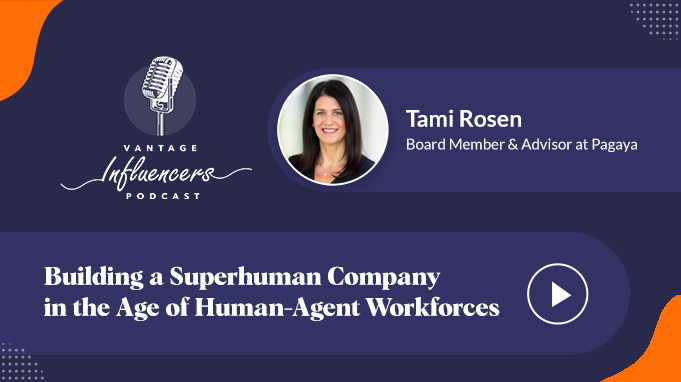
Building a Superhuman Company in the Age of Human-Agent Workforces
Episode Overview
Tami Rosen opens by reframing what a "superhuman company" actually means: not a business that has bought the most AI tools, but one that treats people strategy as business strategy strong enough to survive any disruption, whether that is a market shift, a product launch gone wrong, or an AI revolution. She pushes back on the idea that adopting AI automatically makes an organization more capable, arguing that AI is simply another tool for enhancing how people work, in the same way that the shift to remote work during the pandemic only helped companies that changed how they operated, not the ones that just moved meetings onto video calls. As AI agents move from being managed tools to something closer to teammates, she argues HR and leadership share responsibility for defining what work belongs to humans, what belongs to agents, and how trust between the two gets built.
The conversation turns to why cutting headcount is often the wrong response to AI capability. Tami points to Ikea's decision to redeploy roughly 8,500 employees whose roles were automated, rather than laying them off, as proof that redeployment can lead to entirely new revenue lines instead of just cost savings. She argues the real differentiator going forward will not be who has the best AI, since that technology will become table stakes for every company, but who has built the strongest culture and the most capable people to deploy it well. On leadership, she describes learning agility as the new baseline skill, arguing that in an AI-driven workplace, the most valuable employees will not be the ones who already know the most, but the ones who adapt and learn the fastest.
Episode Highlights
- Tami Rosen reframes "superhuman company" as two words, arguing it means treating people strategy as business strategy strong enough to survive any disruption, not buying the most AI tools.
- She compares the current AI shift to the pandemic-era rush to remote work, noting that companies which thrived changed how they worked, not just moved meetings onto video calls.
- As AI agents move from managed tools to teammates, she argues defining what work belongs to humans versus agents, and building trust between them, is now a leadership decision, not just an HR or technology one.
- She pushes back on treating AI adoption as a headcount efficiency play, pointing to Ikea's redeployment of roughly 8,500 automated roles into new work that helped build an entirely new multibillion dollar business line.
- Once every company has access to the same AI tools, she argues the real competitive differentiator shifts back to people, specifically those who know how to deploy and leverage the technology well.
- She closes by urging leaders to build AI literacy, create room for safe experimentation, and treat learning agility as a core cultural trait, since the most valuable employees will be the ones who learn fastest, not the ones who already know the most.
About the Guest
Tami Rosen, Board Member & Advisor, Pagaya
Tami Rosen is a four-time Chief Human Resources Officer, corporate board director, and thought leader who has spent more than 25 years helping organizations build people and culture as a competitive advantage. Her executive career spans Apple, Goldman Sachs, Atlassian, Luminar Technologies, and Pagaya, where she served as Chief Human Resources Officer and Chief Development Officer and was the company's first C-suite executive, helping take it from a high-growth startup to a publicly traded global fintech leader. She continues to support Pagaya's next chapter as a member of its Board of Directors and as an advisor, and has partnered with CEOs and boards across her career to develop leaders, build high-performing cultures, and navigate major organizational transformation.
Host
Sanjeevani Saikia, Vantage Influencers Podcast Host
What You Will Learn
- Why Tami Rosen believes a "superhuman company" is about people strategy, not how much AI a company adopts
- How the shift to human-agent workforces changes what HR and leadership are responsible for defining
- Why she believes cutting headcount is usually the wrong response to AI-driven efficiency, using Ikea's redeployment of automated roles as an example
- What will differentiate companies once every organization has access to the same AI tools
- How leaders can help employees see AI as an opportunity for growth instead of a threat to their jobs
- Why she considers learning agility a core cultural trait for companies competing in an AI-driven workplace
Key Topics & Timestamps
| Timestamp | Topic |
|---|---|
| 01:10 | Tami shares her professional journey so far |
| 02:18 | What a "superhuman company" actually means and why buying AI tools doesn't make you one |
| 06:34 | Agents as teammates, not tools: who inside the company defines that relationship |
| 08:04 | When every company has the same AI, what's actually left to compete on |
| 13:40 | Making sure a human-agent workforce grows people instead of making them feel replaceable |
| 16:40 | The culture, skills, and leadership style humans and agents need to work well together |
| 19:14 | Tami's advice to HR and leaders getting their organization ready for the human-agent workforce |
Full Transcript
Click to read the full episode transcript
Welcome to the Vantage Influencers Podcast. This podcast is sponsored by Vantage Circle, the simple and effective recognition platform for employee engagement. For decades, we've built companies around one assumption, that work is done by people, but that assumption is now changing, and changing very fast. AI agents are no longer just tools we use, they are becoming teammates we work alongside. And that raises a big question for every leader and HR professional: how do you build an organization where humans and agents don't just coexist, but actually make each other better? So today we are exploring what it takes to build a superhuman company in the age of human-agent workforces. And to help us with that, we have with us Tami Rosen. Hi Tami, thank you so much for joining us today. It's a pleasure to have you on the show. Before we begin today's conversation on the topic, would you kindly walk us through your corporate journey so far?
Tami Rosen: Absolutely, and thank you for having me today. Obviously, a topic as near and dear to my heart, superhuman companies and building those that can stand the test of time. So by way of background, I've spent most of my career across the people space, across finance and tech and SaaS and consumer internet, self-driving, and also fintech. Currently, I sit on three boards: a for-profit board, Pagaya Technology, where I was also an executive; a beauty company; and a foundation board, the Elie Wiesel Foundation Board. I advise many companies across finance and tech, and have been an executive across companies like Goldman Sachs, Apple, Atlassian, Luminar, and most recently, Pagaya Technologies.
Sanjeevani Saikia: Wonderful. Tami, thank you so much for sharing your journey with us. Once again, welcome to the show.
Tami Rosen: Thank you.
Sanjeevani Saikia: Tami, so with your permission, we'd like to delve into today's topic, today's discussion.
Tami Rosen: Sounds great. Let's do it.
Sanjeevani Saikia: So, the phrase superhuman company, it kind of really caught my attention when we first discussed it, because it sounds like something more ambitious rather than just adopting AI. We've been hearing "adopting AI" much more frequently, but "superhuman company" is something rare, we haven't heard it very much. And I suspect there's a real distinction there that a lot of leaders are missing. So when you hear the phrase superhuman company, what does it really mean, and why is it different from simply becoming an AI-powered company?
Tami Rosen: Well, I love this question, and the reason I love it is because "superhuman companies" is sort of a play on words. It's not "super-human" like a superhero, it's "super" and "human" as separate words, companies, with the emphasis on human. And I'm in the process right now of writing a book about this very topic, because I think superhuman companies are companies that stand the test of time, that understand that people strategy is their business strategy, and that it doesn't matter whether it's a war, a market dislocation, a product launch, or something that goes wrong, or even, for example, COVID, and now an AI revolution. All of these things are things that happen to every single company. And companies that are superhuman companies are ones that really understand that people is driving their business strategy. What differentiates them is that they realize they have to be prepared no matter what, and that includes having a very strong culture, creating the right decision-making framework, having the right skills to do the right thing, having the right organizational structure, and then creating the HR processes that will modify, support, and amplify those things you care about in how you're going to drive your business forward. It's not just about simply being an AI-powered company. And I think it's easy to mix those words together and say you become superhuman, almost like a superhero, because you have AI amplifying humans. That's just one of many things a superhuman company would do.
Sanjeevani Saikia: So, as I've already mentioned, we get to hear this phrase "AI-powered company" a lot. Do you think it's being overused? And the reason I'm asking is because I think people are forgetting to get the distinction right, simply calling themselves AI-powered by deploying one very simple feature. People are kind of really confusing it. What do you have to say about that?
Tami Rosen: I totally agree, I think it's becoming a buzzword. A lot of companies are using it, whether they're a scaling company or a startup, as a way of getting funding or a way of differentiating themselves. But let's be clear, AI is just another tool that can enhance the way we work, and we have to really start thinking about how we work, not what tool we're using to work. We had a very similar situation during COVID, where people, unfortunately, could not convene because of sickness, so we ended up having to change where we work. But the companies that really succeeded through that time, and post that time, are those that changed how they worked: the norms, the culture, the way in which they do business. They didn't just put everything on Zoom. And I think that's a similar analogy to how we should be thinking about AI. AI is a tool that's going to enhance humans and help them be better, and do the things that maybe we shouldn't have been doing, or that we've been sort of mired in doing in the past, enabling us to be more creative and more successful. It's not supposed to, in my view, take over human capabilities.
Sanjeevani Saikia: For the longest time, we've thought of AI as some sort of software or a tool, something you deploy and manage. But I think it's now quite evident that it has started acting more like teammates than tools, and that changes the equation entirely, especially for AI. And I think that's the key for the people function. So as agents become teammates rather than just tools, what role should HR and leaders play in shaping the relationship between humans and agents?
Tami Rosen: And I'm glad you said HR and leaders, because I think it is a partnership here. Yes, HR is sort of responsible for designing how humans work together, but now we have to design how humans and AI agents work together, and that's not just a technology decision or a people decision, it's both, it's a leadership decision. HR can help define what work belongs to humans and what belongs to agents, alongside leaders, and then how trust is built, how decisions are made, how skills evolve. Ultimately, this is what we need to ensure: how AI expands human potential instead of just diminishing it. Companies that will win won't just have the smartest AI, they will have the best-designed human-agent operations, the best operating model, where they're working in tandem to deliver the best results.
Sanjeevani Saikia: Now, Tami, here's something I keep thinking about lately. Eventually, every company will have access to more or less the same AI tools, which, to be honest, is a great thing. It gives a level playing field when everyone has access to all the tools possible and everyone has the same technology. But technology alone can't be the advantage for any organization. So if technology becomes table stakes, what will actually differentiate the companies that win? Some may perform better, some may be average, but I think it's eventually going to bear more or less the same results. So what's the differentiating factor here?
Tami Rosen: Yeah, this is exactly the right question to be asking. The differentiator is going to be humans and people. A lot of companies right now believe AI will be a differentiator, but like you said, the table stakes will be the same, everyone will have the same tools and be able to create the same tools. So how do you make a company unique? How do you find your competitive advantage? It's going to go back to, as it always has, the people you hire, who actually know how to deploy and manage and leverage it for the best of that company, and to make them the most competitive in the marketplace. And honestly, service companies in general used to always realize that people were the most important asset they had, and that made sense, because without people, they had no real service, and if they didn't have the best people, they didn't have the best service. Then you go into a product-level company, and you could say, well, if we're building great products, people will come. I like to call that the "Goodwill Hunting" way of thinking about it. But in general, product companies used to think that as long as you build great products, you don't need as good people. But that's actually also a myth, you need great people to build great products. And here we are in an AI world, and the only thing that's going to differentiate company to company is the people you have who know how to leverage, deploy, and amplify what makes sense. So I think it's really important for us to be using AI as a tool for replacing low-level work, and letting the creativity of those humans become the new value creator.
Sanjeevani Saikia: I think our listeners might have the same question I do. Many founders, many organizations, are now finding it very comfortable to replace people with AI. We've been talking through this, and we'll be talking about it again in the podcast, but here I just want to pause and ask you, why is it so comfortable to replace humans? I understand AI is making things more efficient, you needed a hundred people to do a job before, now fifty is just good enough. But why is it so comfortable to replace those remaining fifty?
Tami Rosen: Well, it's always easy to think about what the lowest-hanging fruit is, and when you think about budgets, people are the largest cost in a budget, so it's easy to say technology replaces humans because it's cheaper. Now, we all know that's not true anymore. The first thing I want leaders to start asking is not what jobs AI can replace, but what capabilities AI can unlock, and that's a fundamentally different mindset. When companies view AI only through the lens of efficiency, people naturally become anxious, and you're going to start to see people not wanting to show their creativity and solve the problems that are really most important for the company. What we need to think about is how AI will amplify human potential, not diminish it. There's an interesting new trend that's happened for leaders. Early last year, everything was about, well, if you let go of a number of people, your stock price goes up, companies get more money from investors, people see that as you deploying AI in the right way. Now you're seeing people rehiring those people back, and you're starting to see people ask the question, wait, is that the right solution? Because actually the compute power is greater in cost than the humans were. One of the best examples today is what happened at Ikea. Ikea basically had eighty-five hundred people replaced by an AI technology tool, and then they didn't let go of those people, they deployed them into different areas and different roles, and as a result, built another multibillion-dollar business. That's a great case study that I think a lot of companies are going to have to look at. You've also seen companies like OpenAI, and other senior leaders, coming out saying, wait, we need to double down on people right now, not less. So I do think the easiest thing is that people see this as an efficiency game. It's not an efficiency game, it's about how you get to be competitive, and how you amplify your uniqueness by having the right people with the right technology and AI integrated, in order to make your people and your company successful.
Sanjeevani Saikia: Wonderful, very well said, and thank you for sharing that case study, I wasn't aware of it. I think it really highlights the crux of what I was asking, and what's the need of the hour to be talked about. So, yes, thank you so much for highlighting that. Now, for many employees, the rise of AI agents doesn't feel very exciting, it feels kind of more threatening, if I may say so, and no transformation succeeds if people feel they're being written out of the story. So how can HR leaders ensure that human-agent workforces increase human potential, as we've already discussed, instead of making people feel replaced or less valued? I know the previous question touched on this, but is there anything to add?
Tami Rosen: Absolutely. It's not surprising at all that at some commencement speeches, when the word AI was mentioned, people booed, because it's been pitched as something that's taking away your jobs and your future. We have to change that narrative and reduce that fear, and people need to be AI literate. They can no longer not understand the technology around them in order to be successful. You can't just keep working the way we always have and look backwards, you have to look forward, and I think that's key to a lot of this. People really aren't thinking about this as an opportunity for learning and growth. One of my favorite Peter Drucker quotes is that the greatest danger in times of turbulence is not the turbulence itself, it's acting with yesterday's logic. What that really means to me is that people are looking at the past to define the future, and that's not how to think about this turbulent moment. You have to figure out how to reinvent, rethink, and reimagine. As employees, you have to think about how you learn and use this as a learning environment for yourself, and as employers, how you give your employees the opportunity to fail safely, so they can make mistakes and keep learning, and that will help you as a company get better and better. So a lot fundamentally has to change to reduce this fear, which doesn't always enable the best outcomes. Sometimes fear is a motivator, but in this case, I don't think it's a motivator for good. We have to look at how we create environments where people can experiment, so they can learn and companies can learn at the same time. Nobody's got this right yet, nobody has shown that the ROI on using AI as a replacement for humans, or even alongside humans, is really at the point of adding the value we expect. So it's anyone's game to create that outcome, and my expectation is that the companies and employees that really embrace it will be the most successful, and those that don't will not.
Sanjeevani Saikia: Exactly. Shifting gears, I think it's important to ask you about the impact this will have on culture. We can't not talk about culture at this point, since it's a big change that employees, and employers, will be going through. So according to you, Tami, what kind of culture, skills, and leadership will be needed for humans and agents to work together effectively?
Tami Rosen: First of all, I want to understand what the impact on culture is actually going to look like. I don't know if it's an impact on culture per se. Going back to where we started, with superhuman companies, one of the core components of a superhuman company is that it relies on a very strong and intentional culture. So I think those companies that have cultures which are strong, intentional, and really working towards their business outcomes will be successful, and you have to double down on culture, on the norms, the values, the behaviors you want people to operate with, and how they're going to interact with technology, as you call them, teammates, in order to be successful. So I don't think we want to overestimate the importance of technical skills and underestimate the importance of human skills. We need to encourage people to see culture as part of the glue that helps humans and agents work well together, and what the rules of the road will be. That's what culture is, so culture matters more today than ever, and it's going to be a differentiator for companies that succeed and stand the test of time. Leadership also has to understand how to evolve. The best leaders won't have all the answers, their job will be to ask better questions, create clarity from uncertainty, and help teams navigate through this. They need to coach, connect, and develop people. And I actually think, in the age of AI, learning is no longer a competitive advantage, it's a price of admission, and the most valuable employees won't be the ones who know the most, they'll be the ones who learn the fastest. That's going to be core to what culture is. So I think every superhuman company in this age is going to have learning agility as a key component of culture.
Sanjeevani Saikia: Tami, we're almost arriving at the end of today's episode, but before we wrap up, for all the HR folks and leaders listening in who want to prepare their organizations for the human-agent workforce, what advice would you give them?
Tami Rosen: My advice is really simple: don't wait for the future to arrive, start designing it today. Too many organizations are treating AI as just another technology rollout, when it's really fundamentally changing the nature of what we are as human beings. The employees who help us collaborate and network, and who are creative around this and see how it can amplify humans as a great partnership, will be the ones who are more successful. So don't ask where we can automate, ask what more value we can create. Don't ask how many people we need, ask what our people will be capable of when every employee has AI as a tool to help them do better. Build AI literacy across your organization, create opportunities for experimentation and the ability to fail fast and learn, and help leaders learn how to lead teams that include both humans and agents. Let's not lose sight of what makes our organizations unique, and that's our people. Technology alone won't increase that, you have to invest in your culture, you have to invest in building trust. And I think the most important thing is that people strategy is your business strategy. If you see that, you're going to be a superhuman company. AI may become a competitive necessity, but humanity will remain the competitive advantage.
Sanjeevani Saikia: Wonderful, people's strategy is going to be the business strategy, that was beautifully put, Tami. Thank you so much for joining us today, it was a pleasure to have you on the show, and all the best for all your future endeavors. Good luck.
Tami Rosen: Thank you. Thank you so much for having me, this was a great conversation.
Thanks for listening to the Vantage Influencers Podcast. Be sure to subscribe on Apple Podcasts, Spotify, and our Vantage Circle YouTube channel for the latest episodes.
FAQ
What does Tami Rosen mean by a "superhuman company"?
She frames it as two separate words, "super" and "human," not a comic-book pun. A superhuman company is one where people strategy is treated as business strategy strong enough to survive any disruption, whether that's a market shift, a product launch gone wrong, or an AI revolution. Simply buying AI tools does not make a company superhuman.
Is AI actually reducing headcount, according to Tami Rosen?
She argues cutting jobs is often the wrong instinct. She points to Ikea's decision to redeploy roughly 8,500 employees whose roles were automated instead of laying them off, using the move to build an entirely new multibillion dollar business line rather than treating AI purely as a cost-cutting tool.
If every company eventually has access to the same AI, what will differentiate them?
Tami argues technology becomes table stakes once every company can access the same tools. The real differentiator shifts back to people, specifically the employees who know how to deploy, manage, and leverage that technology for the company's advantage.
What culture and leadership traits does she say companies need for a human-agent workforce?
She points to a strong, intentional culture built around clear norms, values, and behaviors for how people interact with AI "teammates." On leadership, she argues the best leaders won't have all the answers; their job is to ask better questions and build learning agility, since the most valuable employees will be the ones who learn fastest, not the ones who already know the most.
Related Reading
Also listen on