Science of Leadership
Episode Overview
Neetu Choudhary opens with a claim that cuts against a popular piece of self-help wisdom: the idea that nobody can make you feel good or bad without your permission is, in her words, complete nonsense. She walks through how every interaction sets off a measurable chemical reaction in the brain, whether that means oxytocin, serotonin, or the stress hormone cortisol, and argues that leaders who ignore this are missing the real mechanics behind trust and defensiveness on their teams. She backs this up with concrete examples: a single skipped good morning, the word "rejected" instead of "not approved yet," or a well-meaning "but" dropped into an otherwise warm compliment, each one enough to trigger a stress response that shapes how someone shows up minutes later.
From there, the conversation turns to what leaders can do with this science. Neetu reframes leadership itself as a role anyone can step into, not a title tied to a designation, and reframes stress as fuel rather than a problem to eliminate, pointing to periods of scarcity and crisis as some of history's most innovative stretches. She explains why resistance to change is a survival instinct rather than a character flaw, since the brain is wired only to protect what already feels safe, and why growth mindset and neuroplasticity are the tools that override that wiring over time. She also makes a genetic and neurological case for why men and women assess risk and empathy differently, and closes on the principle she considers the true starting point for any leadership shift: self-awareness.
Episode Highlights
- Leadership is a role, not a title. The moment someone takes ownership of a situation, the brain releases serotonin, a chemical Neetu calls the "leadership hormone," making a person more alert and resilient regardless of their job title.
- Cortisol gets an undeserved reputation. It is the hormone that gets people out of bed in the morning, and some of history's biggest bursts of innovation happened during periods of scarcity and stress, including both World Wars.
- Word choice changes brain chemistry in real time. Swapping "rejected" for "not approved yet," or catching a "but" before it undoes a compliment, keeps a listener's brain out of defensive mode.
- Resistance to change is a survival instinct, not a flaw. The brain evolved purely to protect what already feels safe, so uncertainty around restructuring or job security can register as a literal threat.
- Growth mindset, grit, and neuroplasticity are the counterweight to that wiring, and the brain's proven ability to rewire itself after injury shows how far that adaptability can go.
- Men and women process risk and empathy differently at a neurological level, which is why Neetu recommends building enterprise risk committees with both perspectives represented.
About the Guest
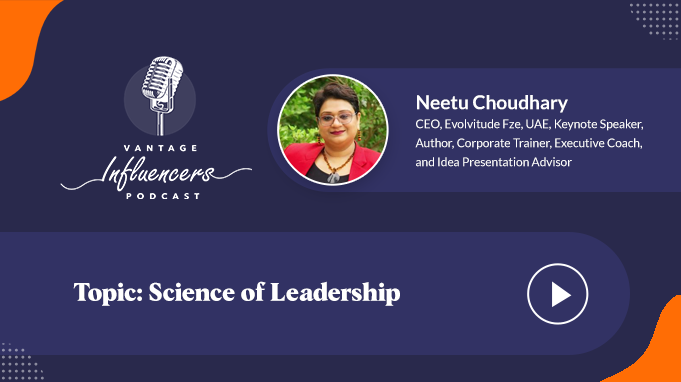
Neetu Choudhary, CEO, Evolvitude Fze, UAE
Neetu Choudhary is a Keynote Speaker, Author, Corporate Trainer, Executive Coach, and Idea Presentation Advisor, recognized as one of the UAE's top professional development coaches. Over more than 22 years of experience, she has collaborated with more than 150 companies across 30 countries, drawing on a corporate background in IT governance, business excellence, risk management, and project oversight. She holds a Master's degree in Computer Applications, is a Six Sigma Black Belt and EFQM Certified Assessor, and is also a certified organizational coach, NLP practitioner, emotional intelligence coach, and hypnotherapist, an interdisciplinary mix she brings directly into her work on the neuroscience of leadership.
Connect with Neetu on LinkedIn
Host
Susmita Sarma, Vantage Influencers Podcast Host
What You Will Learn
- Why reframing leadership as a role instead of a title changes how the brain responds to responsibility.
- How to use cortisol and stress as fuel for better decisions instead of letting them hijack judgment.
- The specific words and phrasing that trigger defensive brain responses in a team, and what to say instead.
- Why resistance to change is a survival instinct, and how growth mindset and neuroplasticity help leaders move past it.
- How genetic and neurological differences between men and women shape risk assessment and empathy in leadership roles.
- The one principle Neetu considers foundational to every meaningful leadership transformation.
Key Topics & Timestamps
| Timestamp | Topic |
|---|---|
| 01:34 | Neetu's path from 22 years in corporate IT to leadership coaching |
| 03:32 | Debunking the myth that leadership is a title, not a role |
| 06:47 | The neuroscience finding that changed how Neetu leads |
| 09:05 | How specific word choices trigger chemical reactions in the brain |
| 11:32 | Reframing cortisol and stress as tools, not threats, under pressure |
| 14:55 | Why resistance to change is a survival instinct, and how to build a growth mindset |
| 19:30 | The genetic and neurological roots of the leadership challenges women face |
| 22:00 | Empathy differences between male and female brains |
| 22:59 | Self-awareness as the one principle behind every leadership shift |
Full Transcript
Click to read the full episode transcript
Welcome to the Vantage HR Influencers Podcast. This podcast is sponsored by Vantage Circle, the simple and AI-powered rewards and recognition platform for employee engagement. The science of leadership is rapidly evolving with new insights from neuroscience, reshaping how we understand and practice effective leadership. So from improving decision-making under pressure to fostering a growth mindset, brain science offers powerful tools for leaders at all levels.
Susmita Sarma: Hello everyone, and welcome to another exciting episode of the Vantage Influencers Podcast. I am your host, Susmita, and in this episode we are joined by Neetu Choudhary, the CEO of Evolvitude Fze, a keynote speaker, author, and executive coach. Neetu brings her expertise in leadership development to explore how neuroscience can drive positive change in leadership practices, from debunking myths to supporting women in leadership. Neetu, it's so wonderful to have you with us today. How are you doing?
Neetu Choudhary: I'm doing great, and it's my pleasure to be here.
Susmita Sarma: It's great to hear. So before we dive into the topic, the science of leadership, I'd love to hear a little bit about your journey. Neetu, you have worked with such a diverse set of organizations, from large corporations to global thought leadership. So how did you first get into the leadership space, and what's the most transformative part of your journey so far?
Neetu Choudhary: Well, that's a very interesting question. I have more than 22 years of total experience, working with more than 150 companies across more than 30 countries. I have worked with different nationalities and more than thousands of professionals. One thing that inspired me to get into this domain is that leadership is something overrated, actually, in the sense that people think it's only for somebody with the designation. But leadership has nothing to do with the designation. Every single person is the leader of their own life, so I think leadership training is something every single person should go through.
And how did I get into this? I worked in corporate for 22 years, in different roles, and my last role was with an IT company as an IT release manager. During COVID, that made me think that I have so much to give to the world, and if I don't do this, if I wait till retirement, it's not going to happen. So this was the time to take the risk. I started my business about two and a half years back. Coming from a Six Sigma, IT, and neuroscience and behavioral science background, it was very natural to connect these dots, because what I see in the market is that leadership, especially with AI, is opening new doors. We need to understand what leadership means from the science perspective, and that's what I think we are going to discuss today: the neuroscience of leadership, and how science is helping us connect all the dots.
Susmita Sarma: Yeah, that's an inspiring journey, Neetu. And given your vast experience, one thing I'd love to kick off with is the many myths around leadership that tend to persist in organizations. So with your deep understanding of leadership science, what's the one myth you have encountered time and again that really needs to be debunked?
Neetu Choudhary: You know, the first thing, as I mentioned, is that many people think leadership is a title. Leadership is not a title, it's a role. So if I take responsibility, I feel I'm a leader no matter what designation I hold in a company. The moment I take on the role of a leader, my brain starts secreting serotonin, which is a leadership hormone. It makes me healthier, happier, and more alert. A lot happens the moment I realize that I'm the leader.
The second myth I'd like to highlight is that with AI coming into the picture, the next five to ten years will bring a huge amount of change in the market, in industries, and in companies. The market is becoming much more competitive, and success doesn't depend only on technical skills. It depends a lot on human behavior, and that's where neuroscience helps us understand what leadership is, how anyone can take on a leadership role, and what skills are required to develop it.
I'll give an example. In Japan, there's a restaurant where they've put an AI tool in place to monitor whether staff are smiling at customers or not. From an AI perspective, that's very good. But put yourself in the customer's place and imagine how much stress the staff must be under to give a fake smile. Neuroscience has proven that the subconscious mind can tell within a few seconds whether a smile is fake or real. I'll give another example from COVID: even when we were all wearing masks, the subconscious mind could tell whether someone was giving a real smile or a fake one, even with half the face covered, because a genuine smile lifts the cheekbones and creates wrinkles near the eyes. These are the subtle changes the subconscious mind is constantly reading.
And there are so many examples like this. Think about Kodak. There's a well-known story of an engineer who pitched the idea for a digital camera to Kodak, and the company turned it down. He eventually took it to Sony instead, and today that company leads the market while Kodak is no longer around. So listening to your team members matters, because you never know where a brilliant, groundbreaking idea will come from. It could come from a janitor, a clerk, an accountant, not necessarily from the ideation team. It could come from anywhere. So be open as a leader, be open to ideas, and don't reject anything outright. If something doesn't seem viable right now, just park it, but don't reject it, because you never know: if that idea goes to a competitor instead, you're out of the market.
Susmita Sarma: Very true, I completely agree. It's fascinating how different kinds of misinformation still exist despite all the research we have today. And on that note, Neetu, you've spoken extensively about the neuroscience of leadership before as well. So I'm curious: is there a finding from neuroscience that has completely transformed your own approach to leadership, something that might even be counterintuitive to how we traditionally think about it?
Neetu Choudhary: You know, one thing I've heard a lot, and it's everywhere on social media, is that nobody can make you feel good or bad without your permission. This is complete nonsense, because neuroscience has proven otherwise. Right now, as you're talking to me and I'm talking to you, something is happening in your brain at the neuron level, and something is happening in mine too. A lot of chemical reactions are triggered because I'm speaking, you're listening, or you're asking a question and I'm thinking about the answer.
So it's simply not true that people can't make someone feel good or bad without their permission. As a leader, I need to understand that whether I'm saying something or not, responding to something or not, ignoring somebody or giving them more importance, every single thing I do is triggering a neurochemical reaction in the brain of every team member, and their next response is shaped by that. As a leader, I need to understand that when I do something, their brain is secreting oxytocin, serotonin, or cortisol, which is the stress hormone. If I usually say good morning to someone every day and one day I don't, that person's brain starts secreting cortisol, because they're thinking, "Oh my God, what happened? Why didn't they say good morning to me today? Did I do something wrong?" Now, if that person immediately has to present in front of a customer, that cortisol rush is already there, and it affects how they handle difficult questions.
So there's a whole chain reaction happening, and once we as leaders start to understand it, it becomes much easier to manage our own behavior so that we can inspire others. There's so much more to this: how empathy works, how expectations matter, what happens when you set an expectation and someone doesn't meet it or exceeds it, different brain responses come into play for each. There's a lot to discuss here.
Susmita Sarma: Some really interesting examples you've put forward there. It definitely challenges conventional wisdom, doesn't it?
Neetu Choudhary: Yeah, that reminds me of something else. The simple words we use have a huge chemical reaction in someone's brain. I'll give a very simple example. Never use the word "rejected," because rejected is a negative word for the subconscious mind. Nobody likes to be rejected. Instead, say "not approved," because that's a more logical, more objective word. No matter how many times you tell someone not to take it personally, when a person is involved, everything is personal. The moment you reject someone's idea, they go into a defensive mode, and next time they won't share an idea with you. But if you say, "That's an interesting idea, let me park it, it's not approved yet, but we'll consider it again in six months," they'll keep bringing you ideas after that.
So a small change in vocabulary can create a huge change in your team. Here's another example. If I'm talking to you face to face and I say, "Susmita, you're such an amazing person, you organized this podcast well, right on time, and the communication was excellent, everything is so good," but the moment I add "but," control shifts from the prefrontal cortex, the front part of your brain, to the amygdala, which sits right behind your eyes. The amygdala is like a paranoid security guard. The moment that happens, you start thinking, "Oh my God, what is she going to say bad about me? She said all these good things, and now she's said 'but.'" Everything good that came before is nullified. Now your brain goes into fight, flight, or freeze mode, and the cortisol rush is there.
Susmita Sarma: It happens in all aspects of life, right? Not just at work.
Neetu Choudhary: Yeah, in relationships, in family too, especially as parents. I always say leadership and parenting aren't that different. So I tell all parents: don't show your "but" in public. Replace "but" with "and."
Susmita Sarma: As you're already speaking about the brain, chemical reactions, and how they relate to leadership, one thing a lot of leaders struggle with is stress, especially in high pressure situations. So as someone who focuses on the brain's natural wiring, how do you recommend leaders use this to make better decisions, stay clear headed, and manage stress?
Neetu Choudhary: You know, when we spoke about misconceptions about leadership earlier, I want to touch on one here too: it's a huge misconception that cortisol, the stress hormone, is bad for us. Cortisol isn't bad. This morning, you woke up from your bed, and now we're sitting here talking to each other. Why did you get up from bed? Because you had a cortisol rush. Without cortisol, we wouldn't even feel like getting up or achieving anything in our lives. So cortisol itself isn't bad. The problem occurs when cortisol goes out of control.
In fact, I'll tell you something interesting. The highest number of innovations happen during times of crisis, like the World Wars. That's when the most innovation happened, because when there's scarcity, there's stress, and we become more innovative and resourceful. So cortisol in a high pressure, stressful situation isn't bad. But when it goes out of control, that's when an amygdala hijack happens. The amygdala is an almond shaped organ right behind our eyes, on both sides. The moment a person feels like, "Okay, either I'm going to die, or I'm going to get pushed out of my tribe, my safe space," the amygdala starts pushing blood away from vital organs like the heart, kidneys, and liver, and into the hands and legs, and the skin starts sweating. That's because the body is getting ready to fight, flee, or freeze. I see so many people freeze the moment they step on stage. They don't know what to say because the amygdala has been hijacked in that moment.
To overcome that, there are four or five neuroscience-based methods that can help you shift out of that state within three to five seconds and get more oxygen flowing through your body. So high pressure, high stress situations are unavoidable. As a leader, it's important that I first understand why it's happening. Second, understand that it's not inherently bad, I just need to know how to manage it. And third, learn neuroscience-based methods to respond in that situation instead of just reacting. One method that many athletes use, especially around Olympic time, is a technique where they press their arm with their hand. It's a well known technique that helps signal to the brain that control doesn't need to stay with the amygdala, and that it can shift back to the prefrontal cortex, the more rational part of the brain, so we can make wiser decisions. I talk about this in sales training, leadership, and public speaking, because stress is unavoidable. We can't remove every stressful situation from our lives.
Susmita Sarma: For sure, for sure. And sometimes we also see resistance to change among leaders. How can they actually cultivate a growth mindset, both in themselves and in their teams?
Neetu Choudhary: Okay, from a neuroscience perspective, your brain isn't evolved for growth, change, making money, the limelight, or influence, none of that. Your brain is wired only for survival. And what is survival? If I know that when I get up in the morning, I'll have water to drink, I go to the office, I do my work, I get my salary, I eat food, that's my safe zone. The moment anyone mentions change, it means I'm stepping into something unknown, and I don't know what's going to happen. Maybe the company is restructuring, and I don't know if I'll have a job tomorrow. That creates uneasiness and insecurity in the brain, and since the brain is evolved only for survival, it treats that like a life and death situation. So restructuring in a company, or losing market share in a particular country, feels like a life and death situation to the brain. That's why change is always challenging for people.
I emphasize this because, as a leader, don't just blame people for resisting change. It's a very natural instinct that's evolved over the last seven million years, and we can't change that in one day. The only real solution is a growth mindset, neuroplasticity, and grit. The concept of growth mindset was developed by Carol Dweck, and it's the belief that your capabilities and skills aren't fixed, that you can learn anything at any time if you put in the effort. That's backed up by research on grit, the idea that every time you fall, you get up and try again, you don't give up. Growth mindset and grit are interconnected, and neuroscience proves the same thing through neuroplasticity.
I'll share an interesting story. In China, a while back, there was a woman who was feeling a headache and some dizziness, so she went to the doctor. When the doctors ran an MRI and a CT scan, they were shocked. She was in her late twenties at the time. The doctors went to her mother and asked what her childhood had been like. Her mother explained that she hadn't walked until she was five or six years old, and she hadn't spoken either, but she'd slowly started doing both. The doctors were shocked, because the part of the brain responsible for walking, eating, and speaking simply wasn't there in her brain, and yet she had been speaking normally for twenty or thirty years. How was that possible? When they looked further, they realized that because that part of her brain was missing, neuroplasticity had allowed the neurons to develop those capabilities in a different part of her brain instead. That's why it took her a little longer than other children, but it happened. So imagine an entire part of the brain missing, and the brain still finding a way. That's the power of neuroplasticity.
Susmita Sarma: Amazing example, Neetu. That's something.
Neetu Choudhary: And on the topic of mindset, since you mentioned it, take tennis as an example, it's a very demanding sport. Some of the longest matches ever played lasted around eleven hours across three days, in a famous match at Wimbledon in 2010. Now imagine playing continuously for eleven hours over three days. Technically, both players are equally capable, but every single time, the player who keeps thinking, "It's okay, I can do this, I can still do better," is the one who wins in the end. That applies in business too. When your product is technically identical to everyone else's, your mindset, and how you communicate with vendors, clients, and stakeholders, is what matters most, because that's what makes you stand out.
Susmita Sarma: True, very nice examples, Neetu. We have very limited time, so let's move on to the next question. There are still certain barriers to leadership that women in particular face, especially in male dominated industries. Based on your experience, what do you think is the key to overcoming those challenges, and how can the science of leadership help women thrive in this environment?
Neetu Choudhary: I love this question, and I want to go a little deeper, right down to the DNA level. We have around 30,000 genes in the human genome, and there's only about a 1% difference between male and female genes. But that 1% makes a huge difference when it comes to leadership and behavior. The male brain is about 9% bigger than the female brain, and for generations, people assumed that meant women had less intellectual capacity. But that's not true. Research over the last 20 to 30 years has shown that the number of neurons in male and female brains is exactly the same, it's just that the female brain is more compact and organized than the male brain.
I mention this because if someone assumes a woman can't handle a particular task or can't do business, that's simply not true, she can do anything. It's just that that one genetic difference shapes reality a little differently for her. Here's a practical example. When it comes to corporate risk identification, the biggest difference between men and women is that men tend to focus on the short term, immediate benefit, the financial upside, market share, and reputation for the organization. Women, when assessing the same risk, tend to weigh sustainability, brand image, and impact on people more heavily than immediate financial gain or market share.
So when you're building an enterprise risk committee, make sure you have a balance of both, because men tend to focus on likelihood, and women tend to focus on impact, and you need both perspectives to properly analyze risk. It's the same with crisis management. A female leader's risk appetite tends to decrease during a crisis, while a male leader's risk appetite tends to increase, because men are more focused on a do or die mentality, while women are focused on making sure the people, the team, and the organization stay sustainable through the crisis. That's why her risk capacity decreases. It's fascinating how neurons and genes connect to our decision making in the corporate world.
Susmita Sarma: Is there also a difference in empathetic skills between men and women?
Neetu Choudhary: A hundred percent. Women have a higher number of mirror neurons. Mirror neurons are what make you feel the same pain in your own brain when you see someone else in pain. Women have more active mirror neurons than men, and that's why they tend to be more empathetic. It's because women evolved more around relationships and society, while men evolved more around status and hierarchy.
Susmita Sarma: It really does drive stronger relationships and, ultimately, better decision making too, I believe.
Neetu Choudhary: Definitely. And it's a skill that can be learned and refined, which should be reassuring for all of us.
Susmita Sarma: So as we begin to wrap up, Neetu, if you had to distill this down to one principle from the science of leadership that could radically transform a leader's approach to driving change, what would that principle be, and why?
Neetu Choudhary: For me, leadership is an inside out journey. Everything starts with self awareness, and self awareness isn't a buzzword reserved for people meditating in the Himalayas. As a leader, I need to know what I'm thinking, why I'm thinking it, and what childhood experiences might be shaping that, because all of it impacts the brain through which I make decisions. So self awareness is the most important thing for leaders. The second most important thing is to stop treating leadership as an abstract concept and bring it down to the science level, to understand why things happen the way they do. Once you understand that, it becomes much easier to inspire your team, inspire yourself, and achieve bigger goals. These two things are at the very foundation of leadership.
Susmita Sarma: Neetu, thank you so much for sharing your insights with us today.
Neetu Choudhary: It was truly my pleasure. This topic is so close to my heart, I could talk about it for hours.
Susmita Sarma: I can tell, that's exactly why we chose this topic today. So from debunking leadership myths to exploring the neuroscience of decision making, it's clear that the science of leadership has so much to offer. I know our listeners will walk away with valuable takeaways from this conversation. Thank you again for your time, your expertise, and your thought leadership, Neetu.
Neetu Choudhary: Thank you, thank you so much.
Susmita Sarma: And thank you to our listeners for tuning in. Until next time, keep leading with purpose and keep questioning the norms. See you on the next episode of the Vantage Influencers Podcast.
Thanks for listening to the Vantage HR Influencers Podcast. Please subscribe to the Vantage HR Influencers Podcast on Apple Podcast, Spotify, and our YouTube channel for new episodes.
FAQ
What is the science of leadership, according to Neetu Choudhary?
Neetu Choudhary frames leadership as something rooted in brain chemistry rather than job titles. She argues that every action a leader takes, or doesn't take, triggers a measurable neurochemical response (oxytocin, serotonin, or cortisol) in the people around them, and that understanding this chain reaction is what separates leaders who inspire trust from those who unintentionally create defensiveness.
Why does Neetu Choudhary say cortisol is not necessarily bad for leaders?
Cortisol is the hormone that drives people to get out of bed and take action, and Neetu points out that some of history's biggest bursts of innovation happened during periods of stress and scarcity, including both World Wars. The problem isn't cortisol itself, it's when cortisol goes out of control and triggers an amygdala hijack, pushing the brain into fight, flight, or freeze mode instead of clear decision-making.
How can leaders build a growth mindset in their teams?
Neetu explains that resistance to change is a survival instinct, not laziness or stubbornness, because the brain is wired to protect whatever already feels safe. She points to growth mindset, neuroplasticity, and grit as the counterweights to that wiring, arguing that leaders should treat change resistance as a natural human response to manage rather than a behavior to blame people for.
What does neuroscience reveal about empathy differences between men and women?
Neetu attributes the empathy gap to mirror neurons, which let a person feel the same pain they observe in someone else. She says women have a higher number of active mirror neurons than men, which she connects to women having evolved more around relationships and society while men evolved more around status and hierarchy, and she notes this empathy gap is a skill that can be learned and refined by anyone.
Related Reading
Also listen on