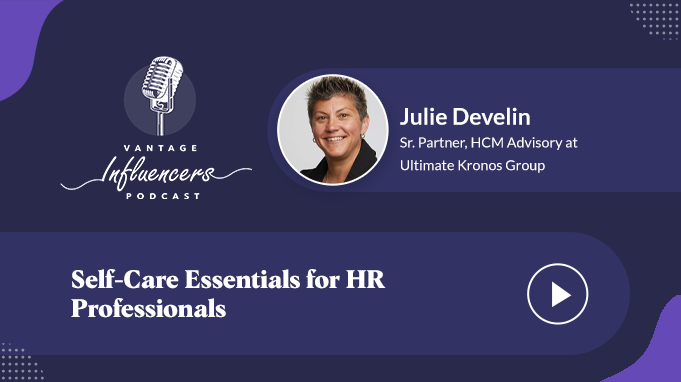
Self-Care Essentials for HR Professionals
Episode Overview
Julie Develin spent over 17 years as an HR executive before moving into her current role as Senior Partner, HCM Advisory at UKG, where she now speaks with HR professionals across the world and teaches in the HR management graduate program at McDaniel College. She only fully understood the weight HR practitioners carry once she left the practitioner role herself: HR is routinely turned to as an internal counselor, absorbing other people's personal problems on top of the ordinary stress of the job, and that emotional labor rarely gets acknowledged as a distinct source of burnout.
Her most useful reframe is that self-care advice for HR shouldn't be aspirational or abstract — it should be as concrete as setting a goal to take an uninterrupted lunch break once a day. She's equally direct about a common HR blind spot: practitioners spend their time designing employee experience initiatives while forgetting they are employees too, and deserve to be included in that same conversation.
Episode Highlights
- Burnout in HR often shows up as lack of motivation, dread, or blurred lines between work and home, rather than the more obvious signs people expect — and someone can be "working" without actually getting much done.
- HR carries a distinct form of emotional labor: practitioners are routinely turned to as internal counselors, absorbing employees' personal problems on top of ordinary job stress.
- Setting boundaries, including saying no and delegating, is one of the most practical self-care tools HR has — and one Julie Develin says many HR professionals, including herself, struggle to use.
- HR professionals design employee experience initiatives for others while often forgetting they are employees too, and deserve to be included in that same experience conversation.
- Self-care goals work best when small and attainable — something as concrete as an uninterrupted lunch break — rather than aspirational, since reaching small goals reinforces the habit.
- Culture change starts at the top: leaders and the C-suite need to treat mental health as something employees can openly discuss, since stepping away to reset is a sign of self-awareness, not weakness.
About the Guest
Julie Develin — Senior Partner, HCM Advisory, UKG
Julie Develin is Senior Partner, HCM Advisory at UKG (Ultimate Kronos Group), helping companies build positive, modern employee experiences through the intersection of strategy, intention, and technology. She speaks regularly at SHRM and other conferences nationwide, hosts the People Purpose Podcast through the Workforce Institute at UKG, and teaches and advises graduate students in the Human Resources Management program at McDaniel College.
Connect with Julie on LinkedIn
Host
Susmita Sarma — Vantage Influencers Podcast Host
What You Will Learn
- The less-obvious signs of HR burnout: lack of motivation, dread, and blurred work-home boundaries
- Why HR carries a distinct emotional labor burden as an informal internal counselor for employees
- Why setting boundaries, saying no, and delegating are core self-care skills, not signs of weakness
- Why HR professionals need to include themselves in employee experience conversations, not just design them for others
- How to set small, attainable self-care goals that actually stick
- Why leadership buy-in from the C-suite is essential to normalizing mental health conversations at work
Key Topics & Timestamps
| Timestamp | Topic |
|---|---|
| 01:50 | Julie's introduction in her own words |
| 03:10 | Easy-to-maintain self-care practices for HR practitioners |
| 08:20 | Setting boundaries and managing workload to avoid overwhelm |
| 11:50 | The role of HR practitioners in communicating self-care to employees |
| 15:30 | What employers and bosses can do to promote self-care organization-wide |
Full Transcript
Click to read the full episode transcript
As HR professionals, we play a very critical role in supporting the well-being and success of our employees and the organization as a whole. However, we often neglect our own self-care needs in the process. In this podcast, we'll explore the importance of prioritizing self-care as an HR practitioner and discuss practical strategies for managing stress, promoting well-being, and achieving work-life balance in this very demanding profession.
Susmita Sarma: Hello everyone, and welcome to another episode of the Vantage Influencers Podcast. Today we'll be talking about caring for yourself as an HR practitioner. I'm your host, Susmita, and I'm so excited and glad to be joined by our special guest today, Julie Develin. Julie is a Senior Partner, HCM Advisory, at Ultimate Kronos Group, and she brings a wealth of knowledge and experience to our discussion today on this very important topic. So whether you're an HR practitioner looking to improve your self-care practices, or just interested in learning about the topic, we hope you'll find today's discussion informative and engaging. So without any further delay, let's dive in. Welcome to our show, Julie.
Julie Develin: Thank you so much. How are you today?
Susmita Sarma: I'm doing fine, Julie. Thank you so much for joining me today. How are you?
Julie Develin: I'm doing fantastic, looking forward to the conversation.
Susmita Sarma: Me too, Julie, thank you once again. So before we move into today's topic, could you tell us a bit about yourself and your corporate journey?
Julie Develin: Absolutely. I'm a Senior Partner in the HCM Advisory, on the Human Insights team, at UKG, which is an HR software and workforce management software company. In my role at UKG, I do a lot of speaking, a lot of writing, and a lot of consulting from an HR perspective. I do that because HR is pretty much my life — I spent over 17 years as an HR executive, and I'm currently also a graduate school professor in HR, which I've been doing for about 16 years.
Susmita Sarma: So how many years into HR total, Julie?
Julie Develin: Over 20 years now — many, many years.
Susmita Sarma: Since you've been in HR and worked with so many other HR professionals, I'm sure we have a lot to learn from you today. Moving forward, Julie, we've picked a very sensitive, very important topic that we somehow haven't covered in our HR podcast until now, but today we have the perfect opportunity to talk about caring for yourself as an HR professional. HR definitely plays a critical role in managing human resources, overseeing hiring and training, managing conflicts and employee relations, and handling the countless HR-related tasks in the workplace. In this demanding, high-pressure role, there's a real risk of burnout given the nature of the job. What would you say are the common signs of burnout in HR practitioners?
Julie Develin: The common signs shouldn't be too surprising, but what I see a lot of is lack of motivation — that's one we don't always think of as a sign of burnout. It's not just feeling depressed or tired, it's more a feeling of dread, not wanting to be productive, not wanting to engage with other people, not wanting to put your all into whatever task is in front of you. Signs of burnout vary by person, and a lot of times a sign of burnout is actually working too much — if the lines between home and work have blurred, that's a sign too. You can also be, quote-unquote, "working" without actually getting much done, which is worth paying attention to as well.
Susmita Sarma: So apart from the physical labor HR does, there's also a lot of emotional labor — the effort required to manage emotions and maintain a positive attitude in the workplace, isn't there, Julie?
Julie Develin: Yes, exactly — it's more emotional. It's people not always knowing how to cope with the stressors coming down on them. If you think about where we are in the world and all the stressors coming down on us as people, those things don't disappear when we walk through the door at work or log onto a Zoom call. So any stress we experience at work, HR professional or otherwise, sits on top of the stress we're already dealing with in everyday life.
Susmita Sarma: So it's definitely important to prioritize self-care to avoid burnout and maintain overall well-being for HR. What are some easy-to-maintain self-care practices HR professionals can incorporate into their daily routines?
Julie Develin: There are personal self-care aspects and professional ones — let me differentiate. On the personal side: step away from work when needed, and recognize the signs of your own burnout, of getting tired, of feeling different from a mental health perspective — walking away for however long that needs to be, whether it's five minutes, a whole day, or a week. It's important to recognize your own signs and symptoms, and if you're not sure what those are, ask people closest to you whether they've noticed changes in you that you might not see yourself. From a personal perspective, exercise, get fresh air, journal your thoughts and feelings whenever you feel the need. I have friends who do a gratitude journal every morning before work — they wake up and write down three things they're grateful for, and that starts the day off on a good note.
From a professional angle, in HR we always talk about "employee experience" as something we design for other employees — but I think what HR professionals don't always remember is that our experience matters too, because we're employees as well. When we talk about employee experience, it's a healthy thing to include ourselves as HR practitioners in that conversation.
Susmita Sarma: So the first point you mentioned — stepping away from work when you're feeling stressed — does that mean setting work boundaries and managing workload to avoid feeling overwhelmed?
Julie Develin: Yes, setting boundaries becomes increasingly important as priorities shift and workload increases. I think setting boundaries also means saying no — you don't always have to say yes to people, and I don't mean that in a negative way, you don't have to be mean about it. But recognizing when you're too overwhelmed or don't have the capacity for something you're being asked to do, and being able to say "I'll get to it on X day" or passing it to someone else. Asking for help isn't a strong suit of mine, and I think a lot of HR professionals I come across feel the same way — we assume just doing something ourselves will be easier than the effort of delegating it. But doing the thing yourself can also take too much effort and lead to additional burnout. So saying no and delegating wherever possible is a good self-care practice.
Susmita Sarma: Good point. And going back to what you said earlier — HR is very much part of the total workforce, and when we talk about employee experience and a culture of wellness, HR professionals should be included in that focus too, alongside other employees.
Julie Develin: Right, and it wasn't until I was out of the practitioner role — I'm now in a consulting role — that I realized how much stress I was carrying on a daily basis, and how much of it was actually other people's problems. In HR, we're so often turned to as internal counselors — people come to us about very personal things, and those things can weigh heavily on us too. When it comes to HR having a good employee experience themselves, it's important to remember that we need to ask for the tools we need to do our jobs — whether that's HR technology, more team members, whatever it is. Sometimes we sit back on autopilot and think, "well, this is the way it's always been, so this is the way it has to be." There are so many tools out there that can improve an HR person's work life — we just have to look for them, and make sure we ask for what we need when we need it.
Susmita Sarma: For that reason, HR professionals are role models for a lot of us — we look to them for how to work and how to deal with stress and anxiety. So the role of HR in communicating the importance of self-care to employees is a big one.
Julie Develin: Yes — we have to walk the talk. If we're telling employees to take care of themselves, we need to be taking care of ourselves too. It's the old adage of putting your own mask on before helping others. Communicating self-care to employees benefits the entire workforce, including HR, because employees who take care of themselves need less emotional support from HR down the line. HR can also provide best practices — "this is what's worked for other people" — because a lot of employees, and HR people alike, don't know where to start with self-care. But the thought is to just start and figure it out as you go, because doing nothing won't get you closer to preventing burnout, and it won't get you closer to self-care either.
Susmita Sarma: So maybe setting some self-care goals — measurable, focused goals — just to get started?
Julie Develin: Right, and the important thing about goals is that they need to be attainable — they don't have to be astronomically difficult. Sometimes it's as simple as, "I'm going to take an hour-long lunch and not check email today," or half an hour, whatever amount of time. Reaching those small goals becomes important because it helps us internally renew our sense that we can do this, no matter what "this" is. There's no right or wrong way to approach it — whatever works for you as an individual, do that, and if it stops working, find something else. It's a lot of trial and error.
Susmita Sarma: So easy goals, but they can have great results.
Julie Develin: Exactly. I think about the goals I set for myself each week, and here's the other thing about goals — if you don't attain them, don't beat yourself up over it, just recognize that other priorities got in the way. If you step back and think about what you did accomplish rather than what you didn't, it reframes things in your mind and helps you feel more productive. There are also times you just won't get to things for various reasons, and that's okay too — it's about intention, setting a goal or two, or ten, whatever works for you, over a day, week, month, or quarter, and working toward those goals to foster a sense of internal productivity.
Susmita Sarma: Apart from their own efforts, employers and bosses also play a crucial role at the organizational level in promoting self-care, not just for HR but for other employees too.
Julie Develin: Yes, and that's a cultural thing. I think HR can do a better job of explaining to the C-suite and to managers just how important it is for employees to embrace the idea of self-care. Managers and the C-suite often get caught up in day-to-day pressures and don't always think about empathetic leadership as much as they should — which is understandable, given the pressure coming down on them too. But HR can do a better job of informing managers that mental health is no longer taboo in the workplace, it's okay to talk about it, and it's not a sign of weakness for someone to say they need time away for a few hours or days — it's actually a strength, because that person recognizes they may not be doing their best work and need to reset. Culturally, this starts at the top — leaders need to understand this is what this newer generation of work looks like, because the way work "used to be" wasn't working for everyone. The newer generations entering the workforce expect to be able to talk about their mental health, and they will talk about it. So providing resources, and even making monetary investments in things like therapy access, is where managers and the C-suite can step in — for employees and for HR too.
Susmita Sarma: Definitely. Julie, thank you for sharing your expertise today. Anything you'd like to add before we wrap up?
Julie Develin: I have a podcast as well, called the People Purpose Podcast, through the Workforce Institute at UKG, if anyone's interested. And if folks want to connect with me, they can find me as Julie Develin on LinkedIn. Thank you so much.
Susmita Sarma: I'll add your profile link in the show notes for this episode. Thank you so much for your time today, Julie — it was wonderful talking to you, and I hope to have you back for another episode on another interesting topic. Thank you so much once again.
Julie Develin: Thank you. Have a great day.
Thanks for listening to the Vantage HR Influencers Podcast. Please subscribe to the Vantage HR Influencers Podcast on Apple Podcasts, Spotify, and our YouTube channel for new episodes.
FAQ
What are the common signs of burnout in HR professionals?
Julie Develin identifies lack of motivation, a sense of dread rather than obvious sadness, blurred boundaries between work and home, and being "busy" without actually getting much done as key, often-overlooked signs of HR burnout.
Why is emotional labor a distinct challenge for HR professionals?
Because HR is routinely turned to as an informal internal counselor, absorbing employees' personal problems on top of ordinary job stress, a form of emotional labor Julie Develin says weighs heavily even when it isn't formally recognized as part of the role.
How can HR professionals practice self-care day to day?
Julie Develin recommends recognizing your own burnout signs, setting boundaries (including saying no and delegating), asking for the tools and support you need, and setting small, attainable goals like an uninterrupted lunch break rather than aspirational ones.
What role does leadership play in supporting HR self-care?
Culture change has to start at the top — Julie Develin argues C-suite leaders and managers need to normalize talking about mental health at work and treat stepping away to reset as a sign of self-awareness, not weakness, since newer generations of employees expect to discuss mental health openly.
Related Reading
Also listen on