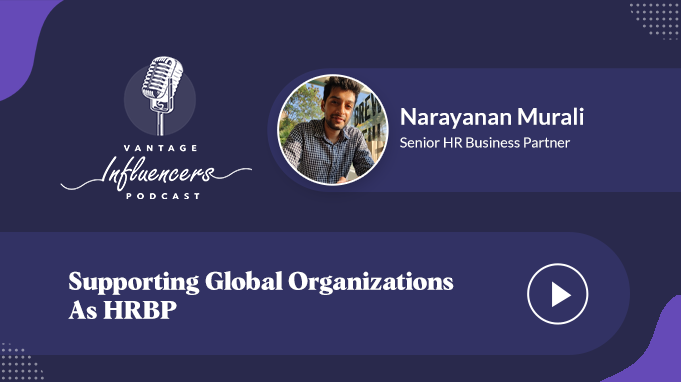
Supporting Global Organizations As HRBP
Episode Overview
Global companies love to talk about a borderless business world, but someone still has to make HR work across a dozen legal systems, time zones, and cultural norms at once. Narayanan Murali has spent his career doing exactly that, and he opens this episode by cutting through a confusion many HR professionals never fully resolve: what actually separates an HR Business Partner from every other role in HR. His answer isn't about seniority or scope, it's about breadth. While specialists in compensation or talent acquisition go deep in one lane, the HRBP has to hold working knowledge across every HR discipline and layer it against a genuine understanding of the business itself.
From there, Narayanan walks through what changes once that role goes global. A people strategy has to stay uniform in intent (grow the business, keep the right people) while flexing hard on execution, because what retains an employee in India rarely maps to what retains one in Europe or the US. He also draws a clear line between what an HRBP should own directly and what has to be handed off to local compliance experts, especially when labor law and employee relations issues cross borders. The conversation closes on two threads that HR teams often treat as separate problems: proving the business impact of "soft" HR work, and building diversity and inclusion into everyday decisions like performance reviews rather than treating it as a standalone initiative.
Episode Highlights
- The single biggest difference between an HR generalist and an HR Business Partner comes down to breadth: knowing a bit of everything, from compensation to learning and development, and a lot about the business itself.
- A global people strategy needs one consistent goal but different execution paths, because retention levers that work in India can look completely different from what works in Europe or the US.
- HRBPs need to know exactly where their authority ends, especially on labor law and employee relations issues that call for a local compliance expert instead of a global generalist.
- Quantifying HR impact means tracking two layers: input metrics you control directly, like participation rates and feedback scores, and output metrics you can only influence, like retention or manager performance.
- Strong on-the-ground leadership still matters in a hyper-connected, remote-enabled world, because tools alone can't surface the local context behind an employee signal.
- Diversity and inclusion has to show up in everyday HR mechanics, like training managers to catch gendered bias during performance reviews, not just in hiring targets.
About the Guest
Narayanan Murali, Senior HR Business Partner
Narayanan Murali is a seasoned HR professional with expertise in the HR Business Partner space, currently supporting a tech workforce of 900 employees at a leading Internet and e-Commerce firm. He has managed large-scale Talent Development and Compensation projects for organizations of up to 20,000 employees and previously played a pivotal role in transforming Performance Management strategies at a prominent investment management firm, building expertise across Performance Management, Total Rewards, Learning and Development, Change Management, Employee Relations, and HR analytics. Outside of work, he enjoys singing, traveling to new destinations, and, as a history enthusiast, studying maps to explore the world's past and present.
Connect with Narayanan on LinkedIn
Host
Sanjeevani Saikia, Vantage Influencers Podcast Host
What You Will Learn
- How the HR Business Partner role differs from other HR specializations, and why breadth matters more than depth in this role
- How to align an HR strategy with a global business's evolving goals, from talent sourcing to retention frameworks
- The unique challenges of supporting employees across multiple countries, cultures, and legal systems
- Practical ways to attract and retain diverse talent using both technology and strong local leadership
- How to navigate legal and compliance risk in global HR without needing to become a legal expert yourself
- How to measure and communicate the business impact of HR initiatives using input and output metrics
Key Topics & Timestamps
| Timestamp | Topic |
|---|---|
| 01:45 | Narayanan's professional journey from software engineering to HR Business Partner |
| 03:17 | What the HR Business Partner role means, and why it matters in global organizations |
| 08:52 | Aligning HR strategy with overall business goals |
| 13:22 | Unique challenges of being an HRBP for a global organization |
| 19:09 | Strategies to attract and retain talent from around the world |
| 24:19 | Legal and compliance risks in global HR |
| 28:03 | Quantifying and communicating HRBP impact on the business |
| 32:35 | How HRBPs promote diversity and inclusion |
| 37:23 | Closing thoughts and how to connect with Narayanan |
Full Transcript
Click to read the full episode transcript
Welcome to the Vantage HR Influencers Podcast. This podcast is sponsored by Vantage Circle, the simple and AI-powered rewards and recognition platform for employee engagement.
We live in an era where the boundaries of the business world are shrinking, where distance and borders are no longer the hurdles they once were. In this landscape, the role of HR Business Partners in supporting global organizations has risen to unprecedented importance. HRBPs have evolved as the virtuosos of talent acquisition, management, and development strategies, performing on a stage set with diverse cultures, intricate legal landscapes, and operational intricacies, making them a key figure in the global landscape.
Sanjeevani Saikia: Hello listeners, welcome to another episode of Vantage Influencers Podcast, where we explore a wide range of HR topics that are sure to grab your attention and inspire you. I am your host, Sanjeevani Saikia. Today, our quest is to uncover the art and science behind how HRBPs must combine the HR strategies that keep global organizations sailing smoothly. And for the same, we have with us Mr. Narayanan Murali. Hi Narayanan.
Narayanan Murali: Hi Sanjeevani.
Sanjeevani Saikia: First and foremost, I want to express my gratitude for your presence today and for taking the time to be part of this episode. Before we delve into today's topic, which is about supporting global organizations as HRBP, could you kindly walk us through your corporate journey so far?
Narayanan Murali: Sure, thanks Sanjeevani, and yeah, it's a pleasure to join this podcast.
Sanjeevani Saikia: Great to have you here.
Narayanan Murali: Sure, I think I'll start from about 10 years back. I actually started in a software company working as a software developer. I did my engineering, so it was a natural kind of progression into a corporate role from campus. I did that for a couple of years, realized that's not really my area of interest. I then did my MBA in Human Resources at XIMB. Post that, I was placed at a company, where I worked for close to three years in talent management as well as an HR business partner role. After that, I've been working at Amazon for five years, again in an HR business partner role. So yeah, it's been close to 10 years overall, I would say, in HR.
Sanjeevani Saikia: Perfect. Thank you for sharing your journey with us. It has been a remarkable one, I must say. So moving on, as we delve into the topic of supporting global organizations as HRBP, let's begin by gaining a solid understanding of the role of HRBP. So could you please provide our listeners with a concise overview of the role of HR business partner? And Narayanan, it could be great if you could elaborate on its significance within the context of a global organization.
Narayanan Murali: Sure, I think that's a pretty tough question to answer. I sometimes try to answer that question when some of my friends or relatives ask, who don't necessarily understand what the human resource function is or what the HR Business Partner role is.
Sanjeevani Saikia: Yes.
Narayanan Murali: In a nutshell, if I were to explain this very simply, I think if you look at any organization, you have central functions which you call the COE function. So that would be functions like talent acquisition or compensation, learning and development. They develop solutions for the entire organization or the entire company, right?
Sanjeevani Saikia: Yes.
Narayanan Murali: And they generally tend to be process experts or specialists in that particular area. Then you have business lines or functions. And then somewhere in between you have the HR Business Partner, who is supposed to be the person providing people solutions for the business line they are tagged to. Because businesses tend to be varied, and because the nature of the functions tends to be versatile, you can't always have ready-made solutions that a COE team can go and plug and play into these particular functions. So you need that HR Business Partner role, who understands the business context in a much deeper manner and can provide more contextualized or customized solutions for those business lines. Primarily, I would say that's the reason why you have HR Business Partner roles everywhere. Secondly, it's also a matter of scale, right? When you have big organizations, you can't expect a COE function, which is typically made up of specialists and usually thinly staffed, to go and regularly connect with business lines and understand what their challenges are, or be able to provide that kind of guidance or support on an ongoing basis. Probably, in my experience, one of the COE functions that can do that is talent acquisition, because that's a very specialized function. They have a very clear set of roles and responsibilities in terms of hiring. But keeping that function aside, a lot of the other COE functions rely on the HR Business Partner to help run initiatives for the company or these particular business lines. I hope that answered the question. It's still difficult to exactly pinpoint what an HRBP does. It also depends on the company, the way the role is defined, the way COE functions are structured. I know certain companies where there are no COE roles, except maybe talent acquisition or compensation. In those companies, the HR Business Partner is literally doing everything, and sometimes that role is called HR Generalist. But in companies where you have strong COE functions, I think the business partnering role is really about providing those customized solutions and being able to understand business context and put that into the solutions they offer.
Sanjeevani Saikia: So, is it possible to answer, say if I ask you, can you just give me one major difference between an HR professional and an HRBP? So, forgive my limited knowledge, I actually wanted to know this. If I said regular HR professional and HRBP, is there one particular difference that you would want to highlight?
Narayanan Murali: Okay, so let me put it simply. Every HRBP is an HR professional. Let's clarify this. But when you come out of your specialization, there are usually two choices, maybe even three. One is HR consulting, you know, like any consulting. You would join a consulting firm and then work with clients and provide HR solutions. Then you have a COE function, which is a Center of Excellence, and that's usually when you want to become an expert and really go into the depth of a particular area. For example, you might want to be an expert in compensation, so you might do a COE role in compensation, or you might want to get into talent acquisition. And even within talent acquisition, there are multiple roles. There are folks who do only campus hiring, and then there's lateral hiring, and so on. And then you have the third type of role, which is your HR Business Partner, which I would say is more of a breadth-oriented role, where you need to know a bit of all of these functions, like a bit of compensation, a bit of talent management, and more importantly, you need to know a lot about the business. So what really sets apart an HRBP from the rest of the HR folks is the fact that it's more breadth-oriented, and the fact that you need to have more business knowledge and the ability to work more closely with the business, versus maybe a COE or an HR specialist kind of function.
Sanjeevani Saikia: Perfect. So, it's important to ask you here, and your take will be very crucial in further understanding this particular area better. And that is, how can HRBPs align their HR strategies with the overall business goals and objectives of a global organization?
Narayanan Murali: Okay, so I think those are two different questions. Let me try and answer the first one, which is aligning with business goals.
Sanjeevani Saikia: Yeah.
Narayanan Murali: So, I think, personally, as an HR Business Partner, what I typically do is be involved in every business review meeting, or get a thorough understanding of what the business is about, what the critical functions in the business are, where the top line is coming from, where the bottom line is coming from, where they're getting talent from, and what tailwinds they're facing in the industry. When you get an understanding of that, then it's important to get into the nitty-gritties of what the strategy is for maybe this year or the next couple of years, sometimes even three or four years. And then you bring in your HR knowledge, or your knowledge of areas like compensation or talent management, and try to plug that in with the business strategy and translate it into people strategies. Simply put, a people strategy is what will enable your business to achieve its goals through people. That could be, crudely put, something like, this business needs X number of people with these skill sets by the end of the year to deliver value to the customer. Let's assume a technology team who wants to get heavily into AI. Right now, as an HR Business Partner, I realize the strategy for this team is that if they want to provide differentiated offerings and get into AI, because obviously there's a lot of cost savings there, and it also helps develop better solutions for customers, then using that as a goal statement, I probably should look at every aspect of the people strategy. Number one, do we have the talent internally? If we do, how are we getting them into those roles? Have we created those role opportunities for them? If we don't have talent internally, then how are we sourcing that talent? I need to work closely with the talent acquisition partners to understand where we can source that talent from. Then you go into things like retention. I would want to study what other companies with AI talent do to retain that talent. Is it through compensation? Is it through rotation programs? Or is it through better benefit offerings? So I need to study that, and I need to go and tell my business that the current strategy they have may not work when they have a workforce with these skill sets. You need to look at these factors. So, by the way, I've already covered compensation, recruitment, and L&D. And then, obviously, you also look at existing frameworks for how you manage talent. For example, the existing processes for promoting people may not work when you have a different kind of talent coming in. So then you need to provide a customized solution, and that's where my initial point about working closely with COE functions, but being able to offer that differentiated or contextualized solution, comes in. So now I'll probably go and have a dialogue with, say, the talent management function and tell them, we have this workforce, it's kind of different, we need slightly different frameworks, how can you help me provide that? So it's going to be a complete study of all the different areas I just talked about, and being able to provide that holistic picture to the business. That's what you need to do to help ensure you're setting up your people for success.
Sanjeevani Saikia: Okay. I think, just like any other role, the role of an HRBP is not free from challenges. So as we explore the complexities of HRBP roles in global organizations, it's essential to understand the unique challenges that arise in this context. So it would be great if you could shed light on the unique challenges HRBPs face when working with a global organization, as compared to their counterparts in local or regional settings. So what do you have to say about this particular question?
Narayanan Murali: Yeah, that's a good question. Through my experience so far, I've worked mostly in multinational companies that have operations in multiple countries, or let's say geographies or regions. So when you say global, I guess what you're referring to is where they have operations in multiple countries, multiple regions, geographies, multiple areas where the legislation or labor laws could be different. I think firstly, what you need to understand as a business partner is that you're obviously aligned to a particular team or function. Now, if that particular function is operating in multiple countries or geographies, you need to start thinking for the entire business line. You can't just say, I'm going to only create a strategy for the number of people in India, and I don't really care about your other employees in other countries. That, in itself, is a pretty wrong way to go about it. So I think it has to start with saying, the people strategy you create is universal, it's for your entire business, and my objective is to make your business successful regardless of where you're operating. That's the bottom line. Now, at the same time, you need to be mindful of regional nuances. If, for example, a business line you support has operations in the US, in Europe, and in India, the retention strategies you might use are probably slightly different for each region. Your baseline would be similar, saying, this is the value proposition you're providing. For example, the value proposition of a technology team that I'm hypothetically supporting is, we are doing cutting-edge work, and we are helping customers solve real problems through AI. That baseline is the same for all, whether the employee is sitting in India or wherever. But the strategy you use to actually deliver that value proposition might be different. For example, in India, when I benchmark with other companies, maybe the strategy would be, you need to compensate better. I'm just hypothetically saying that. Whereas in Europe, it could be something different, it could be, we need to offer different benefits. Or it could be that in a particular geography, there's a tendency for employees to prefer or optimize for work-life balance over working long hours. So then I need to create a differentiated strategy for that region and say, you need to offer benefits that can help them balance work and life, because that's important in that geography to retain people.
Sanjeevani Saikia: Yeah.
Narayanan Murali: So the nitty-gritty of how you actually go about doing it varies by country. But again, you are the global HR Business Partner for that function, so you need to understand it. And lastly, you also need to know where you cannot provide a solution and where you need to step back and get expert advice from local partners. For example, if you have an employee relations issue that involves understanding the labor laws or legislation of a particular country, you're not the expert. So you need to realize at that point that's where your role stops, and you need to bring in the local HR partner there to help solve that problem.
Sanjeevani Saikia: Yes.
Narayanan Murali: For example, a business leader might come and tell you, I have this performance management case happening in this particular country, but it's taking such a long time to resolve. Obviously, you'll tell the business, I'll go find out what the challenges are, but then you need to connect with that country's HR compliance team, whoever it may be, to understand how to go about it and let them handle it. So you also need to understand where to draw the line and ensure the right people are involved in that particular case or problem. So, sorry, just to summarize, I think three things. One is obviously the overall strategy, which is probably universal and uniform, but getting into the nitty-gritties of it and getting the local nuances right, you cannot be blind to that, otherwise your strategy will not work everywhere. And lastly, also knowing where to draw the line and ensuring you're not doing the wrong thing, because doing the wrong thing can also attract a lot of bad attention, and it can also cost the company a lot in terms of compliance or legal issues. So in those cases, being very aware of who the people are that you need to loop in to help solve the problem.
Sanjeevani Saikia: Yeah, perfect. Now moving on, as we navigate the vast global landscape of HRBP responsibilities, one critical facet that emerges is talent management on a worldwide scale. So in a time where talent transcends geographical boundaries, and the success of organizations increasingly relies on diverse perspectives, could you help us learn more about how HRBPs can strategically ensure that the organization not only attracts but also retains and develops top talent from diverse corners of the globe? Because I think attracting is one part, and retaining is another. So can you focus mostly on the retention part in your answer?
Narayanan Murali: Got it. I think that's a pretty loaded question. Are you specifically asking about how we get diverse perspectives in, or is it about how we ensure that in such a global setup, we're able to acquire employees and then also come up with strategies to retain them?
Sanjeevani Saikia: I think retention would be something I'd like to focus on here, because having them on board is okay, but what strategies could HRBPs use to keep them onboard once they've joined?
Narayanan Murali: Sure, I think it's a good question. First and foremost is having the right tools or mechanisms to listen to employees. And there are various ways to do that. Thankfully, today, you have technology that makes it very easy to connect with people across the globe, across time zones. And thankfully, most of the companies I've worked for have always invested in technology to ensure there's open, real-time communication. So that's super critical, you need to listen to employees, get signals, and so on. The other thing I often insist on as an HR Business Partner is having strong leadership on the ground. As an HRBP, you can get these signals from different tools, but to really understand the context behind some of these signals, you need a strong connection with leaders or managers on the ground. There could be cultural nuances involved, local market nuances involved. For example, in a certain country, maybe the job market is very hot right now, and I'm hearing signals that people aren't happy with their job, that they're not being paid well. But if I just look at those signals and assume it's a false alarm, because I'm sitting in India and I think the job market here isn't very hot, and maybe that's the case everywhere, then I'm not really listening to that signal well, or doing a deep dive into it. So that's why you need to tie the signals to real issues on the ground and have strong leadership there. So one of the things we always insist on, when you have operations across multiple countries or sites, is having strong site leadership on the ground. It's kind of paradoxical, on one end I'm saying, at a global level, have all these tools to help you connect with everyone, but at the same time, ensure you have strong local leadership on-site. It has to be a hybrid approach. That's what I want to call out, that you need those leaders or managers on the ground who you can listen to. Now, having heard those data points, that's when you ideate and come up with solutions. Like I said, some solutions can be core and common across the entire team or business line, whereas some solutions may be very customized and specific to a particular country, geography, or even a particular team. It may not necessarily be an entire city or an entire country, it could even be a couple of teams in that particular country where there are some challenges with retention. So, for whatever reason, it could be that you have a manager in that particular country who's actually from another geography and isn't able to acclimatize or understand the local nuances well. And because of that, maybe that person's team has higher attrition than the rest of that particular country or site. So there, your intervention may be very different. It could be about assimilation into cultural nuances, it could be about having the person go through a culture workshop, it could also be about having an open dialogue between the team and the leader. For example, in HRBP, we have sessions where we facilitate conversations between managers and employees, different companies have different names for that. But sometimes that's usually facilitated by the learning and development team, so you want to get L&D involved and design a customized intervention. So it could be any type of intervention, depending on what the problem is.
Sanjeevani Saikia: Okay. So, in our exploration of HRBP responsibilities within the global arena, it's clear that understanding the intricacies of legal and compliance is paramount when managing a diverse global workforce. So, with this perspective in mind, could you illuminate the potential legal and compliance challenges that may surface, and share strategies HRBPs can employ to proactively mitigate these risks? Again, legal and compliance, but anything you'd want to share on this, your take basically.
Narayanan Murali: Yeah, I think it's very, very crucial. I don't think you can act as an HRBP anywhere, whether it's supporting a global team or even a local team, without really understanding labor laws, compliance issues, or what could potentially be a red flag. I think one of the most important subjects you need to know in HR is labor law. If you're supporting a team with employees in multiple countries, you need to have some understanding, you can't be an expert, but more importantly, you need to know where there's a potential signal that something is going wrong, and then loop in the right person or team to handle it. For example, hypothetically, if I'm supporting a team with employees sitting in Japan, I don't know Japan's labor laws, but what I do need to know is who I can quickly loop in to handle a potential labor law issue in Japan. So that's reactive. One of the things you can do proactively is, obviously, when you're sitting with your business leader and creating a people strategy, or looking at their business plans, and if they have plans to open sites in different countries, then as a best practice, you should proactively involve the HR compliance team of that particular country and understand from them what needs to be taken care of before you open the site. And that's not just for a country expansion, even within India, for example, different states have different labor laws, your overtime laws and so on vary by state. So even when a business leader says they want to open a site or hire employees in a particular state or city, you need to loop in your India compliance team and get their expertise on the labor laws that apply. For example, you have Shops and Establishments Acts, every state has one, so you need to thoroughly understand what provisions of that act will apply to your particular team or business when you hire employees there. Now, you may not know the ins and outs of the act, but you need to understand at least the bare minimum aspects of it, or if you don't, it's always important to call the right person and get an understanding from them. But the bottom line is, you cannot operate in a vacuum, you can't say you didn't know, because that's a huge cost for the company. For example, a lot of geographies have very strict laws around data privacy and protection of data rights, and as an HR person, you're dealing with a lot of sensitive data. So again, you need to ensure you're compliant and aware of the issues or red lines you cannot cross in those particular regions.
Sanjeevani Saikia: Perfect. So, Narayanan, we're arriving at the end of today's episode, but before we let you go, there's one last thing that both our listeners and I would love to know your take on. And that's, how can HRBPs quantify and communicate their impact on the organization's success and growth?
Narayanan Murali: Thank you, Sanjeevani. That's always an existential question.
Sanjeevani Saikia: Yes.
Narayanan Murali: But I think it's not just for the HRBP role, I think in general for any role. In some roles, it's easy, it's very numbers-driven, and you can say sales grew by X percent. I think the beauty of the HRBP role is that you can quantify it. Usually, I look at any initiative I do and try to quantify it, at least in terms of input metrics, and then maybe output metrics. I don't know if listeners would know the difference between input and output metrics, but I'll try to explain it simply. An input metric is something you have control over. For example, let's assume you're doing a training intervention, say a training intervention for manager capability building, to build better managers in your organization. The typical input metric would be things like the percentage of participation of managers in the session, the average feedback score for the sessions. Then you'd look at things like, if you rolled out a survey, you'd have questions like, would you recommend this session to someone else, so scores for survey questions or participation would be your typical input metric, and you can define goals like, I want to achieve a participation rate of X percent. Now, output metric is slightly more difficult to connect to the input metric, because your ultimate output goal is to have better managers in your organization. So you could potentially take an output metric saying, if I do this intervention, my expectation is that employee retention will increase by X percent, because you have better managers in the organization. Or you could have an intervention saying, because of this intervention, manager performance will increase by Y percent. Obviously, this is not the only parameter that will impact those output metrics, but it could be one of the factors that impacted it, but it's obviously pretty difficult to completely tie the output metric to the input metric. So typically, I try to take an input metric for any goal I work on. But at the same time, you need to be honest, I think one of the things about the HR role that people need to appreciate is that a lot of it is also about building culture, building the right culture in the organization, making your leaders think in a certain manner, or guiding them, consulting with them, coaching them. It's difficult to quantify that, and that's okay. I don't think you need to quantify everything you do in this particular role. I think there are certain things you're adding as an HR Business Partner that really make a difference, and ultimately it will come out, you'll get good feedback. The moments where I've really felt happy in my career so far are when a leader tells me, the piece of advice you gave me last week, I actually went and did that, and you know what, it worked. Trust me, that gives me more happiness than some initiative that had a feedback score of 100 out of 100. So I think it's about what you take out of the role and how you're able to manage that balance. I think it's important to show output, like you rightly called out, in terms of metrics and impact. But at the same time, you need to not over-index only on that, but also be able to guide and provide coaching to leaders or managers, and offer those inputs that are super critical.
Sanjeevani Saikia: Yeah. So, Narayanan, the moment you mentioned culture, you've actually opened the Pandora's box for me, because I wanted to ask you, when it comes to HRBP roles, how do HRBPs promote diversity and inclusion, because both our listeners and I are very interested in this subject matter. So D&I, how do HRBPs go about it, because from a global perspective, it's something that's very crucial, and right now many HR teams are focusing on it.
Narayanan Murali: I think the HRBP plays the most important role in facilitating a culture of D&I. I'm using the word facilitating because the leaders are obviously the most important people in the organization in terms of building that culture. But as an HRBP, you have to facilitate or bring that conversation to the top of the agenda. A couple of ways I do it, number one, whenever you're reviewing people data or designing a people strategy, ensure it meets the core principle of bringing in the D&I aspect. Now, when I say that, for example, when you have a retention strategy, ensure you're factoring in challenges or nuances that a particular diverse group or cohort may be facing. In India, for example, I think ensuring gender diversity or gender parity is super critical, that's a core and common focus across organizations. So when I create a retention strategy, I'll definitely look at data for both men and women and see where there are differences. Of course, there could be some commonalities, but there will definitely be differences, for example, women may be leaving the company for slightly different reasons than men. Now, if I'm blind to that, and if I'm not creating a strategy to address it, then I'm missing the whole point, I'm just paying lip service to it, not really creating solutions. So that's one, always look at data, look at different cuts, bring in multiple diverse cohorts, and ensure your business is listening to that. Secondly, in a global setup, different countries have different definitions of diversity or representation targets, so be mindful of that too, that's critical. And lastly, this is a good question, because a lot of the time we focus a lot on data, in terms of needing to reach a certain target or representation, so we aim for, say, more women to enter the company, but what we sometimes miss out on is inclusion, which is where culture comes in. So, as an HRBP, what I typically do is, before we do a performance review session, we ask managers to go through inclusion training. Are they using the right kind of language to promote inclusion in their team or business line? Are they aware of potential unconscious biases coming in when they're rating people? There are a lot of differences in the way managers perceive certain behavior, depending on whether it's a man or a woman, you can actually read up on this online. I think a classic example, and this is quite common, is when a man tends to be aggressive, that's actually attributed to being a good behavior, it's seen as, this person is a go-getter, trying to get things done. Whereas if a woman does it, that's perceived in a very negative manner.
Sanjeevani Saikia: True.
Narayanan Murali: Right, so there are many such examples of how the same behavior gets perceived differently depending on gender or race. So, as an HRBP, you need to ensure you're providing those trainings, or at least having those conversations with your leadership, and ensuring your leadership is well acquainted and aware of it.
Sanjeevani Saikia: Yeah, perfect. I think you've highlighted some really crucial points here. Narayanan, it's been a pleasure to have you as our guest today, your insights and expertise have been invaluable. But before we let you go, do you have any message for our listeners? Our listeners will be delighted to hear it from you. Also, our audience might want to stay in touch with you after this podcast, so it would be great if you could tell them how they can reach out to you.
Narayanan Murali: Yeah, sure. I think my message to listeners is, if anyone has any apprehensions about taking up an HR Business Partner role, or even a role in HR, I think you should just take it. It's a fantastic role, you get to play a big role in helping businesses grow and achieve success. And yeah, if you want to connect with me, I'm available on LinkedIn, my full name is Narayanan Murali.
Sanjeevani Saikia: We'll be linking it anyway. Thank you so much, Narayanan, thank you so much for giving your time and sharing your knowledge with our listeners.
Narayanan Murali: No, thank you, Sanjeevani. I hope this was insightful, and hopefully listeners will take something from this. Thank you.
Sanjeevani Saikia: Yeah. Thank you so much.
FAQ
What is the main difference between an HR professional and an HR Business Partner?
Every HR Business Partner is an HR professional, but the role is defined by breadth rather than depth. Narayanan Murali explains that HRBPs need working knowledge across compensation, talent management, and learning and development, combined with a much deeper understanding of the business itself, which is what sets the role apart from specialist Center of Excellence functions.
How should HR strategy change across different countries in a global organization?
The underlying business goal should stay consistent, but execution has to flex by region. What retains talent in one country, like stronger compensation, can look completely different in another, like work-life balance benefits, so HRBPs need to study local nuances rather than apply one global template everywhere.
Where should an HR Business Partner draw the line and involve local experts?
Whenever an issue touches labor law, employee relations, or country-specific compliance, an HRBP should recognize the limits of their own expertise and loop in the local HR compliance team rather than trying to resolve it alone.
How can HR Business Partners prove their impact on the business?
By tracking two layers of metrics: input metrics they control directly, like training participation or feedback scores, and output metrics they can only influence, like retention or manager performance. Some of the most meaningful HR impact, like culture-building, is real but harder to quantify.
Related Reading
Also listen on