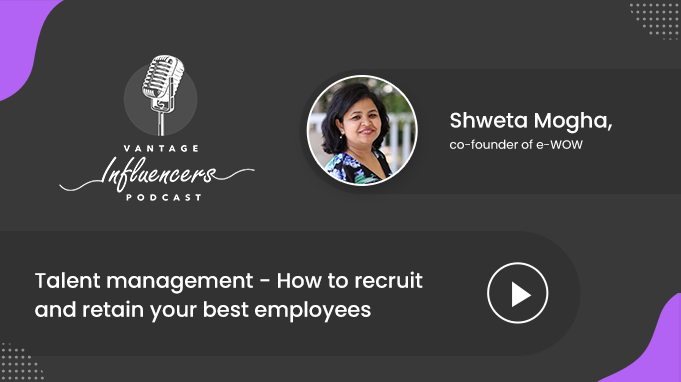
Talent management - How to recruit and retain your best employees
Episode Overview
When the pandemic upended how companies hire, Sweta Mogha argued that many long-held assumptions about remote work no longer held true. She points to how large organizations quickly re-engineered roles once considered office-only into remote-friendly positions, breaking work into smaller projects that could be handled by talent scattered across geographies. This shift, according to Sweta, did not just solve a short-term staffing problem. It also opened the door to a much more diverse pool of candidates, including women and professionals who had stepped away from the workforce and were now looking for a way back in.
The conversation moves quickly from hiring to retention. Sweta pushes back on the idea that competitive pay and rewards alone keep people around, arguing that culture fit, transparent communication, and a genuine sense of trust matter just as much once someone joins a distributed team. She also weighs in on how HR can think about the return on employee experience investments, why onboarding needs to look different in a remote-first world, and what she has observed about engagement scores swinging in opposite directions depending on how honestly a company communicates during a crisis.
Episode Highlights
- Sweta explains how COVID forced traditionally office-bound roles to become remote almost overnight, citing examples like large banks converting branch staff into remote call handlers.
- She argues remote work has opened up hiring to a far more diverse talent pool, including women and professionals returning to work after a career break.
- On culture fit, Sweta stresses that pre-boarding and onboarding both need a rethink, with mentors and buddies playing a bigger role when new hires never set foot in an office.
- She pushes back on the idea that rewards and feedback alone drive retention, pointing instead to culture, career paths, and learning opportunities as equally important factors.
- Sweta shares how she thinks about measuring ROI on employee experience, weighing engagement survey data against harder-to-quantify signals like what employees say about the company externally.
- She closes with candid advice for young HR leaders on championing diversity of thought and challenging the status quo inside their organizations.
About the Guest
Sweta Mogha, Co-founder, e-WOW
Sweta Mogha is an HR and Talent Acquisition leader with more than two decades of experience across the telecom, technology, and retail industries, having held senior HR roles at organizations including Airtel and Amazon. Her work has spanned talent management, talent acquisition, and learning and development across geographies including North America, India, Africa, Sri Lanka, and Bangladesh. Through e-WOW, she now focuses on coaching and mentoring leaders, and on building programs that help professionals, including those returning to the workforce, reach their next career milestone.
Host
Rohit, Vantage Influencers Podcast Host
What You Will Learn
- How COVID-19 accelerated the shift toward remote-friendly roles across industries
- Why remote work is opening hiring to a more diverse, previously overlooked talent pool
- What it takes to build cultural fit and trust with employees who join remotely
- Why rewards and feedback alone are not enough to drive retention
- How HR can approach measuring ROI on employee experience
- What onboarding and engagement look like in a remote-first organization
Key Topics & Timestamps
| Timestamp | Topic |
|---|---|
| 00:39 | Sweta's journey into HR |
| 02:35 | The shift in hiring during the COVID-19 crisis and going forward |
| 06:22 | Whether remote work will stay forever |
| 08:29 | How HR leaders can ensure remote hires match company culture |
| 10:46 | Building transparency and trust in a remote work environment |
| 13:53 | Whether rewards and feedback are enough to motivate employees |
| 16:01 | Measuring ROI on employee experience |
| 17:26 | Onboarding new employees in a remote setup |
| 20:56 | Whether engagement scores are rising in remote work |
| 23:41 | Sweta's favorite business book |
| 25:42 | Advice for young HR leaders |
Full Transcript
Click to read the full episode transcript
Welcome to the Vantage HR Influencers Podcast. This podcast is sponsored by Vantage Circle, the leading employee benefits and engagement platform.
Rohit: Hi, this is Rohit from the Vantage HR Influencers Podcast. Today I'm excited to have with us Sweta Mogha, a talent acquisition leader with over 20 years of experience across the telecom, technology, and retail verticals. She has worked with companies like Airtel and Amazon, and her career has spanned geographies including North America, India, Africa, Sri Lanka, and Bangladesh. She's also the co-founder of e-WOW and an alumna of Airtel. Welcome, Sweta.
Sweta Mogha: Thank you, Rohit.
Rohit: Awesome. So how did you get into HR, and what excites you about the field?
Sweta Mogha: I had an interesting journey, Rohit. I did my postgraduate studies in sales and marketing, and I joined Airtel as part of my campus placement. I actually started my career in sales and marketing, not HR. After my training period, I was given the option to continue in sales or move into customer service, and I chose customer service because I felt I could make a bigger impact and manage larger teams. I'm a bit of a restless soul. I spent two years in customer service, but I soon realized my real passion was coaching and mentoring people, and that pulled me into training and development, which is really where my journey in HR began. I ended up spending about 18 to 19 years at Airtel, one of the largest telecom companies in the world, and did pretty much everything under the sun in HR there, from HR business partnering to learning and talent development to talent management and talent acquisition. After 18 years, I decided to try something different, and Amazon came knocking with a great opportunity. I led operations there for two years before moving to the US to lead diversity and military hiring. Today, I'm proud to be co-founder of e-WOW, a learning platform that helps leaders visualize and actualize success on their own terms, and we support them through coaching and mentoring in that process.
Rohit: That's a great journey. You've worked across different geographies and now you're co-founder of a young company. We're recording this podcast during the COVID crisis. Do you see a big shift in hiring going forward?
Sweta Mogha: That's a great question. COVID changed a lot of long-held myths around remote work. India isn't traditionally a country where remote working is common. Even one day of work from home used to be a big deal here, and it was mostly global companies that allowed for it. But COVID forced organizations to revisit how they had traditionally looked at roles that were never considered remote. For example, large organizations like Bank of America converted more than 3,000 employees from different branches into remote call handlers for their consumer and small business customers, because their physical branches were closed for a long stretch. A global company like Cisco is setting up internal project marketplaces, breaking work down into tasks and projects that can be handled by people anywhere in the organization, wherever the relevant skills are available. So a lot of innovative thinking is happening, and remote work is here to stay. A lot of organizations also see this as an opportunity to tap into a much more diverse talent pool. Women, in particular, have traditionally struggled with roles that require extensive travel or hours that stretch well beyond nine to six, especially once they have families to manage. COVID is opening up those opportunities because good remote work is now possible. That's a very diverse pool of talent that large organizations like Google and Amazon will be looking to hire: people who can work remotely and still take the organization to the next level.
Rohit: And you also foresee a lot of women getting back into the workforce, as you pointed out?
Sweta Mogha: Yes, absolutely, and not just women. Male employees who've taken career breaks, whether to support a spouse, take care of family, or start their own venture, and then decide they want to come back, stand to benefit too. This is more common in other parts of the world than it currently is in India, but it's shifting. It's a boon for anyone looking to return to the workforce, because a lot of organizations are now dividing work into smaller projects and offering them to people who can come in as contingent staff or returning employees. I think many organizations are eyeing that population today, because it brings more diversity of thought to the table and improves diversity ratios across levels.
Rohit: Do you think remote work will stick around for good after this year, or will it end up being limited to just a certain segment of roles?
Sweta Mogha: It's a very interesting question, and most organizations are still grappling with the right approach. Microsoft, for instance, has said that while remote work is good for now, it may not be sustainable in the long run, and people will eventually miss coming back to the office. Companies like Twitter, on the other hand, have announced that employees can work from home permanently. Microsoft's own leadership has been fairly open about not being a big fan of remote work in the long term. So different companies are looking at this through very different lenses, but the common thread is that they're all offering more flexibility than before. Even in India, you'd never have imagined organizations letting people work remotely the way they are now. Will it stay forever for certain roles? Yes. Roles like data engineering or data center work often need people physically present to manage complex infrastructure. But roles like program management or recruiting can essentially be done from anywhere. So organizations are still exploring and trying to find what works best for them.
Rohit: How can HR leaders ensure that an employee who joins the company remotely shares the same cultural values as the organization? Is that even possible for someone who's never set foot in the office?
Sweta Mogha: Organizations are really working out how to make the experience seamless for new employees, everything from making sure laptops are set up properly with the right links already bookmarked, to converting training programs into e-learning modules, to assigning mentors and buddies to people joining at this time. Communication is critical in a remote setup, and most organizations are focused on bringing leaders together with new joiners in whatever form works, whether that's virtual happy hours or simply making sure they're present on video calls and getting regular check-ins. But it's not just about onboarding, it's about pre-onboarding and culture fit, and that's extremely important. Rewards and perks are very competitive today. You won't find a huge difference between what one company offers versus another. What matters is the culture of the organization, the ecosystem built around employees to help them succeed, and the career and learning opportunities that come their way. Does that align with the values of the person joining? That's the real question. So during the interview process, digging into what motivates a candidate, what doesn't motivate them, and what kind of culture they enjoy working in becomes very important.
Rohit: In large organizations, there are tens of thousands of people already working remotely across the world. How do you ensure an environment of transparency and trust in remote work conditions, when people can't physically meet, bounce ideas off each other, and Zoom calls have their own limitations? How do you build that trust, transparency, and easy back-and-forth between employees?
Sweta Mogha: A lot of organizations never really did remote onboarding before, to be honest, and everyone is still navigating this. Only time will tell whether it's working. But I know some organizations are focusing heavily on communicating with employees. In a remote environment, as I said, communication is key, so empowering managers to stay connected with their teams becomes very important. Small things like daily check-in calls, setting clear expectations, and focusing on output rather than hours worked matter a lot, especially now when the lines between home and office are blurring for most employees. Some organizations have already moved to flexible hours, letting people pick whatever time works for them, because at the end of the day it's the work that needs to get done. I'd also say it's important to respect employees' privacy. Many companies are now saying it's fine if you don't want your video on during a call, because people may be dealing with things at home that make that difficult. People are becoming more flexible in their approach, and that matters. That said, it is genuinely challenging when you don't have people around you. You can't just walk down the corridor and talk to someone or build that kind of culture organically. But people are innovating, from virtual potlucks to virtual happy hours. I know a friend at a company who had a virtual happy hour where everyone was sipping a drink together over Zoom. It's not the same as being together in person, but I think this is a time when we're making the most of what we have.
Rohit: What are your thoughts on rewards and constant feedback as tools to motivate employees?
Sweta Mogha: There's no doubt that competitive rewards and feedback help employees understand how they're doing and how motivated they are in their current role, and what they might want to do next. But those two factors alone can never be the only thing that motivates people. Every individual is unique. For me personally, autonomy of work, learning opportunities, and the ability to make a cross-functional or larger impact matter a great deal. For someone else, it might be recognition on high-impact, large-scale projects. Others prefer a very clear career path: what do I need to do to reach the next level, how long until my next promotion? So there are multiple factors at play: culture, work environment, career paths, learning opportunities, recognition, and autonomy. All of these combine to create a great work environment and motivate employees. You can't simply say that great rewards alone will keep attrition low. If your culture isn't good, and you don't have managers who can support, empower, and develop their teams, money alone won't retain your employees.
Rohit: That's fair, money alone can't motivate employees. Is it possible for companies to measure ROI and employee experience?
Sweta Mogha: Attrition is one of the key factors people look at, along with employee satisfaction and engagement surveys. Gallup used to run one or two surveys a year, but organizations have now moved to daily check-ins: you open your laptop, a question pops up, you answer it, and that feeds into an ongoing engagement score. That score is itself a kind of ROI on what's happening in the organization, whether that's reward and recognition, culture, or learning opportunities. So yes, you can trace back whether your initiatives are working. The way I look at ROI is whether you can put a monetary value on it, and in my personal opinion, not everything can be monetized. Some of it can, to an extent, but I'd rather look at what people are saying about the organization on external review sites, or the feedback coming through engagement scores, as a form of ROI as well.
Rohit: That makes sense. What should HR teams do to onboard new employees, especially in a remote setup? You've touched on this already, but any fresh ideas for people coming on board over the next six months or so?
Sweta Mogha: One thing we need to clearly understand is that remote is different. We're not used to it. Having flexibility in how the onboarding schedule looks for new hires is very important. If you're doing e-learning, it has to be a blended approach. We're moving from traditional classroom learning straight into e-learning, but not everything can be as impactful that way compared to in-person sessions. So blending in live interactions, logging on to Zoom or WebEx calls rather than just pushing people through e-learning modules back to back, matters a lot. The second big thing is that we're social people. We need to interact, talk, and build relationships. That's why assigning buddies and mentors at this point is extremely important, especially because new hires aren't physically present to observe what works and what doesn't in the organization's way of working. Are we a more formal, presentation-driven company, or a more informal one? Do we lean on email, or more direct conversations? These are things you can't really learn unless someone is working closely with you. Mentors coach and guide you through the process, while buddies fill you in on the informal, unwritten stuff you wouldn't otherwise pick up. Virtual onboarding can also cause a lot of fatigue for new hires. It's not easy being on calls with your headphones on all day, so being flexible with the schedule is essential. Regular check-ins and interactions matter a great deal. I think this moment calls for a more personalized approach. In a traditional classroom onboarding session, you might have 40 people at once. In a remote setup, you'll probably want smaller cohorts so you can give people that one-on-one attention even at a distance.
Rohit: Absolutely right, buddy systems and regular check-ins can make a real difference. But do you think engagement scores are actually rising for companies in a remote working environment?
Sweta Mogha: It's a very mixed picture. You can't say engagement scores are uniformly rising or falling. This is COVID time, and there's a lot happening globally: layoffs, positions being put on hold, companies furloughing employees, which means giving them temporary leave without pay because there isn't enough work or revenue to sustain everyone. In some companies, engagement scores are actually going up because people are grateful just to have a job, and their company is financially stable enough to support them through this. In other companies that have had to do layoffs because they couldn't sustain paying employees for months on end, engagement scores are naturally going down. It's public knowledge that Uber, for example, had to announce layoffs over a Zoom call. If you ask those employees whether they're happy, the answer is probably not. So it really is company-specific, and it comes down to how effectively an organization has managed communication, whether that's onboarding, dealing with COVID, or managing remote work. Not giving people a heads-up and then suddenly telling them they've lost their job isn't going to raise engagement scores. On the flip side, you have companies like Google announcing they'd pay employees working from home a stipend to help set up their home office or buy whatever they need. Employees are naturally happier and give higher engagement scores in situations like that. It really is a very mixed bag.
Rohit: Now I want to quickly run through a few rapid-fire questions. What's your favorite business book?
Sweta Mogha: I've always been a big fan of Harvard Business Review. It's a magazine I read regularly, and since it's available online, I can just log in and read the digital version. It covers everything from technology to leadership to entrepreneurship to diversity and empowerment, which is close to my heart. Through e-WOW, I keep gaining more insights from the articles HBR publishes. I'm definitely a fan.
Rohit: Do you follow any particular HR leader or CEO?
Sweta Mogha: Different leaders have inspired me at different points. The founder of Airtel, for his risk-taking ability and his knack for thinking big and setting ambitious goals. Sanjay Kapoor, the first CEO of Airtel India, someone I still deeply admire. He's been out of Airtel for about ten years now, but he still carries a lot of weight whenever he comes up in media interviews. Mark Zuckerberg at Facebook, someone who's achieved so much at a very young age. And my sister, Rashim, who founded e-WOW. She moved to India and built her own venture from scratch, which today has a presence in many countries, through her podcast and the book she's written. There are a lot of people I admire, so it's hard to pick just one.
Rohit: What's one piece of advice you'd give to young HR leaders looking to build a career in this field?
Sweta Mogha: For me, diversity of thought and action is very important. As HR leaders, we need to challenge the status quo on how organizations hire, onboard, and think about career and succession planning. It's important to bring in that mindset: diversity matters, and it's not about hiring people who all think alike. A diverse portfolio of employees who can challenge the status quo and take risks is always a good thing. It's easy to just say this is what management wants or what the business wants, but having your own stance on what's genuinely right for the organization in the long run matters, especially when it comes to decisions about bringing in new talent. It's not just about today, it's about the future too, and about finding the right learning opportunities for people. A one-size-fits-all approach doesn't work in HR anymore, and HR isn't a personnel department. We're strategic business partners to leaders, and that's how we need to position ourselves.
Rohit: What's the best way for people to reach out to you and learn more about e-WOW?
Sweta Mogha: Our brand identity is built around empowering leaders. We publish podcasts across a wide range of topics, from leadership and technology to entrepreneurship and personal effectiveness. We just wrapped up our second e-WOW virtual summit, attended by more than 200 people from across the globe, with speakers from organizations like Facebook, Google, and Dell. You can find me on LinkedIn, feel free to reach out, and you can also follow e-WOW on Twitter. We recently launched an incubator program for entrepreneurs, helping them get their ideas pitch-ready by connecting them with industry leaders who can critique and guide their pitch decks. Reach out through e-WOW's website, and we're happy to help.
Rohit: We'll put that in the show notes. Thank you so much for your time, I really enjoyed speaking with you.
Sweta Mogha: Thank you, Rohit. It's been a pleasure, and I know Vantage Circle is doing great work as well. All the very best to you and your team for the rest of the year. Stay safe, stay healthy. Thank you.
FAQ
Will remote work continue after the pandemic?
According to Sweta Mogha, it depends on the company and the role. Some organizations, like Twitter, committed to permanent remote work, while others, like Microsoft, viewed it as sustainable only in the short term. Roles that need hands-on access to infrastructure, such as data engineering or data center work, are likely to stay in-office, while roles like recruiting or program management can be done from anywhere.
Can rewards and feedback alone retain employees?
No. Sweta argues that competitive rewards and consistent feedback help employees understand how they're doing, but they are not enough on their own. Culture, career paths, learning opportunities, recognition, and autonomy all play a role, and a poor culture or unsupportive managers can undermine retention even when pay is competitive.
How should HR onboard new employees in a remote setup?
Sweta recommends a blended learning approach that mixes e-learning with live interactions over video calls, assigning both mentors and buddies to new hires, keeping onboarding schedules flexible, and moving to smaller, more personalized cohorts instead of large classroom-style sessions.
How can companies measure ROI on employee experience?
Sweta points to daily engagement check-ins, attrition data, and satisfaction surveys as ways to track whether HR initiatives are working. She is cautious about putting a dollar value on everything, and also weighs qualitative signals, like what employees say about the organization externally, as part of the picture.
Related Reading
Also listen on