Aug 18, 2023

Technology for Sustainability: Driving Environmental and Social Progress
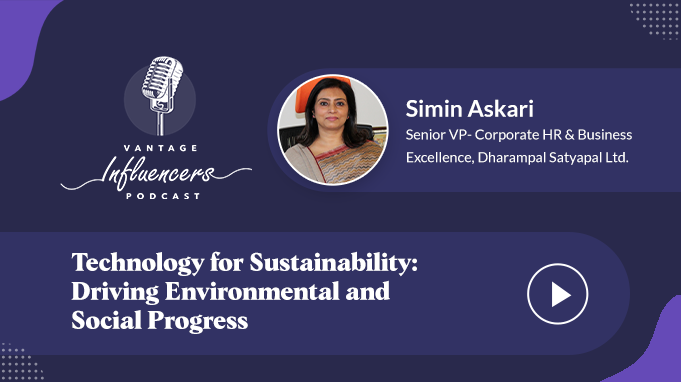
Technology for Sustainability: Driving Environmental and Social Progress
Listen on Spotify Click to load player

Episode Overview

In this episode of the Vantage Influencers Podcast, host Susmita Sarma sits down with Simin Askari to explore how technology and sustainability intersect inside the modern workplace. Simin argues that sustainability is no longer a buzzword reserved for environmental teams. It is a lens that should shape how every process, from manufacturing to everyday IT purchases, gets designed and run.

The conversation moves through practical territory: the resistance employees often feel when new, more efficient technologies get introduced, and how clear communication and training turn that resistance into buy-in. Simin also digs into e-waste, an overlooked byproduct of digital transformation, describing how organizations can set up proper collection and recycling systems instead of letting old devices pile up in storage. She closes with a call for HR to build cross-functional sustainability committees that give employees a real outlet for environmentally conscious ideas.

Episode Highlights

  • Sustainability isn't a standalone initiative. It's a lens that can be applied to every business process, not just energy use or carbon reduction.
  • Technology enables real sustainability gains, from energy-efficient appliances and smart grids to solar and hydroelectric power that cut reliance on fossil fuels.
  • Employees often resist new technology out of fear for their jobs, so clear communication and hands-on training turn hesitation into acceptance.
  • Cost and lack of in-house expertise are the two biggest barriers organizations face when adopting sustainable technologies.
  • E-waste is a growing, often-ignored problem. Dedicated collection points and partnerships with certified recyclers keep old devices out of landfills.
  • Cross-functional sustainability committees that bring together manufacturing, CSR, facilities, and business excellence teams give employees a structured outlet for environmentally conscious ideas.

About the Guest

Simin Askari, Senior VP - Corporate HR & Business Excellence, Dharampal Satyapal Ltd

Simin Askari leads strategic HR and business excellence initiatives across Dharampal Satyapal Ltd's diverse portfolio, spanning Food & Beverages, Dairy, Hospitality, and more. She has driven organizational capability building, digital transformation, process design, and business transformation, and has created global HR policies, developed innovative performance management approaches, and implemented employee welfare and recognition schemes. A strategic thinker known for introducing digital interventions that improve business processes, Simin has been recognized with the "Women Super Achiever" award at the Global HR Excellence Awards in 2010 and the "Women Leadership Award" in 2014.

Connect with Simin on LinkedIn

Host

Susmita Sarma, Vantage Influencers Podcast Host

What You Will Learn

  • How technology and sustainability intersect in everyday business operations
  • Common obstacles organizations face when adopting sustainable technologies, and how to overcome them
  • Ways HR can help employees move past resistance to new, efficient technologies
  • Why e-waste is an overlooked risk of digital transformation, and how to manage it responsibly
  • How to build a cross-functional culture of sustainability-driven innovation

Key Topics & Timestamps

Timestamp Topic
00:39 Introducing Simin Askari and the focus on technology for sustainable development
02:14 How technology and sustainability intersect in practical terms
04:30 Common obstacles organizations face when adopting sustainable technologies
09:17 Addressing employee resistance to sustainable technology adoption
12:38 Managing e-waste through recycling and responsible disposal
14:18 Building a culture of creativity and innovation for sustainability
17:17 Simin's closing advice for HR leaders

Full Transcript

Click to read the full episode transcript

Welcome to the Vantage HR Influencers Podcast. This podcast is sponsored by Vantage Circle, the simple and AI-powered rewards and recognition platform for employee engagement.

In today's rapidly advancing technological landscape, there is a golden opportunity to leverage these innovations for a sustainable future. By merging technology with environmental and social principles, we can craft a world where progress aligns with preservation, ensuring a balanced planet for generations to come.

Susmita Sarma: Hello, listeners. You are tuned into the Vantage HR Influencers Podcast. I'm your host, Susmita Sarma. And today we have with us Simin Askari, the Senior VP of Corporate HR and Business Excellence at Dharampal Satyapal Ltd. The focus of today's episode is harnessing technology in the workplace for sustainable development, a path to environmental stewardship and social responsibility. Welcome to the show, Simin. It's an honor to have you here.

Simin Askari: Thank you so much for having me here on this show, Susmita. It's a pleasure.

Susmita Sarma: Yeah. Would you like to say hi to your audience and tell us a bit about you and your work?

Simin Askari: Hi, everyone. Thank you for joining in. It's really a pleasure to be on air talking about something which is so close to my heart and so relevant in today's world. I'm Simin Askari. I head HR and business excellence for the DS Group. We are a very large, diversified conglomerate headquartered in Noida, but present everywhere. There is definitely a part of us touching each of your lives when it comes to the products and services we offer. In our practices, we try to be very sustainable and we try to do our bit in terms of contributing to sustainability and preserving the earth.

Susmita Sarma: Great, Simin. So, as I've already mentioned, in this episode we'll be talking about harnessing technology for sustainable development. Let's get right into it. We often hear about the potential of technology in promoting sustainability. Could you help our audience understand how these two aspects intersect and complement each other in practical terms?

Simin Askari: Sustainability, I think, is no longer just a buzzword. It's something each one of us needs to adopt. We have just one earth, and we need to ensure that whatever we're doing isn't impacting it adversely. This is true for workplaces too, and how we go about doing the jobs or running the businesses we're running. Technology has a very large part to play in the practical applications of sustainability. It basically helps us make things more efficient, sometimes more cost-efficient, and better, while also helping us do our bit for sustainability. Some examples that come to mind immediately would be energy-efficient solutions, thanks to the technology advancements we've seen in energy-efficient appliances, smart grids, and solar or hydroelectric technologies. These are helping us reduce greenhouse emissions, reduce our dependence on fossil fuels, and reduce the environmental impact around us. All of that is possible only when we're able to deploy the available technologies properly.

Susmita Sarma: So there's immense potential, right, Simin?

Simin Askari: Absolutely, yeah.

Susmita Sarma: However, as HR professionals know, implementing sustainable technologies can be very complex and can present a lot of challenges for organizations. From your experience, Simin, what are some common obstacles that organizations face while adopting these sustainable solutions? And most importantly, how can HR assist employees in overcoming these challenges?

Simin Askari: That's an interesting question, Susmita. When we talk about sustainability, we tend to look at it through a very narrow lens; we think of it only in terms of energy saving or reducing carbon footprint or dependence on fossil fuels. To me, sustainability has a much larger context. It can be present in any of our processes. If we're doing any process in a better, more efficient manner, that's also sustainable. We're primarily a manufacturing and sales-driven organization, and if we adopt, for example, lean manufacturing, that's also a sustainable way of using technology to make manufacturing processes more efficient.

In organizations, when we think about bringing in technology to make things more efficient, employees often start feeling a little uncertain about their jobs. I'd like to take you back to the days before we had computers. When they were first introduced, there was so much resistance; people felt their jobs were at risk and wondered how they'd be able to sustain themselves. The same is true today. But today, computers are part of our lives, and everyone uses them; technology is so much a part of how we live and work. So when employees feel discomfort about a new technology we're bringing in to create efficiencies, the first thing to do is bring in clarity through communication, explaining why it's been introduced and what impact it will have. If an employee is given training or upskilling on how to use the technology, they're no longer scared of the change. They welcome it and see the benefits.

Susmita Sarma: Yeah. In fact, discussing both the pros and cons of using the technology might give a clearer picture, right?

Simin Askari: Exactly. When we bring in technology, especially sustainable technologies such as renewable energy systems, energy-efficient equipment, or things like wind power or solar energy, the first obstacle an organization normally faces is the cost implication. Everyone around the world is talking about how good sustainable products are, and there have been organizations, for example those working in lab-grown meat, whose valuations went through the roof. But when it comes to actually adopting or consuming the product, because sustainable products are also more expensive, it becomes difficult for a consumer to accept it. It's similar in an organization; when we talk about implementing sustainable technology, cost is one of the biggest challenges. The second challenge is a lack of expertise; people may not know how to implement these things, and that can also lead to resistance to change. At the end of the day, businesses exist because they want to earn a return on investment for their stakeholders, and if adopting these technologies carries a big cost implication, that becomes a real challenge.

Susmita Sarma: Yeah. So, as you've mentioned, despite the obvious benefits, there can be resistance to adopting sustainable technologies. HR definitely plays the topmost role in effectively communicating the importance of embracing these technologies and addressing the concerns of hesitant employees, right?

Simin Askari: Yes, I completely agree. HR plays a very important role. HR professionals can help create a more sustainable and socially responsible organization. They're the first point of connection with people, so they can drive sustainability initiatives and help make the organization more socially and environmentally responsible. There are many ways HR can do this, like incorporating sustainability into HR policies and making sure employees are aware of the impact of their actions on the environment and society. Going paperless is one of the best examples of working for the environment without harming it. When it comes to sustainable technologies or processes, every organization starts by looking at the lowest-hanging fruit, and going paperless is a no-brainer. If an organization hasn't already done it, it should start.

But we also need to look at the other side of it. When we go digital, we're relying a lot more on the tech, the computers, and the mobile handsets we give out to people. The implication of these tech assets is what happens at the end of their life: the e-waste we generate, and whether we're a responsible organization that sends it to proper e-waste collection centers so it's disposed of correctly. More often than not, you'd see, and this was a problem when computers first came in, that there were storage rooms filled with old computers, plastic waste, and precious metals that were simply thrown away. You may have heard about the metal mining that resulted from that. So organizations need to be careful about these impacts too. It's not just about doing something because everyone else is; it's about a cost-benefit analysis, the ROI implications, and the impact on the environment relative to what we're doing, and whether that process will leave a bigger footprint or not. All of that has to be taken into consideration.

Susmita Sarma: And talking about the e-waste you mentioned, Simin, would you like to give some pointers on how this e-waste problem can be solved in a multi-faceted approach?

Simin Askari: E-waste is something that's being generated, and a lot of us are unfortunately not even aware of it. Think about it: when we exchange our old phone for a new one because we're excited about the new one, we rarely pause to think about what happens to the old one. We just leave it lying around at home and don't think about how to dispose of it, or the batteries we use in various gadgets; we just throw them in a bin somewhere without thinking about it. I'm really proud of my organization; we have an e-waste disposal bin placed within the organization, and people can even bring e-waste from their homes to put in it. We then send it to partners who properly recycle this e-waste, and they responsibly dispose of these old or obsolete technology devices. We've partnered with an e-waste recycling company that handles our e-waste, as well as the e-waste our employees bring in from their homes, in a proper manner.

Susmita Sarma: That's a brilliant idea, and a totally well-rounded approach, Simin. If we want to talk about people who are full of creativity and innovation, would you agree that HR should encourage a culture of creativity and innovation, allowing employees to contribute their own ideas toward protecting the environment and social responsibility?

Simin Askari: Yes, of course. Encouraging and growing creativity for sustainable innovation requires a lot of effort from HR in fostering a culture that values and supports new ideas focused on sustainability. It doesn't happen in thin air. In our organization, for example, we have a sustainability committee in place with team members not just from manufacturing, where a lot of our sustainability efforts are focused, but also from facility management, CSR, and business excellence. These are the people who come together, brainstorm, and figure out what we could do next, how we could reduce the organization's carbon footprint, and where we could bring in efficiencies. For example, I also work in business excellence, and our role there is to try to figure out how to make our processes more efficient, whether through technology or otherwise. The CSR person talks about how employee volunteering can help the communities around us, so as an organization we become more socially responsible, not just more efficient in our manufacturing or other processes. The manufacturing head figures out how we can manufacture products that are more sustainable and less harmful to the environment, and the packaging development person chips in with more sustainable packaging. So, HR can definitely help instill a culture of innovation by bringing cross-functional teams together and having them collaborate and think through sustainable initiatives that can be brought into the organization.

Susmita Sarma: Simin, your expertise and insights have been incredibly enlightening and inspiring. We cannot thank you enough for sharing your valuable knowledge with our HR audience. It's quite evident that the strategic integration of technology in sustainable development can create a positive impact with the guidance and support of the HR team. Before we sign off, Simin, is there a final piece of advice you'd like to share with our HR audience?

Simin Askari: Thank you so much. It was an interesting conversation, and as I said, this topic is close to my heart. My parting advice to the HR fraternity listening in would be to take sustainability on as a core value for the organization. Only then will you be able to ensure that sustainability becomes part of your daily life. You need to lead by example, and HR can start by showing sustainable initiatives in their own processes and in the way they do things themselves. Going paperless, of course, is the first thing that comes to mind, but there's so much more HR can do to build a culture of innovation that embraces sustainability at its core. Show that you're promoting data-driven decision-making, and bring in technology that helps you do all of that. HR is a true business partner, and it can showcase that by bringing value to the business when it puts sustainability at the core of everything it does.

Susmita Sarma: Very well said, Simin. In case our listeners want to reach out to you for further consultation or knowledge on this topic, where can they find you?

Simin Askari: They can send in their questions and queries by email, and I'd be happy to respond.

Susmita Sarma: Thank you once again, Simin, for being part of our show today. To all our listeners, we hope you found this conversation as informative and insightful as we did. Stay tuned for more episodes where we explore diverse topics related to the HR and business world. Until next time, this is Susmita signing off. Thanks for listening to the Vantage HR Influencers Podcast. Please do subscribe to the Vantage HR Influencers Podcast on Apple Podcasts, Spotify, and our YouTube channel for new episodes.

FAQ

How does technology support sustainability in the workplace?

Technology supports sustainability through energy-efficient appliances, smart grids, and renewable power sources like solar and hydroelectric systems that cut dependence on fossil fuels. Simin Askari explains that the same efficiency mindset also applies to processes like lean manufacturing, not just to obvious green-tech purchases.

What are the biggest obstacles to adopting sustainable technology in organizations?

Simin Askari points to cost and lack of expertise as the two biggest barriers. Sustainable products and equipment tend to carry a higher upfront cost, and organizations often lack the in-house know-how to implement new sustainable processes, which can also fuel resistance to change.

How can HR help employees overcome resistance to new sustainable technologies?

HR can reduce resistance by communicating clearly about why a technology is being introduced and what impact it will have, then backing that communication with hands-on training. Employees who understand and can use a new technology are far less likely to see it as a threat to their jobs.

How should organizations manage e-waste responsibly?

Organizations should set up dedicated e-waste collection points and partner with certified recycling providers rather than letting old devices, batteries, and equipment accumulate in storage. Simin Askari describes how her organization even lets employees bring e-waste from home into the same collection system.

Also listen on

You might also like

Follow on