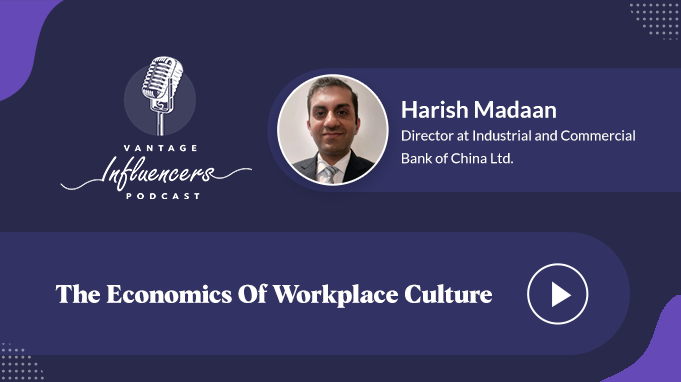
The Economics Of Workplace Culture
Episode Overview
Harish Madaan is a Director at ICBC with 15 years in banking treasury, having built the bank's treasury business from scratch and, more recently, its physical bullion business, which earned ICBC recognition as India's most promising bullion bank in 2022. His own path there was genuinely difficult: he grew up in a small town in Punjab, lost both parents while completing his education, and financed his CA studies by running a coaching center, before moving to Mumbai and enduring nearly a year without stable housing.
His definition of "economics of workplace culture" is precise: it's how workplace culture shapes a company's economic future, in aggregate contributing to a country's economic development, not just a company's bottom line. His most useful framework links reward and recognition to real economic outcomes only when paired with clear goals, visible growth trajectories, and what he calls "relational contracts", an empathetic, two-way relationship between employer and employee. He backs this with concrete Indian examples: ITC's transformation from a tobacco company into a diversified FMCG conglomerate built around "human capital" as one of its six core growth pillars, and Zomato's founder-level belief that long-tenured employees create value that takes too long to replace to risk losing.
Episode Highlights
- The "economics of workplace culture" is how workplace culture shapes a company's economic future, in aggregate, Harish Madaan argues, it contributes to a country's economic development, not just an individual company's bottom line.
- Poor workplace culture translates directly into economic cost: higher attrition, higher hiring and training costs, decreased productivity, and ultimately lower profitability and weaker customer experience.
- Rewards and recognition only translate into real economic impact when paired with clear organizational goals, visible individual growth trajectories, and what Harish Madaan calls "relational contracts", an empathetic, two-way employer-employee relationship.
- ITC's transformation from a tobacco company into a diversified FMCG conglomerate is built around human capital as one of its six core growth pillars, tying employee investment directly to business transformation.
- Zomato's founders reportedly treat long-tenured employees as creating value that's too costly and slow to replace, which shifted the company's culture and policy decisions toward employee well-being as a growth lever.
- Harish Madaan's core advice for building positive workplace culture: open communication, recognizing contribution, promoting work-life balance, and investing in employee training and development, prioritized in that order.
About the Guest
Harish Madaan, Director, Industrial and Commercial Bank of China Ltd.
Harish Madaan is a Director at the Industrial and Commercial Bank of China (ICBC), a banker with more than 15 years of experience across asset-liability management, liquidity management, investments, forex, derivatives, physical bullion, and financial institution relationships. He built ICBC's treasury business from scratch into a major revenue driver, and more recently set up its physical bullion and financial institution relationship businesses, work that earned ICBC recognition as a Promising Bullion Bank in India in 2022. He is a Chartered Accountant, an FRM, and an alumnus of IIM Kozhikode.
Connect with Harish Madaan on LinkedIn
Host
Susmita Sarma, Vantage Influencers Podcast Host
What You Will Learn
- What "economics of workplace culture" actually means, and how it connects individual company culture to national economic development
- The concrete economic costs of poor workplace culture: attrition, hiring and training costs, and lower productivity and profitability
- Why rewards and recognition only drive real economic impact when paired with clear goals, visible growth paths, and empathetic "relational contracts"
- How ITC built human capital into one of its six core growth pillars during its transformation into a diversified FMCG conglomerate
- Why Zomato's founders treat long-tenured employee value as difficult to replace, and how that shaped company culture and policy
- Harish Madaan's prioritized advice for building a positive workplace culture that drives economic growth
Key Topics & Timestamps
| Timestamp | Topic |
|---|---|
| 01:25 | Harish's corporate journey so far |
| 14:00 | Defining the economics of workplace culture and its significance |
| 18:00 | Can rewards and recognition improve the economics of workplace culture? |
| 21:43 | Examples of companies that successfully leveraged workplace culture for economic success |
| 26:25 | Harish's advice for businesses looking to improve workplace culture to drive economic growth |
Full Transcript
Click to read the full episode transcript
The concept of the economics of workplace culture is vital for organizations to understand, as it delves into the relationship between workplace culture and a company's financial performance. By analyzing the economic impact of a company's culture, organizations can make strategic decisions to improve themselves, not just in terms of a better culture, but also leading to increased productivity, employee satisfaction, and ultimately a better bottom line. So, owing to its significance, this podcast is dedicated to discussing the economic impact of a positive workplace culture on employee engagement and productivity.
Susmita Sarma: Hi everyone, I'm your host for the show, Susmita, and to discuss the economics of workplace culture, please welcome my guest today, Harish Madaan, Director at the Industrial and Commercial Bank of China Limited. Welcome to the show, Harish.
Harish Madaan: Thank you, Susmita, for inviting me to your podcast.
Susmita Sarma: Thank you for joining me today in this wonderful episode of the Vantage Influencers Podcast. Before we move forward to today's topic, would you like to tell us about yourself and your corporate journey?
Harish Madaan: Sure. I'm Harish Madaan, a treasury professional with 15 years of experience in bank treasury. I have expertise in setting up businesses for banks. I started my corporate journey as a sales-side professional with ICICI Bank, and over 15 years, got the opportunity to work across asset-liability management, liquidity management, investments, foreign exchange, derivatives, physical bullion, and financial institutional businesses. I set up a treasury business for the bank from scratch and turned it into a deep revenue driver. More recently, I set up two businesses, a financial institutional business and a physical bullion business, and in a very short span, the bullion business grew tremendously, and our bank was awarded Best Promising Bullion Bank in 2022. On the academic side, I'm a Chartered Accountant and an FRM, and I completed my EMDP in Advanced Strategy Management from IIM Kozhikode.
My corporate journey is quite interesting, I never thought I'd reach where I am today. I belong to a very small town in Punjab, a rural area, where I did my schooling and higher education. I wanted to do something in finance, but there was no guidance or exposure to markets and the financial sector, and my financial background wasn't supportive either. My father passed away when I had just completed 10th standard, and my mother, who was sick, passed away when I completed my graduation. Financially, conditions weren't conducive, I didn't have the resources to move ahead, but I had a passion for studies. My auntie came in like an angel, she said whatever I wanted to do, she'd support me with food and basic needs, but for my studies and day-to-day expenses, I'd need to work. So I started a commerce coaching center in that small town, and studied alongside it. An MBA wasn't financially possible, so after a lot of thought, I started with CA, one of the few courses that requires education, commitment, and passion rather than money, since the fees are fairly nominal.
The coaching center did well, and I completed CA Level Two, a big personal achievement, since I did it without any coaching or guidance of my own. The next step was a three-year internship program required as part of the CA curriculum. I could have easily stayed in my small town, kept the coaching center running, and completed my CA quietly nearby. But my cousin encouraged me to go to Mumbai, and after some discussion, I agreed to pursue my three years of training there. When I landed in Mumbai, having never had exposure to a big city, I was happy, it's considered a dream city for so many of us. But it's a genuinely tough city to live in, even though it opens up a lot of opportunity. My first year was a real struggle, I couldn't find a place to stay for almost 11 months, and that was probably the toughest period I can imagine in my life. I kept wondering if I'd made a mistake choosing Mumbai over just completing my CA back home.
Susmita Sarma: That's something I wanted to ask too, Harish, we usually hear about people going to Mumbai to become actors, not for the corporate sector.
Harish Madaan: Right, but Mumbai is India's financial hub, and honestly, it's a fantastic place to work, which inspires finance professionals to come here. It's a city of dreams not just because of the film industry, but because it's India's financial lifeline. When I was struggling, I thought about going back, but that felt like surrendering to circumstances out of fear, and some part of me would always resent not having pushed through. So I kept pushing. On the personal side I was struggling, but on the training and work side, the opportunity in Mumbai was amazing, and I think that's what really kept me going. I applied to several CA consulting firms and was selected by one of them, though I didn't know at the time how well-regarded they were in the finance sector. I picked them mainly because their stipend was higher than other offers, which mattered given what I'd saved from teaching.
Eventually I got an assignment in the banking sector, and I think that was the formative period of my corporate journey, I met wonderful people there who supported me, and my employer was fantastic. I don't think I've had that kind of opportunity anywhere else, the flexibility to work, the ability to speak with anyone from the most junior person to senior leadership, across the entire hierarchy. That kept me pushing forward, and once I finally got into a hostel, that was a huge relief. The people around me were wonderful, and I never looked back.
Susmita Sarma: You took the right decision at the right time, though your aunt and cousin clearly played a big role too.
Harish Madaan: They played a huge role, I can never repay my aunt for what I owe her, because where I am today is because of her and my cousin's encouragement. I faced a lot of circumstances where I genuinely didn't know how things would turn out, and someone always came in like an angel to guide me through. I believe God has been very kind to me, there's always been some invisible force supporting me through the toughest challenges.
Susmita Sarma: Congratulations, Harish, on where you are today.
Harish Madaan: Thank you so much.
Susmita Sarma: Let's move to today's topic, the economics of workplace culture. Since workplace culture has been shown to directly impact employee productivity, engagement, retention, and well-being, all of which carry economic implications for a company, it's important to understand this concept in depth. Could you describe what the economics of workplace culture means, and its significance?
Harish Madaan: Sure. When we talk about economics of workplace culture, it means how workplace culture shapes the economic future of a company. If you look at it in aggregate, collectively, it results in the economic development of a country, culture impacts both company and country through higher productivity, innovation, health, and happiness. Some of that shows up as direct, tangible income, but a lot of it has a broader bearing on shaping the company, the economy, and society as a whole. Workplace culture refers to the set of shared values, beliefs, and practices that shape employee behavior and attitudes in an organization, and it has a profound impact on both employee experience and company growth.
On the positive side, workplace culture can create an environment where employees feel valued, supported, and understand their contributions are meaningful, organizations recognizing and appreciating that make employees feel more engaged and more committed to company goals and mission. The result is engaged employees, higher productivity, greater collaboration, more innovation, and a foundation for long-term development. On the contrary, without good workplace culture, you get employee disengagement, higher attrition, higher hiring and training costs, and decreased productivity, employees feel their opinions aren't being heard, which translates into lower productivity, which immediately becomes lower profitability and a weaker customer experience, making it harder for a company to grow. So an influential, positive workplace culture drives innovation, productivity, and long-term company development, and in aggregate, contributes to a country's economic development too. That's what I mean by economics of culture.
Susmita Sarma: So the culture of any workplace has real potential to shape engagement, retention, and reduced absenteeism, which are all downstream of employee engagement, and all of this leads to increased profitability in the long run. Let's talk about motivating and appreciating employees specifically, the significance of rewards and recognition, which we definitely can't undermine. Do you think rewards and recognition can be a helpful tool in improving the economics of workplace culture?
Harish Madaan: I definitely agree rewards and recognition play a vital role, but alongside that, it's important for a company to have clarity of goals and vision, and individual KPIs should be aligned with organizational goals. Incentive programs need to be very clearly defined, and employees' growth trajectory in the organization should be clearly defined and visible to them. I also believe reward and recognition programs should be complemented by employee engagement built through what I'd call relational contracts, being empathetic toward employees, understanding their challenges, improving workplace culture so employees feel heard and their feedback is valued, and giving them space to show their creativity. Put all of that together, aligned KPIs plus engagement leads to commitment, and committed employees mean less attrition, more innovation, and a more collaborative workplace culture, which is where new product ideas actually come from. New product ideas mean a company gets ahead of competitors, which leads to higher profitability and a stronger value proposition, and in aggregate, that kind of culture, across enough companies, drives greater economic development for a country.
Susmita Sarma: So when values, vision, and mission are genuinely embedded in the workplace, it gives employees a sense of direction and purpose, and helps align their behavior and attitudes with organizational goals, employees should feel proud to be associated with the company.
Harish Madaan: Exactly. A company can be big or small, but once a person has that inner feeling toward a company, that it shares their values, understands them, recognizes their contribution, that they've been heard and given space to show creativity, that's a huge positive, and that's where new innovation, new product ideas, and better customer experience come from. The key is somehow ensuring employees feel a genuine sense of belonging and pride in being associated with the company.
Susmita Sarma: Can you give our audience some examples of companies that have successfully leveraged their workplace culture to achieve economic success?
Harish Madaan: Rather than global MNCs, let me give Indian examples. First, the CA consulting firm where I did my internship and training, I spent three years there, and I believe the culture there was deeply relational, where partners were personally accessible, and employees were given real space to grow. That experience, at a small consulting firm, had a profound impact on me as a person and as a manager, because it taught me how employees should be treated, that they shouldn't lack access to senior leadership. I was fortunate to work under wonderful senior partners there, and I have enormous respect for the values they instilled, honesty and transparency, even when that wasn't always convenient. Next, looking at a large Indian company, ITC has developed a high-performance culture, and if you look at their transformation journey from a tobacco company into a large, diversified conglomerate with a strong FMCG portfolio performing well across product lines, the underlying culture is built on offering top salaries and hiring the best talent, and then nurturing that talent by giving clear visibility, aligning organizational goals with individual goals, and supporting engagement programs. If you look at their growth strategy, what they call the "six growth pillars," human capital sits at the core of it, that's how they value their employees, and that's reflected in the company's transformation.
The next example is a startup, not a unicorn exactly, Zomato. Their founder built a culture around listening closely to employees, believing that if a person spends significant time at the company, they create a value proposition that's difficult and time-consuming to replace. Once the founder recognized that the company's growth depended on employee well-being, it changed the mindset around what kind of policies and culture needed to be in place so people would want to stay and grow with the organization. I think this ultimately comes down to a mindset and a belief, putting employees at the center and core of your growth strategy is what allows these companies to grow and transform in their respective spaces.
Susmita Sarma: Thank you for sharing those examples. Finally, what advice do you have for businesses looking to improve their workplace culture to drive economic growth and success?
Harish Madaan: Today's organizations, especially in the services sector, are very complex, it's difficult to measure individual performance because we're all interdependent. In service and high-value industries, human capital is the biggest asset, and any organization's success depends first on business strategy and second on the strength of its human capital, and I'd actually rank human capital first, because without a strong workforce, no strategy a company adopts will yield the desired result. So, to create a positive workplace, I'd advise companies to focus on a variety of initiatives: fostering open communication, recognizing and rewarding employee contribution, promoting work-life balance, and investing in employee training and development. By prioritizing these, a company can create a culture that values and supports employees, one they're proud to be associated with, which leads to better employee experience and long-term growth.
Susmita Sarma: Brilliant, Harish, thank you for joining us today. Before we wrap up, our audience might want to ask further questions, share feedback, or express interest in working with you. How can they reach out?
Harish Madaan: Reach out to me on LinkedIn, I'm quite active there, and would be happy to engage with anyone who has questions or wants to connect further. Thank you so much for inviting me to this podcast to share my perspective. I generally speak about economics, but on human capital specifically, this was a brilliant opportunity for me to talk about it.
Susmita Sarma: Thank you so much, Harish, for accepting my invitation and joining our conversation today. It's been an honor to have you share your thoughts and experiences with us. I'd also like to thank our listeners for taking the time to tune in, stay tuned till next time.
Thanks for listening to the Vantage HR Influencers Podcast. Please subscribe to the Vantage HR Influencers Podcast on Apple Podcasts, Spotify, and our YouTube channel for new episodes.
FAQ
What does "economics of workplace culture" mean?
Harish Madaan defines it as how a company's workplace culture shapes its economic future. In aggregate, across enough organizations, this contributes to a country's broader economic development, not just an individual company's bottom line.
How does poor workplace culture create economic cost?
According to Harish Madaan, poor culture leads to employee disengagement, higher attrition, higher recruiting and training costs, decreased productivity, and ultimately lower profitability and weaker customer experience.
Do rewards and recognition alone improve workplace culture economics?
No, Harish Madaan argues rewards and recognition only translate into real economic impact when paired with clear organizational goals, visible individual growth trajectories, and empathetic "relational contracts" between employer and employee.
What real-world examples does Harish Madaan cite of culture driving economic success?
He points to ITC's transformation into a diversified FMCG conglomerate built around human capital as one of its six core growth pillars, and Zomato's founder-level focus on retaining long-tenured employees whose value is difficult and slow to replace.
Related Reading
Also listen on