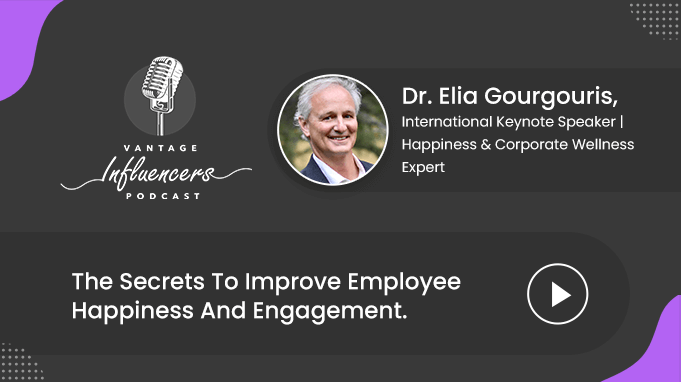
The Secrets To Improve Employee Happiness And Engagement
Episode Overview
Elia opens with a claim that surprises most HR leaders: salary usually ranks fourth or fifth on the list of what actually makes employees happy. Ahead of it, he says, are feeling appreciated by an employer, having room to grow and learn, and working in a safe, comfortable environment. He walks through why recognition, whether it is a heartfelt word, a gift card, or an unexpected day off, does more for morale than compensation alone, and why organizations that treat recognition as common sense rather than a program end up with the happiest, most engaged workforces.
The conversation turns serious as Elia describes the toll two years of pandemic disruption took on employee mental health, arguing that leaders solved the physical safety problem faster than the emotional one. He introduces what he calls hot communication, honest, open, and transparent conversations where leaders show real vulnerability instead of asking hollow check-in questions, and makes the case that trust, not surveillance software that tracks keystrokes and mouse activity, is what actually keeps a remote or hybrid workforce productive and happy.
Episode Highlights
- Salary rarely tops the list of what makes employees happy; appreciation, growth opportunities, and a safe environment usually rank higher.
- Recognition, whether verbal, a gift card, or a spontaneous day off, has a bigger impact on morale than employers often assume.
- Unlimited vacation policies sound generous, but employees often use less time off than before, afraid that taking it makes them look dispensable.
- Happy employees are not just more productive and creative; they are also physically healthier, which quietly affects the bottom line.
- Two years into the pandemic, employers had largely solved for physical safety at work but were still falling short on employee mental health.
- Elia introduces "hot communication," honest, open, transparent conversations, as the alternative to surface-level check-ins, and argues that trusting employees beats monitoring their keyboards every time.
About the Guest
Dr. Elia Gourgouris, President, The Happiness Center
Dr. Elia Gourgouris is the President of The Happiness Center, an organization of world-leading experts in the field of Positive Psychology dedicated to creating personal success and happiness, and Founding Partner at The Global Institute of Thought Leadership. He is the author of the number one best-selling Amazon book, 7 Paths to Lasting Happiness, and co-author of 7 Keys to Navigating a Crisis: A Practical Guide to Emotionally Dealing with Pandemics and Other Disasters. With a background in Positive Psychology, he has coached thousands of people and organizations on building trust, resilience, and a culture of engagement, and he co-hosts the weekly The Kindness and Happiness Connection podcast.
Host
Susmita Sarma, Vantage Influencers Podcast Host
What You Will Learn
- Why salary usually isn't the top driver of employee happiness, and what actually is.
- How recognition and rewards, big or small, influence day-to-day morale.
- Why unlimited vacation policies don't always translate into employees taking more time off.
- What the pandemic revealed about the gap between physical and mental well-being at work.
- How "hot communication" helps leaders build real trust with their teams.
- Why monitoring employee activity undermines the very trust it is meant to protect.
Key Topics & Timestamps
| Timestamp | Topic |
|---|---|
| 00:39 | Introducing Dr. Elia Gourgouris and The Happiness Center |
| 01:48 | What actually makes employees happy |
| 03:05 | The role of rewards and recognition in employee happiness |
| 04:17 | Which rewards work best, from gift cards to surprise time off |
| 06:07 | Is employee happiness overhyped |
| 07:45 | Obstacles to keeping employees happy during the pandemic |
| 09:22 | Why organizations reached out for help with traumatized, anxious employees |
| 14:25 | "Hot communication": honest, open, transparent leadership |
| 16:52 | Does a happier workforce actually improve people's lives |
| 19:04 | Using technology to support employee happiness |
| 22:17 | Why tracking employee activity undermines trust |
| 23:27 | Elia's advice for HR leaders |
Full Transcript
Click to read the full episode transcript
Welcome to the Vantage HR Influencers Podcast. This podcast is sponsored by Vantage Circle, the simple and AI-powered rewards and recognition platform for employee engagement. What makes employees happy? What do they really want? Is there a hype about employee happiness? Is workplace happiness overrated? What obstacles do leaders face while keeping their employees happy and engaged? We'll answer all these questions today in this episode of the Vantage HR Influencers Podcast.
Susmita Sarma: I'm Susmita, and today with me I have the guest speaker, Dr. Elia Gourgouris. Dr. Elia is the President of The Happiness Center, an organization of world-leading experts in the field of Positive Psychology dedicated to creating personal success and happiness. Welcome to the show, Elia.
Elia Gourgouris: Thank you very much. It's nice to be here.
Susmita Sarma: Thanks for joining me. So, we spend a lot of time at work and in the workplace, and I believe it can be a huge downer if we aren't happy to be there. You've given this a lot of thought already, Elia. How do you see this as a very important matter, and how do you help others understand it better?
Elia Gourgouris: I think happiness at work is probably one of the most important aspects in our lives, because, like you said, Susmita, we spend an extraordinary amount of time, decades, at work throughout our lifetime. So if we spend it miserably, we're going to be miserable in our lives outside of work too. If we have a positively engaged workforce, that's obviously going to impact our personal lives as well.
Susmita Sarma: Right. So I have a lot of nitty-gritty questions for you about employee happiness today, but to get started, my first question is the simplest one to ask, but probably a little difficult to answer, and that is: what makes employees happy? What do they really want? I mean, we know that it differs from person to person, but there must be some common things we can't miss mentioning here.
Elia Gourgouris: Yeah, and believe it or not, salary is not at the top of the list. It usually comes in fourth or fifth. What makes employees happy, number one I think, is a great employer, someone who expresses appreciation. When employees feel appreciated and seen, they feel welcome at work, they feel like they matter, and I think that's usually at the top of the list. The other thing is that they work within an organization where they have an opportunity to grow, to learn new things, and to advance. In other words, they're not stuck in a position for the next five or ten years. Their work is rewarded, they have opportunities to grow, and the actual physical work environment is important as well. Those are some of the things that make employees happy. There's a lot more than that, and we can discuss as we go on.
Susmita Sarma: Right. So there's a famous quote that says people work for money but go the extra mile for recognition, praise, and rewards. What role do you think recognition plays in employee happiness?
Elia Gourgouris: We have to remember that regardless of the title or position a person has within an organization, in the end we're all human beings, and we have feelings. When human beings do a good job, they'd like to be rewarded, whether verbally or through other means, and organizations have to reward them. It just makes people feel better. I know this is common sense, but it's not common practice. It may seem too simple, like, well, we all know that. Yes, we do know that, but we don't put it into effect consistently throughout organizations. The companies that actually do that obviously have happier and well-engaged employees.
Susmita Sarma: Right. So what kind of rewards and recognition do you think plays the best role? We understand recognition as praising someone, but when it comes to rewards, what kind of rewards work best?
Elia Gourgouris: I think sometimes even a gift card works, you know, you do a good job and somebody asks what's your favorite restaurant, and gives you a very targeted reward like that. I think some other rewards are maybe telling someone to take the day off tomorrow, almost as an unexpected thing. You've done such a great job today, take the day off tomorrow, do something for yourself, don't answer any emails, do something you enjoy, and come back refreshed and renewed the day after. Obviously, more vacation time, if that's possible. There are a lot of companies switching to almost unlimited vacation time nowadays. That's been implemented as of late, with mixed results, I have to say.
Susmita Sarma: Yeah, I don't know how good that would be for employers. It sounds a little difficult for employers, unlimited holidays.
Elia Gourgouris: What's funny about that is that employees actually aren't taking that time. They're taking less time off than before, because they're afraid that if they take too much time off, they'll be seen as dispensable and replaced. So even though on paper, according to HR, employees have unlimited vacation time, they're not actually taking it. It's a very interesting psychological phenomenon, because you'd think if you had unlimited time off, you would take it and use it. But when someone gives that to you, you don't take it, maybe.
Susmita Sarma: Yeah, there's a reluctance to use it too much.
Elia Gourgouris: Yes, there's a reluctance.
Susmita Sarma: So again, what do you have to say about the hype around employee happiness? Do employers really care about that, or do you think the term workplace happiness is overrated?
Elia Gourgouris: I definitely don't think it's overrated. I categorically tell you that employee happiness is one of the most important things within any organization, whether profit or nonprofit. Why is that? Let's discuss why employee happiness is important. Number one, happy employees tend to be more productive. They're more innovative and more creative. They're better teammates. People have asked me why that is, and it's because when we take care of ourselves and practice great self-care, we have enough energy to help somebody else. So we make better teammates, which means stronger teams, which means a more collaborative, creative, and productive environment, which in the end is more profitable. Everything leads to everything else. The other thing very few people notice is that happy employees are physically healthier. Think about the cost when you have employees who are sick a lot, physically, or who have to take days off because of their mental health. Happy employees are physically healthier, and that also adds to the bottom line. That's something people rarely talk about.
Susmita Sarma: Yeah, so there must be some obstacles in keeping employees happy and engaged, like you mentioned, mental health. I think that's more difficult than keeping a person physically happy and engrossed in a job. There must be some obstacles for employers. How does one overcome those?
Elia Gourgouris: Here's what's interesting. In the COVID world, for almost two years now, we've seen the workforce upended across the globe, regardless of industry, size of company, profit or nonprofit. I wrote a book in the middle of the pandemic called Seven Keys to Navigating a Crisis, together with a close friend and co-author, and I have to give him credit because I wouldn't have been able to do it without him. Initially, we wrote the book for consumers. We got it out in May of 2020, so it was the first book to market in the world on that topic. We initially wrote it just for everyday people, because we could see there was a multitude of crises coming to the world besides COVID. What we didn't anticipate was that back in June of 2020, after the initial lockdown, as companies began to emerge after the first wave, companies reached out to us and said their employees were traumatized, scared, depressed, anxious, basically stressed out, and they didn't know what to do. Could we help them? So we were hired, and we continue to be hired, by organizations that ask us to help with employee engagement and happiness. It turns out that the biggest challenge facing organizations, and this comes from a study of thousands of HR directors and professionals, is how to maintain the physical and mental well-being of employees while battling this global pandemic. I feel like a lot of companies have done a pretty decent job on the physical side, providing masks, hybrid workplaces, work from home, spacing when meeting in person. Part of that was because it was mandated by government. However, they haven't done a great job at ensuring the mental well-being of their employees. If you look at the United Nations data, going back even to last year, we have billions of people suffering from stress, anxiety, and depression, people who did not have a pre-existing condition, meaning this is a direct result of the pandemic. There's a mental health crisis that's huge, I think even more damaging than the pandemic itself. There's also a financial crisis, with tens of millions of people unemployed or hundreds of millions underemployed, and billions of people feeling financially insecure, not knowing how they'll take care of their families. As human beings, we're very resilient, we've handled crises before in our lives, and I'm not even counting people's individual crises right now, like going through a divorce, a relationship issue, a sick child, or caring for an elderly parent with dementia or Alzheimer's. We can handle one or two crises, but we can't handle multiple crises happening at the same time with no end in sight. As a result, there's a huge obstacle for employers trying to keep their employees happy and engaged, because it's a global issue, not specific to a country, industry, or company size. So the second challenge organizations face is how to maintain employee engagement, productivity, and effectiveness in the midst of all this. But you're not going to solve that until you solve the first challenge, which is ensuring the mental well-being of your employees. From an HR perspective, because I work with a lot of senior HR leaders, it's no longer enough to ask your employees how they're doing, because most of them aren't going to tell you the truth, especially when meetings happen over Zoom and you can't physically see and make eye contact with them, or feel the energy in the room. So as senior leaders, we have to change ourselves. I think the responsibility lies on leaders to show up differently. Imagine you're in a Zoom call with your team. If you ask how they're doing, you'll get silence, or a mumbled "fine," which isn't true. You have to lean into the camera, get your eyes into the frame, and ask, how are you really doing, how is your family, how are your loved ones, how are the kids, make it much more personal, and show real empathy and concern. Ask, is there anything I can do as your leader, is there anything the company or organization can do to make this transition, working from home or under these very difficult circumstances, better. The extra credit, and this is where it requires great emotional intelligence from a leader, is that when you're leaning into the camera and asking those questions, you have to be transparent. Practice what I call hot communication, meaning honest, open, and transparent communication. What that looks like is you look into the camera and say, by the way, it's been really hard in my home too. Our kids haven't gone to school in nine months, it's really stressing us out. Be vulnerable and real as a leader, because then you're basically saying, we're in this together, I feel your pain, I understand your concern, and what can we do collectively to move forward. That's the type of leadership required right now. People don't want to hear, oh, we replaced the potato chips with apples so we have a slightly healthier workforce, or let's stretch for half an hour and that'll make you happier. That's not enough anymore. We have to raise our own bar as leaders, and as we do, and stay consistent throughout the organization, we're showing our employees that they matter to us. We have to communicate much more clearly, and communicate our expectations clearly. This may sound a little unusual, but we have to show our employees that we care about them and that we genuinely value them, that they're not just a number in the organization to be used and then discarded. So if I'm going to ask you to work an extra ten hours this week, I should explain the why behind that. It's not because I want my company to be more profitable so we can get better margins and bonuses. It's because if we don't hit certain numbers, I may have to lay off ten percent of my workforce, and my workforce is like a family, and I don't want to lay anyone off. So I'm asking everybody to step up a little more, because revenues have been down for the last year because of the pandemic, and we're trying to make that up. It's not because I'm greedy, it's because I want to preserve livelihoods and people's jobs. If you explain that to people transparently, and give them the reason why, believe me, they'll work harder for you as a result. But you have to explain the why. Does that make sense?
Susmita Sarma: Right, exactly. So the whole thing is that leadership has stepped up?
Elia Gourgouris: Well, they need to step up. Yes.
Susmita Sarma: Yeah. So Elia, you've helped thousands of people, both personally and professionally, achieve happiness, prosperity, and wellness as the President of The Happiness Center, which is a premier international professional association in the field of Positive Psychology. Does your research and experience prove that people's lives get better all around if they're happy and perform well at work?
Elia Gourgouris: Yes, there's no question about it. I've been working with people for many years, first as a clinical psychologist, and then I switched over to the corporate side as an executive coach and in leadership training and development. In my experience, when you have a person who's content and happy at work, imagine what they're like when they go home, and what impact that has on the home. Usually when someone comes home from work, they're tired, exhausted, cranky, maybe angry, and they bring that energy into the home, and it impacts the rest of the family for the rest of the evening. Imagine what it would be like if we had a positive experience at work, if we were engaged, connected, felt like we made an impact in a positive light. Now we go home, we open the door, and instead of grumbling or being upset when someone asks how work was today, we say, actually, I had a great day at work today, let me tell you what happened, and we bring that energy and excitement into our own home with the people we love and care about most. Imagine how impactful that is, not just to your own inner circle, but for society as a whole. Usually that's not what happens. People come home saying work was so hard, that guy's so stupid, my boss is an idiot, it's all negativity. Human beings are all about energy, and that negative energy impacts your most intimate environment. Imagine if the opposite were true, how great that would be.
Susmita Sarma: Very true. So, coming to the next question, what are some of the ways we can use technology to improve employee happiness and engagement, and learn more about what's going on in the workplace?
Elia Gourgouris: I'm not a technology expert, and I'd say that's one of my biggest weaknesses. I know people very well, inside and out, but I don't know technology very well. I think since a large portion of the workforce has needed to work remotely, technology has become even more important. The fact that we're able to have meetings with people working from different parts of the world, getting together over Zoom or other means, seems to be relatively effective. I know people talk about Zoom fatigue, and I'd include myself in that too. People, of course, prefer meeting face to face and in person. However, there are still some people who are reluctant to come back into work. I know of several companies that have said they won't have people come in until 2022, because this whole thing has lasted far longer than anyone anticipated, so there's a huge sense of world-weariness and fatigue. But technology has allowed us to continue working, and I believe the future of work will be hybrid, because people and leaders have recognized that it's cost-effective in a lot of ways if people work from home. I don't think it will be full-time like that, but people may come into work two or three days a week. The main thing to me is to communicate your expectations clearly, and then trust that your employees will actually do the work, even though they're not being supervised all the time. In other words, treat them like adults, treat them like they matter and that you trust them to get the work done. As a leader, I don't care if you're in front of your computer eight or ten hours a day. What I care about is the outcome. If you get it done in four hours and meet the deadline, I don't care if you go play with your kids afterward, or go for a walk, or go to the gym.
Susmita Sarma: That makes sense.
Elia Gourgouris: Very much. Otherwise, we're not here to babysit, checking how long someone's computer was open or whether they were in front of the screen the whole time. That means you don't trust your employees. And as you know, employees will rise to whatever level of trust you give them. I really believe that. If you trust that they're doing a good, honest job, and they perform and deliver on time, or even faster than expected, well, good for them. I'd tell them to take the rest of the day off and go do something that matters to them and fills their bucket.
Susmita Sarma: Yeah, we've also heard of employers tracking employees' keyboard and mouse activity, and employees, in turn, keeping different tricks to keep their laptops looking active. These are small things, but they point to major concerns around trust between employers and employees.
Elia Gourgouris: Yeah, but that's like playing cat and mouse with your employees. I feel like that creates a very unhealthy environment, because it's the opposite of trust. You're essentially showing that you don't trust them when they're working. We want people to be engaged, connected, innovative, and more productive. But I feel like when you expect the best from people, people actually show up for the most part. They don't cut corners, as a matter of fact they work even harder, because they feel appreciated, they feel loved, they feel supported by senior leadership. That's why trust is such an important factor in a happy workplace.
Susmita Sarma: Absolutely.
Elia Gourgouris: Because otherwise, why are you hiring these people if you don't trust them? And if you tell them you don't trust them, then they won't trust you either. That sends you into a negative spiral.
Susmita Sarma: Okay, so finally, what would be your suggestion to our HR listeners today?
Elia Gourgouris: Well, like I shared before, I think HR leaders need to show up differently themselves and practice hot communication, honest, open, and transparent. Not just go through the motions and ask how things are going, because most people aren't going to be honest about that. They need to be open and vulnerable, and say, you know, I'm struggling myself too, be real, basically, as an HR leader, and show that kind of vulnerability. That's what's expected nowadays. Because if employees feel like your life looks perfectly fine while their life at home is falling apart, there's a huge disconnect between the two, versus saying, we're all in this together, I'm struggling with my family too, so what can we do to better our lives and help one another. In other words, there needs to be connectivity between leadership and employees, this feeling that we're all in this together. I heard a great quote once: we may not all be in the same boat, but we're all in the same storm. Different boats mean we're not in the same exact circumstances, because people's circumstances are different, but globally, I think we're all in the same storm, because we've all been impacted. I don't know one person who hasn't been impacted by what's happened in the last year and a half, two years.
Susmita Sarma: Right, very true. Okay, so finally, how can our listeners reach out to you?
Elia Gourgouris: LinkedIn is probably the best way. Search for Elia Gourgouris, PhD, the happiness doctor, and you can reach me there. That's probably the best way to do it, and I'd love to connect with your audience if they have any more questions. I work with organizations across the globe, and I've actually been expanding a lot in India over the last year. That's one of the blessings of technology, my sphere of influence has grown a lot in Europe and India, with multiple webinars and seminars there. There's a real movement toward understanding the importance of happiness for employees, and I'm happy to share that, because I'm very passionate about happiness, as you can tell. I spend my entire life focusing on people's happiness, both on the personal and professional levels.
Susmita Sarma: Brilliant. It was really great to talk to you, Elia, and thank you so much for all the insights. We hope to have you back soon. Thanks a lot for joining me on the Vantage HR Influencers Podcast.
Elia Gourgouris: I appreciate it very much. Thank you.
FAQ
What makes employees happy at work, according to Dr. Elia Gourgouris?
Salary is not the biggest driver of employee happiness; it typically ranks fourth or fifth. Feeling appreciated by an employer, having room to grow, and working in a safe, comfortable environment matter more.
Why do employees hesitate to use unlimited vacation policies?
Even when companies offer unlimited time off, many employees actually take less time than before. They worry that using too much vacation will make them look dispensable or replaceable.
What is "hot communication"?
Hot communication is Dr. Elia Gourgouris's term for honest, open, and transparent conversations where leaders show real vulnerability, such as admitting their own struggles, instead of asking surface-level check-in questions like "how are you doing?"
Does tracking employee activity, like keyboard and mouse usage, help build trust?
No. Dr. Elia Gourgouris argues that monitoring employee activity signals distrust and creates an unhealthy "cat and mouse" dynamic. He recommends trusting employees to deliver outcomes instead of policing their hours.
Related Reading
Also listen on