Understanding The Big Talent War
Episode Overview
Prosenjit Mukherjee joins this episode to unpack why the war for talent, a phrase coined back in 1997, feels sharper and more complicated today than it ever has. He argues that the pandemic and the wave of resignations that followed did not create this fight for people, but exposed how unprepared most organizations were for it. Where compensation once decided who stayed and who left, Prosenjit makes the case that flexibility, transparent employer branding, and benefits built around an employee's real life, not just a paycheck, now carry equal weight. He walks through why candidates sitting on multiple offers are comparing far more than salary, and why organizations that still lead with "what's in it for us" rather than "what's in it for you" are losing ground.
The conversation then turns to why hiring the best people keeps getting harder even as companies pour more money into it. Prosenjit points to rigid job descriptions that demand a specific degree or pedigree as a filter that quietly screens out capable candidates, and to a persistent bias toward hiring only in a handful of major cities while overlooking talent everywhere else. He shares examples of organizations that found their most committed employees by looking past conventional credentials and beyond metro hubs, and closes with a pointed reminder that slow, impersonal candidate responses are quietly costing companies the very talent they are fighting hardest to win.
Episode Highlights
- The war for talent isn't new, but pandemic-era shifts in expectations have made it far more complex to win.
- Compensation still matters, but flexibility, transparent benefits, and genuine employer branding are now deciding factors for candidates weighing multiple offers.
- Companies that quietly demand a specific degree or "top-tier" pedigree in job descriptions are screening out strong candidates for the wrong reasons.
- A persistent bias toward hiring only in major metro cities is starving organizations of talent that exists everywhere else.
- Response management, replying to candidates quickly and respectfully, is one of the most overlooked levers in winning the talent war.
- Building a genuine, transparent employer brand matters more than offering the highest possible salary.
About the Guest
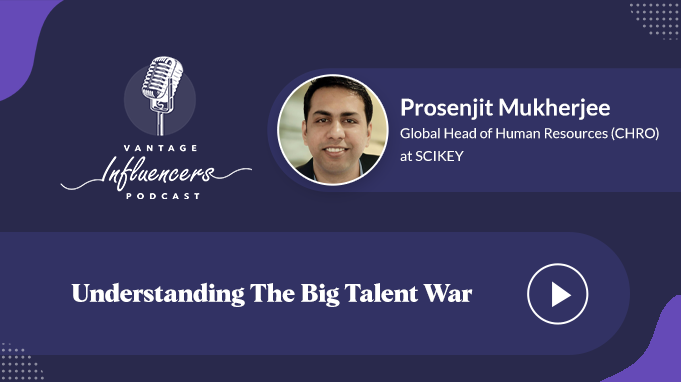
Prosenjit Mukherjee, Global Head of Human Resources (CHRO), SCIKEY
Prosenjit has spent his career moving between HR roles at large, process-heavy corporations and fast-moving startups, working across geographies that span the Indian subcontinent, the US, the UK, and parts of Asia and Eastern Europe. He has led talent acquisition, talent management, organizational development, and diversity and inclusion practices, and has been recognized nationally and globally for his work, including honors from the World HRD Congress and the Indian Achievers Award Forum. He holds a specialization in business and commerce and completed his management education at XLRI, and is an active member of NHRD, SHRM, and the Harvard Business Review community.
Connect with Prosenjit on LinkedIn
Host
Susmita Sarma, Vantage Influencers Podcast Host
What You Will Learn
- Why the war for talent has grown more complex since the pandemic and the Great Resignation
- How flexibility and benefits now compete directly with compensation in a candidate's decision
- Why rigid degree requirements in job descriptions quietly cost companies strong candidates
- How looking beyond major metro cities can unlock overlooked talent pools
- Why fast, respectful response management can make or break the candidate experience
- What it takes to build a transparent, genuine employer brand
Key Topics & Timestamps
| Timestamp | Topic |
|---|---|
| 01:05 | Prosenjit's journey into HR and his work at SCIKEY |
| 13:55 | The biggest challenge he has faced in the field of HR |
| 22:49 | The scenario of the talent war, its origins, and its connection to the pandemic and the Great Resignation |
| 32:59 | Why hiring the best people has become more difficult for most companies |
| 41:28 | The importance of response management and hiring from locations beyond major cities |
Full Transcript
Click to read the full episode transcript
Welcome to the Vantage HR Influencers Podcast. This podcast is sponsored by Vantage Circle, the simple and AI-powered rewards and recognition platform for employee engagement.
All that we thought we understood about talent has changed in recent years, especially during the pandemic. Every organization, as well as every individual, has undergone a reset and is looking at everything with fresh perspectives. What does this mean for the talent industry? It shows that the game has begun. The struggle for talent has begun. It has arrived on our doorstep, and we must be prepared.
Susmita Sarma: Hi everyone, I'm your host, Susmita, and to have a discussion about the ever-increasing talent war, I have with me today Prosenjit Mukherjee, Global Head of Human Resources at SCIKEY. Hi Prosenjit, welcome to the show.
Prosenjit Mukherjee: Hi, thanks Susmita for inviting me to the podcast.
Susmita Sarma: Thank you so much for being here today, Prosenjit. It would be nice to know about your background and your journey as an HR professional, and of course our audience would want to know about your work at SCIKEY.
Prosenjit Mukherjee: I've moved around a lot within India, so I've become a fairly cosmopolitan person over the years. I actually started out as a non-HR person. I always say I'm an accidental HR professional. I had to start working at a fairly early age because my family was going through a tough phase, and my father was unwell. We unfortunately lost him in 2007, but I had already had to step in well before that to support the family financially.
So I started in sales and worked with a few well-known corporations, including Thomas Cook, then moved into marketing, and later into customer support. That was around the time of the BPO and tech boom of 2004-05, just before the 2008 financial downturn, when there was a lot of disruption in the technology and outsourcing market. I started in customer service at a fairly junior level, speaking directly to customers, solving their problems, and reaching out to them. I'd always been someone who enjoyed talking to people, ever since I was young. I took part in a lot of school programs, dramatics, and competitions. So I was naturally drawn to problem-solving and communication.
That's what eventually pulled me toward HR. I realized that if I was already doing sales and customer service, why not move into a role built around solving people's problems directly. Recruitment, in a lot of ways, is sales. Whether you're selling a product or selling your organization as a brand, the fundamentals are the same, and I still believe that today.
I went to XLRI and completed a management development program there, and after that I moved into recruitment. Gradually, with time and effort, I moved up into managerial, senior managerial, and then director-level HR roles. Over the course of my career I've handled HR for organizations as large as 40,000-plus employees and as small as around 200, so I've really seen the full range.
Early and mid-career, I worked mostly with large, well-established organizations, companies that had been around for decades, some of them already publicly listed, with mature processes and policies. The scale in those organizations was huge, multiple locations, a lot of travel, a wide scope of work. But when it came to building or creating something new, the room to innovate was limited, because in a large, mature organization, the founders and early leaders have already built the core processes, and your job becomes running and refining them.
I think of it this way: in any organization there are broadly three kinds of people. There are the creators and innovators who come up with the original idea. There are the builders who take that idea and build the culture and the operational backbone around it. And there are the people who sell it. In my earlier roles, I was mostly a builder. Creating, innovating, and selling tended to sit with the business side rather than HR.
Along the way, I developed a strong conviction that HR shouldn't just be about championing employee value. It should also mean sitting at the business table, understanding revenue, and partnering directly with the business on its goals. That shift has really crystallized over the last five or six years, and COVID accelerated it, because it forced HR leaders to prove they could add real, measurable value to the business, not just to employee sentiment. That's part of why, in a lot of companies, you'll notice the CFO sits closer to the CEO than the CHRO does. It's because HR, traditionally, hasn't thought in financial or business terms. The business runs on numbers, and if HR treats that as secondary, it stays at a distance from the center of decision-making.
Before joining SCIKEY, I was an individually contributing CHRO at a market research firm, working across UK and US time zones. That was a great experience because it pushed me to reach out to top management, founders, and decision-makers globally and understand how they think, not just in India but across other markets too.
SCIKEY has been a different kind of experience altogether. It's a genuinely flat organization. There's very little top-down restriction. If you have an idea, you're encouraged to pursue it, and if it works, the company backs you fully. I'm proud to say that over the last three years, we've grown revenue by 196%, become one of the fastest-growing companies in our space, and been recognized as one of the top companies to work for in rankings covered by major business publications in Asia. And through all of that, we've stayed very deliberate about remaining a people-first company. That, to me, is proof that you can build a strong people culture and strong business performance at the same time, not one at the expense of the other.
Susmita Sarma: That's a great journey. So, what has been your biggest challenge in the field of HR?
Prosenjit Mukherjee: Without question, the pandemic. There were several challenges packed into that period, so let me try to break it down. The first was mindset. Even before the pandemic, in the technology industry, people were used to some remote work, but this was different. People were genuinely afraid, and we had to help them believe that this shift was for their own good. Health became a central concern, and we had to reach out to people, and their families, individually. If someone had a five-member household and needed dietary or medical support, we tried to make sure that support reached them.
We ended up becoming one of the first IT companies in Gujarat to achieve 100% vaccination coverage, and that included housekeeping staff and security staff, not just core employees. We also extended that to employees' families, so it wasn't just our people who were vaccinated, but their households too. We rolled this out early, around May 2021, right when vaccine eligibility was just opening up more broadly, and we didn't wait around, we moved on it immediately, alongside a number of other health-focused policies and campaigns.
The second big challenge was flexibility. People were unsure about returning to office, and rather than force a decision, we ran multiple pulse surveys and had direct conversations with our people. Those who wanted to come into the office did. Those who didn't were given permanent work-from-home options. We built a flexible work-location policy so that someone could live in one city, be mapped to an office in another, and simply work in the way that suited them best, without being pressured to prove productivity by physically showing up.
We also moved away from a rigid, annual appraisal cycle to a more dynamic model, where performance was recognized and rewarded as it happened. We had people get promoted within eight or nine months because they were delivering. All of this was built on a foundation of trust and transparency, what we internally think of as a trust-and-business-excellence model.
We also flattened our internal hierarchy. If someone had an idea, they could take it straight to the CEO, regardless of their level. There was no fear or red tape blocking that kind of access, and leadership stayed just as approachable and agile in return.
Beyond that, we digitized a lot of manual recruitment processes, sped up how quickly we responded to candidates, supported people who had lost jobs elsewhere by helping place them, and ran CSR efforts to support daily-wage workers and laborers who were struggling during the pandemic. None of it was about branding those efforts loudly. It was simply about taking care of our people quietly and consistently, because we see ourselves as a close, family-oriented organization, not just in India, but across our teams in Malaysia, Singapore, and other locations too.
Susmita Sarma: You all did a great job navigating that. Okay, let's move to today's topic. The war for talent is a term that was coined back in 1997, so it's definitely not new. But in today's workplace, it's not just challenging, it's downright hard and complex, and it feels like we need a completely new playbook for it. Prosenjit, how would you describe the whole scenario of the talent war, how it started, and where it's going? Do you think it intensified with the pandemic and the Great Resignation that followed?
Prosenjit Mukherjee: The Great Resignation really started around 2020-21, when the market froze, people were leaving jobs, and many companies, especially startups, were shutting down or scaling back hard. The impact on the technology sector in particular was significant. Then, almost overnight, things turned around, startups started getting funded again, and hiring picked back up sharply.
But I think what matters more than the resignation wave itself is understanding why people actually leave. I'd point to three or four key factors. The first is flexibility. Compensation used to be the dominant factor when I started my career twenty-plus years ago, and it still matters, but it's no longer the sole reason someone stays or leaves. I've spoken to hundreds of professionals who've had multiple job offers in hand, and even then, they're not just comparing salary. They're comparing what else is on the table. In effect, this has become as much a benefits war as a compensation war. People who can work flexibly, from home or from anywhere, will consistently choose that option over a long commute to an office, because they're also weighing their time, their transportation costs, and their overall quality of life.
Second is work culture. A rigid, highly restrictive culture doesn't sit well with people who've experienced the autonomy of choosing their own schedule, whether that's exercising in the morning, spending time with family in the afternoon, and finishing work in the evening. Some organizations still expect people to sit in front of a screen for a fixed nine-hour block regardless of actual output, and that mismatch drives people away.
Third is benefits, and I mean this well beyond the traditional definition. Health insurance, mental health support, mediclaim coverage that extends to parents and not just a spouse and children, maternity and paternity leave, career-gap-friendly hiring policies, and similar programs. The list is long, and it keeps growing. The challenge is that not every company can offer all of this. Even large corporations with significant budgets and infrastructure often can't flex their policies for every individual, because doing so changes the shape of the entire organization at scale. Startups, by contrast, have more room to be flexible, and in a competitive market, they often have to offer noticeably more than an established company would, sometimes multiple times over, just to attract the same caliber of talent, particularly in the technology space.
On top of flexibility and benefits, employer branding matters enormously. If you're offering good things but not communicating them clearly, candidates simply won't know your intent, and they won't join you. There's also a mindset shift needed here. A lot of organizations still lead with what they need from a candidate, rather than what they're offering the candidate. The framing has to flip to "what's in it for you," not just "what's in it for us." And compensation on its own isn't the answer either. If you pay someone significantly more but overwork them to the point of burnout, they'll eventually leave anyway. It has to be a balance of fair pay, respect, culture, and flexibility together, not any single lever in isolation.
Susmita Sarma: You'd probably agree that businesses are already spending a lot of money on hiring, but hiring the right talent still remains the number one concern for CEOs worldwide. Would you like to highlight some of the factors that make hiring the best people more difficult for most companies?
Prosenjit Mukherjee: Absolutely. I'd point to two persistent issues. The first is how rigid and process-bound a lot of hiring has become. When companies get too attached to fixed processes, their policies become inflexible, and that shows up clearly in job descriptions. Look at almost any HR leadership job posting and you'll see requirements like "MBA from a top-tier institute" attached to a specific number of years of experience. But there's no real evidence that an MBA, or a specific pedigree, predicts success. I've seen highly credentialed hires from top institutes fail in real organizations, and I've seen people without an MBA, sometimes with a completely different academic background, go on to become highly successful HR and business leaders. We're clinging to what worked for previous generations rather than focusing on what actually matters today, which is skill, not conventional credentials.
The second issue is geography. Most hiring stays concentrated in a handful of tier-one cities, and there's an unspoken assumption that strong talent doesn't exist outside them. That's simply not true. Organizations rarely make the effort to hire from smaller cities and towns, so all the competition, and all the leverage, ends up concentrated among candidates in the same few metro areas, who can then pick and choose between offers. Startups have started to break that pattern. They're hiring in smaller cities at a lower cost, offering solid benefits, and building genuinely loyal teams as a result, because those hires often have as much talent and even more commitment than candidates in oversaturated metro markets. There's a well-known example from the 2008 Mumbai terror attacks, when staff at the Taj Hotel who came from smaller towns and modest backgrounds stayed behind to protect guests at real personal risk. That level of commitment often comes from exactly the kind of talent pool that big-city-focused hiring overlooks entirely.
Susmita Sarma: Really interesting, thank you for sharing your knowledge and experience today. Any final suggestions for people out there on attracting and getting the best talent possible?
Prosenjit Mukherjee: A few points, if I had to summarize. First, create a genuine candidate experience. Show candidates what you actually offer, don't oversell it, and be transparent from the very beginning, because if you're not honest upfront, employees won't stay with you once they find out the truth. Second, brand your company well, and make sure candidates can actually see the effort you're putting into that employee experience.
Talent acquisition is a genuinely critical function, and under the pressure of targets, recruiters sometimes don't respond to applications for a week, ten days, even twenty days, and that delay alone damages the candidate's impression of the company. Response management, being fast and human in how you communicate with candidates, is one of the biggest gaps I see in the industry today, and I keep telling recruiters that being consistently responsive matters just as much as anything else in the process.
Third, keep expanding your search beyond where you've traditionally looked. I read a report recently showing that hiring from locations other than the cities where a company has offices has grown from around 5% before the pandemic to about 35% now, which is a meaningful shift. And going back to the credentials point, I still see job descriptions asking for an "MBA from a top college," without any real evidence that pedigree alone predicts performance. I've seen wonders come from people without that pedigree. My own chairman only completed education up to a certain point and later received an honorary doctorate; he started out in a very modest role and built an organization worth well over a billion dollars in value. Look at many of the founders who've built major Indian business groups, they aren't all graduates of top-tier institutes either. Education is secondary. Skill, and the willingness to keep learning, matters far more.
At our organization, we believe in staying humble, in the idea that where you come from doesn't mean you already know everything, and that you should always approach your work ready to learn. If you have passion and purpose, the willingness to learn and grow will follow, regardless of your starting point. I'd close by saying that believing in your employees, and being willing to change your own mindset, is essential. HR today looks nothing like HR did a decade or two ago, and if you're not open to that shift, that's where the real problem lies.
Susmita Sarma: Thank you, Prosenjit, for joining me today and for all the information you've shared. Finally, how can our listeners reach out to you?
Prosenjit Mukherjee: I'm quite consistent about writing on LinkedIn, so people can always find and reach out to me there. I'm not particularly active on Instagram, though I do have a profile, but LinkedIn is where I spend most of my time compared to other platforms. Anyone can search for my name there, send a connection request, or follow me, and I personally respond to every message I receive.
Susmita Sarma: Thank you, Prosenjit, for bringing your expertise and experience to the table today. Thank you once again, and we hope to speak again soon. Take care.
Prosenjit Mukherjee: Thank you, Susmita. Thank you for a wonderful session. Take care.
Thanks for listening to the Vantage HR Influencers Podcast. Please do subscribe to the Vantage HR Influencers Podcast on Apple Podcasts, Spotify, and our YouTube channel for new episodes.
FAQ
What is the "war for talent," and why is it more complex today than when the term was coined?
The phrase was coined in 1997, but Prosenjit Mukherjee argues that today's version is harder to win because candidate expectations have shifted well beyond pay. The pandemic and the Great Resignation didn't create the talent war, they exposed how unprepared most organizations were to compete for people on flexibility, benefits, and culture rather than compensation alone.
Is compensation still the biggest reason employees leave a job?
Not on its own. Prosenjit explains that candidates weighing multiple offers are comparing flexibility, benefits, and work culture as much as salary. Overpaying someone while overworking them still leads to burnout and attrition, so compensation has to be balanced with respect, culture, and genuine flexibility.
Why do strict degree requirements in job descriptions hurt a company's ability to hire well?
Job postings that demand a specific pedigree, such as an MBA from a top-tier institute, filter out capable candidates based on credentials rather than skill. Prosenjit points to examples of highly credentialed hires failing and non-traditional candidates succeeding as evidence that skill and willingness to learn matter more than formal education.
Why should companies look beyond major metro cities when hiring?
Concentrating hiring in a handful of tier-one cities inflates competition for the same pool of candidates and overlooks committed, capable talent elsewhere. Prosenjit notes that startups hiring outside major cities have found strong loyalty and lower costs, and cites the well-known example of Taj Hotel staff during the 2008 Mumbai terror attacks as proof of the commitment that can come from outside the usual metro hiring pool.
Related Reading
Also listen on