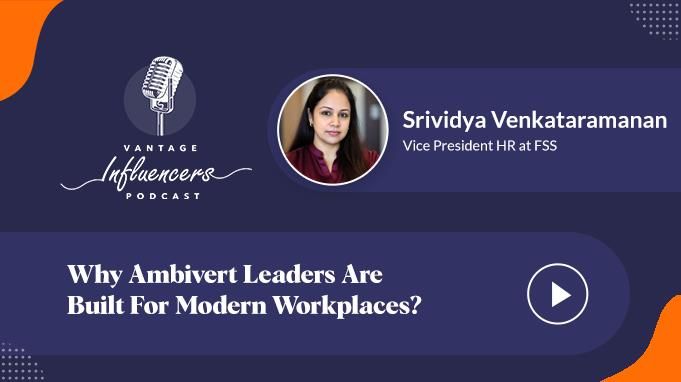
Why Ambivert Leaders Are Built For Modern Workplaces?
Episode Overview
Leadership conversations tend to flatten into a binary: leaders are either introverts or extroverts, either quiet observers or loud commanders. Srividya Venkataramanan pushes back on that framing entirely. In this conversation, she argues that the most effective leaders today are ambiverts, professionals who move fluidly between speaking up and listening, between collaboration and solo decision-making, depending entirely on what a moment calls for. Rather than treating this middle ground as indecision, she frames it as situational fluency, a deliberate skill that lets leaders read a room and respond accordingly instead of defaulting to one fixed style.
Srividya walks through how this plays out in practice, from knowing when to think aloud with a team versus when to step back and make an assertive call alone, to reading the more subtle signals of hybrid and remote work where body language and tone are harder to catch. She also gets candid about the friction ambivert leaders face, the frustration of trying to calibrate for people with very different communication styles, and shares three practical habits, managing energy deliberately, speaking last in important discussions, and making transitions between modes feel smooth rather than jarring, that she believes any professional can use to lead more intentionally.
Episode Highlights
- Ambivert leaders aren't caught in the middle between introvert and extrovert, they're situationally fluent, consciously choosing when to be vocal and when to hold back based on what a moment needs.
- Modern leadership requires a constant switch between collaborative "thinking aloud" with a team and independent "thinking alone" when a decisive call has to be made.
- In one-on-one conversations, the strongest move for an ambivert leader is often to listen first and speak last, letting others go first before adding a final, considered perspective.
- Hybrid and remote work removes the body language cues leaders normally read in person, so ambivert leaders have to be more intentional about tone, timing, and how they communicate.
- Ambivert leaders can feel real frustration when their calibrated communication style meets colleagues with very different personalities, which is why a pause-and-reflect habit matters.
- Three practical habits keep ambivertism from becoming an accident: managing energy deliberately, speaking last in important discussions, and making the shift between modes feel smooth rather than sudden.
About the Guest
Srividya Venkataramanan, VP - HR, FSS
An organizational effectiveness professional with a strong focus on strategic planning and business-aligned change, Srividya brings deep HR expertise across diverse industry verticals, spanning employee relations, workforce management, performance management, learning, compensation and benefits, and talent acquisition. A Certified NLP Master Practitioner (NFNLP, Florida) and a change champion, she has led people functions with a sharp focus on building executable HR strategies that attract and retain high-potential talent, strengthen performance systems, and enable teams to consistently deliver on business goals.
Connect with Srividya on LinkedIn
Host
Sanjeevani Saikia, Vantage Influencers Podcast Host
What You Will Learn
- Why ambivert leaders are situationally fluent rather than stuck between two fixed styles
- How to switch deliberately between collaborative thinking and independent decision-making
- When listening should take priority over speaking, especially in one-on-one conversations
- How to lead effectively when hybrid and remote work strip away in-person cues
- What commonly frustrates ambivert leaders and how a pause-and-reflect habit helps
- Three practical habits for practicing ambivertism intentionally, from energy management to smooth transitions
Key Topics & Timestamps
| Timestamp | Topic |
|---|---|
| 01:04 | Srividya's career path and background in HR |
| 02:22 | What ambivert leadership means and why leaders aren't just introverts or extroverts |
| 05:41 | Switching between collaborative thinking and independent decision-making |
| 11:48 | Balancing speaking up and listening when communication is largely virtual |
| 19:31 | How an ambivert mindset supports empathy without compromising decisiveness |
| 23:26 | Everyday habits that help ambivert leaders thrive in modern organizations |
Full Transcript
Click to read the full episode transcript
Welcome to the Vantage Influencers podcast. This podcast is sponsored by Vantage Circle, the simple and effective recognition platform for employee engagement.
Leadership conversations often feel a bit binary. We're usually told leaders are either introverts or extroverts. But in real workplaces, most leaders sit somewhere in between, constantly adjusting how they show up based on a situation and the people in front of them.
That's the space we are exploring today, ambivert leadership, and what it looks like when that balance is used intentionally. And to talk through this with me, I'm joined by Srividya Venkataramanan, Vice President, HR at FSS, who's seen firsthand how leadership really plays out beyond personality labels.
Sanjeevani Saikia: Hi, Vidya, it's a pleasure to have you on the show. Thank you so much for joining us again.
Srividya Venkataramanan: Hi, thank you so much for having me here. And it's a very interesting topic, in fact, for us to discuss today. So thank you so much. And just to give a brief about me, for the people who are going to listen today. So I have close to 20 years of experience in HR. And my career and my experience spans from talent acquisition to workforce management to HR operations to culture building. And today I'm heading HR at FSS.
Sanjeevani Saikia: Thank you so much, Vidya, for walking us through your corporate journey so far. With your permission, I'd like to begin our discussion on the topic. So everyone keeps talking about introverted leaders and extroverted leaders. We almost treat leadership like we have to pick a side. Either the leader is loud or they're quiet. But the question is, is leadership really that simple? What if some of the most effective leaders today actually sit in the middle between being loud and quiet? So what keeps emerging is, where do ambivert leaders really fit in? What really defines an ambivert leader, most importantly? And why do you think this middle ground matters so much in today's workplace?
Srividya Venkataramanan: Okay, it's a great question. So probably I think that we should first understand what this ambivert leadership is all about, which we're discussing today. So over the period of our leadership journey, over the period of time, leaders are typically classified as people who are very charismatic, very loud, who are too good in public speaking, who can just attract people. And those leaders are kind of categorized as extroverted leaders, and people who are very submissive, very calm, and rather not so flamboyant in their attitude. So those leaders are generally categorized as introverted leaders. So I would like to say that ambivert leaders are actually not stuck in the middle, in the middle of these two, rather they are situationally fluent. That's how I would like to call them, ambivert leaders, because not every scenario in an organization requires someone to be very vocal, and not every situation in the organization requires you to be calm.
So I think the ideal balance that is required for a leader, especially in today's world, where change is constant, where change is the thing every day. So today is different from yesterday, and tomorrow is going to be different from today. So when we are wading through so many transformations, technologically, people-centric, with a lot of changes happening around the world globally, economically, and everywhere, I think what we need today is a person with a balanced personality who can handle every situation and get to a type of expertise. So for that, sticking to one side of this leadership personality will not work. So we need someone who understands, who adapts, who is flexible. That flexibility is what we call an ambivert leader. And an ambivert leader is again not a fixed style. It's about how I react, how I respond, and how assertive I am towards the situation. And that's what we call an ambivert leader.
And today's situation is that we are working with a multi-generational workforce also, and people from different levels, different strata, different experiences. So there is no one-size-fits-all. So that holds good for leadership also. So a leader should be someone who is able to act according to the situation, according to the people, according to the organizational ask, and the kind of role that they play. So that is what we define as an ambivert leader.
Sanjeevani Saikia: Now, once we understand who ambivert leaders are, the next question is really about how they operate day-to-day. Because again, leadership today is constant switching. We all know that. One moment you're brainstorming with a team, and the next you're expected to step back, think independently, and make sense of complexity. So it's quite obvious that modern leaders constantly move between collaboration and independent thinking. How does being an ambivert leader help someone switch between these modes more effectively? How can they actually switch between those modes more efficiently and effectively?
Srividya Venkataramanan: See, what I would say is, if I identify myself as an ambivert leader, we will have so many ambivert leaders, but they aren't consciously self-aware that they have this skill with them. That's what I would call it. So it's not that people don't know this. People might already practice this, but unknowingly sometimes. Intentional practice of this ambivertism is something which is required if you have to become the ambivert leader that we are talking about today.
So ambivert leaders are leaders who are generally very comfortable, both to think aloud and to think alone. This is the switch that we are talking about today. One is to think aloud, so when I say think aloud, obviously the collaboration with the team, collaboration with cross-functional leaders, collaboration with outside stakeholders. This collaboration is required for a certain nature of the job, for a certain strategic initiative that we have, because leadership is also not meant to be authoritative. We also speak about democratic leaders. So somewhere that balance is required. So an ambivert leader will know when to think aloud, when to ask for other people's perspective, when to brainstorm together. But at the same time, there are situations where you will have to take a call after doing a deep dive with all these people. Now that call is a decisive call as a leader, which you will have to take. So at that given point of time, the democratic approach doesn't work. You will have to think alone and take an assertive decision. And that's the stage where you think alone. So this is the switch.
And an ambivert leader, if he understands the situation right, say for example it is a situation where you are going to have a one-on-one discussion with an employee or with a peer, at that given point of time, the ask here is to listen and not react, listen and not speak. You don't speak first, you speak last. That is the situation where you are a listener. So a kind of introvert instinct steps in there. Now you have to run a different organization-level program, and for that you cannot be the one person who decides for the organization. You will have to collaborate with your team, you will have to collaborate with the cross-functional team, where collaboration and democratic decision-making play a vital role, because an initiative will be successful only when you have equal partnership from all functions. So at that given point of time, collaboration works, where you are thinking aloud, brainstorming.
So this constant shift, from every single transaction that you do, and intentionally you decide whether a call should be only yours or a call made together, that is something that helps a person become a better leader for tomorrow. And that is what we call an ambivert leader. And that's the advantage they have. If I have the ability to switch myself readily for every decision that I take, then I become a successful ambivert leader. That's how we can create more of them.
Sanjeevani Saikia: Yes. So in this response of yours, you have highlighted the significance of listening more than speaking for any leader, I suppose.
Srividya Venkataramanan: Yes, I think that's something that is very crucial that you've highlighted.
Sanjeevani Saikia: Now that we know the meaning of ambivert leadership, and we know how they operate on a day-to-day basis, if I ask you which one you prefer the most, either the two extremes, whether you prefer introverts, or you prefer extroverts, or you think ambiverts are the best, what would you say if you were asked to choose a particular style of leadership?
Srividya Venkataramanan: Okay, fine. See, I come from a perspective that extrovert leaders and introvert leaders are now a subset of ambivert leaders, right? Because ambivertism has got both in it. So there's no personal specific choice. It all depends on the role that people play and the kind of work that they need to do, right? Because it has to be the right balance. It's like, you can't be too rude, and you can't be so nice. There's a lot of balance because I'm an HR leader, not a leader who can show my emotions as is, right? So we will have to be balanced. At the same time, you need to understand for whom are you spending your energy, and for what reason. So ambivertism is also a smart way of aligning your energy for the strategic initiatives that you're taking. There are a few cases where your listening would help, there are a few cases where your action helps. So I don't prefer any specific model. Rather, I would see what requires my energy more, and what requires focus. If focus is more required, then logically I would be listening and understanding things, and then I'll take a call where it requires me to act. I'll put more energy there. I think it has to be a perfect balance and blend of both. That helps.
Sanjeevani Saikia: True. Now, when you layer in hybrid and remote work, communication becomes a real leadership test. I strongly believe being visible doesn't always mean being loud, and staying quiet doesn't mean you are not leading. Leaders today have to constantly judge when to step in, when to create space, and when to step out. So how do ambivert leaders strike that balance? I think you have talked about it, but I would like to know, in particular, how do they decide when to speak up and when listening actually has more impact? As you've already mentioned, listening is important. When do you think it has the highest amount of impact?
Srividya Venkataramanan: See, even putting aside what kind of leadership works, I think for a moment we will have to ideally think about how to manage hybrid and remote workers, especially in any organization for that matter. So we all know that we are in the people business, and we have to respect every independent individual's emotions, thoughts, and perspectives. So it becomes inevitable for all managers who have teams under them to understand people, not just from a work perspective. I think we have come to a stage where we will have to go one step further, to even understand a person's background, and understand what kind of family setup they have, because especially in HR, it is becoming very important for us to be sensitive to people, their perspectives, and their emotions. So it's not going to be as easy as it was before, because people management, emotional connection, and empathy all play a vital role in today's world.
So that being the case, especially as an ambivert leader, because as I already said, ambivert leaders are intentional speakers. So when I say intentional speakers, it means they need to know what they need to communicate, and to what kind of audience. They can't speak forcefully to a person who is already very soft in nature. And especially in the case of hybrid or remote work, where you are not going to meet people face to face, you might not be able to pick up on the cues you'd get through body language when you meet a person face to face at work. So that being the case, I think it's very important for a person to understand a specific person's behavior pattern, and talk to them in a softer way where they understand things.
Now, you also have a very critical situation where delivery is getting affected because people are working hybrid and remote. That's also one instance. In that case, I think a little assertive talking would help. The one-on-ones can still be more empathetic, where you show empathy because you understand people individually. But when it comes to a larger team, and the situation requires some kind of assertive decision-making, then an assertive tone and assertive messaging is very important. Again, I'm not using the word loud or strong, because situations don't require you to be very strong until it's punitive, right? Until things become a disciplinary issue or whatever. So I'm just speaking from an HR perspective. I think this is very important, especially in remote and hybrid working, because employees look up to their supervisor, look up to the manager as the first go-to person.
So managing intentional discussion, and having a clear plan before you speak to a person, helps with retention too, because people leave managers, not just organizations, is what we keep believing. So that being the case, a leader's style and the way they speak, the way they communicate, matters a lot. And ambivertism is all about that. It's about being conscious of yourself, being self-aware, because it's important for us to pick up on all the signals, said and unsaid, delayed or avoided. So it's important for us to notice everything when we communicate, period. So that's how I feel ambivert leaders can add value in situations that are hybrid and remote.
Sanjeevani Saikia: Yes. If I ask you, Vidya, can you tell me three major obstacles that ambivert leaders usually face? If I just ask you to name three, do you have anything, even though ambivert leaders face this a lot and it's a big problem?
Srividya Venkataramanan: I think one practical problem ambivert leaders could actually feel, in fact I know it's different from person to person. So maybe I should just express the practical difference we see, which is that when we, as an ambivert leader, put a lot of energy into being right, being conscious, trying to be assertive, and when we stage our conversations and communications step by step, sometimes what happens is our energy gets strained, and there'll be another personality opposite to you who might not understand what you're communicating at times. And that leads to multiple leadership communication issues. See, the point is, you can't expect the whole setup around you, maybe the whole organization or all the leaders around you, to be the same, because everybody is an independent personality, right? So an ambivert leader has a high probability of feeling a bit frustrated at certain times. I mean, every leader feels that. But an ambivert leader still feels it, because when he or she is putting a lot of effort into being more appropriate for situations, their peers might come up with different personality traits, right? So aligning everybody and bringing everybody onto the same page might be an issue, and might be a problem that frustrates a person, because when you choose your words, when you choose your body language, when you choose what to communicate, and somebody comes and dismisses the information right in front of the audience, that's not something you would want to happen, but it will happen, right? So I think a pause and reflect is always required. It's important for any leader, for that matter, especially an ambivert leader, to pause, reflect, and find alternate methods to handle things and switch gears. That's very important. You try something, you want to be nicer to somebody, and you try to address things, but then it doesn't work. It's always okay to go back to that slightly louder perspective. It's actually fine. In your mind, if you have a strong conviction that this will work, it will work. Sometimes I would say situations are complex, and it's important for us to quickly bounce back. That's very important. Pressure is common for any kind of leader. For an ambivert, it's slightly more, because you put a lot of effort into it. When you don't get the result because of some reason around your environment, you get frustrated. It's there.
Sanjeevani Saikia: Correct. Leaders today don't really get to choose between being understanding or being firm. Very often they're expected to do both in the same moment, especially when things are moving fast, or particularly in a moment of crisis. That makes me wonder, how does being an ambivert shape decision-making in high-pressure situations? You just mentioned handling pressure. How do they really do it?
Srividya Venkataramanan: See, handling pressure, certain things that are highly stressful for one person may not be stressful for another. So obviously it's all based on the level of empowerment that you typically have in a specific role, which might give you the provision to take certain decisions, and it might be a certain hurdle for a certain situation. So pressure is there across all functions and all leadership roles. I think it's the mindset that matters a lot, I would say. Especially as an ambivert leader, what we also expect from an ambivert leader, if someone claims to be one, is also to stay calm and stay put. That's more important for an ambivert leader, because that's where they're neither getting into a shell like an introvert leader, nor instantly reacting like an extrovert leader. That's what we typically expect from an ambivert leader. And that's the ask of the hour as well, because I'm sure every organization, in every domain that we have, is focusing on a lot of changes, be it structural, functional, or the introduction of recent technologies. I think the world is catching up with itself. Every day there's new tech coming in, new inventions happening. I think everybody wants to innovate, and there's pressure on everything. The pressure isn't just about how much revenue an organization makes. That's one, that's fundamental. But the pressure is on how much we're doing as an employee value proposition, how much we're giving to our employees, how we're doing outside the market, how we're competing with our peer group, what new thing I'm presenting today. There's a lot of pressure from different directions.
So I think it's very important for a leader, especially if practicing ambivertism in their style, to cascade and prioritize to what extent they want to take on in a day, or what the priority is. I think that prioritization, and switching energy from a high-voltage area to a low-voltage requirement, is the good balance that the ambivert mindset can bring. And it happens through practice, obviously, because, being human, we tend to react to a certain situation, but reacting alone versus reacting in front of a larger audience is the difference you'll see if you're an ambivert leader. An ambivert leader should, and will probably, keep their emotions intact. I would also say the emotional quotient of an ambivert leader should be much better compared to other leadership styles. So that's the right mix and balance we can expect from an ambivert leader in such situations.
Sanjeevani Saikia: Finally, bringing this closer to the listener's own experience, many professionals already see themselves somewhere in the middle. They're not trying to become louder or quieter, they're just trying to be more effective. The real question then becomes, how to use ambivertism intentionally rather than accidentally. Maybe you're not born with it, but you come to believe this is the best way to do leadership, so you work on it intentionally. So for all those professionals who identify as ambiverts, what small leadership habits can help them thrive in modern organizations?
Srividya Venkataramanan: See, as I've already said, maybe the first thing is, don't spend your energy on things that don't require it. That's the first and foremost thing. Which means ambiverts perform well when they're able to manage the transition from high energy to low energy. So don't drain it. For that, you need to pause. When there's a problem statement, it's equally important for you to pause and understand the problem statement well before deciding what route you want to take. If things can be resolved by just listening to a problem and giving a one-line update, saying this can happen this way, that's enough. It's not required for you to put in all your energy, call ten or fifteen people, and ask for so much information. It's not required. But if it's a larger decision, then you focus on that. So energy is very important for any leadership role, and especially if you want to practice ambivertism, manage your energy, balance your time and energy. It's important for you personally first, and then for the organization.
Second, I would say, predominantly in all discussions, if possible, speak last, especially in important discussions. If there are important discussions where you have to encourage diverse thinking, where you're supposed to take the final call, in such situations where your decision matters a lot, it's important for you to listen and speak last. So, energy and listening.
The third thing is the shift. Whenever you shift, whether from a louder to a calmer energy flow, or a calmer to a louder energy flow, either way, whenever you shift, ensure that the shift is smooth. People shouldn't see you as a split personality, is what I gently, humorously say, because you shouldn't come back to people, or make people very uncomfortable. All this time they might have seen you as a person who is calm and balanced, and then suddenly you raise your voice and say something. I don't think people are ready to accept that. So it's important for you to make the shift seamless and effective, because it's not about putting your thoughts forward strongly, it's about putting your thoughts forward assertively, and making people understand: I have heard your inputs, I have been a good listener, and here's the decision we will take, which means you build trust, and you also provide the reasoning that I'm taking this decision because of what we discussed. That summarization of the whole communication we've had helps resolve the issue very amicably. So your energy, speaking last, and the shift, these three are the most important things we need to practice if we want to practice ambivertism and become an ambivert leader.
Sanjeevani Saikia: Perfect, Vidya. Thank you so much for responding to all of our questions and answering them so lucidly. I think each of your responses was perfect. So thank you so much once again for that. We have almost arrived at the end of today's episode. Before leaving, is there any message for our listeners? They would definitely like to hear it from you.
Srividya Venkataramanan: Sure, I'll do that. So maybe one line I want people to listen to, and maybe that might help others as well. See, ambivert leadership is something which in recent times we call authentic leadership. Ambivertism is nothing but being authentic in action. Because authenticity isn't just about one's fixed style, it's about responding truthfully to people, to the context, to the organization, and to the moment. So ambivert leadership is being authentic. So be as authentic as possible, and ensure that you do the right thing for yourself, for people, and for the world. That's what I would like to end this discussion with.
Sanjeevani Saikia: Wonderful. Thank you so much for joining us today, Vidya. It was a pleasure to have you on the show.
Srividya Venkataramanan: Thanks a lot. Thank you so much. Thank you so much. Yeah, thanks.
FAQ
What is an ambivert leader?
An ambivert leader is someone who isn't fixed as either an introvert or an extrovert, but moves between the two depending on the situation. Rather than defaulting to one style, they consciously choose to be vocal and collaborative in some moments and quiet and decisive in others, a trait Srividya Venkataramanan calls situational fluency.
How do ambivert leaders decide when to speak up and when to listen?
They read the moment before responding. In group brainstorms or cross-functional initiatives, they lean on collaboration and think aloud with the team. In one-on-one conversations or when a decisive call needs to be made, they hold back, listen first, and speak last so their input carries the full weight of what they've heard.
Why does hybrid and remote work make ambivert leadership more important?
Hybrid and remote settings strip away the body language and in-person cues leaders normally rely on to gauge how someone is reacting. That makes intentional communication, choosing tone, timing, and what to say based on the audience, far more important than it would be in a face-to-face setting.
What habits help someone practice ambivertism more intentionally?
Srividya points to three habits: managing energy deliberately so it isn't wasted on situations that don't need it, speaking last in important discussions so listening comes first, and making transitions between a louder and calmer style feel smooth rather than abrupt, so colleagues never experience the shift as jarring.
Related Reading
Also listen on