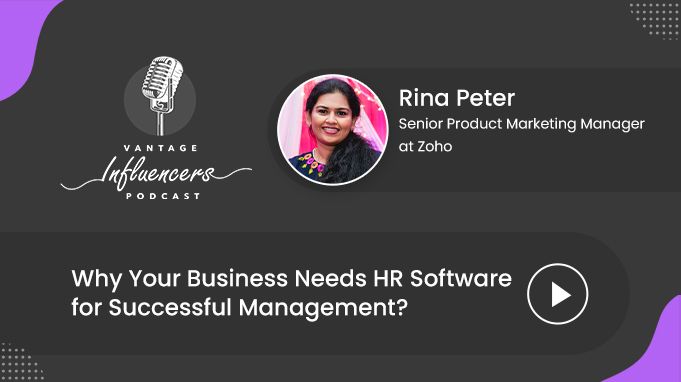
Why Your Business Needs HR Software for Successful Management?
Episode Overview
Rina Peter, who leads product marketing for Zoho's HR solutions (Zoho People and Zoho People Plus), walks through how the HR function has changed over her nearly 12 years in the corporate world. She argues that HR has moved well past hiring and payroll administration into a strategic role that shapes company culture, drives change management, and uses employee data to make decisions that put people ahead of pure profit. In her view, this shift is exactly what makes HR software non-negotiable: when routine tasks like leave tracking, attendance, and query management are automated, HR teams get the bandwidth to focus on the initiatives that actually retain and engage a workforce.
Her sharpest point comes when she talks about startups. Rather than treating HR software as a discretionary expense, she frames it as a way for resource-constrained founders to avoid the compliance risk and wasted leadership time that come from handling HR manually. She extends the same logic to enterprise HR technology trends: growing automation for hybrid and remote workplaces, deeper reliance on people analytics to personalize hiring and performance decisions, and data security as a baseline requirement rather than a nice-to-have, given how much sensitive employee information HR systems now hold.
Episode Highlights
- HR software automates repetitive tasks like leave, attendance, payroll, and query management, freeing HR professionals to focus on strategic work rather than administrative upkeep.
- The role of HR has expanded beyond hiring and paperwork into shaping culture, driving change management, and using employee data to inform decisions.
- Every core HR feature, from onboarding to self-service portals to performance management, plays a distinct role in reducing errors and improving the employee experience.
- Startups should not treat HR software as optional; without it, leaders risk compliance gaps and lose time to manual processes instead of strategic priorities.
- Three trends will shape HR technology going forward: automation for hybrid and remote work, deeper use of people analytics, and stronger data security standards.
- Trust and communication, not micromanagement, are what Rina credits for keeping her own team engaged, alongside giving them tools that remove manual busywork.
About the Guest
Rina Peter, Senior Product Marketing Manager, Zoho
Rina has spent close to 12 years in corporate marketing and currently leads product marketing for Zoho's HR solutions, Zoho People and Zoho People Plus. She builds go-to-market strategies for feature launches, leads market research and product messaging, and shapes content strategy across several other Zoho products. Beyond brand strategy, she manages a team of seven to eight people and has deep experience in customer relationship management, partner management, and employee and community engagement.
Host
Susmita Sarma, Vantage Influencers Podcast Host
What You Will Learn
- How to identify which HR software features cut administrative burden the most, from onboarding to self-service portals.
- Why the HR function's role has shifted from administrative support to a strategic partner in shaping culture and driving decisions.
- What makes the case for startups to invest in HR software early, rather than treating it as a discretionary cost.
- Which HR technology trends, automation, people analytics, and data security, matter most going forward.
- How to keep a team engaged without micromanaging, using trust, communication, and the right tools.
Key Topics & Timestamps
| Timestamp | Topic |
|---|---|
| 01:03 | Rina's journey in the corporate world |
| 02:20 | How the HR workspace has evolved |
| 04:11 | Community and employee engagement in her role |
| 05:38 | The most important aspect of HR technology |
| 06:47 | HR software's competitive advantage for businesses |
| 08:53 | Should startups invest in HR software |
| 10:23 | HR technology trends for 2022 |
| 12:04 | Recommended HR resources |
| 13:17 | Rina's closing thoughts |
Full Transcript
Click to read the full episode transcript
Welcome to the Vantage HR Influencers Podcast. This podcast is sponsored by Vantage Circle, the simple and AI-powered rewards and recognition platform for employee engagement. Cloud-based HR software has made it easier for companies to automate their HR activities. HR software enables your HR department to work more effectively by aligning teams with the organization's goals, focusing on improving employee engagement, morale, and productivity. If you are wondering whether or not your company needs an HR software, or if it's just an extra cost that you'll have to face, you are in the right place today.
Susmita Sarma: Hi everyone, I'm Susmita from the Vantage HR Influencers Podcast, and I'm so delighted to welcome our guest today, Rina Peter, the Senior Product Marketing Manager at Zoho. Welcome to the show, Rina.
Rina Peter: Hi, Susmita.
Susmita Sarma: Yeah, once again, thanks for joining me today, Rina, in this podcast.
Rina Peter: Oh, it's my pleasure.
Susmita Sarma: Yeah, thank you so much, and it'll be great, Rina, if you can kick-start this podcast with a brief about your journey in the corporate field.
Rina Peter: Yeah, sure. So, first of all, thank you to Vantage HR Influencers for giving me this opportunity here. So, yeah, well, I've been in this corporate world for almost 12 years now, and my experience has been nothing short of amazing. So, I currently head the marketing for Zoho's HR solutions, which is Zoho People and Zoho People Plus. And I specialize in increasing brand awareness and reaching the target audience. And as a part of maximizing the brand reach, I have developed the go-to-market strategies for feature launches. We conduct market research, then the crafting of product messaging, and create content strategies for several other products within Zoho as well. So, I've been delving deep into the HR sector for quite a long time to make sure our HR solutions have all the functionalities to save HR professionals from their repetitive tasks and provide a greater working experience to employees.
Susmita Sarma: Right, and Rina, you have worked for 11 plus years in the field, is that correct? So, how do you see the HR workspace changing?
Rina Peter: Well, if you see, over the last 10 years, I see the HR workspace has evolved quite significantly to manage the changing expectations of today's multi-generational workforce. High-level concepts like employee experience, work-life balance, people-first culture, inclusion, diversity, and so on, are becoming super important to employees. So in today's workspace, the role of HR professionals, in my opinion, is no longer just restricted to managing hiring and administrative processes, but today's HR departments are trying out creative ways to deliver an exceptional working experience to their employees. And they have started using employee data to drive important decisions. So, they are making HR processes as simple as possible, for themselves as well as for their employees. And they are also introducing policies that put their people before profits. They are also being involved in a lot of strategic tasks, including defining the company's culture, spearheading change management initiatives, introducing new tech tools, and managing workflow optimization, and it goes on. So, they are basically charged with managing everything that retains employees and keeps them engaged, satisfied, and productive. This was definitely not the case five or ten years ago. Back then, the HR team was predominantly tasked with just hiring employees and managing administrative tasks like record keeping, payroll management, and so on.
Susmita Sarma: Right, brilliant. So in your role, as you've already mentioned, you work with culture as well. So I'm sure you also take part in community engagement or employee engagement initiatives as well, right? Can you tell us more about that, like what are the initiatives you take up for employee engagement and community engagement?
Rina Peter: So, I actually manage a team of seven to eight people in my current role, and in my previous roles as well, we've had around ten people or so. So one important thing I personally do to keep my team engaged is I don't micromanage them. Instead, I allow them to work independently. This shows the trust I have in their abilities and motivates my team to go above and beyond. I also make sure that they have access to all the tech tools that simplify their work and save time for them, so there isn't much manual work involved. Software that is easy to use can contribute significantly to employee engagement, and that's what I believe in. Also, how you communicate with your team is super important. It's important to provide feedback, recognize the hard work, and keep them updated on all important developments from time to time to improve their engagement and motivation levels.
Susmita Sarma: Okay, that partly comes into my next question, which is, what is the most important aspect of using HR technology or HR software, in your view?
Rina Peter: Well, in my opinion, I feel every feature in HR software is crucial to streamline and simplify the HR process. For instance, if you take the onboarding module, it is essential to save new hires from tedious paperwork and help them adapt to their organization's culture and values. Similarly, the core HR features, like attendance and payroll modules in the HR software, are super important to cut down repetitive work and prevent errors. Then something like the performance management system is essential to evaluate employee performance and provide feedback to help them understand their strengths and weaknesses. And the self-service portal is crucial to empower employees to complete their HR tasks at any time, from anywhere. So I believe every feature present in HR software is critical to help HR teams bring out the best in their employees.
Susmita Sarma: Right. So it clearly has a lot of benefits that it provides to businesses, isn't it? So how can it help gain a micro competitive advantage in the VUCA world, especially?
Rina Peter: Well, employees are the most valuable attribute an organization will ever have to offer. So how they work and manage business operations can make or break an organization's success, right? Employees cannot thrive in a place where there is no convenient working experience. So to help them bring out their best efforts, it's important to make business processes frictionless and manage employees in the best possible way. And I feel this is where HR software truly shines. It can be a game changer for all businesses, irrespective of the size or the industry they belong to. It also simplifies every aspect of HR operations, from onboarding to off-boarding, for both employees and HR professionals, and it reduces their administrative burden overall. So a comprehensive HR software empowers employees to complete all of their HR tasks, whether they're raising requests, communicating with their peers, giving and receiving feedback, taking training, or staying informed of other important updates, effortlessly, no matter where they work from. It can also be customized and integrated with multiple third-party apps to make sure the HR software works the best way that fits every organization, not just for one particular need, but for every organization and how they want to set up their own workflow. So this kind of technological sophistication, I believe, is vital to cater to employees.
Susmita Sarma: Right. So it's a big yes for HR software in businesses today. We already see a lot of small businesses and companies trusting HR software companies for the right payroll and HR management solution. So what is your view on this? Should progressive startups invest in HR software, or is it overkill for them? Should we think twice before investing in HR software?
Rina Peter: Right. Well, HR software for progressive startups is definitely a yes. But while having limited resources, startup leaders cannot really afford to spend time on repetitive tasks rather than focusing on strategic tasks. At the same time, letting go of these routine administrative tasks can sometimes lead to gaps and unnecessary compliance issues. So in such a situation, having a tech tool like HR software can automate most of the routine HR operations, like leave management, payroll management, attendance, and employee query management, and it requires very little supervision. You don't really have to keep following up on it. So, in addition to automating the core HR operations, HR software can also help substantially in tracking employee performance and training them effortlessly. So, yeah, HR software for progressive startups is a big yes.
Susmita Sarma: Okay, so moving forward, Rina, looking towards HR technology trends coming into 2022, we've seen a significant influence over the past two years regarding COVID, and the ongoing movement towards complete digital transformation across workplaces. So what are the new HR technology trends that you see picking up speed in 2022?
Rina Peter: Yeah. So HR automation is one of the major technology trends that will continue to rule the HR sector in 2022. With many organizations planning to go remote-first and adopt hybrid workplace models, automation would really help them ensure these HR operations are completed on time and without any errors. This would also help provide an exceptional remote working experience to employees. Similarly, dependence on people analytics solutions will increase as organizations begin to hyper-personalize their HR practices, including hiring, onboarding, performance, and many more, using employee data. And in addition to these, I also see an increased emphasis on data security. This is super important for the HR sector, as they manage a large amount of sensitive data pertaining to their employees. So this means HR technologies without robust data protection features are no longer optional, but crucial to shield sensitive HR information and ensure employee privacy.
Susmita Sarma: Thanks for sharing this, Rina. So any resource on HR that you want to suggest to our listeners, maybe a book or an e-book or a podcast, anything?
Rina Peter: Well, there's a lot on the web right now, but there's something that we have created, a resource hub for actionable insights on the best HR practices. Through it, we hope to provide useful articles, blogs, and infographics on a variety of HR topics, and you can find it on the Zoho People website. We've also been organizing informative webinars regularly with HR thought leaders, just to help HR professionals learn different perspectives on best HR practices. So you can follow Zoho People's official social pages to stay updated on upcoming webinars, and you can also check out our official YouTube channel for recordings of previous thought leadership webinars. So, yeah, this will be my suggestion.
Susmita Sarma: Okay, thank you so much for that. What would be your end note to our listeners? Any suggestions that you want to give to our HR listeners today, Rina?
Rina Peter: Yes. So the world of work is changing very rapidly, and we see new workplace models evolving, we see new technologies coming up, and we also see progressive organizations adopting new management styles and so on. As a result, what employees expect from their workplace has shifted a lot. So it's important for all HR professionals to keep pace with these changes and leverage useful tech tools to cater to employee needs and enable them to work in the best possible way. And holding on to traditional ways of people management can put an organization at a huge loss. So I feel it's very vital to prioritize what actually matters to your workforce.
Susmita Sarma: Right, great, amazing. Rina, thanks for sharing that as well. So finally, how can our listeners reach out to you?
Rina Peter: Yeah, you can reach out to me through social channels, or you can also write to me at my official email address.
Susmita Sarma: Thank you so much for all the insights, Rina, that was lovely talking to you. Thanks a lot once again for joining me on the Vantage HR Influencers podcast.
Rina Peter: Thank you so much, Susmita. Thank you, Vantage Circle, for giving me this opportunity to speak on the key trends that we expect in 2022.
Thanks for listening to the Vantage HR Influencers podcast. Please do subscribe to the Vantage HR Influencers podcast on Apple Podcasts, Spotify, and our YouTube channel for new episodes.
FAQ
What is the biggest benefit of implementing HR software?
According to Rina, HR software's biggest benefit is that it automates repetitive administrative work, like leave, attendance, payroll, and employee queries, so HR teams can focus on the strategic work that actually keeps people engaged. Every core feature, from onboarding to self-service portals to performance management, plays a specific role in reducing errors and improving the day-to-day employee experience.
Should startups invest in HR software?
Yes. Rina argues that resource-constrained startup leaders cannot afford to spend time on repetitive administrative tasks instead of strategic priorities, and that skipping HR software raises the risk of compliance gaps. She frames HR software as something that requires minimal supervision once set up, freeing founders to focus on growth.
What HR technology trends should businesses watch?
Rina points to three trends: continued growth of HR automation as organizations adopt hybrid and remote-first models, greater reliance on people analytics to personalize hiring, onboarding, and performance decisions, and a rising emphasis on data security given the volume of sensitive employee information HR systems hold.
How does Rina keep her own team engaged without micromanaging?
Rina manages a team of seven to eight people and says she avoids micromanaging, choosing instead to trust them to work independently. She also credits giving her team easy-to-use tools that remove manual busywork, along with consistent communication, feedback, and recognition, as key drivers of engagement and motivation.
Related Reading
Also listen on