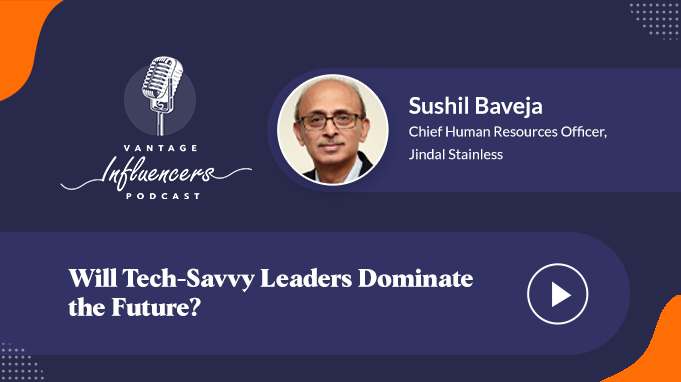
Will Tech-Savvy Leaders Dominate the Future?
Episode Overview
"The technology you use impresses no one. The experience you create with it is everything," as Sean Geraty puts it. In this episode of Vantage Influencers, host Sanjeevani Saikia speaks with Sushil Baveja, CHRO of Jindal Stainless, about whether leaders who excel with technology will genuinely dominate the future, or whether that advantage comes with real trade-offs.
With nearly 40 years of HR experience across companies like Cadbury, Gillette, Alcatel, and DCM Shriram, Sushil argues technology is a powerful enabler for leaders, but only when it triggers human creativity and connection rather than replacing it.
Episode Highlights
- Technology is a driver of employee experience, customer experience, and business performance, and leaders who avoid getting tech-savvy risk falling behind on all three.
- "Touch and technology have to go hand in hand." Even in a fully digitized performance management system, the manager's face-to-face conversation with an employee still matters, the system becomes a reference record, not a replacement for that conversation.
- Understanding domains beyond your own (marketing, finance, and so on) helps leaders connect the dots and build stronger rapport with stakeholders outside their immediate function.
- Innovation today moves faster because of technology, data, quick prototyping, and analytics all accelerate the pace of breakthrough change compared to a purely manual, human-driven process.
- The real risk isn't using technology, it's over-relying on it. Technology should trigger a leader's intrinsic creativity, not substitute for it.
About the Guest
Sushil Baveja — CHRO, Jindal Stainless
Sushil Baveja was appointed Chief Human Resources Officer at Jindal Stainless in January 2023, bringing over three decades of experience driving people strategy, workplace culture, and talent management. He has held HR leadership roles at DCM Shriram Ltd, Alcatel, Cadbury India Ltd, and Gillette India. He is an alumnus of the Institute of Management Technology (IMT), Ghaziabad, and completed the Advanced Human Resource Executive Program (AHREP) in HR Strategy at the Ross School of Business, University of Michigan.
Connect with Sushil on LinkedIn
Host
Sanjeevani Saikia — Vantage Influencers Podcast Host
What You Will Learn
- Why technology is becoming essential for leaders to drive employee experience, customer experience, and business outcomes
- Why "touch" and technology need to coexist, not compete, especially in people-facing processes like performance management
- Whether leaders benefit from understanding domains outside their own
- Why the pace of innovation has accelerated with data, prototyping, and automation
- Where the real risk lies in tech-driven leadership, and how to avoid it
Key Topics & Timestamps
| Time | Topic |
|---|---|
| 01:36 | Sushil's career highlights so far |
| 03:10 | How AI and automation are reshaping the concept of leadership |
| 11:42 | The fine line tech-savvy leaders walk between innovation and potential pitfalls |
| 13:40 | Whether a deep focus on tech enhances innovation or risks stifling creativity |
| 17:20 | Strategies for maintaining organizational agility amid rapid technological change |
Full Transcript
Read the full transcript
Sanjeevani: Welcome to the Vantage HR Influencers Podcast. This podcast is sponsored by Vantage Circle, the simple and AI-powered rewards and recognition platform for employee engagement.
Sanjeevani: Of late, there's a question buzzing around: will tech-savvy leaders dominate the future? The hype around this question is no surprise. As Sean Geraty wisely puts it, "the technology you use impresses no one, the experience you create with it is everything." That quote highlights that while having the latest tech is impressive, it's how people harness it to create genuinely impactful experiences that matters. With that in mind, it's intriguing to think about how leaders who excel with technology will shape the future. Will their tech skills give them a real advantage, or are there challenges and trade-offs we should be aware of? To help us with these questions, we have with us Sushil Baveja, CHRO at Jindal Stainless. With over 38 years of experience spanning Indian family enterprises to global corporations, Sushil brings a wealth of insight to this conversation, and it's a genuine pleasure to have him on the show. I'm Sanjeevani Saikia, your host, and you're tuning in to the Vantage Influencers Podcast. Let's get started. Hi Sushil, thanks so much for being here with us today.
Sushil Baveja: Thank you, Sanjeevani, it's a pleasure being on your platform.
Sanjeevani: It's a pleasure to have you on our show. We've got an interesting topic to dive into: will tech-savvy leaders dominate the future? Before we jump in, could you walk us through your professional journey so far?
Sushil Baveja: I've been in the HR space for close to 40 years now. I did my management degree from IMT Ghaziabad in 1984, and since then I've worked with some interesting Indian and multinational companies. I started my career at a company called Samtel, then moved to Cadbury India, from there to Dalmia Industries, then to Gillette, then to Alcatel, and from Alcatel to DCM Shriram, where I spent close to 18 years. And now I'm here at Jindal Stainless as CHRO.
Sanjeevani: Thanks for sharing your journey, it's fantastic to have you on the show. With your permission, I'd like to move into today's topic, are you ready for it?
Sushil Baveja: Absolutely, interesting topic.
Sanjeevani: AI and automation are becoming a core part of how organizations and businesses operate every day, and it's fascinating to see how these technologies are reshaping what we think leadership should look like. As tech-savvy leaders step into these roles, how are they redefining what leadership really means?
Sushil Baveja: Technology has been a genuine game-changer over the last decade or so, and its impact keeps growing, in the corporate world and beyond. Whether you call it AI or any other tech platform, I see it fundamentally as a driver of experience, employee experience, customer experience, business performance and outcomes. It's very desirable for today's leaders to come to terms with the fact that this is here to stay, and to adapt quickly to an ecosystem that's now shaped by technology. Leaders in particular should be getting far more tech-savvy, because at the end of the day, they're meant to impact performance and influence outcomes, and technology is a huge enabler in their hands to drive whatever they're trying to drive today. We shouldn't shy away from it or hesitate to learn what it's about, we have to move away from old habits, stop carrying the same old baggage, and adapt to what the environment demands. It's a genuinely important tool today for driving employee experience, customer experience, and business performance.
Sanjeevani: I pretty much agree. It's exciting to see how much technology has opened up new possibilities for innovation, but there's also a balancing act going on, there's always a risk of moving too far, too fast, or getting swept up in the latest trend without thinking it through. Are tech-savvy leaders walking a fine line between innovation and potential pitfalls?
Sushil Baveja: That's a good take, and I think what you've described is true, ultimately life is all about balance, you can't get carried away by just one thing. Particularly in HR, I've always said that while technology is there, touch has its own place too. Touch and technology both need to go hand in hand, it doesn't mean technology takes over the "touch" element of an organization, touch is there to stay, but it's important that technology is leveraged to actually drive that touch experience. From an HR perspective, most progressive, professional organizations today use some kind of technology platform to drive HR processes, but it has to be delivered in a way where the user genuinely feels it's making things simpler, more effective, and helping them do their job better. Whether it's talent acquisition, performance management, or a learning management system, any module has to be implemented in a way that creates a real pull, a value proposition the stakeholder actually feels.
In my previous organization, and in this one, while we've driven a lot of HR processes through technology, we've also made sure there's still an element of genuine connection and touch with employees. Take a performance module, for example: it makes goal-setting, self-assessment, and manager feedback simpler, and it creates a repository of information. But when it comes to actual feedback and conversation, we say the manager should still have a real one-on-one, face-to-face conversation with the employee, so the employee feels it's their manager talking to them, not just a system. Any feedback still gets recorded, so the advantage is that goals and feedback both live on the system, accessible anytime, useful for knowing what to improve and what strengths to keep leveraging. It's a driver of experience, and a reference tool, but it's not meant to substitute the actual face-to-face conversation. Touch and technology need to go hand in hand, technology helps drive employee experience more effectively, it isn't meant to replace touch.
Sanjeevani: I've noticed many tech-savvy leaders take an interest in technology well beyond their own domain, a marketing leader who understands tech used in HR or another department, for instance. Do you think that's genuinely necessary, or should leaders focus more deeply on just their own domain?
Sushil Baveja: First, I should know my own domain well, that's most important. But beyond that, I should also keep my learning instinct alive and stay abreast of what's happening in the world around me, because we all operate within a certain context and ecosystem. If we confine ourselves purely to our own domain, we sometimes can't connect the dots or relate properly to the broader context we're operating in. It helps to know what's happening on the marketing side, or the finance side, it makes your thinking more holistic. And practically, I interact with stakeholders from different domains all the time, understanding their space helps build rapport and makes you more relatable to them. That's a real advantage of spending some time understanding what's happening beyond your own domain.
Sanjeevani: Being tech-focused is clearly a huge advantage, and it's driven innovation in ways we haven't seen before. But could it also narrow a leader's thinking? Could relying too heavily on technology actually limit a leader's perspective?
Sushil Baveja: We started this conversation with balance in mind, and balance has to stay alive in everything we do. When we talk about innovation, or any breakthrough change, it's driven by data, quick prototyping, and various forms of analytics, you have to study patterns and historical data to conclude that something genuinely needs a breakthrough change. To that extent, technology is fine, it gives you a base to think out of the box, to think differently. But we have to be careful that innovation and creativity don't cross certain lines. Even today's breakthrough changes are driven by people leveraging technology to bring about new initiatives, and the real difference between how technology helped innovation in the past versus today is speed, when everything was manual with negligible technology involvement, things had their own natural time cycle. With automation now, the speed of innovation has genuinely increased. But I agree we have to avoid over-dependency on technology, we all have a creative instinct within us, and we should use technology to trigger that intrinsic creativity, not become completely dependent on it to create something new entirely on its own.
Sanjeevani: So the focus should be on avoiding over-reliance while keeping intrinsic creativity alive, that's a great point. Shifting gears, how can tech-savvy leaders keep their organizations nimble and ready to pivot in a world of constant technological change?
Sushil Baveja: One advantage technology has brought is automating tasks and making organizations far more process-oriented and process-driven. People dependency has definitely gone down, and knowledge management...
FAQ
Will tech-savvy leaders have an advantage in the future?
Yes, according to Sushil Baveja, because leaders are ultimately meant to impact performance and influence outcomes, and technology is a major enabler for driving both employee experience and business results. But the advantage comes from using tech well, not simply having access to it.
Does technology replace the human "touch" in HR?
No. Touch and technology are meant to work together, not compete. Even in fully digitized processes like performance management, the face-to-face conversation between a manager and employee still matters, the system becomes a reference record, not a replacement for that connection.
Is it useful for leaders to understand domains outside their own?
Yes. Understanding areas like marketing or finance beyond your own domain helps you connect the dots across the business and builds stronger rapport with stakeholders from different functions.
What's the real risk of tech-driven leadership?
Over-reliance, not the technology itself. Technology should trigger and support a leader's own intrinsic creativity rather than substitute for it entirely.
Related Reading
This episode is part of the Vantage Influencers Podcast, where we bring HR thought leaders to discuss engagement, compensation, benefits, and everything related to HR.
Also listen on