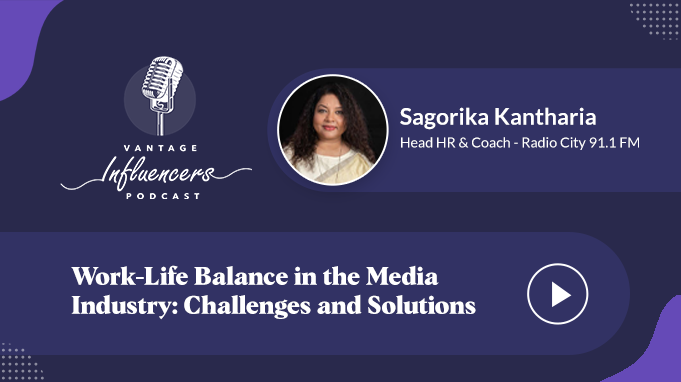
Work-Life Balance in the Media Industry: Challenges and Solutions
Episode Overview
Media newsrooms and radio stations do not run on a nine-to-five clock, and that reality shapes almost every conversation in this episode. Sagorika joins the podcast to unpack why work-life balance looks fundamentally different in media compared to most other industries: irregular shift patterns, high-pressure output deadlines, and a workforce that includes journalists, RJs, sales teams, and digital content creators all operating on overlapping but distinct schedules. Rather than treating flexibility as a perk, she frames it as an operational necessity for keeping people well while still hitting daily broadcast and publishing deadlines.
The conversation moves into the practical mechanics of building that flexibility responsibly. Sagorika describes how shift timing can be negotiated directly with reporting managers as long as the required work hours are completed, how work-from-home is extended selectively based on role and business need, and how a recurring "late sitting" analysis helps HR spot teams that are quietly overworking before burnout sets in. She closes with candid advice for HR professionals working in high-attrition, creative industries: retention starts with building a culture people are proud to stay in, not just policies that look good on paper.
Episode Highlights
- Media industry schedules are inherently irregular, spanning journalists, RJs, digital teams, and sales, which makes a one-size-fits-all work-life balance policy impractical.
- Employees can negotiate shift timing directly with their reporting officer as long as they complete the required work hours, giving them a sense of control over their day.
- Work-from-home is offered selectively. Roles that depend on studio-quality or in-person collaboration are treated differently from roles that can be handled remotely.
- HR runs a regular late-sitting analysis to identify departments consistently working extended hours, then has direct conversations with managers to determine whether it is a temporary spike or a structural workload problem.
- Employees get a small number of flexible early-leave or late-arrival days each month to handle personal needs without formal approval friction.
- Wellness initiatives span physical, mental, and financial well-being, including daily wellness tips, quarterly expert-led workshops, a 21-day habit-building challenge, and peer-led hobby masterclasses.
About the Guest
Sagorika Kantharia, CHRO, Radio City 91.1 FM
Sagorika has an overall work experience of over two and a half decades, almost entirely within the media industry. She started her career at Bennett Coleman and Co. Ltd and has since worked at multiple organizations, including Jagran Prakashan and KYO Human Resource Consultancy, building HR functions from the ground up and leading Radio City's climb from an unranked employer to a consistent Top 5 finisher in the Great Place to Work survey. She earned her Bachelor of Science from the University of Mumbai and her MBA from Jamnalal Bajaj Institute of Management Studies, and alongside her HR leadership work, she is also a certified ICF coach who has served in leadership roles with the ICF Mumbai Charter Chapter.
Connect with Sagorika on LinkedIn
Host
Susmita Sarma, Vantage Influencers Podcast Host
What You Will Learn
- Why work-life balance requirements differ so sharply in media compared to standard corporate environments
- How to structure flexible shift timing without compromising accountability
- When work-from-home should and should not be extended, based on role type
- How a late-sitting analysis can help HR catch burnout risk before it escalates
- Practical, low-cost wellness initiatives that touch physical, mental, and financial well-being
- What sustains long-term retention in high-attrition, high-pressure creative industries
Key Topics & Timestamps
| Timestamp | Topic |
|---|---|
| 01:05 | Background and journey in HR across media organizations |
| 06:19 | Unique challenges and rewards of working in the media industry |
| 10:12 | Managing employee expectations given the industry's fast pace and irregular hours |
| 12:35 | How Radio City approaches work-life balance in practice |
| 14:53 | Employee wellness and mental health initiatives at Radio City |
| 19:11 | Advice for HR professionals working in the media industry |
Full Transcript
Click to read the full episode transcript
In the fast-paced world of the media industry, maintaining a healthy work-life balance can be a big challenge. We are diving deep into this topic with our guest today to explore the unique hurdles and innovative solutions in the media world. Whether you are a part of this industry or simply curious about the dynamics, this conversation will surely provide valuable insights.
Hello everyone, you're tuned in to the Vantage HR Influencers Podcast. I'm the host, Susmita, and today I have with me a very special guest, Sagorika Kantharia, the head of HR and coach at Radio City 91.1 FM.
Susmita Sarma: Hi Sagorika, welcome to the Vantage Influencers Podcast.
Sagorika Kantharia: Hi Susmita, thank you for inviting me.
Susmita Sarma: Thank you so much for being here, Sagorika. Let's dive in. Could you start by sharing a bit about your background and your journey in HR?
Sagorika Kantharia: Yes, sure. As you would know from my profile, I've been a media HR professional throughout. The journey has been very interesting and rewarding. I've worked with journalists, RJs, the digital team, and of course our aggressive sales teams across the board, so it's been a lovely journey.
I started my career at a time when the organization was setting up its HR function from scratch, so I got to work on all kinds of assignments: setting policies, recruitment, performance management. I also worked on job evaluation, job roles, compensation benchmarking, and an all-India employee engagement program. I was also involved in launching a new publication, which was an exciting and important learning experience that laid the foundation for the work I do today.
In 2007, I joined Radio City at a very interesting phase, when the company was moving from seven stations to twenty-one, and later from twenty-one to thirty-nine. Again, the role was to set up the entire HR function: performance management, recognition, and a whole range of employee-friendly HR policies. One of the key mandates I was given was to create a compelling workplace and a great culture, and I'm proud to say we did. We went from not ranking at all in the Great Place to Work survey to being ranked in the Top 5 best companies to work for, competing with multinationals across banking, IT, and other industries.
Later, I also took on HR leadership for several business verticals under the parent group, building the HR practices for those units from the ground up, and they too became certified great places to work.
In my second stint, I rejoined the organization in 2022, at a time when the industry is going through a transition toward a radio-plus-digital strategy. I'm also working on some board-level assignments and setting up HR and culture for newer verticals. During a career break, I certified myself as an ICF-credentialed coach, served as secretary of the ICF Mumbai Charter Chapter, and currently co-lead group and team coaching there. That's been my journey so far.
Susmita Sarma: Yeah, pretty extensive experience in the media industry, Sagorika, having worked with several renowned organizations before your current role at Radio City. You have undoubtedly navigated various challenges and reaped significant rewards throughout your career. Could you share some insights into the unique challenges and gratifying experiences you've encountered in this dynamic industry?
Sagorika Kantharia: Yeah, I'd say challenges are really a forcing function. They push you to build new things, work on new ways of looking at a situation, and provide solutions. So I'll focus more on the rewards I've enjoyed through this journey in media: hiring the best talent for your organization and creating a culture people want to join. I can talk more about Radio City here because I built that up from scratch. People say that in their career, they want to work with Radio City at some point, because Radio City is known for its culture.
Media, as you'd know, has high attrition, so finding the right talent within the right turnaround time, so the business isn't impacted, while also creating a culture employees want to join and stay with, matters a lot. I'm proud to say that today, seventy to seventy-five percent of my senior leadership has grown from within, which reflects the kind of culture and grooming we've built. We've also been consistently ranked in the Top 50 companies to work for over the last ten years by the Great Place to Work survey, and moving from a rank of forty-five to the Top 5 has been genuinely gratifying. It's a survey employees themselves respond to, reviewing our ways of working, our policies, and our initiatives, so that recognition means a great deal. Personally, I've also been recognized by industry HR bodies for leadership contributions, which has been very gratifying too.
Susmita Sarma: I am personally very much drawn to the media industry. I was part of it earlier in my career, and it comes with some of the most incredibly talented individuals, which itself brings its own rewards. Dealing with professionals who wear many hats, from talent management to keeping pace with technological change, must be a thrilling experience.
Sagorika Kantharia: Yes, it is.
Susmita Sarma: Talking about work rhythms in the media industry, it's a very fast-paced environment that often involves irregular working hours, and the roles are in pretty high demand. How does Radio City effectively manage employee expectations and well-being given these unique aspects of the industry?
Sagorika Kantharia: Different departments work at different times to manage workflow, so what we do at Radio City is provide a lot of flexibility. We ensure discipline is maintained, but employees get a shift timing they can decide after discussing it with their reporting officer, as long as they complete eight hours of duty. Giving them that choice, confirmed with their manager, really helps.
We also have work-from-home options for employees who want to use them to manage work-life balance, and there have been times we've extended relief beyond the standard number of work-from-home days to help someone manage a crisis at home. When people have stretched themselves on certain assignments beyond normal work hours, we also try to give them compensatory time wherever possible.
We also run a late-sitting analysis to understand and prevent burnout. We look at which departments are consistently sitting late, and then have a conversation with the reporting officer to understand whether it's a temporary phase or a permanent one, and what can be done so employees aren't inadvertently spending long hours at work.
Susmita Sarma: As you've mentioned scheduling flexibility and work-from-home, balancing work and life is already a struggle for most professionals, but it must be particularly challenging in the media sector. Could you give us a glimpse behind the scenes of how your organization approaches this challenge, and any advice for others in the industry looking to achieve that balance?
Sagorika Kantharia: Today, work can genuinely be done from anywhere, but a few functions are the exception. For example, if certain technical roles work from home for a long period, the quality of the output can get affected. So some jobs can't be given long-duration work-from-home, but others can, where people can work remotely. If you can fix the accountability piece through clearly defined KPIs and monitoring, there's a possibility of offering work-from-home for exigencies. But whether it can be given for a long period, and for how many days, depends entirely on the business reality of each organization.
For example, in our organization, employees can take a day off or come in late or leave early, up to three or four times a month, which I think is adequate to manage work-life balance. If someone needs more than that, they can always talk to their reporting officer and send a note to HR. We also do something interesting that adds a surprise element: for locations that have achieved their revenue targets, we sometimes announce that everyone can leave two hours early to enjoy time with family or with their team. We do these kinds of things to energize the workplace and create happiness.
Susmita Sarma: If we talk about a very crucial aspect, mental health, especially given the intensity of media work, would you like to tell us about specific initiatives Radio City has implemented to prioritize employee well-being and mental health?
Sagorika Kantharia: Employee wellness has become very important today, given the rise in lifestyle diseases and the importance of mental well-being. We send out a daily wellness tip early in the morning that reaches everyone's desktop, so the moment someone switches on their computer, they see a tip of the day from our internal wellness channel. It might cover simple exercises to do during the workday, healthy food tips, meditation practices, or yoga postures that can help with certain areas of discomfort or weight management. We also cover how to improve mental health through these same channels.
We also run a quarterly wellness session, sometimes a webinar and sometimes an in-person workshop, where we invite experts to talk about lifestyle diseases and stress management, and employees can ask questions directly. We run a wellness initiative that's a habit-building and engagement program: a twenty-one day challenge where employees take part in physical, mental, and fun activities, often along with family members. The idea is that if you do something consistently for twenty-one days, you start to see the benefit and the habit sticks.
We also run hobby masterclasses once a month, where employees who are skilled in something like cooking, photography, or painting lead a session for their colleagues. Learning something new tends to leave people feeling more energized and mentally more agile, which supports mental well-being. Beyond mental and physical well-being, we also look at financial well-being, running organized sessions for employees on how to invest better.
Susmita Sarma: Some really exciting initiatives in place, Sagorika, and these clearly promote a culture of empathy and support.
Sagorika Kantharia: Correct, correct. The employee feels cared for.
Susmita Sarma: Definitely, and it sounds really impactful. Finally, as we wrap up, Sagorika, what valuable advice do you have for our fellow HR professionals in the media industry?
Sagorika Kantharia: I've been in media throughout my career, with a bit of time in the services industry as well, and I personally feel media is a very interesting, dynamic industry, and a lot of fun for HR precisely because it has high attrition. As an HR professional, if you're able to add value by identifying the right talent, supporting your organization, building a culture people want to join, retaining your high potentials, and building a system to keep bringing in and grooming more high-potential talent for the next level, that matters immensely. It's also a creative medium, and creative people tend to be very emotional, so being able to build a genuine one-to-one connection and stay tuned in to your employees is, in media, not optional. It's a requirement.
Susmita Sarma: Fantastic insights, Sagorika. Your valuable contributions have certainly enriched our discussion and given our listeners a wealth of knowledge. We're grateful to have had you as our guest today. Our audience might want to connect with you further, so would you like to share how they can reach out?
Sagorika Kantharia: Yes, of course. I'm available on LinkedIn, and also on Twitter, Facebook, and Instagram, so those are some ways people can look out for me.
Susmita Sarma: Brilliant, I'll tag your LinkedIn profile in the show notes of this episode. Thank you so much for being here with us today, Sagorika, it's been an absolute pleasure.
Sagorika Kantharia: It's my pleasure. Thank you so much for inviting me. It was lovely talking to you.
FAQ
Why is work-life balance particularly challenging in the media industry?
Media roles span journalists, RJs, digital teams, and sales staff, all working on overlapping but different schedules, often against tight daily broadcast or publishing deadlines. That irregularity makes a standard nine-to-five work-life balance policy difficult to apply uniformly.
How does Radio City give employees flexibility without losing accountability?
Employees can agree on shift timing directly with their reporting officer as long as they complete the required work hours. Work-from-home is offered where the role allows it, and a recurring late-sitting analysis helps HR flag departments at risk of overwork so managers can address the root cause.
What kind of wellness initiatives does Radio City run for employees?
Initiatives include a daily wellness tip sent to every employee's desktop, quarterly expert-led workshops on lifestyle and stress management, a 21-day habit-building challenge involving physical and mental activities, peer-led hobby masterclasses, and sessions on financial well-being.
What advice does Sagorika give to HR professionals working in high-attrition industries like media?
She emphasizes that value creation in HR comes from identifying and hiring the right talent quickly, building a culture employees genuinely want to join and stay in, retaining high performers, and creating a pipeline for grooming future leaders. In creative industries specifically, she stresses the importance of building a genuine one-to-one connection with employees.
Related Reading
Also listen on