
Somewhere on your calendar sits a meeting that will decide whether your employee recognition program gets funded or gets filed under "revisit next year." The program design will not decide that meeting. The pitch will.
Stakeholder buy-in for a recognition program means getting the people who control budget and priorities, usually finance, HR leadership, and department heads, to approve the program and champion it before launch. Each group asks a different question, and a single pitch that tries to answer all three at once usually convinces none of them.
This guide gives each of those three stakeholders their own answer, then shows you a pilot-first strategy that lowers the approval bar. Let's get you ready for the room.
Why Generic Stakeholder Buy-In Advice Falls Short for Recognition Programs
Generic buy-in advice fails recognition programs because it skips the one objection every recognition pitch runs into: the soft benefit problem. Map your stakeholders, communicate the vision, follow up. That playbook works for a payroll migration. It does not survive the moment a CFO asks, "How do we know this actually works?"
Here is the uncomfortable part. That skepticism is earned. Leadership teams have watched engagement initiatives arrive with fanfare and leave without a trace. When you walk in to pitch employee recognition, you are not just pitching your program. You are pitching against the reputation of every feel-good initiative that came before it.
And the timing makes executives warier still. Employee thriving at work has fallen to 44%, the lowest figure Mercer has ever recorded. Leaders know something is wrong with the employee experience. What they doubt is that one more platform will fix it.
The problem you are solving is real. Only 55% of employees feel truly recognized, according to The Recognition Effect, a Vantage Circle and Great Place to Work study covering 5.7 million employees. But a real problem is not the same thing as a funded program. To close that gap, you need to answer three different questions coming from three different chairs. Let's take them one at a time.
What Finance Stakeholders Actually Ask
A finance stakeholder evaluates a recognition program the way they evaluate any line item:
- What it costs per employee?
- What it returns?
- How that return will be measured?
- What happens if it underperforms?
Answer those four questions with numbers and you have their vote. Answer with "it boosts morale" and you have their polite silence.
A CFO cannot track morale. But, every CFO already tracks attrition. Lead with the number they own. Start the conversation there, because the do-nothing baseline is expensive: 77% of employees are not engaged or actively disengaged at work, according to Gallup. Disengagement already sits on the P&L. It just is not itemized.
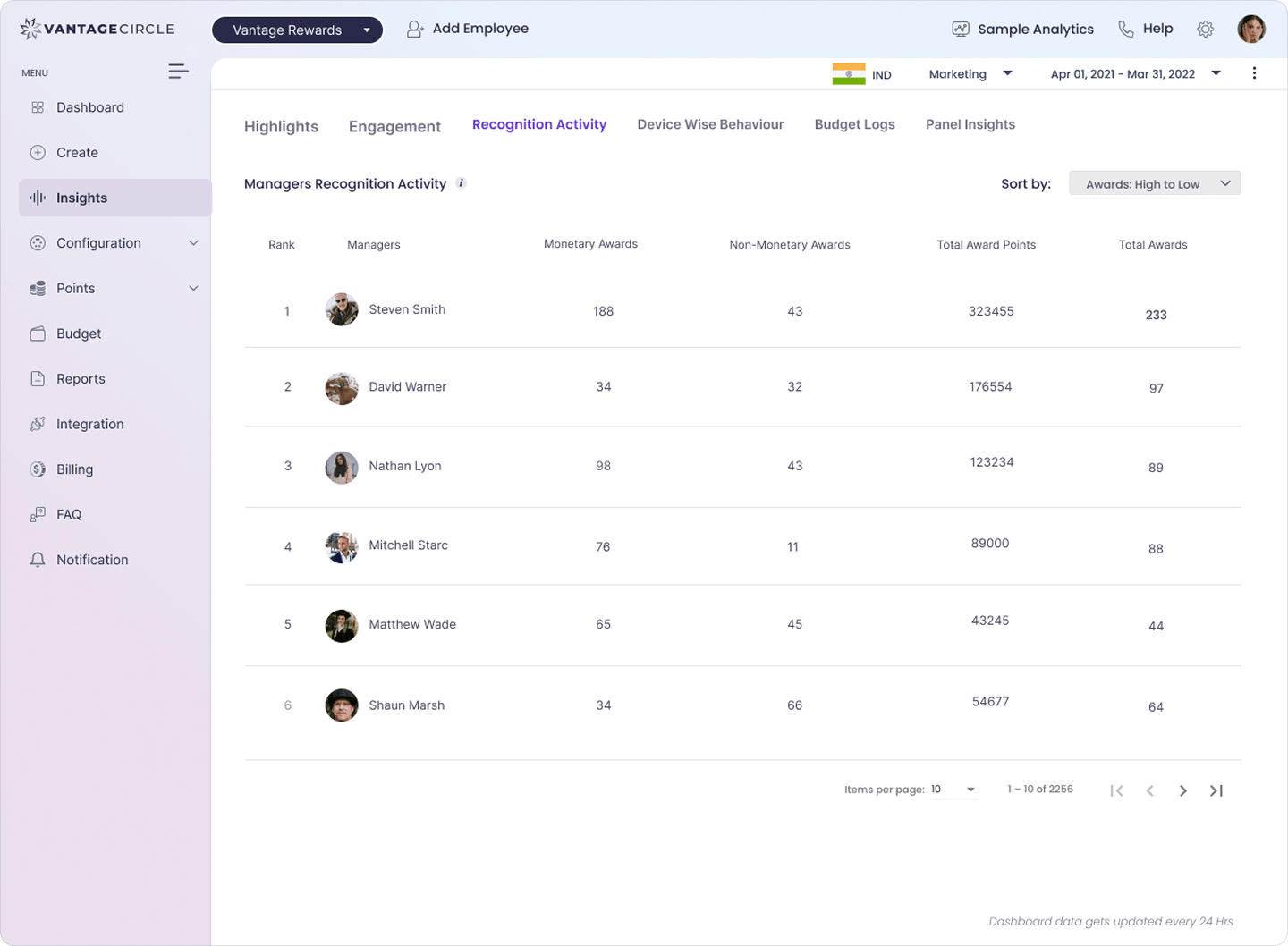
Then show how the return gets tracked. The ROI of employee recognition stops being a leap of faith the moment the program is instrumented from day one. Employee recognition platforms put participation, coverage, and spend on a live dashboard. That changes what you are asking finance to approve. Not a belief. A metric with a review date.
One note on the approval chain, because it rarely matches the tidy version on the org chart. In many mid-market companies, HR does not hold discretionary budget of its own. Finance releases spend quarterly, and in founder-led firms the final confirmation often sits with someone who thinks in payback periods, not engagement scores. So build your pitch in the currency of that chain: an all-in cost per employee per year, a payback window, and the quarter in which you expect the first measurable movement. A pitch that anticipates the CFO's sign-off sequence reads as operational maturity before you have said a word about recognition.
Here are the four questions to prepare for, and the shape of a good answer to each:
| Finance Question | How to Answer It |
|---|---|
| What does this cost per employee per year? | Give one all-in number: platform, rewards budget, and admin time. Never make finance assemble the total themselves. A number they discover later reads as a number you hid. |
| What return should we expect, and by when? | Anchor on retained employees. Cost of one exit times exits prevented is arithmetic a CFO can check on a napkin. Commit to a measurement date, not just a multiple. |
| How will we track whether it is working? | Name the three metrics you will report each quarter: participation rate, recognition coverage, and eNPS movement against a pre-launch baseline. |
| What happens if it does not work? | Define the exit upfront: if the pilot misses its targets by the review date, it does not scale. An offer to kill your own program is the most credible thing in your pitch. |
What we've seen: Vantage Circle's ROI model, built on client program data, works with three scenarios. A conservative program reduces turnover by 10% with a 2% productivity gain. A realistic one reaches 15% and 4%. A best-case program hits 22% and 7%. And the retention gap is stark: recognition-driven cultures report 92% retention against 76% in low-recognition cultures (The Recognition Effect). At L&T Technology Services, the program reached 93% employee participation.
Not Sure Which R&R Platform Is Right for You?
Our Buyer's Guide covers everything you need — evaluation criteria, must-ask vendor questions, and a side-by-side comparison framework.
Download the Buyer's GuideWhat HR and CHRO Leadership Actually Ask
A CHRO is not approving a rewards budget. They are approving a culture investment, and their real question is whether this program reinforces the strategy they have already committed to or becomes one more disconnected HR tool.
So do not pitch the CHRO on appreciation. Pitch them on reinforcement. When recognition is tagged to specific company values, every recognition moment becomes a public, visible vote for the behavior the strategy needs. The values stop living on a poster and start showing up in the feed, week after week, with names attached.

Vantage Influencers Podcast
"The goal of the employer recognition in the workplace is really to reinforce particular behaviors, practices, activities that result in better performance and ultimately give us positive business results."
— Kyle Chetty, HR executive and Young CHRO of the Year awardee
Listen to the EpisodeThe second thing a CHRO wants is board-ready proof, and the category has moved well past the unproven stage. Vantage Circle's State of Recognition and Rewards 2025 report found that the organizations with the most effective programs are not the ones spending the most: 84% of high-effectiveness programs spend under $100 per employee per year, and they run recognition that is broader, fairer, and embedded in daily culture rather than bolted on. Your CHRO is not being asked to bet on an unproven category. The most effective programs have already shown what good looks like. The bet is only on execution.
Close this conversation with measurement, because a CHRO who reports to a board thinks in baselines. Show how you plan to start aligning recognition with business outcomes from day one: one strategic outcome, one baseline number, one quarterly report.
What Department Heads Actually Ask
A department head asks the most practical question in the building: "Will my team actually use this, or am I about to inherit another tool I have to police?" They have seen platforms arrive with mandatory training and die within a quarter. Their skepticism is operational, not financial.
Your answer has two parts. First, adoption friction. Peer-to-peer recognition is the lowest-friction feature in any recognition program, because it asks employees to do something they already want to do: thank a colleague, publicly, in under a minute. Nobody needs a training session to accept appreciation. That makes peer recognition the easy first yes, and the department head's team feels the program working before anyone asks them to change a habit.
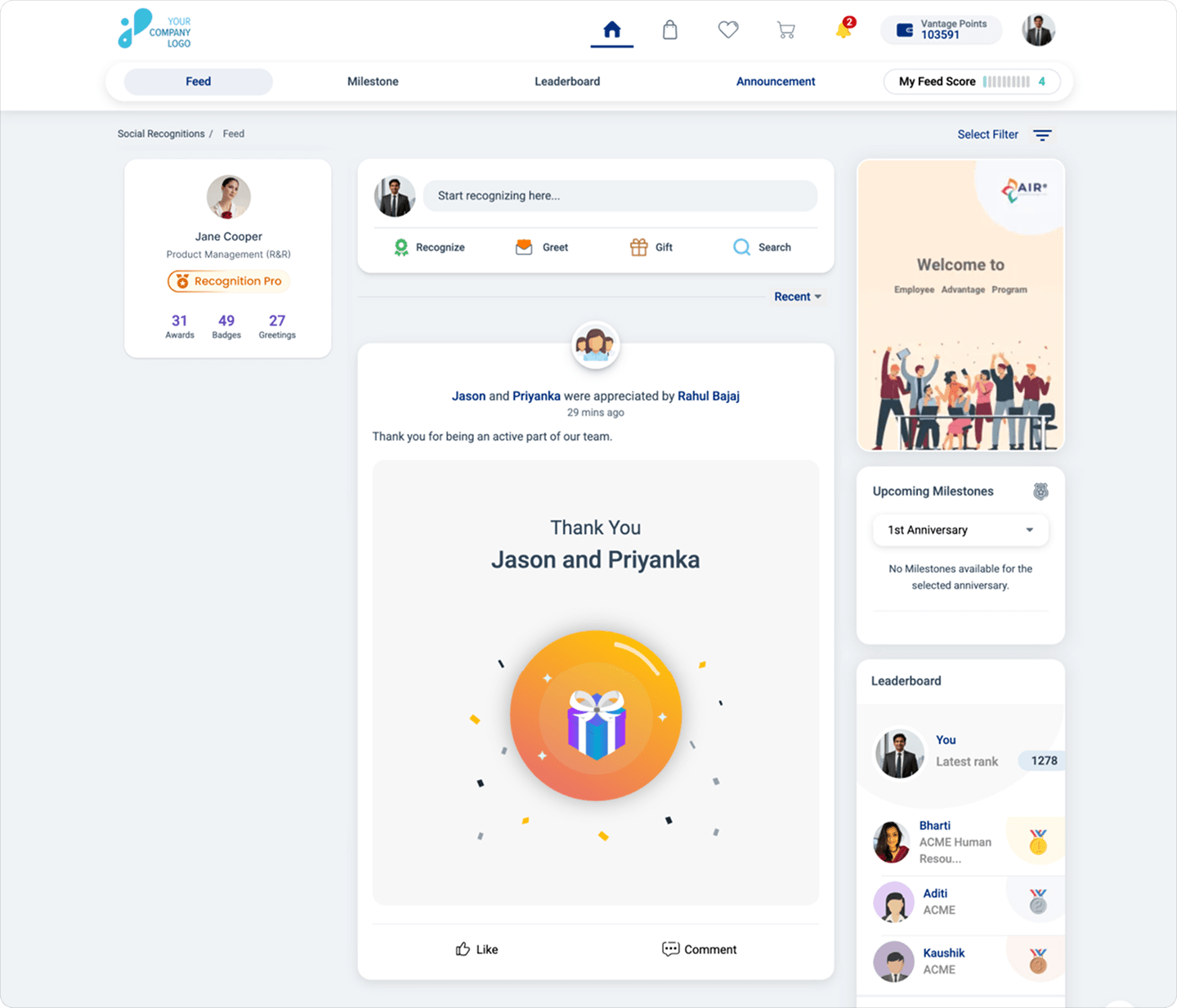
Second, what is in it for them. A department head running a recognized team gets something rare: visibility into morale before it becomes a resignation letter. The recognition feed shows them who is lifting the team and who has gone quiet. Frame the program as a leading indicator they get for free, not a channel they have to feed.
One warning: do not promise department heads zero effort. Their managers will need to give recognition too, not just receive reports about it. Say so in the pitch. Surprising a stakeholder after approval costs more trust than a hard truth before it.
The Pilot-First Strategy: Lowering the Approval Bar
The fastest way to win approval for a recognition program is to stop asking for the whole program. Propose a single-department pilot with a defined budget, a 90-day window, and success metrics agreed before launch. You are no longer asking leadership to believe. You are asking them to let you prove.
The psychology of this move matters more than the mechanics. A company-wide rollout is the hardest possible version of your ask: maximum budget, maximum risk, zero evidence. A pilot inverts all three. The budget shrinks to a rounding error, the risk is contained to one team, and the evidence problem becomes the pilot's entire job. Most stakeholders who would argue with your conviction will not argue with your experiment.
A pilot worth approving has four elements:
- One department, deliberately chosen. Pick a team whose leader already wants this. A pilot fighting an unwilling manager tests the manager, not the program.
- A baseline taken before launch. Run a pulse survey first. Without a pre-launch eNPS number, your post-pilot number has nothing to prove itself against.
- Three metrics, agreed in writing. Participation rate, recognition coverage, and eNPS movement. Whatever you choose, choose it before launch. Metrics picked afterward convince nobody.
- A review date with teeth. The pilot scales if it hits the targets and stops if it misses them. Put that sentence in the proposal. It converts you from an advocate into an operator.
Then let compounding work for you. Programs that start scoped tend to grow on their own evidence. Qualitest, for instance, recorded a 60% increase in participation since launch. A pilot that works does not need you to argue for the rollout. Its own numbers make the second pitch.
A Simple Framework for Structuring Your Pitch
Structure the pitch as four short conversations, not one long presentation: open with the business problem, give each stakeholder their own answer, and close with the pilot ask. The table below is the whole strategy on one page.
| Stakeholder | What They Care About | Your Opening Line |
|---|---|---|
| Finance / CFO | Cost per employee, measurable return, a tracked exit clause | "This pays for itself if it prevents a handful of early exits a year. Here is the dashboard that will tell us whether it does." |
| CHRO / HR leadership | Culture strategy reinforcement, board-ready measurement | "We already agreed culture is a priority. This makes the values on our wall show up in the feed every week, with a baseline to prove it." |
| Department heads | Team adoption, low admin burden, early visibility into morale | "Your team uses this in under two minutes a week, and you see who is thriving and who has gone quiet before it shows up in attrition." |
| CEO | Retention, productivity, competitive position on talent | "Attrition is a number we already report to the board. This is the cheapest lever we have not pulled yet." |
Two sequencing rules make this framework land. First, meet your toughest stakeholder alone before the group meeting. A CFO who has already stress-tested your numbers in private becomes your validator in the room instead of your obstacle. Second, end every conversation with the same small ask: the pilot. Different stakeholders can want different things from the program and still say yes to the same experiment.
What Comes Next
Winning the budget comes down to three moves: translate one program into three stakeholder-specific pitches, lead with tracked metrics instead of morale language, and shrink the ask to a pilot that carries its own evidence.
But budget approval solves exactly one problem. The day the program goes live, a new one starts: getting managers to actually use it, week after week, and that is a very different pitch to a very different audience.
And if you want to walk into your budget meeting with a live dashboard instead of a promise, book a demo and build your pitch on real numbers.
Frequently Asked Questions
How to obtain buy-in from stakeholders?
Identify who controls the decision, learn what each of them is measured on, and translate your proposal into their metric. For a recognition program, that means a cost-and-return story for finance, a culture-reinforcement story for HR leadership, and an adoption story for department heads. One pitch per stakeholder beats one pitch for everyone.
How to get buy-in for a project?
Shrink the ask until saying yes feels safe. Propose a scoped pilot with a defined budget, agreed success metrics, and a review date instead of a full rollout. Stakeholders who resist a company-wide commitment will often approve a low-risk experiment, and a successful experiment makes the larger approval argue for itself.
How to get stakeholders involved in a project?
Give each stakeholder a role in defining success, not just a summary after the fact. Ask finance to set the ROI threshold, HR leadership to pick the culture metric, and department heads to nominate the pilot team. People defend targets they helped set, and involvement before launch is what turns approvers into champions.
How long does it take to see ROI from a recognition program?
Expect the first proof within one quarter and the financial story over three or four. Participation and coverage data show up within the first 90 days, which is why a pilot works on that window. Movement in retention and eNPS builds more slowly, so commit finance to a staged review rather than a single verdict date.
Should I ask for a pilot budget or the full program budget?
Ask for the pilot budget. A scoped single-department pilot lowers the approval bar, contains the perceived risk, and generates the evidence the full budget conversation needs. The only common exception is when leadership has already seen recognition work elsewhere and asks you to scale from day one.

Nilotpal M Saharia is an Assistant Manager, Content Marketing at Vantage Circle and a recognition-and-rewards (R&R) strategist with 9 years of experience spanning Marketing, HR, and content strategy. He helps HR leaders turn employee recognition and leadership research into practical workplace programs.
Connect with Nilotpal on LinkedIn.