

I once managed two teams that sat four desks apart. One had been together for three weeks. The other had nearly three years behind it. Same office, same quarterly targets. The new team brought me every question. The older one mostly needed me out of the way.
Psychologist Bruce Tuckman described that gap back in 1965. His model still explains most of what I see on teams today. I've written this for a manager with a live team. Each stage comes with the signs to look for and what to do this week.
Key Takeaways
- Tuckman named four stages in 1965. Adjourning joined them in 1977, in a paper with Mary Ann Jensen.
- Storming gets rushed. In my experience the skipped argument shows up again in deadline week.
- Monday's standup tells you the stage. The diagnostic table below lists the phrases to listen for.
- One new hire is enough to pull a settled team back toward forming.
- Recognition should change by stage. In week one I thank whoever asks the first awkward question. At close-out the shout-out names the result first, then the people.
What Are the 5 Stages of Team Development?
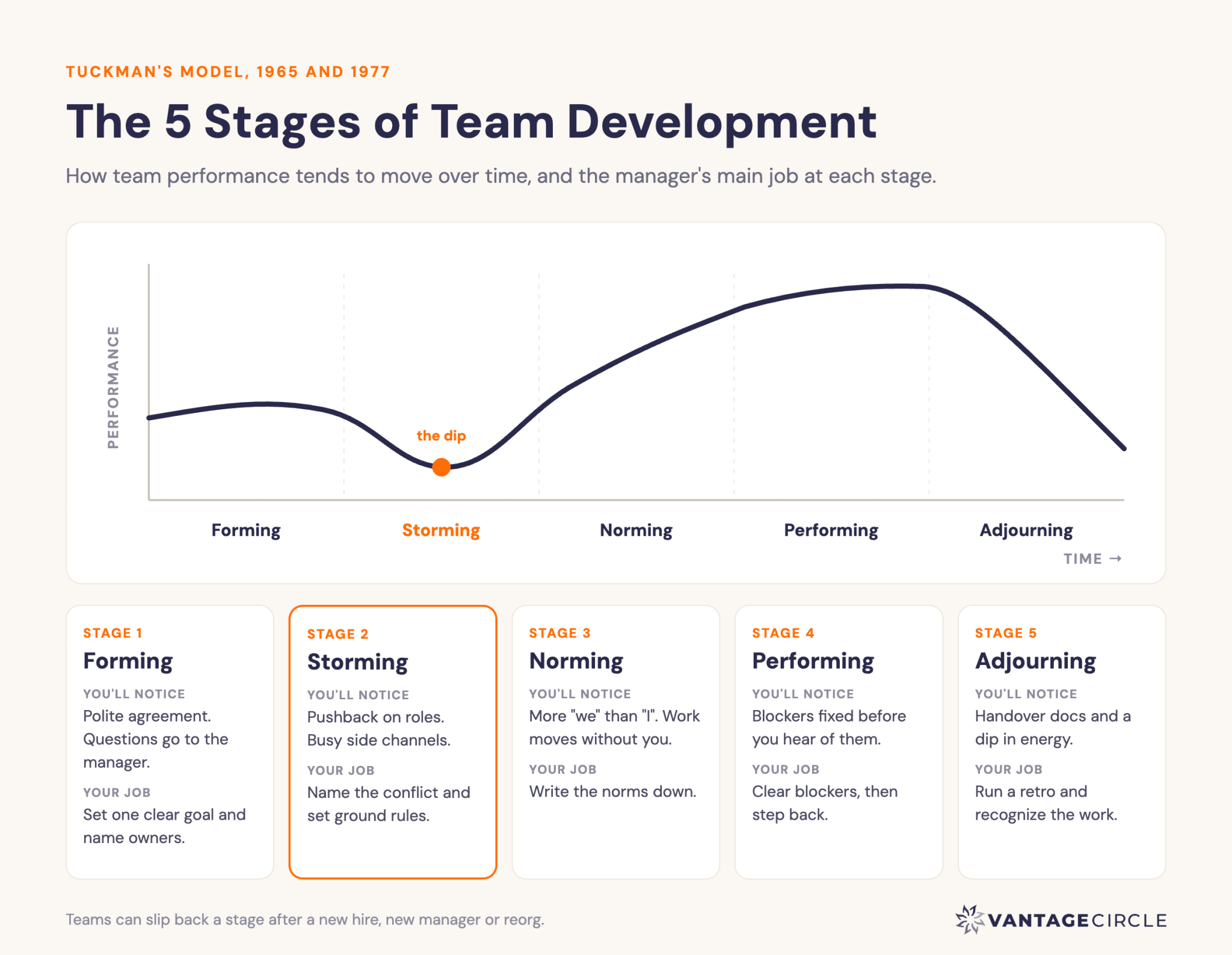
The 5 stages of team development are forming, storming, norming, performing and adjourning. Bruce Tuckman, a psychologist, published the first four in 1965. Adjourning came in 1977, from Tuckman and Mary Ann Jensen. In plain terms, a team starts out polite and unsure, then gets through a rough patch of conflict. Its best work comes after that. The last stage is the wrap-up.
In 1965 Tuckman worked at the Naval Medical Research Institute. He read through 50 published studies of how groups change over time and found a pattern. That review became Developmental Sequence in Small Groups, printed in Psychological Bulletin.
The fifth stage arrived twelve years later. Tuckman and a co-author, Mary Ann Conant Jensen, went back over the newer research and decided groups needed an ending stage too. Their paper, Stages of Small-Group Development Revisited, appeared in Group & Organization Studies in 1977.
| Stage | What it looks like | The leader's main job |
|---|---|---|
| Forming | Polite and cautious. Questions go to the manager | Set the goal. Make roles clear |
| Storming | Pushback on roles and priorities | Surface the conflict and give it ground rules |
| Norming | Shared habits form and trust grows | Get the norms written down |
| Performing | The team solves its own problems | Clear blockers, then stay out of the way |
| Adjourning | The work ends and people move on | Run a proper close-out |
Source: Vantage Circle
For activities matched to a stage, try our guide to types of team building. It sorts them by purpose.
The 5 Stages, One at a Time
Every stage below starts with what you'll notice on the team. Then it moves to what I'd actually do about it.
1. Forming: The Polite, Uncertain Start
The forming stage is a new team's first few weeks. Most of the questions still land on the manager's desk.
Nobody wants to be first to object in meetings. People agree fast because nobody knows yet where the lines are. Questions about scope come straight to you.
Three moves help most here:
- One sentence for the goal. I ask two people to repeat it back. Different versions mean it's not clear yet.
- Owners, by name. Fuzzy roles turn into turf fights by week four.
- Something finished by week two. A small shipped task gives people their first shared story.
The first person who asks a "dumb" question out loud. Also the teammate who answers it before you get the chance.
When people don't agree on what success looks like, start with team alignment. A low-stakes team building activity in week one helps too. People learn who talks first and who needs a minute.
2. Storming: The Argument Phase
The storming stage usually shows up around week three or four, once people stop being polite. People push back on roles and priorities. Sometimes they push back on each other.
Most managers I've worked with try to shorten this stage. I used to as well. I'd smooth over a tense meeting with a quick compromise and call it handled. Two weeks later it came back. Same argument, now in a one-on-one, with a grudge attached.
Deadlines slip. Usually it's two people arguing over who owns a task. Side channels get busy. One person usually goes quiet in meetings. That's the sign I watch hardest.
Name the conflict out loud. "We disagree on priorities, let's settle it Thursday" lowers the temperature more than any amount of smoothing. Then agree on how the team disagrees. One rule I've kept for years: a complaint goes to the person before it goes to anyone else.
Skipping storming is the classic mistake. The disagreement moves into DMs and returns around the first missed deadline.
People who disagree openly and well. Picture the engineer who calls out a bad estimate in sprint planning. Thank her in the team channel that afternoon, by name. Everyone watching learns that pushing back is safe here. Our psychological safety guide covers the rest.
A two-question anonymous pulse helps too. I ask "I can disagree openly on this team" and "My role on this team is clear" on a 1-to-5 scale. A low score on the first, with no visible conflict, usually means the storm is happening somewhere I can't see. Vantage Pulse runs these with anonymous responses. Nobody's name sits next to a low score, and during storming that gets you honest answers.
3. Norming: Shared Ways of Working Take Hold
The norming stage is when the team settles how it works and starts trusting each other's judgment.
You'll hear "we" more than "I." Work changes hands without anyone checking with you first. Arguments still happen. They end with a decision now.
Write the norms down while they're fresh. A half page on response times and how decisions get made is plenty.
Gartner's research shows why this matters. Only 29% of employees are satisfied with their collaboration at work. In 2021 it was 36%. The figure comes from a Gartner survey of nearly 18,000 employees in the second quarter of 2024. Gartner's analysts blamed uncertain connection norms, among other things. Norming is the stage where a team sets those norms for itself.
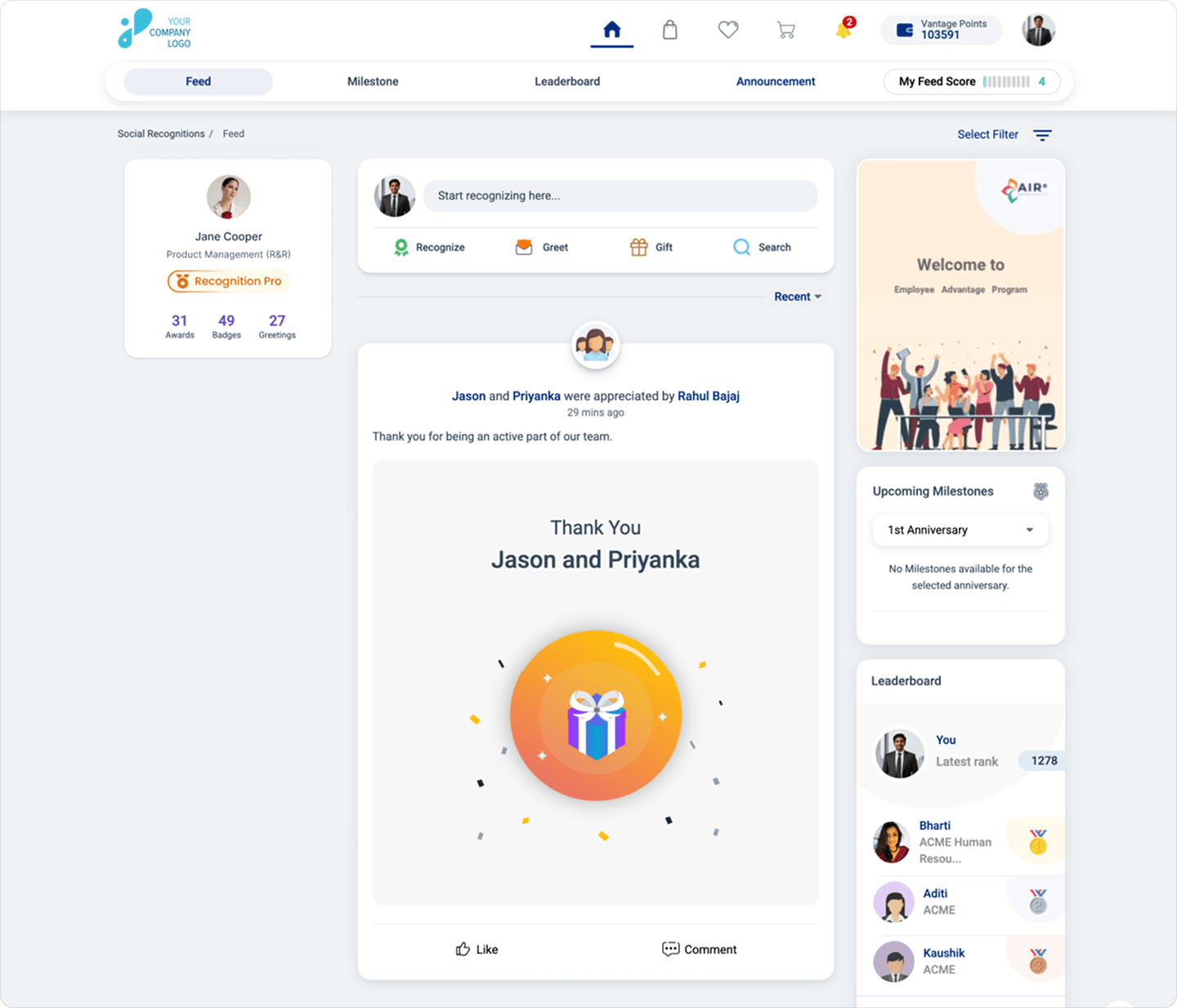
The behaviors that became norms. Say a teammate thanks someone on a shared feed for "flagging the risk early," tagged to the company's Collaboration value. Everyone reading learns how this team works. Vantage Rewards supports exactly this kind of peer-to-peer recognition, with each shout-out carrying a core value badge.
For more on holding a settled team together, see our guide to team cohesion.
Source: Vantage Rewards
4. Performing: High Output With Little Supervision
The performing stage is when the team solves problems on its own and delivers week after week.
You notice it in small ways. A blocker gets fixed before you hear about it. Planning ends ten minutes early.
Clear the blockers only you can clear. Then hand the team a harder goal before boredom sets in.
A performing team still has gaps. In McKinsey's team research, the well-performing teams were very good at 11 of the 17 behaviors measured, on average. Nobody scored perfectly.
The team result and the people who unblocked it. Performing teams get less of your attention by design. They notice. A manager shout-out that names the outcome and one specific person's fix keeps that from turning into feeling taken for granted. Our guide to high-performing teams goes deeper on this stage.
5. Adjourning: Closing Out and Letting Go
The adjourning stage is when the work ends and the team breaks up or moves on. Project teams hit it on a date. Permanent teams hit a version of it during reorgs.
People feel it more than managers expect. A team that shipped something hard together loses its daily rhythm overnight.
Run a retro before people scatter. Capture what worked in a doc the next team can actually find. Then close out with recognition. Vantage Circle's own research points at how.
79% of high-effectiveness recognition programs recognize both the team and standout individuals when celebrating collective achievements, compared with 37% of other programs, according to The State of Recognition & Rewards 2025 (Vantage Circle).
In practice, the close-out message names what the team shipped. Then it names the three or four people who carried the hardest parts.
A one-week close-out campaign on a shared recognition feed gives everyone a place to thank each other before they move to new projects. The thread stays on the feed for whoever inherits the work.
A three-line close-out shout-out
- What the team delivered, with one number attached.
- The two or three people whose work made it possible, and what each one did.
- One habit the next team should copy.
How to Tell Which Stage Your Team Is In
Listen to your next team meeting. The phrases people use give away the stage faster than any survey.
| Stage | What you hear | What you see |
|---|---|---|
| Forming | "What exactly do you need from me?" | Quick agreement. Questions go up to the manager |
| Storming | "Who decided that?" | Missed handoffs and busy side channels |
| Norming | "Let's stick to what we agreed." | Work moves between teammates without you |
| Performing | "Already fixed it." | Steady delivery, few escalations |
| Adjourning | "Who's picking this up after us?" | Handover docs and a dip in energy |
Most teams show signs from two rows at once. Go with the row that matches what you heard most this week.
Your own read deserves some suspicion. McKinsey's study of 110 teams found that team leaders rated their teams more favorably than members did on most of the drivers measured. I've been that leader. My "norming" team was still storming in the DMs.
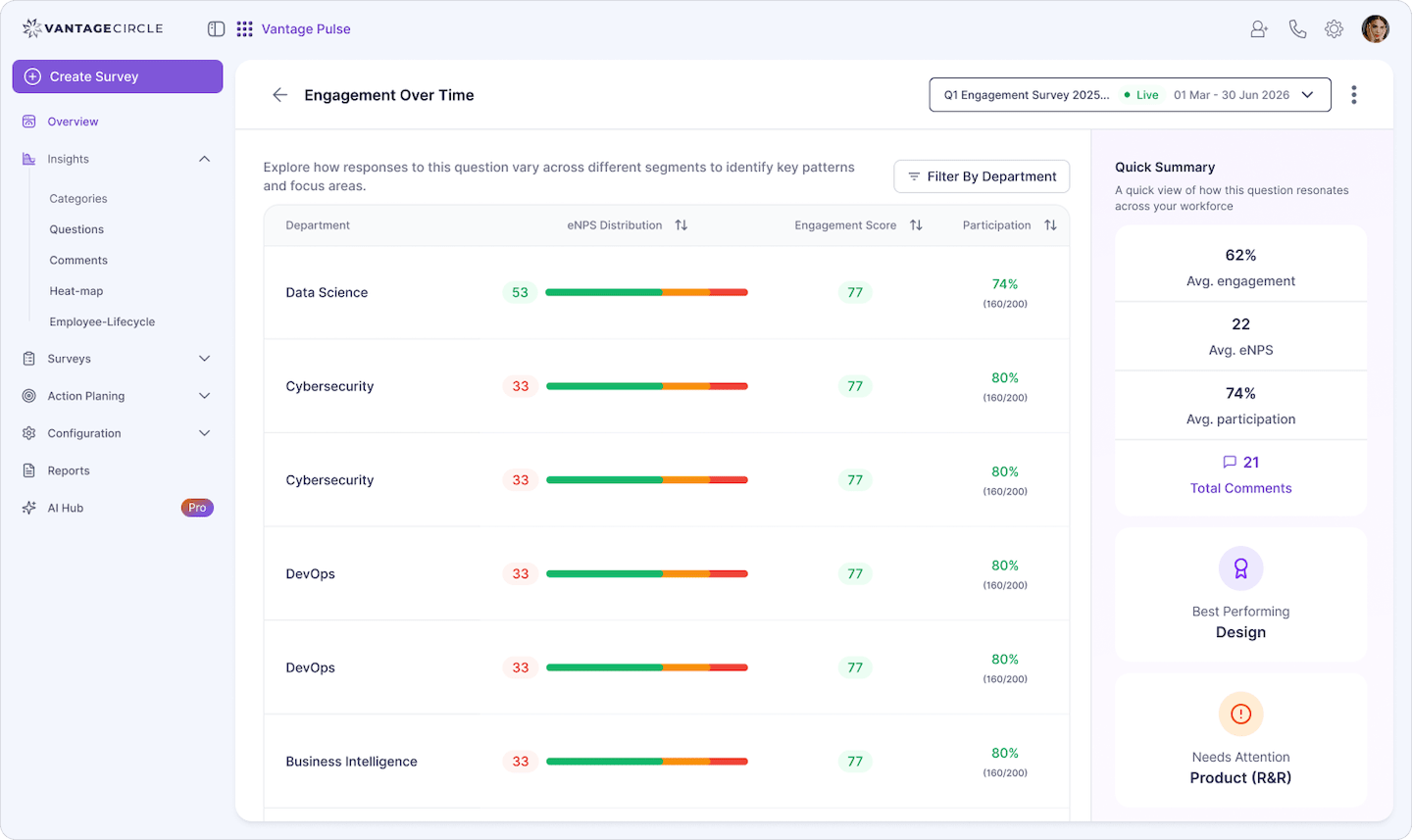
Splitting a short pulse by department helps here. Vantage Pulse's department-wise insights show which teams score low on "I can disagree openly" without asking managers to grade themselves.
Why Teams Slip Back a Stage
Teams move backwards when something basic changes, usually the people or the goal. Most slide back to forming or storming.
- One new hire. Even a strong one. The team has to explain norms it stopped saying out loud months ago.
- A new manager. Trust built with the old manager stays with the old manager.
- A reorg or a merged team. Two sets of norms now compete. Storming tends to return within weeks.
- A new goal. Roles that felt settled get reopened.
- A move to remote or hybrid work. The next section covers that one.
Sanjeeva Maithani has watched the new-hire version play out many times.

VANTAGE INFLUENCERS PODCAST
"Each team, which is established, goes through the usual process of forming, norming. So, therefore, once they are established, a new member finds settling in the team difficult because of various reasons. One, he or she has to understand what is the team culture, whether the team is result oriented, process oriented, who has what kind of personality, what is the communication style?"
Sanjeeva Maithani, VP, Performance & Rewards, HR Tech, HRSS & Global Mobility, Zensar Technologies
Listen to the EpisodeA new manager is the other common trigger. Forty percent of managers with two years or less of experience are struggling to support their team. That's from a Gartner survey of nearly 3,200 managers in January 2023. Hand one of them an inherited team and the slide toward forming gets steeper.
Adam Massman, Chief People Officer at Netchex, starts with one question when a leader says a team has stalled.

VANTAGE INFLUENCERS PODCAST
"My first question I asked them is, how much trust have you built with that team? And I always get an immediate pause... Trust can be built, it can be actually built pretty quickly, if you find creative ways to have fun together and to get to know the people on your team in a way that they feel comfortable."
Adam Massman, Chief People Officer, Netchex
Listen to the EpisodeMcKinsey's numbers back him up. Teams that scored above average on trust were 3.3 times more efficient than teams below average. They were also 5.1 times more likely to produce results. The research covered 110 teams and 905 team members across 42 countries, published in McKinsey Quarterly in October 2024.
When a team slips, I run a mini forming week. The goal gets restated in the first meeting. The new person hears the unwritten norms said out loud, maybe for the first time. Trust comes before anyone sees a roadmap.
A month after someone joins, check whether they've given or received any recognition. Zero usually means they haven't been let into the team yet. Recognition analytics in Vantage Rewards shows that at a glance.
The Stages on Remote and Hybrid Teams
Remote teams go through the same five stages. Storming changes the most. The conflict moves into DMs, or into silence.
Distance also thins out the feedback a team runs on. Harvard economist Amanda Pallais and her co-authors studied software engineers at a Fortune 500 firm from 2019 to 2024. Sitting near teammates increased coding feedback by 18.3%. They also found that when a new hire turned a co-located team into a distributed one, feedback between the original teammates dropped sharply. The paper is The Power of Proximity to Coworkers, revised in 2026.
Here's how each stage shifts once the team is spread out.
Forming takes longer. There's no hallway. Book short one-on-ones between teammates in week one.
Storming hides. Cameras go off. Replies get shorter and more formal. Treat a sudden drop in Slack messages as a signal worth a call.
Norming needs writing. A norm that lives in one person's head never reaches the colleague three time zones away.
Performing looks quiet from the outside. Check on outcomes and leave the hours alone.
Adjourning often gets skipped entirely. A Slack channel gets archived and that's the end.
Recognition gaps widen remotely as well. Fully remote employees are 52% more likely to feel undervalued than hybrid workers. That comes from Aon's 2025 Employee Sentiment Study of more than 9,000 employees in 23 geographies. Our guide to virtual teams has more on keeping distributed people connected.
Source: Vantage Pulse
Limits of the Tuckman Model
The model describes how groups tend to develop. It was never meant as a checklist to run in order.
Tuckman built it from a review of 50 studies. Many of them were therapy groups and short lab experiments. A product team with a launch date is a different animal.
When Tuckman and Jensen revisited the model in 1977, they found 22 newer studies. Only one of them set out to test the stages directly.
Real teams overlap stages and slide back. I still reach for the model most weeks, mostly as a way to name what I'm seeing.
Conclusion
Your team is in one of these stages right now. Possibly two.
Find the row in the diagnostic table that matches this week's meetings. Then do one thing from that stage's section before Friday.
FAQs About the Stages of Team Development
Q. What is the Bruce Tuckman model for team development?
A. A description of how small groups develop over time. Tuckman published forming, storming, norming and performing in 1965. Adjourning followed in 1977, co-written with Mary Ann Jensen.
Q. What are the phases of teamwork?
A. Most people mean Tuckman's five stages. Teams start uncertain and work through conflict before they settle and deliver.
Q. What is the storming stage in project management?
A. The stretch after kickoff when the project team argues over scope and ownership. Agreeing on decision rights early keeps it short.
Q. Can a team go back to an earlier stage?
A. Yes, often. A single new hire can do it.
Q. How long does each stage of team development last?
A. There's no fixed length. Some project teams clear forming in a week. Others sit in storming for months when nobody addresses the conflict.
Q. Which stage of team development is the hardest?
A. Storming, for most managers I know. It's uncomfortable, and the pull to skip it is strong.
Q. What is the difference between a group and a team?
A. Shared accountability. Group members work alongside each other on separate goals. A team owns one result together. More in our guide to building an effective team.
Written by


