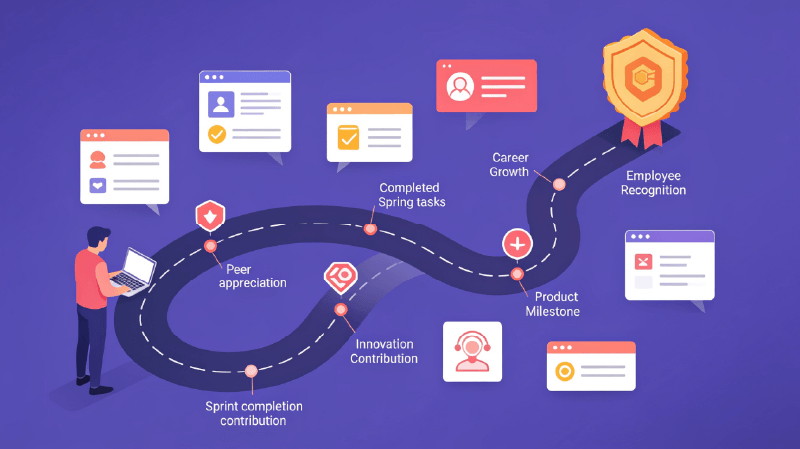
Sara, a project manager, delivered a flawless product launch. The leaders were pleased, but nobody had it in them to appreciate her. By the end of the week, no one breathed a word to her, let alone appreciate. Three months later, she took a recruiter's call.
Her manager wasn't indifferent. The company had a recognition platform. The dashboard functioned well. But the system wasn't equipped to catch the moments that matter, and Sara's moment slipped through.
If your eNPS is flat, retention isn't improving, and recognition feels like a checkbox, chances are, Sara's story is probably happening in your organization right now.
To grasp the underlying reason and what to do about it, this blog will be a great asset. You'll find the complete five-component recognition program framework, a five-stage maturity model to pinpoint where your program stands today, and a 30-day plan to close the gaps.
What a Complete Recognition Program Framework Actually Contains
Do you know which components complete the recognition program framework?
These five interdependent components include:
- Peer-to-peer recognition
- Milestone and Service awards
- Manager-driven recognition
- Value-tagged spot rewards
- Analytics and Operating cadence layer
Eliminate any one component, and the gaps start forming. Over time, these gaps grow worse.
The word "framework" is stressed here because many mistake a framework for something it is not. A software platform is not a framework. A policy document is not a framework. A framework is a structure in which each part performs a specific role, and the components strengthen one another.
The five components aren't interchangeable. Each one solves a different problem associated with employee experience:
- Peer recognition solves the volume problem. Appreciation should go hand-in-hand with the frequency of work, not once a quarter.
- Milestone and service awards solve the tenure problem. Long-term commitment deserves visible, meaningful acknowledgment.
- Manager-driven recognition solves the relationship problem. Employees need to know their direct manager sees and values them.
- Value-linked spot rewards solve the alignment problem. Recognition should reinforce the behaviors the organization wants to propagate.
- Analytics solves the visibility problem. The absence of data makes recognition invisible to leadership and impossible to improve.
A well-crafted employee recognition program always considers these five components as a unified system, not a menu. Simply choosing two or three produces partial results. Over time, it erodes confidence in the entire investment.
The Starting Point Trap: Why Most Programs Stop at Stage 2
Before we move ahead, it's necessary to contemplate why many programs do not move beyond stage 2.
To be very honest, the first two components are the easiest to launch, measure superficially, and demonstrate leadership in the existence of a program. The trap here is not laziness, but it's the absence of a maturity model that shows what comes next and why it matters.
Launching a peer-to-peer recognition platform and setting up service awards will yield immediate positive feedback. Employees post recognitions, managers comment, followed by leaders witnessing the activity dashboards and feeling confident.
However, what you don't realize is that the problems start surfacing 12 to 18 months later. Participation stagnates, and the same employees keep getting recognized, with eNPS scores barely moving.
The four reasons why programs stall are all about structure, not behavioral.
4 Reasons Programs Stall
| Reason | What It Looks Like | What It Costs You |
|---|---|---|
| Component incompleteness | P2P and service awards are live; manager recognition, value tagging, and analytics are absent | Recognition volume is high but behavioral change is low; no signal ties appreciation to company values |
| No measurement infrastructure | Participation rates are tracked but not segmented by team, manager, tenure, or demographic | Blind spots persist; high-risk flight segments go undetected until resignation |
| Manager disengagement | Managers view recognition as an HR responsibility, not a leadership tool | Employees feel unseen by the person whose opinion matters most; turnover risk rises in high-performing teams |
| Recognition-strategy disconnect | Awards exist for tenure, but not for the specific behaviors the company is trying to scale | Culture reinforcement fails; employees cannot decode what "good" looks like from recognition patterns |
With the right architecture, every one of these failure modes is preventable. But the gap won't be visible to you until you know what a complete framework looks like.
The Completeness Test: Score Your Program in 60 Seconds
Answer yes or no for each question:
- Does your program include a formal mechanism for manager-initiated recognition, separate from P2P?
- Can employees and managers tag recognitions to a specific company value?
- Do you track participation rates segmented by team, department, or manager?
- Do you have a recognition operating cadence (scheduled campaigns, cultural moments, or goal-linked sprints)?
- Do you measure recognition's impact on engagement or retention through a regular survey signal such as eNPS?
Score: 4–5 yes = Stage 3 or above. 2–3 yes = Stage 2. 0–1 yes = Stage 1.
Use the maturity model below to find your next move.
The Recognition Program Maturity Model: 5 Stages from Ad-Hoc to Embedded
The recognition maturity model has five stages, ranging from no formal program at Stage 1 to full embedding of recognition in company culture at Stage 5. Each stage builds on the one before it. Knowing where you stand is the first step to understanding what to build next.
Recognition Program Maturity Model
| Stage | Defining Behaviors | Components Present | Typical Company Profile |
|---|---|---|---|
| Stage 1: Ad-hoc | Recognition happens informally, driven by individual manager discretion; no platform, no policy, no consistency | None (goodwill only) | Early-stage startups, SMBs under 50 employees, with no HR infrastructure |
| Stage 2: Foundational | Peer-to-peer platform is live; service awards exist at defined tenure milestones; participation is tracked at the aggregate level | P2P recognition, milestone and service awards | Mid-market companies that have made their first recognition investment; HR can report "we have a program" |
| Stage 3: Programmatic | Manager recognition is formalized; recognition can be tagged to company values; operating cadence includes recognition campaigns | P2P, service awards, manager-driven recognition, value-tagged spot rewards | Companies with 500+ employees actively working to align culture and performance; HR business partners are involved |
| Stage 4: Strategic | Analytics layer is active; recognition data informs talent decisions; eNPS and sentiment signals are reviewed quarterly; recognition is used as a behavioral change lever | All five components | Enterprise organizations with a dedicated total rewards or people analytics function |
| Stage 5: Embedded | Recognition is part of onboarding, performance conversations, manager training, and business review cycles; it is not an HR program but a leadership behavior | All five components, fully integrated with HRIS, performance management, and listening tools | Recognized employer-of-choice brands; organizations where retention and engagement consistently outperform industry benchmarks |
Stage 1: Ad-hoc (No Program, Just Goodwill)
At stage 1, recognition entirely rests on individual managers, which indicates it is inconsistent, unfair, and invisible to the organization. While some managers naturally appreciate their teams, others don't. These appreciative managers help employees stay longer and perform better. However, organizations can't identify or replicate that pattern since it is immeasurable.
The cost of Stage 1 isn't just low engagement; it is the loss of institutional knowledge. When recognition depends on personality rather than system design, retention becomes as unpredictable as the managers responsible for it.
Moving out of Stage 1 will require you to make two decisions: choosing a platform that enables P2P recognition at scale and defining milestones for service awards. None of the two requires a huge budget. Both require leadership to agree that recognition is a business priority and not just a morale boost.
Stage 2: Foundational (P2P + Service Awards Live)
Stage 2 is where most organizations are today. It's a genuine achievement, but not a complete program. P2P recognition creates volume and social visibility. Service awards, on the other hand, mark tenure and demonstrate that loyalty is valued. Together, they lift engagement scores, in the first year of implementation.
However, the bottleneck here is that neither component can carry out a full recognition program on its own. P2P without value tagging becomes a meaningless appreciation, and service awards without manager involvement become transactional. Also, without the assistance of the analytics layer, HR cannot inform leadership which teams are thriving and which are at risk.
The defining characteristics of an organization thriving in stage 2 are that recognition is solely managed by HR, with no ownership by managers or modeling by leaders. Closing the gap is the only way for the organization to move to stage 3. The levers to move ahead include manager enablement tools, a value library within the recognition platform, and a shift from tracking participation to generating real insight.
Stage 3: Programmatic (Manager Recognition + Value Tagging Added)
At the 3rd stage, the organization has closed the manager gap and connected recognition to the behaviors and values it wants to reinforce. Manager-driven recognition becomes more formalized, with managers equipped with a toolset, a clear cadence, and a budget for spot rewards. Value-tagging turns every recognition moment into a data point about cultural alignment.
Value-tagged spot rewards are particularly powerful. When an employee is publicly recognized for demonstrating "customer obsession" or "radical ownership," everyone seeing it gets a real-time signal about what the organization rewards. No all-hands presentation can deliver that message at the same frequency.
Stage 3 organizations typically start to see improvements in eNPS as the gap between employees and managers narrows. As the daily volume of value-tagged recognition shifts, the cultural signals that employees receive start to change. The move to Stage 4 requires building the analytics infrastructure to make those signals actionable for leadership.
Stage 4: Strategic (Analytics + Campaigns + Behavioral Targeting)
At stage 4, recognition ceases to be a program and starts becoming a lever. The analytics layer now connects recognition activity to business outcomes. HR and people analytics teams can categorize recognition participation by team, tenure, role, and manager. They can connect recognition frequency to retention and performance data and design campaigns to target specific behaviors at critical moments in the business calendar.
This is also a stage where recognition takes on a formal rhythm. Instead of reacting to cultural moments as they happen, Stage 4 organizations plan recognition activity around product launches, values campaigns, and quarter-end pushes. Recognition becomes a communication tool, not just a way to say thank you.
The ROI case becomes visible at Stage 4.
Stage 5: Embedded (Recognition as a Cultural Operating System)
At stage 5, recognition is no longer limited to an HR initiative. It becomes a leadership behavior, a management skill, and a cultural signal that runs through every team interaction. Managers are trained in recognition as part of onboarding and development initiative. Recognition language shows up in performance conversations, skip-level meetings, and business reviews. New hires learn to give and receive recognition in their first week.
The distinction between stages 4 and 5 is not about tools. It's about ownership. While stage 4 organizations use recognition strategically, stage 5 organizations have made it second nature. The program becomes invisible because the behavior becomes natural.
The 5 Mapped Components of the Complete Framework
Each of the five components solves a distinct problem, and together they form a complete system that no single component can replicate alone.
The table below shows what each component addresses, how it is best implemented, and at which maturity stage it typically appears.
Component-to-Need Mapping
| Component | Need It Solves | Best Implementation | Maturity Stage Where It Appears |
|---|---|---|---|
| Peer-to-peer recognition | Frequency and social visibility of appreciation | Platform-enabled, mobile-accessible, social feed with public visibility | Stage 2 |
| Manager-driven recognition | Relational validation from direct leadership | Manager dashboards, team recognition budget, structured nomination tools | Stage 3 |
| Value-tagged spot rewards | Strategic alignment between recognition and desired behaviors | Value library inside recognition platform, spot reward triggers tied to company values | Stage 3 |
| Milestone and service awards | Tenure acknowledgment and long-term commitment signaling | Tiered award catalog, automated milestone triggers, personalized award selection | Stage 2 |
| Strategic analytics + operating cadence | Measurement, insight, and continuous improvement | People analytics dashboard, eNPS integration, campaign management, segment reporting | Stage 4 |
Component 1: Peer-to-Peer Recognition (the Daily-Volume Layer)
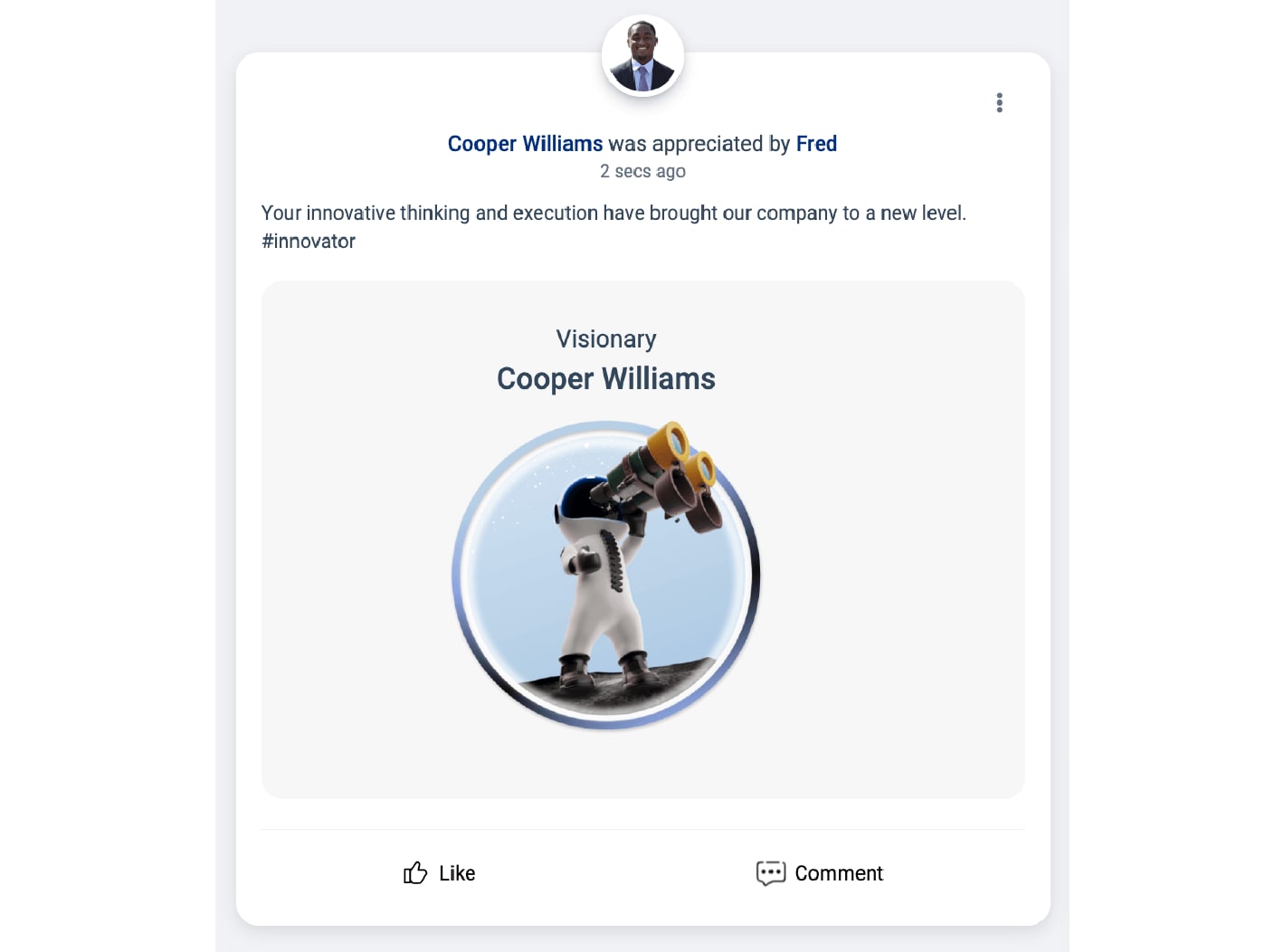
Appreciation should go hand in hand with the pace of work, and managers cannot solely provide that volume. This is where peer recognition barges in to solve the frequency issue. The research supports this. According to a study, peer-to-peer praise is 35.7% more likely to contribute to financial growth compared to manager-only recognition.
The mechanism that works behind P2P is social reinforcement. Three things happen when a peer publicly acknowledges a colleague's contribution: the recipient feels seen, the observers get a signal about which behavior is valued, and the person giving recognition feels good for having expressed appreciation. That triple effect does not occur with a private message or a quarterly bonus.
For peer recognition to function as the volume layer, the platform needs to be frictionless, mobile-friendly, and visible. Participation drops sharply when recognition requires logging into a separate portal, using different credentials, or writing a lengthy justification. The goal is to make appreciation as swift as a social media post by preserving context and values alignment, making it meaningful rather than automatic.
Component 2: Milestone and Service Awards (the Tenure Layer)
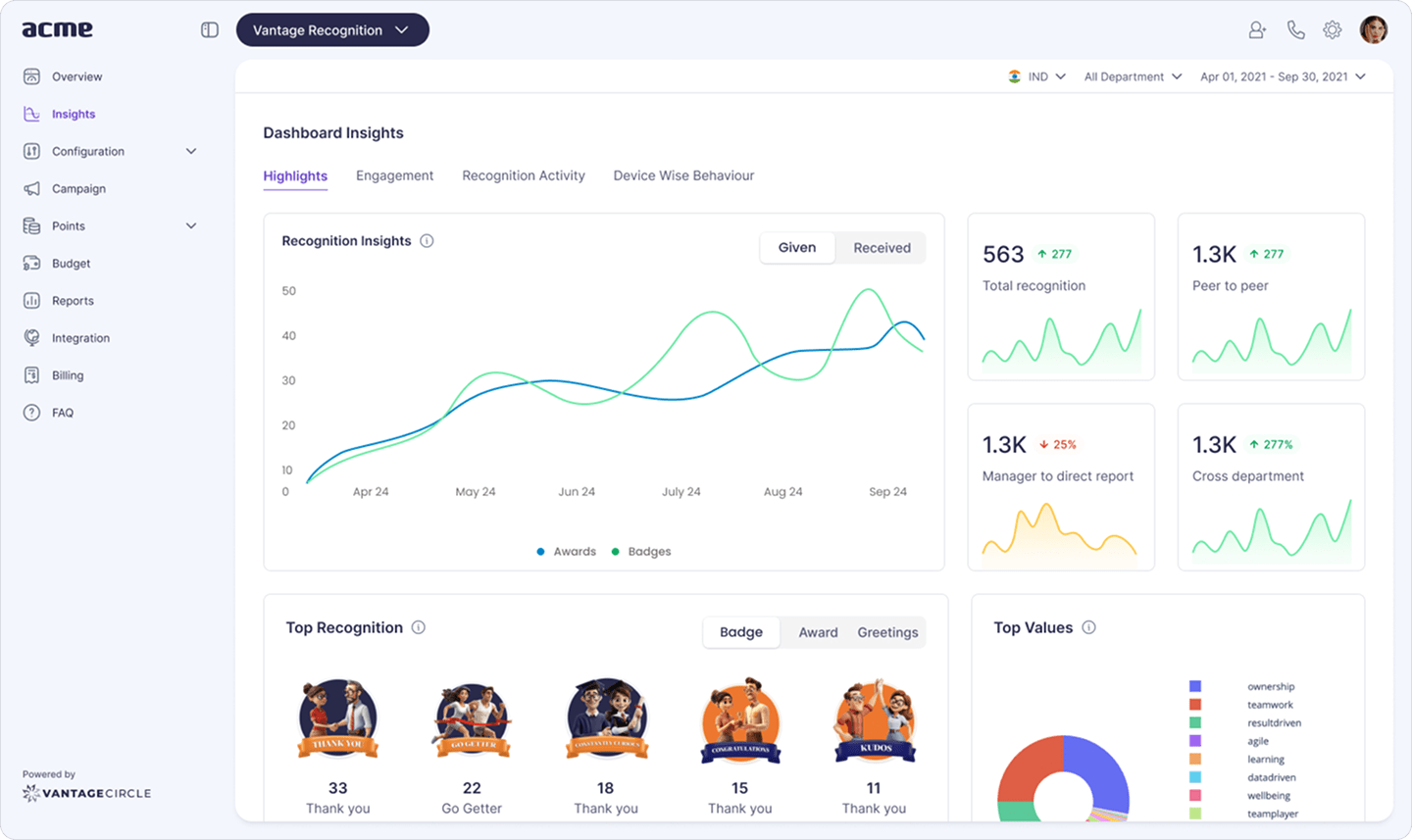
Milestone and service awards enable organizations to honor long-term commitments in a more formal and visible way. It particularly addresses the tenure issue. A well-designed service awards program gestures the visibility of loyalty and the growth of a stronger relationship between the organization and its employees.
The implementation details matter more than most organizations realize. Generic awards, identical catalog options, and automated emails with no personal touch take the meaning out of milestone moments.
Vantage Recognition's Long Service Awards feature supports tiered award catalogs that grow with tenure, manager-narrated recognition posts, and social feed visibility, turning a private milestone into a team moment. The goal isn't to spend more money but to invest the existing budget in experiences employees actually remember.
Component 3: Manager-Driven Recognition (the Relational Layer)
Employees need to know that the person responsible for their performance and growth sees and values their contribution. This is where manager-driven recognition solves the relational gap. Gallup's research is clear:
- managers account for 70% of variance in employee engagement.
- Gallup's workplace survey reveals that the most memorable recognition comes most often from an employee's manager (28%), followed by a high-level leader or CEO (24%).
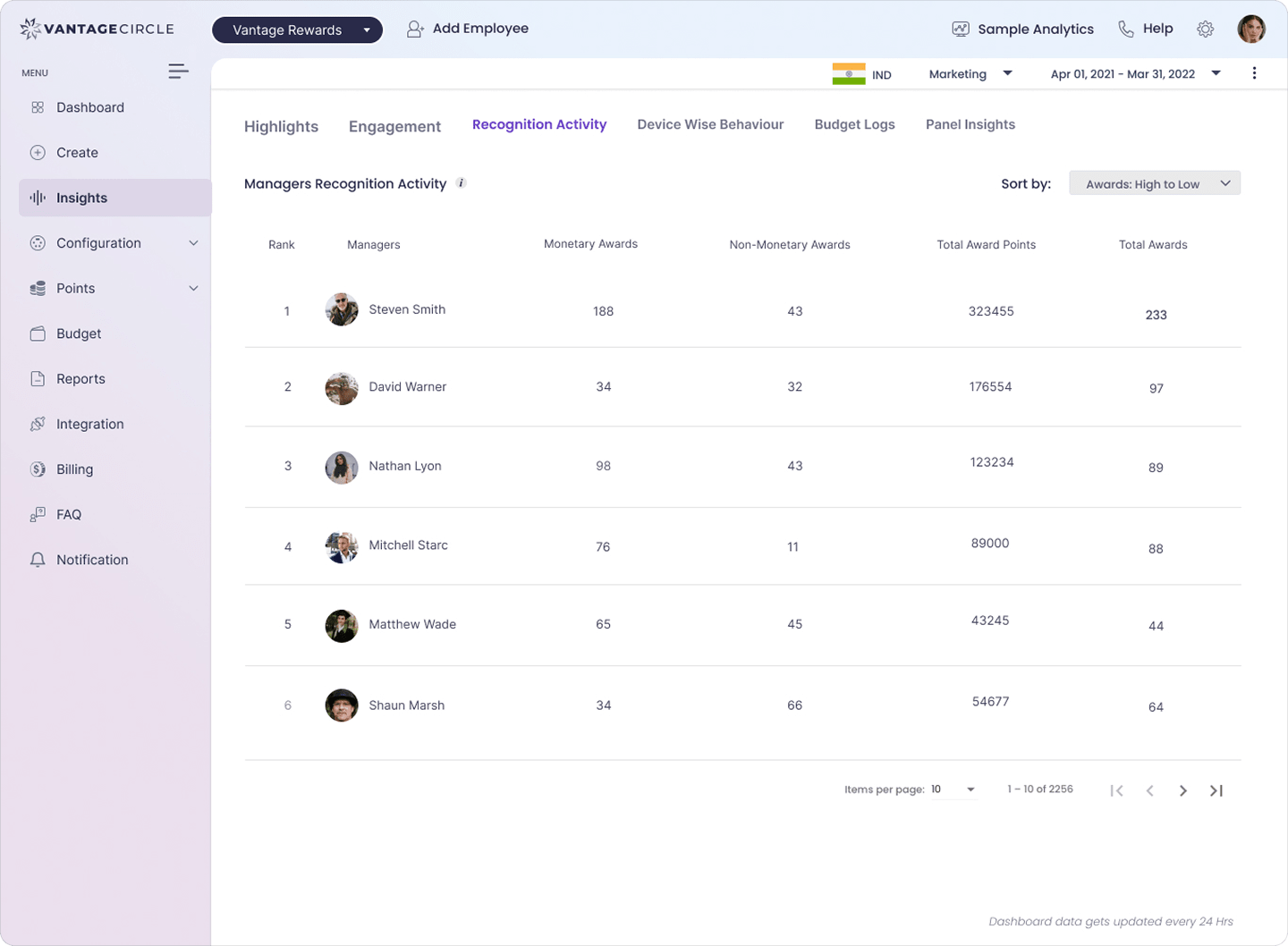
Unlike peer recognition, manager recognition requires the necessary structure and support. Managers require tools that make recognition easy and specific, not an additional task on an already crowded list. They need clear visibility into their team to figure out who has been recently recognized and who hasn't, so that appreciation doesn't always go to the most visible contributors.
Vantage Recognition has dedicated manager recognition tools, including team recognition dashboards, budget visibility, and nomination workflows. The goal isn't to automate warmth but to remove the friction that makes well-intentioned managers bury recognition under the pressure of day-to-day work.
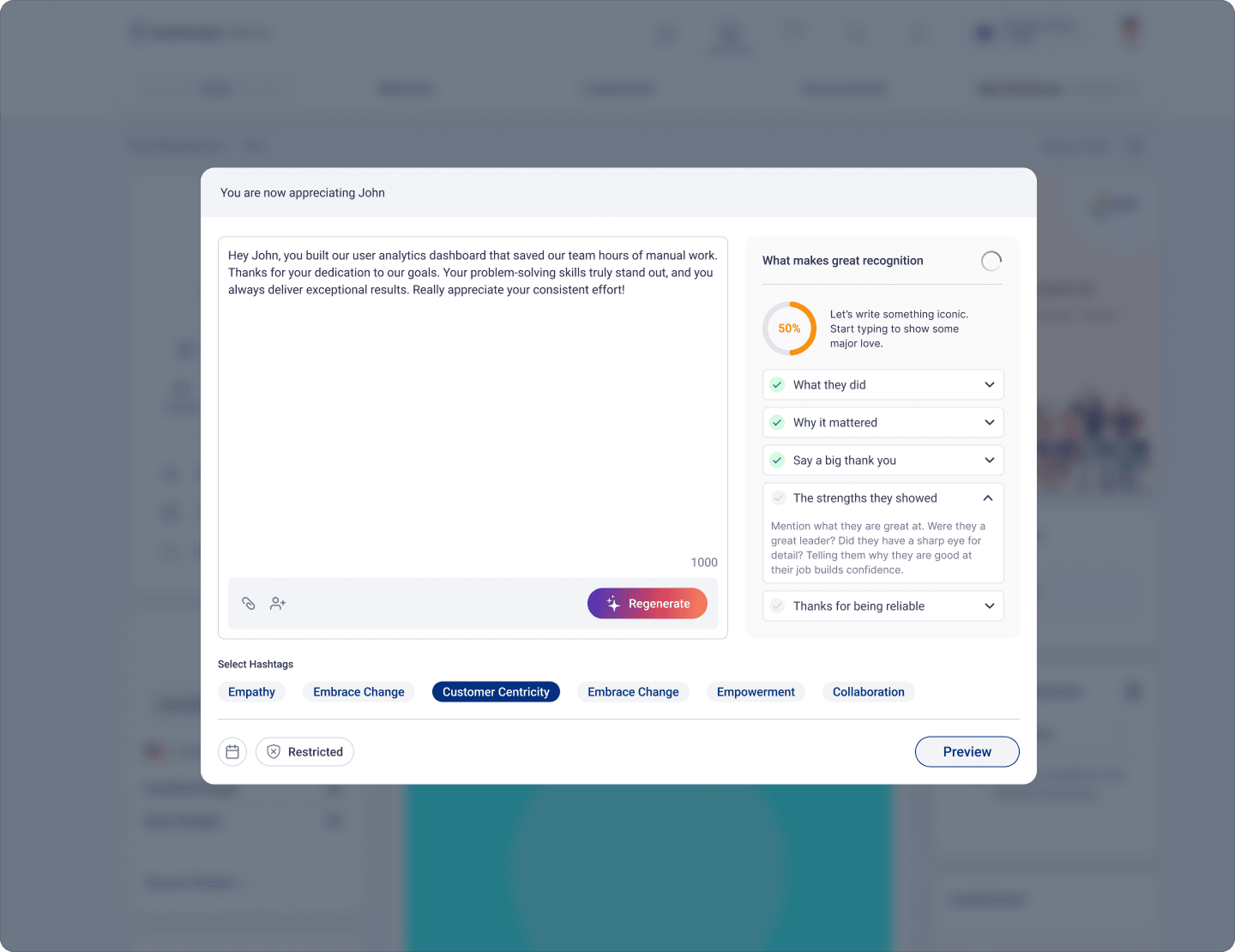
Component 4: Value-Tagged Spot Rewards (the Strategic-Alignment Layer)
Value-tagged spot rewards turn individual recognition moments into real-time signals about the particular behaviors the organization actually wants to reward. This is how it addresses the alignment problem. Without value tagging, recognition is a mere appreciation. But with value tagging, recognition is cultural communication.
The mechanism is pretty simple but powerful. When a manager or peer decides to recognize a colleague, they pick one or more company values from a predefined library and then submit the recognition. The selected tag is publicly visible. Over time, the pattern of value tags creates a map showing where the culture is strong and where it needs improvement.
According to a study, 86% of value-based recognition programs show an increase in workers' happiness.
Vantage Recognition's Core Values Alignment feature enables organizations to build their values library directly into the recognition workflow. This makes value tagging feel like a natural step and not an optional extra.
Component 5: Strategic Analytics + Recognition Operating Cadence (the System Layer)
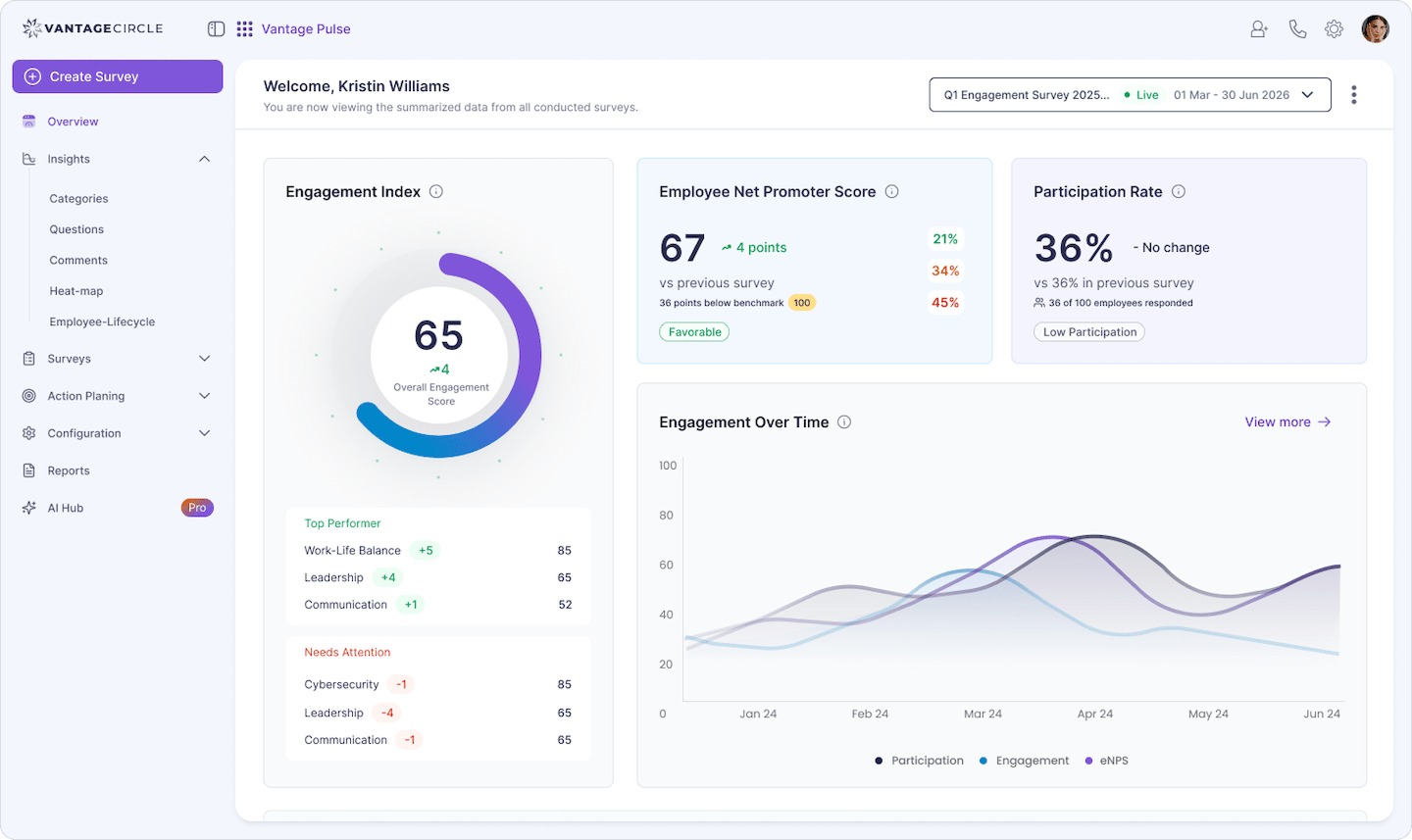
Strategic analytics and a recognition operating cadence address the measurement problem, which is the primary reason most recognition investments fail to demonstrate ROI to leadership. Without a data layer, recognition is an act of faith. With it, recognition becomes a management tool.
The analytics component has two dimensions:
- Participation and equity data: It uncovers which teams are being recognized frequently, which managers are enabling recognition, and which employees are being overlooked.
- Outcome correlation: It figures out whether higher recognition frequency predicts lower attrition, higher eNPS, or stronger performance ratings in your organization specifically. Learn how to measure employee recognition effectively to connect data to outcomes. Organizations that measure recognition ROI see 11-12% lower turnover rates, and companies in the top quartile for recognition and feedback have 31% lower voluntary turnover.
Vantage Pulse's eNPS and Sentiment Analysis capabilities serve as the outcome signal that gives recognition data its business context. When recognition participation rises in a team and eNPS rises in the same period, the connection becomes visible and defensible to leadership. That visibility is what moves recognition from an HR program to a business strategy.
How to Apply the Maturity Model in 30 Days
Following a simple five-step process can help you complete a full maturity assessment, identify your priority gap, and launch the next-stage component within 30 days. This is not a transformation timeline, but a diagnostic sprint that gives your team clarity and momentum.
Step 1: Score your current program. Use the completeness test from the Starting Point Trap section to identify your current stage. Be honest. The goal is an accurate baseline, not a flattering one.
Step 2: Identify your single biggest gap. If you're at Stage 2, the gap is either manager engagement or value tagging. If you're at Stage 3, it's likely the analytics layer. Don't try to close all gaps at once. Pick the one that will most directly move your eNPS or retention numbers.
Step 3: Audit your existing platform for unused features. Most organizations are already paying for capabilities they haven't enabled. Before buying new tools, check whether your current platform supports value tagging, manager dashboards, or eNPS integration.
Step 4: Design and announce one operating cadence element. Pick a recognition campaign for the next 60 days tied to a specific value or business priority. Brief your managers on it. Give them the tools to participate. Measure the lift in recognition volume and eNPS over the campaign period.
Step 5: Review and iterate. At the end of 30 days, pull your recognition participation data segmented by team and manager. Identify the highest and lowest engagement pockets. Use that data to design targeted actions for the following quarter.
The Bottom Line: Stage 2 Is Not the Finish Line
If you have launched peer recognition and service awards, you have undoubtedly built a solid foundation. But stopping there is where most programs quietly stall. eNPS stagnates. Participation clusters around the same people. And when leadership asks for ROI, there is nothing concrete to show.
The complete framework closes those gaps. Manager recognition adds the human layer that peer recognition can't provide. Value tagging turns every recognition moment into a culture signal. Analytics makes the system visible and improvable. And a recognition rhythm turns a program into a habit.
The maturity model is not a report card. It is a map. Knowing your current stage tells you exactly what to build next, so that recognition stops being something your organization does occasionally and starts being something your employees feel.
FAQs
What is a recognition framework?
A recognition framework defines the components, processes, and measurement mechanisms an organization uses to deliver consistent, meaningful recognition. It is distinct from a platform (the technology) and a policy (the rules). Without a framework, recognition is a collection of disconnected gestures. With one, it is a management system.
What are the 5 components of a complete recognition program framework?
The five components are peer-to-peer recognition, manager-driven recognition, value-tagged spot rewards, milestone and service awards, and a strategic analytics layer. Each solves a distinct problem — frequency, relational gap, alignment, tenure, and measurement. Together, they form a complete system that no single component can replicate alone.
Why is peer-to-peer recognition not enough on its own?
P2P recognition solves the frequency problem but leaves the relational, alignment, tenure, and measurement problems unaddressed. Employees need recognition from peers and managers, tied to values, and marked at key milestones. Without these layers, you get high activity volume but modest culture change.
How do you measure whether a recognition framework is working?
Track four signals: recognition participation by team and manager, eNPS trends, voluntary attrition in high versus low recognition segments, and value-tag frequency by department. Together, these tell you whether the system is being used and whether it is actually working.
What are the 5 C's of retention and how does recognition fit?
The 5 C's are Compensation, Career development, Culture, Connection, and Contribution. Recognition directly strengthens three — Culture, Connection, and Contribution — by reinforcing values, building relationships, and validating specific behaviors.
What are the 3 R's of employee retention?
The 3 R's are Recognition, Relationships, and Rewards. A complete recognition framework addresses all three — acknowledging contribution, building relational capital through peer and manager recognition, and reinforcing commitment through spot rewards and service awards.

Riha Jaishi is a Content Marketing Specialist at Vantage Circle and host of the HR Vantage Influencers podcast, sharing insights that help organizations build recognition-rich, people-first cultures!!
Connect with Riha on LinkedIn.