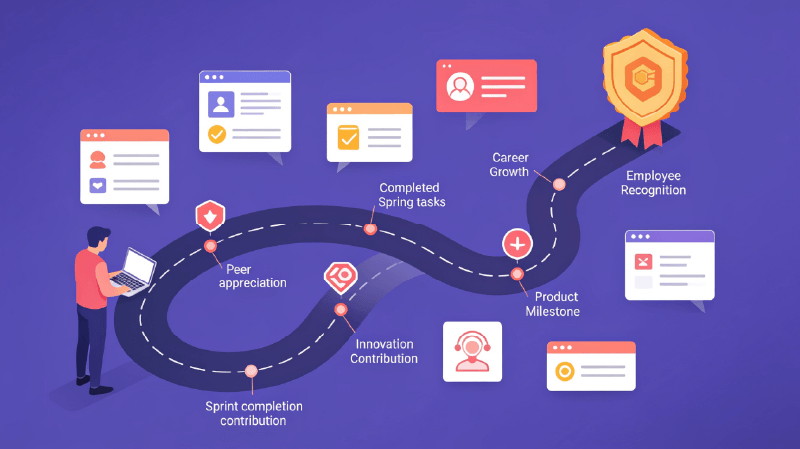
You got the budget approved. You selected the platform. You got the CEO excited about it. And then six months in, only 12% of your employees have actually used it.
That is the most common recognition program story I hear. Not a bad platform. Not a stingy budget. A rollout that nobody owned month by month.
The hard truth is that most recognition programs fail at adoption, not at design. According to the WorldatWork Trends in Employee Recognition report, 94% of organizations have a recognition program, but only 31% rate theirs as highly effective. The catalog, the platform, the reward tiers: those are the easy parts. What HR teams consistently underestimate is the operational discipline required to move employees from "we launched this" to "we use this every day." This guide is that discipline. Six months, one objective per month, measurable adoption targets at each phase, the four pitfalls that kill programs, and a full role-by-role breakdown of who owns what.
Free Template: Download the 6-Month Recognition Rollout Template (PDF). Includes 7 pages: 6 monthly checklists, role responsibility matrix, 3 launch email templates, and adoption rate tracker.

What Does "Recognition Program Adoption" Actually Mean?
Most platforms report login rates. The problem is that login rates measure curiosity, not behavior. An employee who logged in once in October and never returned still counts as "active" by most platform dashboards.
The number that actually matters is adoption rate: the percentage of active employees who have given or received a recognition within the last 30 days.
Adoption Rate = (Unique employees who gave or received recognition in the last 30 days ÷ Total active employees) × 100
This is your north-star metric across all six months. It cuts through login counts and points totals and tells you one thing: are employees actually doing this?
Three secondary metrics sharpen the picture:
- Coverage rate: What percentage of teams have at least one active recognizer this month?
- Frequency rate: Average recognitions sent per active user per month. Target 2+ by Month 6.
- Redemption rate: Percentage of earned points redeemed within 60 days. Low redemption signals catalog or UX friction worth investigating.
According to the Gallup-Workhuman recognition research, more than 55% of U.S. employees either receive no recognition at all or recognition that fails basic quality standards. Employees who do receive high-quality recognition are 45% less likely to have left their job two years later. The Vantage Circle State of Recognition and Rewards Report 2025 found that high-effectiveness programs show 2x higher design maturity and are 2 to 3x more likely to reward specific behaviors rather than outcomes alone.
McKinsey's research on employee motivation found that nonfinancial recognition is the single biggest driver of employee engagement, outperforming cash bonuses and base pay for sustained commitment. That makes the adoption rate your most direct measure of whether the program is generating that engagement or not.
Benchmark targets by phase: 40% by Month 3, 70%+ by Month 6, and 80%+ as your steady-state goal.
For a deeper look at how these benchmarks compare across industries and company sizes, see recognition program benchmarks and the AIRe Framework methodology.
The 6-Month Rollout Roadmap
Six months is not an estimate. It is the minimum operational runway for a recognition program to move from executive sign-off to durable daily habit.
Organizations that rush this to a 30-day launch consistently report adoption under 20% at the six-month mark. The timeline exists because behavior change takes time. Adoption curves respond to sustained attention, not sprint launches.
Each month below has one primary objective, a defined set of activities, a measurable adoption target, and the one pitfall that most commonly ends programs at that stage.
Month 1: Audit and Scope
Month 1 is not the time to start designing the program. That is the most common mistake HR teams make. Month 1 is the time to understand what you are actually working with.
Objective: Establish a current-state baseline and secure the executive sponsor commitment the program will depend on in Months 4 through 6.
Activities:
- Run a current-state recognition audit using the AIRe Framework as the diagnostic lens: Appreciation, Incentivization, Reinforcement, and Emotion
- Document existing recognition touchpoints (manager shoutouts, annual awards, peer tools) and estimate current adoption
- Define program goals with 3 to 5 measurable outcomes tied to retention, engagement, or eNPS
- Secure executive sponsorship with a named CHRO or senior leader who will appear in the Month 4 launch video
- Allocate program budget (industry standard is 1 to 2% of payroll; the employee recognition budget guide covers the full calculation)
- Document the baseline adoption number, even if it is zero
The executive sponsor piece matters more than most HR teams expect. Not a VP of HR who will "champion" the program internally. A CHRO or C-suite leader who will appear on camera in Month 4, put their name on the program, and show up visibly enough that employees read recognition as a leadership commitment, not just an HR initiative.
Adoption Target: Baseline only. If any recognition tool exists, measure current adoption to establish a credible before-and-after comparison.
Common Pitfalls: Starting design work in Month 1 before the baseline is documented; failing to get a named executive sponsor with calendar commitment for the Month 4 launch; treating budget as a line item rather than a program investment.

If the audit reveals that a prior program failed or is structurally broken, the recognition program redesign guide covers when to rebuild versus when to refresh.
Month 2: Design and Platform Selection
Month 2 is where most programs accumulate the design debt that slows Month 4 adoption. The goal is not to build a perfect program. The goal is to build a launchable one.
Objective: Finalize program design and select the recognition platform so that Month 3's pilot launches with a working system.
Activities:
- Define 3 recognition categories: peer recognition, manager-nominated recognition, and milestone recognition (service anniversaries, work anniversaries)
- Set budget tiers per recognition type (peer spot awards vs. manager-level nominations)
- Write a values-tag taxonomy so every recognition links back to a company value
- Evaluate 3 platform vendors using an RFP that scores on Slack/Teams integration, SCIM provisioning, global rewards catalog, and analytics depth
- Secure IT and HRIS buy-in for SSO and data sync
- Identify the pilot team for Month 3 (50 to 200 employees; choose a representative cross-functional group, not the friendliest department)
Adoption Target: Design signed off by HR Lead and CHRO; pilot team identified and onboarded to the platform in staging.
Common Pitfalls: Over-engineering the rewards catalog before the pilot (100 SKUs at launch creates analysis paralysis; start with 20); ignoring Slack and Teams native integration (adoption consistently suffers when employees must context-switch to a separate tool outside their daily workflow); underestimating the legal and procurement cycle for platform contracts.
For platform comparison context, see best employee engagement software.
Month 3: Pilot with One Team
The pilot is your only low-cost opportunity to find out what will break before it breaks in front of your entire organization. Use it as a real test, not a showcase.
Objective: Run a 30-day pilot with a single representative team to surface UX friction and adoption blockers before org-wide launch.
Activities:
- Launch the pilot with a kickoff announcement from the team's senior leader (not HR)
- Run a 1-hour manager training session covering: how to give recognition in the platform, how to read team-level adoption dashboards, and how to coach direct reports to participate
- Monitor daily-use data in the first 2 weeks; watch for zero-activity managers and employees with no logins
- Run a weekly 5-minute pulse check to surface friction (password resets, mobile app issues, catalog confusion)
- Iterate on UX issues before the org-wide launch; this is the only window to fix them cheaply
Adoption Target: 40% of the pilot team gives or receives recognition within the 30-day pilot period.
Common Pitfalls: Choosing the pilot team for friendliness rather than representativeness (a friendly team will hit 60%; a typical team might hit 25%; only the typical team tells you what Month 4 will actually look like); launching without defined success criteria so the team cannot evaluate whether Month 4 is ready to proceed.
Month 4: Org-Wide Launch
This is the month that makes or breaks everything that came before it. A strong Month 4 is not about a big Day 1 announcement. It is about what happens in Week 2 after the excitement fades.
Objective: Roll the program out to all employees with a structured communications cascade that sustains momentum beyond Day 7.
Activities (8 launch activities across 4 weeks):
- Week 1: CEO and CHRO joint announcement video (2 to 3 minutes; authenticity over production quality)
- Week 1: All-hands kickoff session with live demo of the recognition platform
- Week 1: IT SSO go-live and HRIS sync confirmation
- Week 2: Manager enablement workshops (2-hour sessions by department; cover team-level dashboards and recognition writing guides)
- Week 2: Peer champion network activated (1 champion per 25 employees; champions send the first wave of recognitions to model behavior)
- Week 3: Training video library published (3 to 5 short videos: how to give recognition, how to nominate for milestones, how to redeem rewards)
- Week 3: FAQ document distributed via email and intranet
- Week 4: First adoption-rate report to CHROs, showing Week 1 vs Week 4 trajectory
Adoption Target: 30% adoption by end of Month 4.
Common Pitfalls: "Launch fatigue" where the communications cascade peaks in Week 1 and collapses by Week 2; organizations that skip the peer champion network see Month 4 adoption plateau at 15 to 20% because there is no organic momentum after the initial announcement.

Month 5: Adoption Drive and Manager Enablement
By Month 5, the excitement of launch has worn off. This is where programs quietly stall. The teams that get to 70% by Month 6 are the ones that treat Month 5 as a structured campaign, not a holding pattern.
Objective: Drive adoption from 30% to 60%+ by making recognition a visible manager accountability metric and running a targeted adoption campaign.
Activities:
- Publish team-level adoption dashboards to all managers with a benchmark showing their team vs. the org average
- Run a 4-week gamified recognition campaign: per-team leaderboards showing recognition sent and received counts (not dollar amounts)
- Launch a "Spotlight Stories" series: 2 to 3 employee spotlight posts per week on the social feed and intranet, written by HR based on nominations
- Send anti-burnout messaging to managers: frame Month 5 as a sustainment sprint, not a permanent escalation
- Identify the bottom 20% of teams by adoption rate; HR Lead schedules 15-minute calls with their managers to remove blockers
Adoption Target: 60% adoption by end of Month 5.
Common Pitfalls: Manager disengagement is the most common silent program killer in Month 5. HR teams that skip team-level dashboards cannot see which managers have stopped participating until the Month 6 report reveals the damage. HR professionals in the r/humanresources community frequently cite "managers who stopped participating after Month 4" as the primary reason their programs stalled before reaching sustainable adoption. The fix is visibility before disengagement compounds.

Month 6: Measure, Refine, and Report
Month 6 is not the finish line. It is the moment you make the case for everything that comes next. How you present this data determines whether you get Year 2 budget or spend another year defending the program's existence.
Objective: Reach steady-state adoption, build the ROI narrative for budget defense, and plan the Year 1 refresh cycle.
Activities:
- Compute final Month 6 adoption rate vs. the 70% target
- Run an eNPS pulse survey comparing Month 6 scores to the Month 1 pre-program baseline
- Build the CHRO and CFO presentation: recognition coverage rate vs. eNPS lift, voluntary turnover delta (if measurable), cost per recognition vs. cost of a vacancy
- Schedule the Year 1 refresh meeting (Month 9 checkpoint is the standard cadence)
- Publish the full-year recognition report to the organization: top recognized values, most active departments, total recognitions sent
Adoption Target: 70%+ adoption by end of Month 6.
Common Pitfalls: "Set it and forget it" programs that reach Month 6 with no Year 1 refresh plan see adoption decay from 70% to 40% by Month 12 without a scheduled sustain campaign. The second pitfall is presenting Month 6 data without a Month 1 baseline comparison: without a baseline, CFOs cannot calculate ROI and are less likely to fund Year 2.
Who Owns What? Role-by-Role Responsibilities Across the 6-Month Roadmap
Five roles carry a recognition program rollout. Each has distinct responsibilities at each phase. When those responsibilities are not assigned before Month 1 begins, decisions slow down, launch dates slip, and Month 4 ends up being rescheduled. Twice.
| Role | Month 1 | Month 2 | Month 3 | Month 4 | Month 5 | Month 6 |
|---|---|---|---|---|---|---|
| HR Program Lead | Owns audit + baseline; secures CHRO sign-off | Owns design; runs vendor RFP; coordinates IT | Owns pilot; monitors daily; iterates UX | Owns comms cascade; trains managers | Owns adoption dashboards; runs adoption drive | Owns measurement; builds CFO report |
| CHRO / Executive Sponsor | Approves budget + goals; signs executive sponsor letter | Reviews design; approves platform selection | Reviews pilot results; green-lights org launch | Records launch video; presents at all-hands | Reviews adoption trajectory vs. target | Presents Month 6 report to CFO; approves Year 1 refresh |
| Line Manager | Participates in audit survey | Attends design input session; approves team values tags | Attends manager training; runs pilot with team | Attends enablement workshop; recognizes publicly in Week 1 | Uses team dashboard; participates in adoption campaign | Reviews team-level Year 1 refresh goals |
| Employee Champions | Not yet recruited | Identified (1 per 25 employees) | Trained as pilot champions | Activated: send first recognitions; answer peer questions | Leads spotlight story nominations; sustains peer momentum | Reports on peer feedback to HR Lead |
| IT / SSO Owner | Provides HRIS data spec | Reviews SSO + SCIM requirements; approves integration timeline | Confirms staging environment for pilot | Executes SSO go-live + HRIS sync | Monitors integration uptime | Confirms data retention + compliance status |
For the change management methodology behind this matrix, the Prosci ADKAR model maps directly onto the 6 months: Months 1 to 2 build Awareness and Desire; Months 3 to 4 develop Knowledge and Ability; Months 5 to 6 sustain Reinforcement. When you frame the rollout this way in stakeholder communications, it signals intentional change management, not just a software deployment.
The 4 Pitfalls That Kill Recognition Programs (and How to Avoid Each)
Four failure patterns show up again and again in recognition program rollouts. Each one is predictable, phase-specific, and completely preventable. The reason they keep happening is not ignorance. It is calendar discipline.
Pitfall 1: No Executive Sponsor Visibility After Month 1
How to recognize it: The CHRO or senior sponsor signed off in Month 1 but has not appeared in any program communications since. Employees see recognition as an HR initiative, not a leadership commitment.
Why it matters: The Gallup-Workhuman 2024 research found that recognition done well could prevent 45% of voluntary turnover. But that impact depends on sustained leadership visibility, not just a Month 1 sign-off. When the executive sponsor goes quiet after launch, employees read participation as optional, and the adoption curve shows it within weeks.
How to fix it: Build 3 scheduled executive touchpoints into the program calendar at contract: Month 4 launch video, Month 5 mid-campaign message, and Month 6 all-hands report-out. These are 10 to 15 minutes of executive time that prevent a 40-point adoption gap. That is not a hard ask if you make it before the program starts, not after it stalls.
Pitfall 2: Over-Designing the Catalog Before the Pilot
How to recognize it: Month 2 design sessions run for 6 or more weeks as stakeholders debate reward SKUs, approval tiers, and budget exceptions before a single employee has used the platform.
Why it matters: Catalog complexity at launch creates cognitive friction at the exact moment you need employees to act quickly and confidently. Employees who get stuck choosing what to give in the first attempt rarely come back for a second. HR teams in the r/humanresources community describe this as "building a restaurant menu before testing if people are hungry." It is the right observation.
How to fix it: Launch Month 3 with a minimum viable catalog: 20 reward options, 3 recognition categories, and 1 approval tier. Expand the catalog in Month 5 based on pilot feedback. Complexity earned through real usage is stickier than complexity designed in a conference room.
Pitfall 3: Launch Fatigue in Week 2
How to recognize it: Month 4 Week 1 communications are strong. By Week 2, nothing new has appeared on the recognition feed, email volume drops, and adoption stops growing.
Why it matters: The adoption curve is steepest in Weeks 1 through 3 of launch. A momentum gap in Week 2 trains employees that the program was a launch event, not a permanent behavior. That is a very difficult perception to reverse.
How to fix it: Pre-build 4 weeks of launch content before go-live: a CEO video for Week 1, a manager highlight story for Week 2, a peer champion spotlight for Week 3, and a first-month adoption milestone celebration for Week 4. The peer champion network is your organic content engine. When champions are activated on Day 1, they prevent the Week 2 gap without HR having to manufacture it.
Pitfall 4: Manager Disengagement in Month 5
How to recognize it: Month 4 adoption reaches 30%, but Month 5 growth is flat or declining. When broken down by team, a cluster of 5 to 10 manager teams shows zero recognition activity for 3 or more weeks.
Why it matters: According to Gallup's 2025 State of the Global Workplace, manager engagement dropped from 30% to 27% in a single year, and disengaged managers are far less likely to recognize their teams consistently. That trend accelerates when programs lose structured accountability after launch. When managers disengage in Month 5, the peer recognition layer cannot compensate at sufficient volume to sustain momentum.
How to fix it: Make adoption a manager accountability metric in Month 5, not an optional dashboard. Monthly manager scorecards that include team recognition rate alongside pipeline and performance reviews create the behavioral accountability that voluntary dashboards cannot. Visibility has to come before the disengagement compounds, not after.
How Do You Calculate and Track Recognition Program Adoption?
Adoption rate is the primary program metric. Here is the full calculation with 3 secondary metrics HR teams should track alongside it.
Primary Metric:
Adoption Rate (%) = (Unique employees who gave or received recognition in last 30 days ÷ Total active employees) × 100
Example: 340 unique participants out of 500 active employees = 68% adoption rate.
3 Secondary Metrics:
| Metric | Formula | Benchmark (Month 6) |
|---|---|---|
| Frequency | Total recognitions sent ÷ Unique active recognizers | 2+ per month |
| Coverage | Teams with at least 1 active recognizer ÷ Total teams | 85%+ |
| Redemption | Points redeemed in 60 days ÷ Points awarded | 70%+ |
A dashboard that surfaces all 4 metrics by team and by manager gives HR the granular visibility needed to run the Month 5 adoption drive. Without team-level breakdowns, HR can only see the org average and cannot identify which 20% of teams are pulling it down.
The Vantage Circle State of Recognition and Rewards Report 2025 found that 84% of organizations spend under $100 per employee per year on recognition yet still deliver measurable impact. Adoption failure is rarely a budget problem. It is a rollout discipline problem.
What 2026 Trends Are Reshaping How Recognition Programs Get Adopted?
The workforce and platform landscape in 2026 looks different enough from 2022 that HR teams designing rollouts today need to account for shifts that did not exist in the last program generation.
1. AI-Augmented Recognition Nudges
Recognition frequency drops significantly after Month 4 without active manager prompts. AI-driven nudge systems now analyze recognition gaps by team and surface personalized reminders to managers at the moment their team goes 14 days without a recognition event. Adoption programs that deploy AI nudges in Month 5 sustain momentum without HR manually monitoring every team.
2. Hybrid and Remote-First Adoption Gaps
Only 22% of employees say they receive the right amount of recognition for the work they do, according to Gallup's 2024 recognition research, and that gap is wider for distributed teams who are not reached where they actually work. The fix is treating Slack and Teams integration as a launch requirement, not an optional feature. Recognition must arrive in the channels remote employees use daily, or hybrid and remote adoption stalls before it starts.
3. Manager Bandwidth Compression
AI-assisted performance reviews and automated 1:1 tools are compressing managers' available time for relationship-building activities. Recognition programs that require 5 or more minutes to complete a recognition lose manager participation in Month 5. Native mobile apps with 30-second recognition flows are the design standard for 2026 rollouts.
4. Recognition as Retention Defense
The same Gallup-Workhuman 2024 research found that employees receiving recognition that meets even one quality pillar are 2.9x more likely to be engaged. Those whose recognition meets four or more pillars are 9x more likely to be engaged and 65% less likely to be actively looking for another job. In a market where voluntary turnover remains elevated across knowledge-work industries, recognition program adoption is not a culture initiative. It is a retention metric with a measurable dollar value that CFOs can defend in budget reviews.
Frequently Asked Questions
How long does it take to launch an employee recognition program?
6 months to reach durable adoption. Months 1 to 2: audit, design, and platform selection. Month 3: 30-day pilot. Month 4: org-wide launch. Months 5 to 6: drive adoption to 70%. Programs compressed to a 30-day rollout consistently land under 20% adoption at the six-month mark.
What is a good adoption rate for a recognition program?
40% within your pilot team by Month 3, 70%+ org-wide by Month 6, and 80%+ at steady state. If you are below 30% org-wide at Month 6, the root cause is almost always one of three things: missing executive sponsor, no peer champion network, or manager disengagement in Month 5 with no team-level visibility to catch it early.
How do you introduce an employee recognition program?
Use a 3-step sequence: a CHRO or CEO pre-announcement 2 weeks before launch, an all-hands kickoff with a live platform demo on launch day, and peer champions sending the first recognitions within 48 hours to model the behavior publicly. That sequence maps directly to Awareness, Desire, and first-use in the Prosci ADKAR model.
How do you announce an employee recognition program?
Start with a joint CEO and CHRO video on launch day, followed by department-level manager briefings the same week. Name the program, explain the categories, show how points work, and give employees one specific action to take immediately. Announcements with a clear first step consistently drive higher Week 1 participation than those that describe the program without a prompt.
What are common mistakes in recognition programs?
The 4 most common: no executive sponsor visibility after Month 1; over-designing the rewards catalog before running a pilot; communications that peak in Week 1 and disappear by Week 2; and manager disengagement in Month 5 with no team-level dashboard to catch it. Each one is phase-specific and preventable with calendar discipline.
How do you measure recognition program adoption?
Primary metric: (Unique employees who gave or received recognition in the last 30 days ÷ Total active employees) × 100. Track 3 secondary metrics alongside it: frequency (recognitions per active user), coverage (teams with at least one active recognizer), and redemption rate (points redeemed in 60 days). Report monthly to the CHRO; report weekly at team level during Months 4 and 5.
What is recognition program change management?
Recognition program change management is the structured process of moving employees from no-recognition behavior to daily recognition behavior using organizational change principles. The Prosci ADKAR model maps directly onto the 6 months: Months 1 to 2 build Awareness and Desire, Months 3 to 4 develop Knowledge and Ability, Months 5 to 6 sustain Reinforcement. Programs that skip this framing get treated as software launches, and the adoption numbers reflect it.
Bottom Line
Recognition program adoption does not happen because you launched a platform. It happens because someone owned the rollout, month by month, with clear targets and the discipline to intervene when the numbers fell behind.
The programs that reach 70% adoption by Month 6 and stay there are not running better platforms than the programs stalled at 20%. They are running better rollouts. The difference is structure, not spend.
The 6-month roadmap in this guide gives HR teams the activities, targets, and pitfall warnings to close that gap. Every month has one objective, one benchmark, and one common failure mode to avoid. The rest is execution.

Lupamudra is a content marketing specialist at Vantage Circle, where she has written 50+ articles on employee recognition, rewards, and workplace culture, alongside employee engagement, diversity and inclusion, and HR compliance topics, including how India's tax rules apply to recognition and rewards programs.
Connect with Lupamudra on LinkedIn.