Most of the managers I've worked with over the last seven years got promoted for being good at the job one level down. Nobody handed them a manual after that. They figured out the rest on their own time, usually squeezed between back-to-back meetings.
That pressure has only grown. In a July 2024 survey of 805 HR leaders, three in four said their managers feel overwhelmed by how far the role has expanded (Gartner, 2024). I hear a version of that in nearly every conversation I have with HR teams.
The core of effective management is old and fairly simple, though. Most of what makes it hard today is that managers rarely get the time to practice it, and almost nobody measures whether it's happening.
What Is Effective Management?
Effective management is planning, organizing, leading, and controlling a team's work well enough that it hits its goals consistently.
Day to day, that looks like plans that hold up once real work starts, and a manager who can tell early whether things are working.
Henri Fayol, a French engineer who spent decades running a large coal mining company, published his functions of management in 1916 (Britannica). His list actually had five items. Commanding and coordinating were the two that later textbooks merged into "leading," and that merge is where the four-part version taught in most business schools comes from.
The word "effective" carries real weight in that definition. University of Chicago economists tracked managers as they moved between stores at two multibillion-dollar retail companies. Swapping a manager at the 10th percentile for one at the 90th lifted store productivity by 50% to 100%, which the researchers compare to adding a fifth employee to a team of four (Becker Friedman Institute, 2023).
Company policies stayed fixed through every move in that data. So the gap traces back to the person running the store.
I'd be careful about applying retail numbers directly to a software team or a hospital ward. The direction of the finding is hard to argue with, though. By the paper's own estimate, somewhere between a quarter and a third of the productivity gap between stores came down to who managed them.
The Core Principles of Effective Management
Four functions sit underneath almost every serious management framework. Pretty much every "principle" I've seen in a management course turns out to be one of them under a new name.
| Principle | What It Looks Like in Practice |
|---|---|
| Planning | Picking two or three priorities for the quarter, then saying out loud what gets dropped |
| Organizing | One named owner per deliverable, matched to skill plus a bit of stretch |
| Leading | Weekly one-on-ones, and explaining why a decision went the way it did |
| Controlling | Catching a slipping deadline early, with numbers the team can see as well |
Adapted from Henri Fayol's functions of management (1916).
Planning is usually the first thing to go. McKinsey's survey of 706 middle managers shows why, more or less. Nearly half their working hours went to nonmanagerial work, with close to a full day a week on admin alone (McKinsey, 2023). Managing people got less than a third.
When a calendar looks like that, planning turns into reacting. Controlling becomes the moment someone discovers a problem at the monthly review, two weeks after it could have been fixed.
I've gone back and forth on whether the four-function model is too tidy for how management feels on an ordinary Tuesday. Nobody sits down to "organize" on purpose. Still, almost every struggling team I've watched up close had one function that had quietly stopped happening, and naming it made the fix obvious. That's enough for me to keep using it as a diagnostic.
You'll also find lists of "7 principles" and "10 golden rules" of effective management. I went looking for an original source behind those numbered lists and couldn't find one that holds steady. Every training provider seems to have its own. When I lined a few up side by side, most were the four functions again with a line or two about communication added.
The Skills That Separate Effective Managers
If I had to pick one skill, it'd be coaching, and that's also where Google landed. Its Project Oxygen study pulled more than 10,000 data points from performance reviews, feedback surveys, and interviews (Google re:Work, 2025). Teams under highly effective managers did better on results and on turnover. They also said they were happier at work.
Project Oxygen produced ten manager behaviors. Google has since folded its expectations into three manager responsibilities, called Deliver Results, Develop People, and Build Community, and ties them directly into its performance reviews.
| Skill | Why It Matters |
|---|---|
| Coaching | Ranked first among the great-manager behaviors in Google's research¹ |
| Delegating without micromanaging | People only grow into work they actually own |
| Attention and follow-through | Beat cognitive ability and tenure in a 2023 study of 120 production lines² |
| Communicating context | People make better calls when they know why a priority exists |
| Leading through change | The weak spot, with 69% of HR leaders saying managers aren't equipped³ |
¹ Google re:Work (2025). ² Adhvaryu, Nyshadham and Tamayo, Review of Economic Studies (2023). ³ Gartner (2024).
That production-line study is worth a minute. Jorge Tamayo of Harvard Business School worked on it with Achyuta Adhvaryu and Anant Nyshadham (Harvard Kennedy School CID, 2023). They had supervisor surveys and output data from 120 garment lines in India. Supervisors who kept a close eye on their line got more out of it, and they beat colleagues who had better cognitive test scores or had simply been there longer.
Neither trait shows up on a resume, which makes both easy to miss when someone gets picked for promotion.
Josh Bersin's 2025 research on what he calls the "supermanager" takes this somewhere newer. His argument is that managers now have to keep results moving while also helping their teams experiment with AI and rework how the job gets done (Josh Bersin, 2025). I'd push back a little on the label, since it makes the job sound heroic when most managers mainly need fewer meetings. His core point about enabling teams to try things holds up.
For the full skill set grouped by type, our guide to management skills every manager should have goes deeper.
How to Measure Management Effectiveness
Start with the people being managed. Their answers, split by team and asked the same way every quarter, will tell you more than goal completion or attrition can. Those output numbers still matter. They just show up too late to coach anyone.
Most organizations skip this step. McKinsey's same survey found only 20% of middle managers strongly agree that their organization helps them succeed as people managers. A single annual engagement score, reported as one company-wide number, gives a struggling manager almost nothing to work with.
The method I recommend is short.
- Write four to six questions mapped to the four functions. "I know my top priority this month" checks planning. "Work on our team is shared fairly" checks organizing. For leading I like "My manager gives me useful feedback at least monthly." Controlling gets "We catch problems early."
- Run them anonymously, once a quarter.
- Cut the results by team. I'd set the floor at five responses per group. Below that, people start guessing who said what.
- Compare a team with itself first. Going from weak to middling is real progress. A ranking across teams buries it.
- Put one or two hard numbers next to it. Regretted attrition and goal completion work well, mostly because nobody argues with them.
At more than one company, I've seen the company-wide eNPS look fine for three quarters running. Then someone splits it by department and finds two teams sitting far below everyone else, both reporting to a manager who quietly picked up a second team six months earlier.
The average had hidden it, and nobody had raised it in a one-on-one.
Vantage Pulse handles that split for you. Its department-wise insights put each team's score next to the others, so you know which manager to sit down with first. Anonymous responses surface the honest version, since very few direct reports will tell their manager face to face that priorities feel unclear.
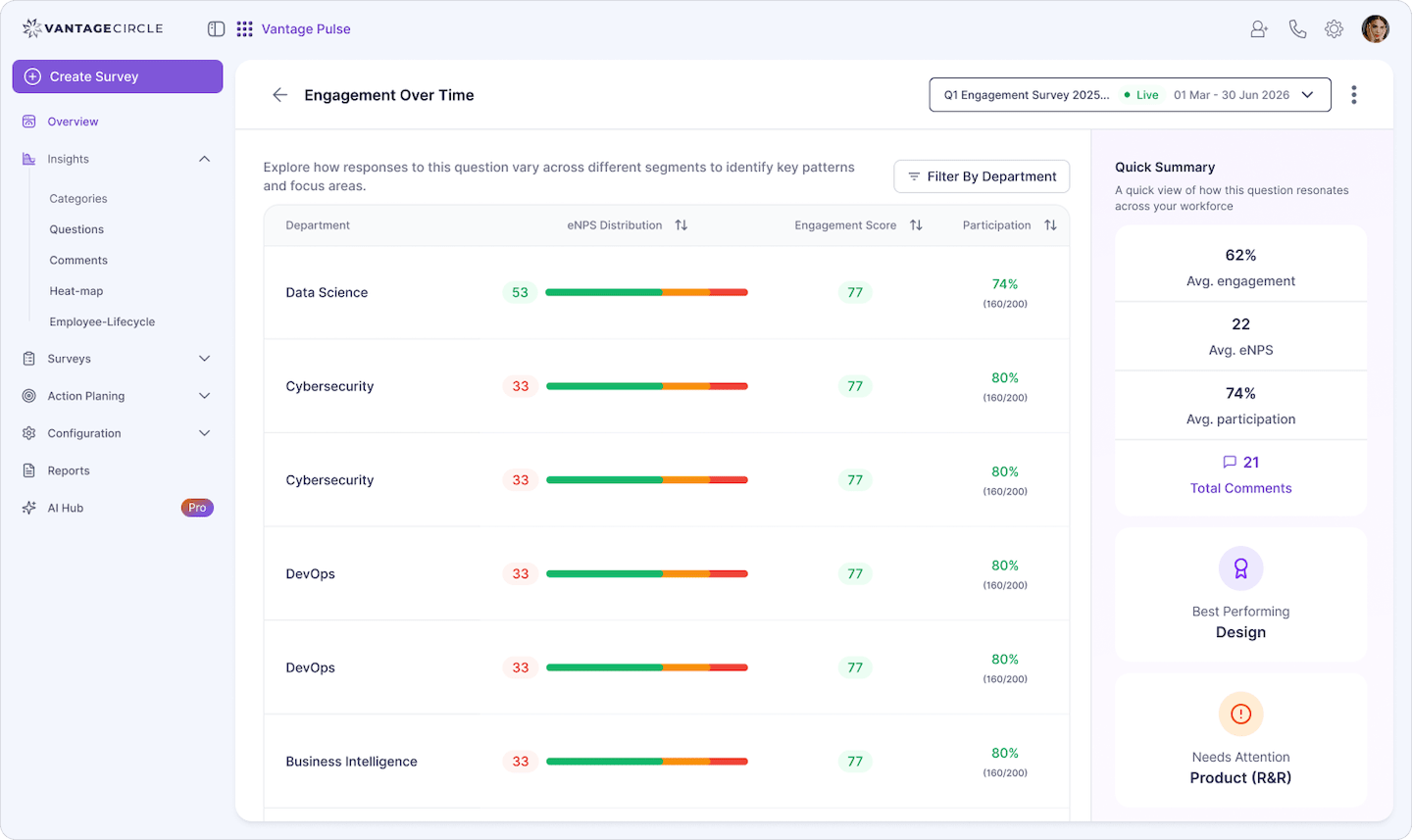
Source: Vantage Pulse
For more ways to track this at the manager level, see our breakdown of manager effectiveness.
Reinforce Effective Management With Recognition
Of everything a manager does, recognition is the easiest to count. You can see who got thanked, how often, and for what. Gartner's 2024 guide for managers on recognition matches what I hear from HR teams. Managers know it matters for performance and retention. Where they get stuck is how to structure it and actually deliver it (Gartner, 2024).
A specific "the way you handled that escalation on Thursday" is about ten seconds of coaching. It tells someone exactly which behavior to repeat. In McKinsey's survey, 86% of middle managers named coaching as the way they add the most value, and recognition is the version of coaching that actually fits into a crowded week.
Most managers have no idea how much recognition they actually give. Recognition Analytics shows it per manager and per team, so when someone goes quiet for a month, it's visible.
The other side gets forgotten. When McKinsey asked middle managers how they'd like their own work rewarded, more autonomy and responsibility came first, with bonuses and raises close behind. Manager recognition lets a manager who's genuinely leading by example get credit for that, apart from whatever the team shipped. Tie it to a named value like ownership, and other managers have something specific to copy.
You'll still see the payoff in work performance and employee productivity numbers. It just takes a couple of quarters to show up there.
Conclusion
Fayol's list is more than a hundred years old and still mostly holds. The part that changed is the calendar. Close to half a manager's week now goes to things that aren't managing.
If I could get one thing onto an HR team's plan for next quarter, it'd be a short pulse built around the four functions, read team by team. You'd find out which function is slipping, and where, while there's still time to do something about it.
FAQ
Q1. What is the meaning of effective management?
A: Planning a team's work, organizing people around it, leading them through it, and keeping an eye on progress, done well enough that goals get hit consistently. Henri Fayol wrote the original version of this down in 1916.
Q2. What are the 7 principles of effective management?
A: Honestly, there isn't one list of seven. I checked. Each training provider writes its own, and read side by side, they mostly restate planning, organizing, leading, and controlling with extra advice on feedback. Fayol's 1916 work is the closest thing to an original source.
Q3. What are the top 5 qualities of an effective manager?
A: Google's Project Oxygen is the best evidence I know of. Being a good coach sits at the top of its list, and not micromanaging comes right after. For the other three I'd pick communication, career support, and decision-making. Our list of qualities of a good manager covers the traits behind them.
Q4. What are the 10 golden rules of effective management?
A: Same story as the 7 principles. No original source, just a lot of versions. Most of them boil down to setting clear goals and checking on them early, with feedback and delegation phrased ten different ways.
Q5. What is the 30-60-90 rule for managers?
A: A plan for a new manager's first three months. Spend the first 30 days listening. Fix a few small, visible things by day 60. By day 90, you should be setting the team's direction yourself.
Q6. What are the 5 C's in management?
A: Depends who you ask, so I wouldn't lean on any single list. The versions I've come across usually include communication and collaboration. Consistency shows up a lot too, and so does some idea of commitment to people's growth.

He has worked in the human resources environment and has elevated recognition and rewards through his insightful and detailed writing. He aims to enhance the practice of Recognition in the workplace with new ideas and innovation that will help shape the work culture. For any related queries, contact editor@vantagecircle.com