
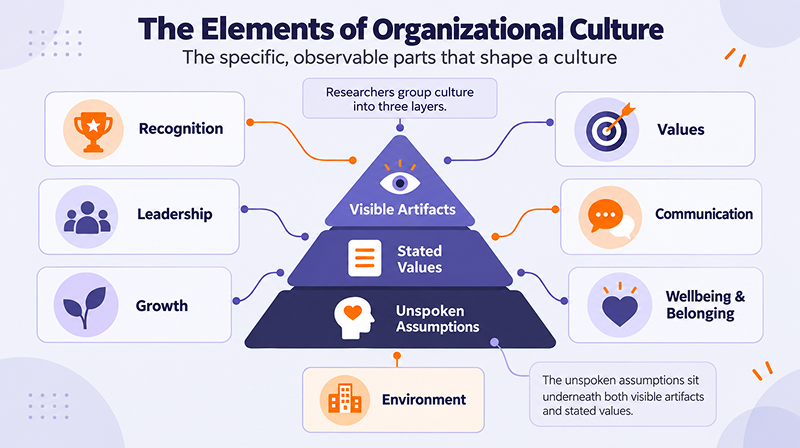
The elements of organizational culture are the specific, observable parts that make a culture what it is: values, leadership, communication, recognition, growth, wellbeing and belonging, and environment. Researchers group these into three layers: visible artifacts, stated values, and the unspoken assumptions underneath both.
Most articles hand you a list and stop there. The harder question is what these elements do when they meet each other, and what happens when two of them point in opposite directions.
A company can write excellent values and still end up with a culture nobody wants. That happens when the recognition system quietly rewards something else. Before you can strengthen any single element, it helps to be clear on what company culture actually is and what it is not.
Key Insights
- What the elements of organizational culture are, and the three layers they sit in
- How elements differ from components, characteristics, and dimensions
- The 7 core elements, with company examples for each
- How AI adoption is testing whether those elements are real
What are the Elements of Organizational Culture?
The elements of organizational culture are the working parts that produce it: what a company believes, how it leads, how it talks, what it rewards, and where people spend their day. Culture is the output. The elements are the inputs.
The most widely used model for organizing them comes from Edgar Schein, the MIT professor who shaped how organizations think about this. His three levels of culture describe how visible each part of a culture is, and every element shows up at all three.
Artifacts are what you can see and hear on day one: office layout, dress code, how meetings run, what hangs on the wall.
Espoused values are what the company says it believes. The mission statement, the stated priorities, the leadership speeches.
Basic underlying assumptions are the beliefs nobody articulates because nobody questions them. Whether mistakes are safe. Whether hierarchy gets challenged. This layer drives behavior.
The gap between layer two and layer three is where culture problems tend to live. Stated values that never reach the assumption layer stay decorative.
Vantage Influencers Podcast
"Culture is what we reward, what we encourage, what we pay attention to."
— Megha Goel, CHRO at Godrej Properties Limited
Listen to the EpisodeElements vs. Components vs. Characteristics: What's the Difference?
Elements, components, characteristics and dimensions get used interchangeably, but they answer different questions. Elements and components describe what culture is built from. Characteristics describe what a culture is like. Dimensions describe the scales you measure it on.
The distinction matters when you are trying to actually do something. If you want to build or fix a culture, you work on elements. If you want to describe one to a candidate or a board, you reach for characteristics. If you want to compare two cultures or track change over time, you need dimensions.
| Term | What it means | When people use it |
|---|---|---|
| Elements | The building blocks a culture is made from, such as values, leadership, and recognition | When designing or strengthening a culture. Action-oriented. |
| Components | Effectively a synonym for elements. Slightly more common in academic writing. | Interchangeable with elements in most business contexts. |
| Characteristics | The observable qualities a culture displays, such as transparent, collaborative, or risk-averse | When describing or diagnosing an existing culture. |
| Dimensions | The measurable scales a culture is plotted on, such as flexibility versus control | When assessing or benchmarking culture with a framework. |
In practice, treat elements and components as the same thing. The sharper distinction is between those two and characteristics, with dimensions sitting apart as the measurement layer. Features of organizational culture is another phrase you will see, and it usually means characteristics.
The 7 Core Elements of Organizational Culture
The 7 core elements of organizational culture are values, leadership, communication, recognition, growth and development, wellbeing and belonging, and environment and rituals. Each one is something a company can deliberately build.
| Element | What it looks like when it works | How to strengthen it |
|---|---|---|
| 1. Values | People use them to decide things when no policy applies | Hire and promote against them, not just print them |
| 2. Leadership | Leaders model the behavior they ask for | Explain decisions, admit mistakes publicly |
| 3. Communication | Information reaches people before rumors do | Build a regular two-way forum, not just broadcasts |
| 4. Recognition | What gets appreciated matches what gets said | Tag recognition to named values |
| 5. Growth and development | People can name their next step internally | Fund learning and open internal mobility |
| 6. Wellbeing and belonging | People bring problems forward early | Back wellbeing with budget, not slogans |
| 7. Environment and rituals | The space and routines support the work | Fix what people are working around |
1. Values
Values are the standards people fall back on when no policy covers the situation. They become part of the culture only when they change decisions, not when they appear on a wall.
Real values are specific enough to rule something out. "Integrity" rules out nothing. "We tell customers about problems before they find them" rules out a lot. The test is whether anyone has ever won an argument by citing them.
Values also set the frame for diversity and inclusion, which is where stated principles get tested hardest.
Southwest Airlines screens candidates for alignment with its stated values during interviews, not just for technical skill. Hiring managers are trained to probe for evidence of how someone has behaved, on the logic that values are easier to select for than to install later.
2. Leadership
Leadership shapes culture faster than any policy, because people read behavior before they read documents. What leaders tolerate becomes the real standard.
The mechanics are unglamorous. Explaining the reasoning behind a decision. Naming a mistake before someone else does. Asking for feedback and then visibly acting on some of it.
Sal Khan, founder of Khan Academy, hosts weekly fireside chats and open Q&A sessions with employees. The format matters less than the frequency. A standing slot where anything can be asked sets a different norm than an annual town hall.
3. Communication
Communication determines whether people find out what is happening from leadership or from each other. In a healthy culture, official information arrives before the rumor does.
Team messaging and collaboration platforms, whether that is Slack, Microsoft Teams, Google Chat or something else, have made constant contact the default. But volume is not the same as clarity. More channels often mean less signal, and an all-hands cadence that people can rely on does more than another tool.
Buffer runs a monthly all-hands with a leadership update on performance, followed by an open town hall where any employee can ask questions. The commitment is to explain the numbers, not just announce them.
4. Recognition
Recognition is the element that tells people which behaviors actually matter. Values describe what a company wants. Recognition reveals what it rewards, and employees believe what gets rewarded.
This is no longer a soft lever. Vantage Circle's State of Recognition & Rewards 2025, a study of 352 recognition and rewards programs across North America, the UAE and India, found that 89% of companies now use these programs to reinforce behaviors and shape culture, not just to lift morale. Nearly three in four, at 74%, extend that to diversity, equity and inclusion and sustainability behaviors.
That shift matters for anyone treating employee recognition as a perk. Most organizations now use it deliberately to shape culture.
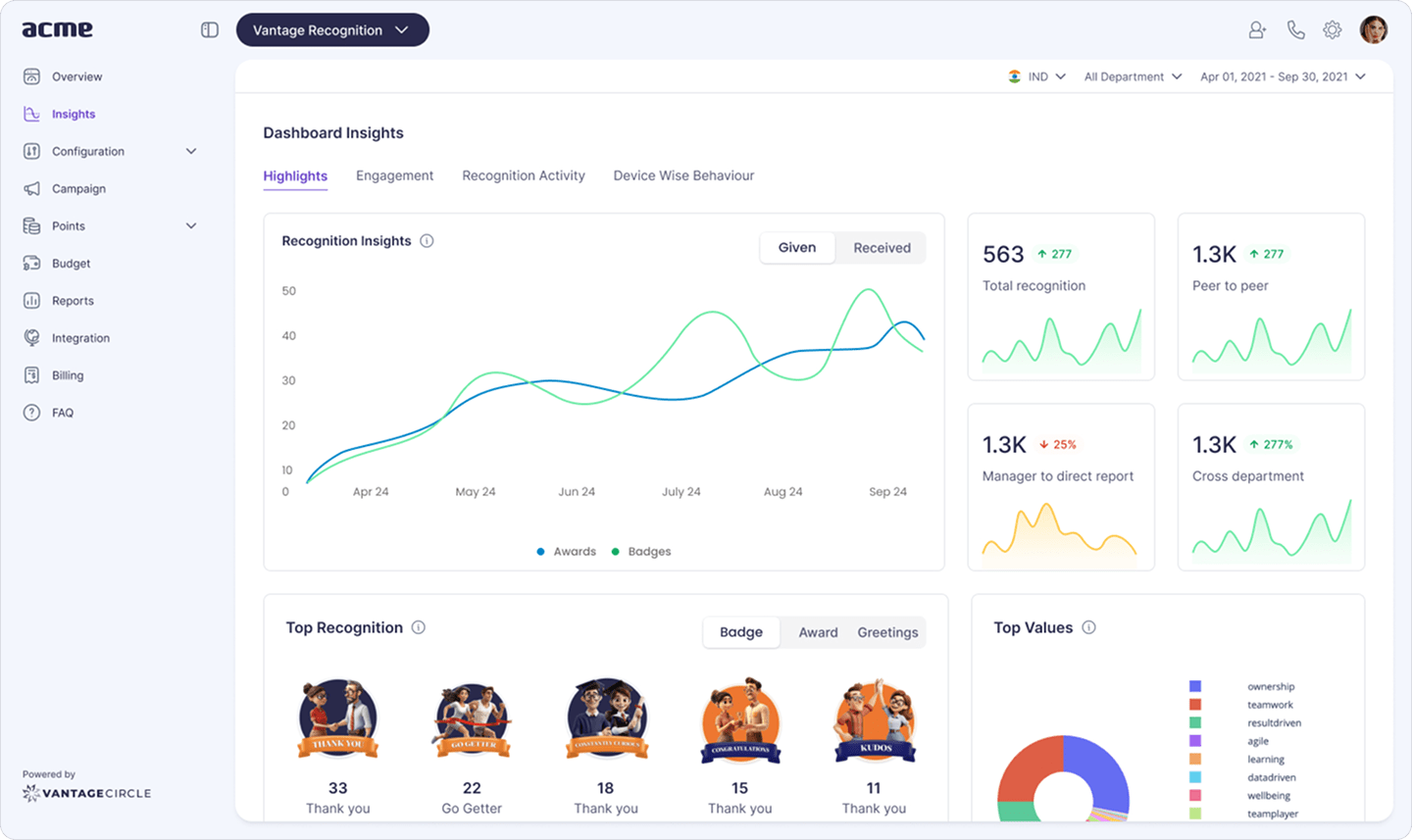
Vantage Recognition, Vantage Circle's employee recognition platform, lets every award be tagged to a named company value. Over time that produces something most organizations lack: a record of which values get reinforced in practice and which exist only on paper.
5. Growth and Development
Growth and development signal whether a company sees people as a fixed cost or a compounding asset. When employees cannot describe their next internal step, they start looking for an external one.
This element runs on three things: funded learning, honest career conversations, and internal mobility that actually happens. Internal mobility is where most programs fail. Training budgets are easy. Letting a strong performer move to another team is hard.
Train people well enough so they can leave. Treat them well enough so they don't want to. – Richard Branson
Chipotle offers employees access to thousands of remote courses spanning business, technology and wellness subjects, tied to an internal career-progression path rather than offered as a standalone benefit.
6. Wellbeing and Belonging
Wellbeing and belonging determine whether people raise problems early or hide them until they are expensive. This element covers physical and mental health, inclusion, and the ordinary social connection that makes a workplace bearable.
The belonging half is measurable. According to BetterUp research, 43% of employees do not feel a sense of connection to their co-workers, and companies scoring high on connection are 14 times more likely to be named a Best Place to Work.
Inclusion shows up in performance data too. Sodexo's 2018 Gender Balance Study, a five-year analysis covering 50,000 managers, found that entities with gender-balanced management reported employee engagement rates 14 percentage points higher than less balanced ones, alongside an 8 percentage point advantage in employee retention.
Johnson & Johnson embeds wellbeing into the physical environment rather than running it as a separate program. Healthy options in the canteens, on-site fitness facilities and lunchtime classes make the message routine instead of occasional.
7. Environment and Rituals
Environment and rituals cover the physical space people work in and the repeated routines that mark time: onboarding, weekly meetings, how someone's last day is handled.
The physical half is more consequential than it looks. The Gensler 2026 Global Workplace Survey, covering more than 16,400 office workers across 16 countries, found that two-thirds of employees "hack" their workspace to compensate for performance gaps. One in four resorts to DIY fixes for ergonomics, temperature or visual privacy. When people are quietly working around the space, that is cultural data.
Rituals do the same work in time rather than space. Onboarding carries the most weight, because it is the point at which someone is most actively trying to learn what the culture expects.
Netflix treats onboarding as a staged introduction to culture rather than a single orientation day. Managers schedule structured introductions across teams over the first weeks, spreading cultural context through the early employee journey.
How AI is Reshaping Organizational Culture
AI is not an eighth element of organizational culture. It is a stress test that exposes whether the other seven are real, because adopting it well depends more on trust, communication and leadership clarity than on the tools themselves.
The evidence is direct. Microsoft's 2026 Work Trend Index found that organizational factors, specifically culture, manager support and talent practices, account for twice the reported AI impact of individual effort alone. The constraint sits with the organization more often than with the individual.
Where that breaks down is visible in the gap between encouragement and explanation. The Culture Amp 2026 AI at Work Benchmark, covering 123 organizations and roughly 112,000 employees, found that 85% of employees say their organization encourages them to experiment with AI, but only 58% say leaders have clearly explained how AI will be used to reach company goals. Only 60% say their manager shares examples of how AI could support their work.
That 27-point gap between "go try it" and "here is why" is a communication and leadership failure, not a technology one. Companies with weak versions of those two elements are discovering that adoption stalls regardless of the tools they buy.
How to Assess Your Organization's Culture
Assessing culture means comparing what leadership describes with what employees experience. The gap between those two is the finding, and it is where the work starts.
Start with the layers. Artifacts you can audit by walking around. Espoused values you can read. Basic assumptions rarely surface in a named conversation, so surveys and sentiment analysis reach what interviews cannot.
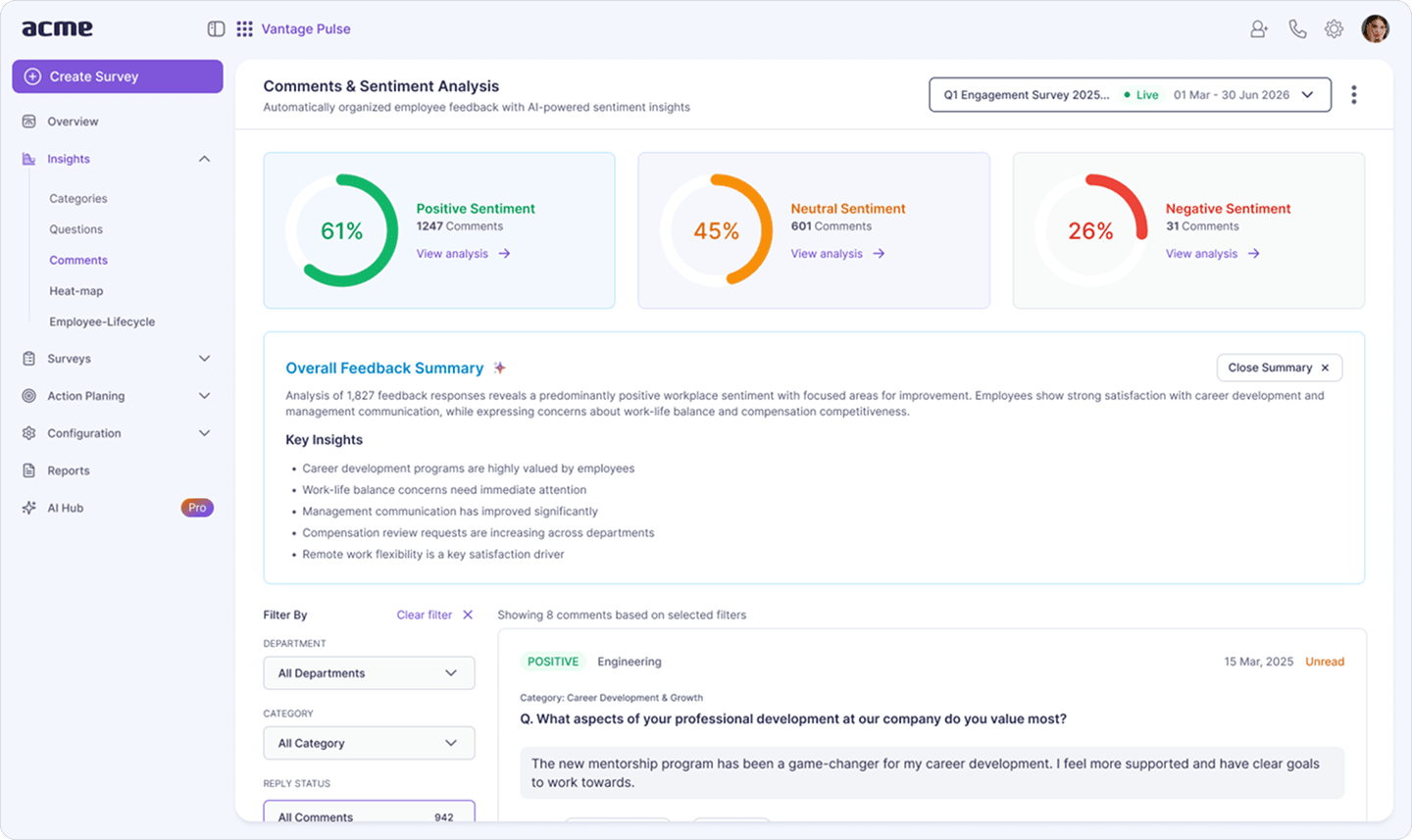
Vantage Pulse, Vantage Circle's employee engagement and pulse survey tool, surfaces sentiment at department level so you can see where the stated culture and the lived one diverge. For the full set of methods and metrics, see how to measure company culture.
Once you know the gap, naming the culture you have is the next step. The four-type model of clan, adhocracy, market and hierarchy is the common starting frame. Reading through the types of organizational culture will tell you which one fits. Strong employee engagement scores tend to follow once the elements stop contradicting each other.
Summing It Up
Organizational culture is not one thing you either have or lack. It is seven elements that either reinforce each other or quietly work against each other.
The problem is rarely a missing element. It is a contradiction between two of them, usually stated values pointing one way and the recognition system pointing another. Employees resolve that contradiction by believing the recognition system.
Start by finding your contradiction. Then decide which side of it you actually meant: the values you publish, or the behaviors you reward.
Book a demo to see how recognition data reveals which of your values are real.
FAQs
What are the 7 key elements of organizational culture?
The 7 key elements of organizational culture are values, leadership, communication, recognition, growth and development, wellbeing and belonging, and environment and rituals. Each one is something an organization can deliberately design rather than leave to chance.
What are the five elements of organizational culture?
Shorter five-element models usually combine the seven into values, leadership, communication, people practices, and environment. The grouping differs by source, but the underlying parts stay the same. Fewer categories mean broader ones.
What are the four elements of an organizational culture?
Four-element models typically reduce culture to values, behaviors, systems, and symbols. This version maps closely to Edgar Schein's layered view, where symbols are visible artifacts and values sit one layer below.
What are the 7 elements of an organization?
The 7 elements of an organization usually refer to McKinsey's 7-S framework: strategy, structure, systems, shared values, style, staff, and skills. That model describes organizational design broadly, while the 7 elements of organizational culture focus specifically on culture.
What is the difference between organizational culture and company culture?
There is no meaningful difference. Both describe the shared values, behaviors and assumptions that shape how work happens. Organizational culture is more common in academic writing, and company culture is more common in business settings.
How do you identify the elements of your own culture?
Compare three sources: what leadership says the culture is, what employees report anonymously, and what the organization actually rewards. Where those three disagree, the reward data is the most reliable signal of your real culture.

Nilotpal M Saharia is an Assistant Manager, Content Marketing at Vantage Circle and a recognition-and-rewards (R&R) strategist with 9 years of experience spanning Marketing, HR, and content strategy. He helps HR leaders turn employee recognition and leadership research into practical workplace programs.
Connect with Nilotpal on LinkedIn.