
Just as an individual's personality shapes their behavior and reactions in different situations, different types of organizational culture guide how employees behave within the company.
With culture playing such a vital role in the organization, business leaders must understand the types of organizational culture to determine which aligns best with their vision, values, and goals.
In this blog, we will explore the various types of culture found in an organization, along with their advantages, disadvantages, and real-world examples. Understanding these distinct culture models can provide valuable insights to help leaders shape an empowering workplace.
What is Organizational Culture?
Organizations with strong cultures see 18% higher productivity, 21% lower turnover, and 78% lower absenteeism. (Source: Gallup)
Organizational culture is the shared values, beliefs, and behaviors that shape how people in a company interact and work. It's less about what's written on the wall and more about what actually happens when no one's watching. It includes how decisions get made, how people treat each other, what gets celebrated, and what quietly gets ignored.
4 Main Types of Organizational Culture
1. Clan Culture
Ever worked somewhere that felt more like a team than a company?
That's the essence of a clan culture. It feels more like a close-knit team rather than a corporation. People know each other beyond their job titles, leaders act as coaches rather than bosses, and collaboration comes naturally. Employees are encouraged to support one another, share ideas freely, and grow together.
Companies like Patagonia and Zappos are often cited as examples because they have built workplaces where people, relationships, and shared values take center stage. The result? Employees feel connected, valued, and genuinely invested in the organization's success.
- Focus: People-oriented, collaborative, family-like
- Vibe: Mentorship, teamwork, strong employee morale
- Example industries: Startups, family-owned businesses, modern tech firms
- Pros: High engagement, low turnover
- Cons: Can lack accountability as it scales
2. Adhocracy Culture
What if your workplace encouraged you to challenge the status quo instead of following it? That's what an adhocracy culture is all about. These organizations thrive on creativity, experimentation, and taking calculated risks.
Employees are given the freedom to test new ideas, move quickly, and explore opportunities without being held back by rigid processes. Companies like Google and SpaceX are often associated with this culture because innovation sits at the heart of how they operate.
The biggest advantage is the ability to stay ahead of the curve. The challenge? Fast-paced environments can sometimes create uncertainty and pressure if innovation becomes a constant expectation.
- Focus: Dynamic, entrepreneurial, innovative
- Vibe: Risk-tolerant, fast-paced, first-mover
- Example industries: Software R&D, marketing agencies, design firms
- Pros: Innovation velocity
- Cons: Burnout risk, unclear processes
3. Market Culture
Workplaces with market culture are highly competitive, goal-oriented, and focused on delivering results. Success is measured through performance, targets, and business outcomes, and employees are expected to consistently perform at a high level.
Organizations like Amazon and Goldman Sachs are often used as examples because of their strong emphasis on achievement and accountability.
The benefit is clear direction and a strong focus on results. However, if performance becomes the only measure of success, employees may experience increased stress and pressure over time.
- Focus: Results-oriented, competitive
- Vibe: Winning, targets, KPI-driven
- Example industries: Sales, consulting, finance
- Pros: Clear performance signals
- Cons: High pressure, potential burnout
4. Hierarchy Culture
Do you prefer clear rules, defined responsibilities, and a structured way of working?
That's what a hierarchy culture is built around. These organizations rely on established processes, clear reporting lines, and standardized procedures to keep operations running smoothly. Everyone knows their role, what is expected of them, and how decisions are made.
Organizations such as the United States Armed Forces and McDonald's are often cited as examples because consistency and operational efficiency are central to their success.
The biggest advantage is stability and predictability, especially in environments where mistakes can be costly. The challenge is that too much structure can sometimes slow decision-making and make it harder to adapt quickly to change.
- Focus: Process-oriented, structured, stable
- Vibe: Clear chain of command, formal procedures
- Example industries: Healthcare, government, legacy financial institutions
- Pros: Reliability, compliance
- Cons: Slow to innovate
Side-by-Side Comparison of the Four Main Culture Types
| Culture Type | Focus | Vibe | Example Industries | Pros | Cons |
|---|---|---|---|---|---|
| Clan | People-oriented, collaborative, family-like | Mentorship, teamwork, strong employee morale | Startups, family-owned businesses, modern tech firms | High engagement, low turnover | Can lack accountability as it scales |
| Adhocracy | Dynamic, entrepreneurial, innovative | Risk-tolerant, fast-paced, first-mover | Software R&D, marketing agencies, design firms | Innovation velocity | Burnout risk, unclear processes |
| Market | Results-oriented, competitive | Winning, targets, KPI-driven | Sales, consulting, finance | Clear performance signals | High pressure, potential burnout |
| Hierarchy | Process-oriented, structured, stable | Clear chain of command, formal procedures | Healthcare, government, legacy financial institutions | Reliability, compliance | Slow to innovate |
6 Supplementary Types of Organizational Culture
5. Purpose Culture (Mission-driven)
Organizations in a purpose culture unite people around a shared cause or vision that goes beyond profit. Employees feel connected to the organization's impact, which often leads to stronger commitment, motivation, and loyalty.
However, it only works if the mission is real. The moment people sense the purpose is just marketing, the whole effect collapses. Patagonia, with its environmental mission baked into how it operates, is a frequently cited example.
6. Learning Culture
In a learning culture, growth isn't an occasional activity, it's part of everyday work. Employees are encouraged to develop new skills, explore ideas, and view mistakes as opportunities to learn rather than reasons to be punished.
Organizations such as LinkedIn are often associated with this approach because they emphasize continuous development and lifelong learning.
The benefit is a workforce that can adapt quickly to change and stay ahead of new challenges. However, learning must be balanced with execution, or teams may spend more time preparing than actually delivering results.
7. Feedback Culture
A feedback culture treats honest, frequent feedback as normal rather than a nerve-wracking event. Employees and leaders regularly exchange constructive feedback, making communication more open, transparent, and focused on improvement.
Instead of waiting for annual reviews, people receive guidance and recognition in real time. Companies like Netflix are often known for fostering direct and candid feedback as part of their culture.
8. Coaching Culture
A coaching culture is built around developing people rather than just managing them. Leaders act as mentors who guide, support, and develop their teams rather than simply directing them. Employees are encouraged to solve problems, build confidence, and take ownership of their development.
Organizations like Microsoft are often associated with this approach, particularly through their emphasis on a growth mindset and continuous development.
The advantage is stronger employee growth, trust, and long-term performance. The challenge, however, is that effective coaching requires time, patience, and skilled leaders who know how to develop others.
9. Accountability Culture
An accountability culture is one where people own their outcomes, whether good and bad, without finger-pointing or excuses. Employees are expected to follow through on commitments, take responsibility for results, and learn from both successes and setbacks.
When done well, this culture creates trust, reliability, and a strong sense of ownership across the organization. The benefit is greater consistency and stronger team performance.
However, accountability must be paired with support and psychological safety. Otherwise, employees may become more focused on avoiding mistakes than taking initiative.
10. Authority Culture
In an authority culture, leadership and decision-making are concentrated at the top. Employees look to senior leaders for direction, and there is usually a clear chain of command that guides how work gets done.
This type of culture is often effective in organizations that require quick decisions, strong oversight, or clear leadership during periods of uncertainty.
Which Organizational Culture Do You Have? A 10-Question Assessment
Not sure which type best describes your workplace? Answer the 10 quick questions below and we'll reveal your dominant culture type. Pick the option that feels closest to your day-to-day reality — there are no right or wrong answers.
10 quick questions · about 2 minutes
How are most decisions made?
What does leadership mostly act like?
What holds the organization together?
What gets celebrated most?
How does the company handle change?
How is success measured?
What's the work environment like?
How are mistakes treated?
What do new hires need most to fit in?
What's the company's top priority?
Organizational Culture by Industry: Which Fits Best?
No industry is locked into a single culture, but certain pressures tend to push companies toward certain quadrants. Highly regulated fields lean on structure; fast-moving ones lean on flexibility. Here's where most organizations tend to land.
| Industry | Most Common Culture | Why |
|---|---|---|
| SaaS / tech startups | Adhocracy or Clan | Speed and innovation matter early; small teams stay close-knit |
| Healthcare | Hierarchy (with Clan elements) | Safety and compliance demand structure; care work fosters teamwork |
| Manufacturing | Hierarchy or Market | Process ensures quality; output targets drive performance |
| Government | Hierarchy | Accountability, consistency, and rules are non-negotiable |
| Financial services | Market (with Hierarchy elements) | Results-driven, but tightly regulated |
| Retail | Market or Clan | Sales targets dominate, but customer-facing teams thrive on culture |
How to Identify and Change Your Culture?
Step 1: Run an OCAI Assessment
The Organizational Culture Assessment Instrument, built directly on the Competing Values Framework, asks employees to score where the company sits across the four quadrants today. It's a structured way to replace gut feeling with data, and it gives you a shared starting point everyone can see.
Step 2: Identify the Gap between Current and Desired Culture
Once you know where you are, decide where you want to be and be specific about why. Maybe you're a hierarchy that needs more adhocracy to survive in a fast-changing market. Naming the gap clearly is half the work, because it tells you exactly which behaviors need to shift.
Step 3: Align Recognition & Values to the Desired Culture
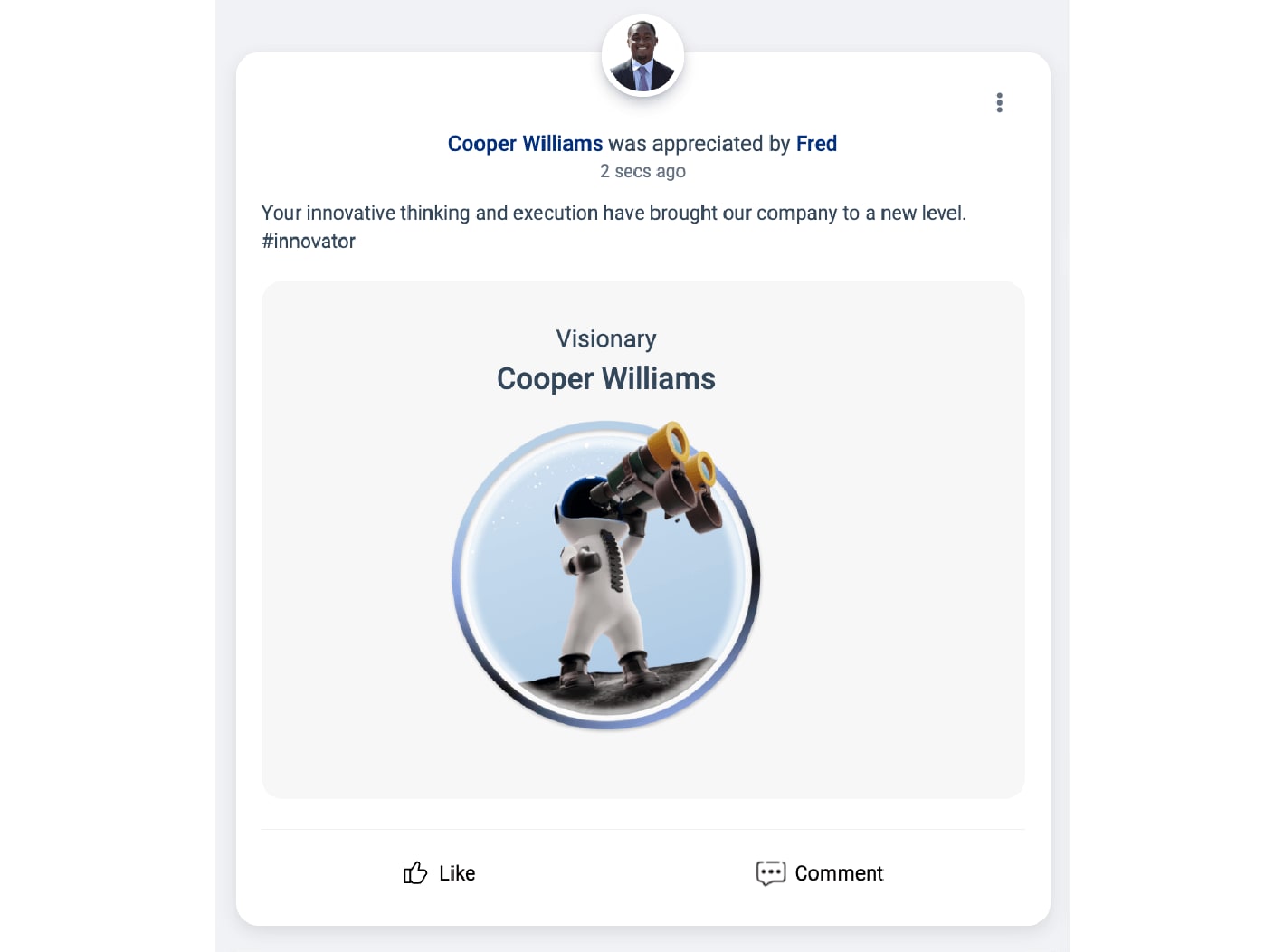
This is where culture becomes visible. People repeat the behaviors that get recognized, so if collaboration is a priority, celebrate it consistently and publicly. When recognition is tied to company values, those values move beyond posters and become part of everyday work. And when employees can recognize one another, the desired behaviors are reinforced across the organization—not just by managers, but by everyone.
Source: Vantage Recognition
Step 4: Hire for the Culture You're Building, Not the One You Have
Every new hire either reinforces your current culture or nudges it. If you're trying to shift, your hiring criteria have to shift with it. Otherwise you'll keep recruiting people who fit the old way and wonder why nothing's changing.
Bottom Line
Organizational culture can make or break a company. A culture that complements the business strategy and resonates with your employees is most likely to yield success. It is also a wise choice to develop a flexible company culture that adapts to the changing business scenarios of the world. Remember, the culture you choose will shape the future of your organization.
FAQs
What are the 4 Types of Organizational Culture?
According to the Competing Values Framework, the four primary types of organizational culture are Clan, Adhocracy, Market, and Hierarchy. Each type differs in its focus on flexibility, stability, internal collaboration, or external competitiveness.
What are the 8 Components of Organizational Culture?
The key components of organizational culture typically include transparency, respect, inclusion, clear mission and values, effective leadership, professional development, employee well-being, and low turnover. Together, these elements shape how people work and interact.
What are the 4 C's of Organizational Culture?
The 4 C's of organizational culture are Communication, Collaboration, Consistency, and Compassion.
What is the Competing Values Framework?
The Competing Values Framework (CVF) is a model developed to assess and categorize organizational culture. It groups cultures into four types based on whether an organization prioritizes flexibility or stability and internal or external focus.
Can a Company have more than One Culture?
Yes. While most organizations have a dominant culture, different departments, teams, or locations often develop subcultures that reflect their unique goals, leadership styles, and ways of working.

Shikha Gogoi is a Content Marketing Specialist focused on SEO-driven content around employee engagement, recognition, and workplace culture, helping build people-first workplaces.
Connect with Shikha on LinkedIn.