
This article reflects the Income Tax Act, 2025 and Income Tax Rules, 2026, effective April 1, 2026, replacing the Income Tax Act, 1961 and Income Tax Rules, 1962. This is general informational content, not tax or legal advice. The Rs. 15,000 threshold and the cliff mechanic have been confirmed by a qualified chartered accountant against the notified text of Rule 15. The section number for the general individual gift-tax rule under the new Act is unconfirmed and deliberately left uncited. Confirm any figure with your own chartered accountant before finalizing reward structures or budgets.
Recognition programs rarely fail because employees dislike the reward. They stall when finance asks whether a gift voucher is taxable, payroll needs to account for it in TDS, and HR doesn't have a clear, cited answer. As of April 2026, the number changed.
Cash, gift cards, merchandise, and points redeemed for any of these carry different tax treatment under Indian income tax law. Assuming one rule covers all of them, or that last year's rule still applies unchanged, is exactly how a payroll error happens.
This post exists to make that meeting shorter.
Non-cash gifts and vouchers an employer gives an employee in India are tax-exempt only if their combined value stays at or under Rs. 15,000 in a financial year, under Rule 15 of the Income Tax Rules, 2026. Cross that line and the entire amount, not just the excess, becomes taxable. Cash awards get no exemption at any amount.
The Income Tax Act, 1961 and Income Tax Rules, 1962 were both repealed on April 1, 2026, replaced by the Income Tax Act, 2025 and Income Tax Rules, 2026. The employer-gift exemption tripled along with them, but the cliff mechanic carried over unchanged. What follows covers the new rule, cash versus non-cash treatment, cumulative tracking, the general gift-tax law, GST implications, where programs still get this wrong, a compliance checklist, and a one-page rules summary.
This post covers India. A US workforce follows entirely different rules, covered in our breakdown of employee recognition tax implications in the US.
The New Rule: What's Tax-Exempt and What Isn't
Non-cash gifts, vouchers, or tokens an employer gives an employee are exempt only if their aggregate value in a financial year stays below Rs. 15,000. Rule 15(5)(a), Table IV, Item 4 of the Income Tax Rules, 2026 values the gift at its full amount, then reduces that value to nil only under the threshold, the same structure the pre-2026 Rule 3 framework used for the old Rs. 5,000 figure. Perquisites are chargeable as salary under Section 17(2) of the Income Tax Act, 2025; Rule 15 supplies the valuation and the threshold. That structure is what creates the cliff. The rule doesn't carve out the first Rs. 15,000 as exempt and tax the rest; it says the value is nil below Rs. 15,000. Cross that line and the full value is added back as a taxable perquisite. A gift of Rs. 14,999 is tax-free. A gift of Rs. 15,001 is taxed in full, not just the Rs. 1 over the line.
The trigger is the date the gift was given, not the date the rules were notified. The rules were notified before they took effect, but they only govern gifts given on or after April 1, 2026. A gift given in March 2026 is still assessed under the old Rs. 5,000 limit, even though the new rules already existed on paper.
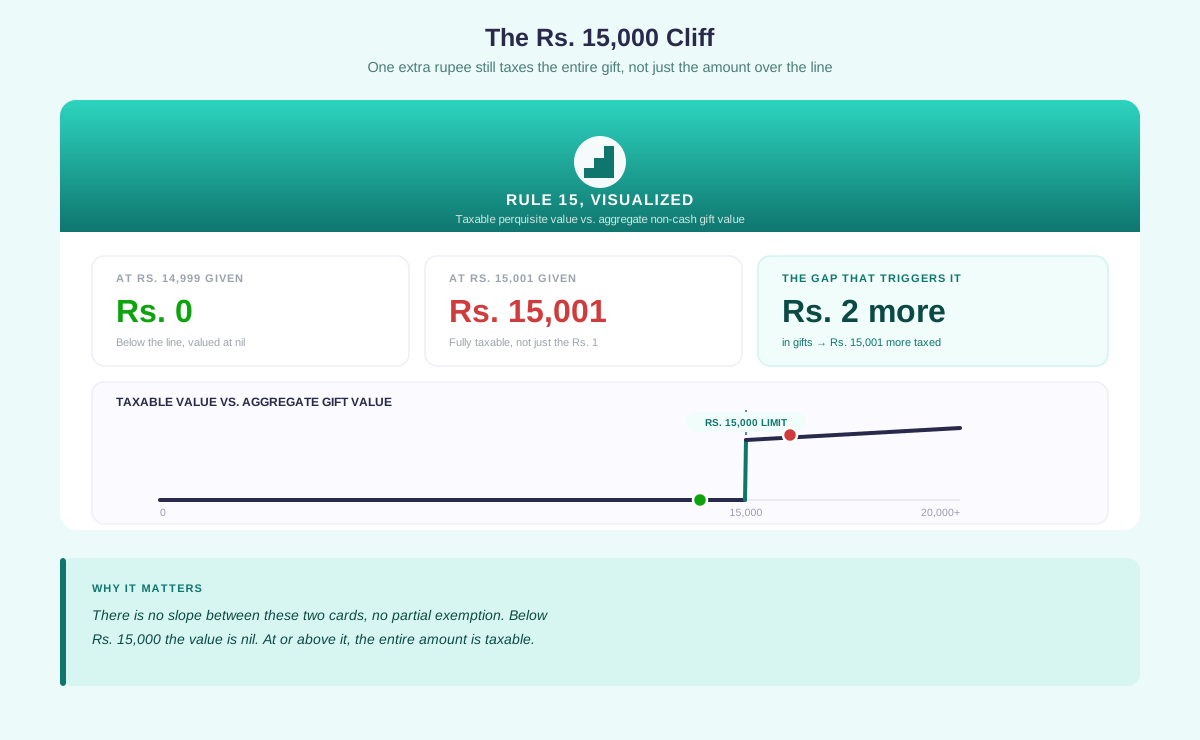
A lot of commentary written since April 2026 gets the mechanic wrong in the opposite direction from the old error, describing it as if only the excess is taxable. That more forgiving reading isn't supported by the rule's own language. Confirm this against the notified text or a CA before relying on either version.
Most day-to-day peer-to-peer recognition on a points-based platform is exactly this reward type, a non-cash "voucher or token in lieu of gift." Getting that classification right is still the first step to structuring a program around the exemption, not against it.
Consider a straightforward case: a Rs. 9,000 Diwali voucher in October, a Rs. 8,000 points redemption in January, same financial year. Neither looks large alone. The aggregate is Rs. 17,000, over the line, and the full Rs. 17,000 becomes taxable, not the Rs. 2,000 excess.
At program scale, the number gets real fast. Consider two ways of running the same Rs. 14,000-per-employee budget across 500 employees:
| Kept under Rs. 15,000 all year | One extra Rs. 3,000 milestone gift pushes it to Rs. 17,000 | |
|---|---|---|
| Taxable perquisite added, per employee | Rs. 0 | Rs. 17,000 |
| Additional taxable salary added, across 500 employees | Rs. 0 | Rs. 85,00,000 |
| Payroll correction required | No | Yes, for every affected employee |
Same budget, same 500 people. One small, uncoordinated gift just turned a fully exempt Rs. 14,000 per employee into a fully taxable Rs. 17,000, Rs. 85,00,000 in fresh taxable salary nobody budgeted for.
Cash Awards vs. Non-Cash Gifts: Why the Distinction Still Matters
Cash awards, including cash-equivalent payouts, are fully taxable as salary with no exemption at any amount. That part hasn't changed. The exemption under Rule 15 applies specifically to a gift, voucher, or token, language that excludes cash by design.
Cash is taxed from the first rupee. A non-cash voucher is taxed in full the moment the year's total crosses Rs. 15,000. A lot of internal HR practice treats a cash spot bonus and a gift voucher as interchangeable gestures of appreciation, when they sit on opposite ends of the tax treatment.
| Reward Type | Tax Treatment |
|---|---|
| Cash award or bonus | Fully taxable as salary from the first rupee. No exemption applies. |
| Cash-equivalent (gift cheque, cash voucher convertible to cash) | Treated the same as cash. Fully taxable, no exemption. |
| Non-cash gift, voucher, or token (aggregate under Rs. 15,000/year) | Fully exempt. Valued at nil under Rule 15. |
| Non-cash gift, voucher, or token (aggregate at or above Rs. 15,000/year) | Entire value taxable as a perquisite, not just the amount above Rs. 15,000. |
Most day-to-day recognition on a points-based rewards system, redeemed as vouchers rather than cash, falls into the third or fourth row of that table. Which row an employee sits in for the year depends entirely on what else they've already received, not on this reward alone.
Why Cumulative Tracking Still Matters
The Rs. 15,000 limit is cumulative across the full financial year, per employee, not a per-occasion allowance. A Diwali hamper, a service award voucher, and a birthday gift card can each look modest and still add up to a fully taxable total before the year ends.
A spreadsheet-and-email approach to rewards is structurally bad at catching this. HR runs several recognition moments through a year, each approved separately without anyone checking the running total. The math is per-employee and cumulative; approvals are per-occasion.
How a points-based platform helps HR track this automatically
A platform that routes every non-cash reward, whether it's a festival gift, a service award, or peer-to-peer recognition, through a single points ledger gives HR a running total per employee without anyone doing manual addition. Recognition Analytics surfaces that cumulative value per employee across the year, turning a compliance question that's easy to miss into a number HR can check before the next campaign goes out, not after the whole amount becomes taxable.
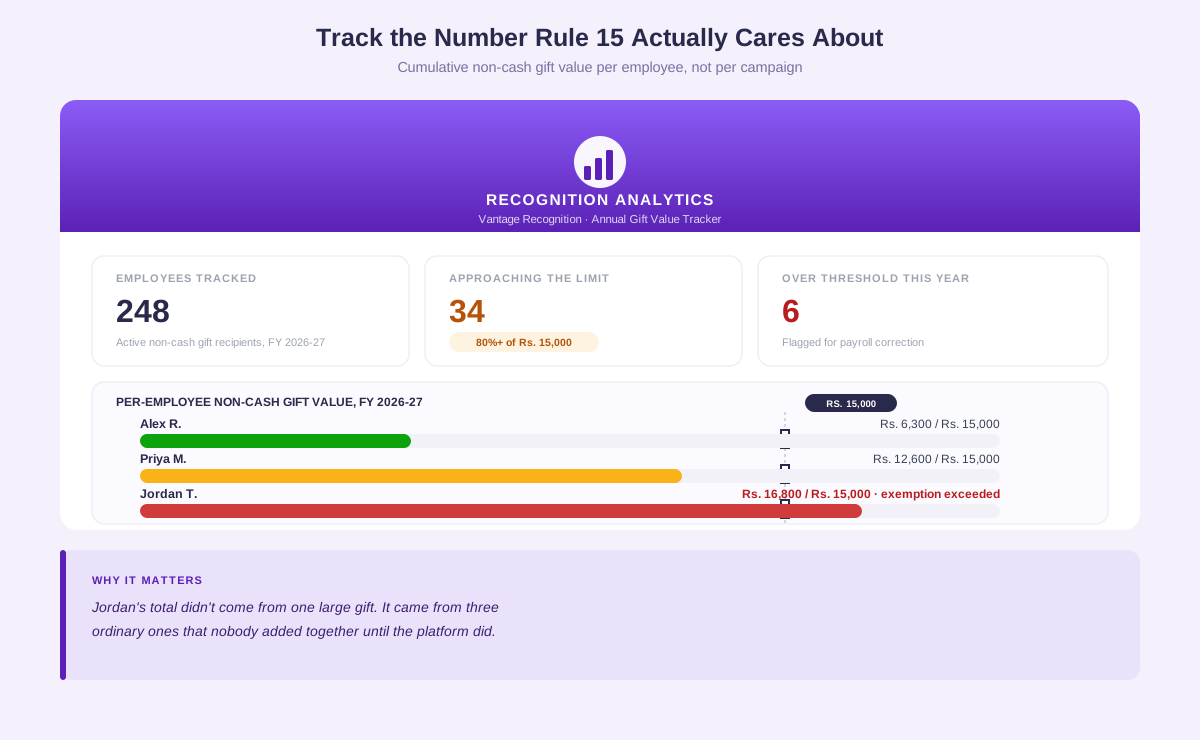
Campaign timing compounds the problem. Diwali gifts, year-end recognition, and service anniversaries often cluster in the same quarter, each owned by a different stakeholder: HR runs the festival gifting, a manager approves the spot bonus, a platform automates the service award, and none sees what the other two already gave that employee. Campaign Management that plans them from one place keeps that total visible before it becomes a compliance surprise.
The Employer-Gift Exemption vs. the General Gift-Tax Rule
The Rs. 15,000 employer-gift exemption under Rule 15 is a separate rule from the general Rs. 50,000 gift-tax threshold for individuals, and the two shouldn't be conflated when structuring a rewards program. Under the repealed 1961 Act, that general threshold was Section 56(2)(x); the corresponding number under the 2025 Act is unconfirmed, so this article doesn't assert one.
That general rule taxes gifts of money or property an individual receives without consideration, once the aggregate from non-relatives exceeds Rs. 50,000 in a year. It's an anti-abuse provision aimed at gifts between individuals, most commonly family and friends, and it exempts gifts from "relatives" regardless of value. An employer isn't a relative under this definition, so an employer-employee gift is governed by Rule 15, not the general Rs. 50,000 threshold.
In practice, an HR team can't treat Rs. 50,000 as the relevant limit for a company gift. The number that governs an employer's non-cash gift is Rs. 15,000, less than a third of the figure most people assume applies. General consumer finance content, aimed at someone wondering whether a wedding gift from an uncle is taxable, correctly quotes Rs. 50,000. An HR leader applying that same figure to a rewards program is applying the wrong rule to the wrong relationship.
GST Implications for Corporate Gifting and Rewards Programs
Gifts up to Rs. 50,000 per employee per financial year aren't treated as a "supply" under GST law, so no GST is charged on the gift itself. This comes from Schedule I of the CGST Act, 2017. Unlike income tax, GST law wasn't restructured in the April 2026 changes, so this figure is unaffected.
That exemption from output GST does not make the transaction GST-neutral for the employer. Under Section 17(5)(h) of the CGST Act, input tax credit isn't available on goods disposed of by way of gift or free samples. The GST paid on those gift items generally needs to be reversed, since the credit was never available in the first place.
Finance teams that don't flag gift-related purchases separately risk claiming credit they later have to reverse, usually caught at year-end or during an audit. Confirm any GST position with your own tax advisor before building it into a standing process.
Where Recognition Programs in India Still Get This Wrong
The compliance gaps here are predictable, with a new one added by the rule change itself.
Policies and platforms still reference the repealed Rs. 5,000 figure. An HR policy, a vendor's default settings, or a manager's mental model written before April 2026 may still assume the old threshold. The mechanic hasn't changed, only the number, so the old figure means treating gifts as taxable, or exempt, at the wrong point.
Reloadable or cash-loadable gift cards get treated as "vouchers" when they may not qualify as one. Rule 15's exemption is written for a gift, voucher, or token redeemable for goods or services, not for cash. Several vendor-issued "gift cards" can be reloaded or converted toward cash-like balances, pushing them closer to a cash-equivalent than a closed-loop voucher. Confirm with the issuer whether the instrument qualifies.
A cash spot bonus gets called "recognition" instead of "bonus." The label doesn't change the tax treatment. Cash is cash, taxable from the first rupee, regardless of what it's named in the expense report.
Nobody owns the running per-employee total. Recognition, payroll, and finance each see a different slice of what an employee received this year, and none of them is tasked with adding it up. The Rs. 15,000 line still gets crossed by consensus, not by any one decision.
A Practical Compliance Checklist for HR Teams
None of this requires a legal team on standby, just a system that tracks the right number, per employee, all year, against the current threshold.
| Compliance Step | Why It Matters |
|---|---|
| Confirm policy documents and vendor settings reference Rs. 15,000, not the repealed Rs. 5,000 figure | Outdated settings can trigger the cliff at the wrong point |
| Route recognition through non-cash points, vouchers, or tokens rather than cash wherever possible | Only non-cash gifts get the exemption; cash is taxable from the first rupee |
| Track cumulative non-cash gift value per employee across the full financial year, not per campaign | The limit is a yearly aggregate; per-occasion tracking misses gifts that add up |
| Coordinate festival gifts, service awards, and spot bonuses through one system instead of separate approvals | Uncoordinated campaigns are the most common way a yearly total goes unnoticed until it's over the limit |
| Flag any employee approaching Rs. 15,000 before the next reward is issued | Once crossed, the entire value becomes taxable, so catching it early avoids correcting it retroactively in payroll |
| Confirm GST input-credit treatment on bulk-purchased gifts with your tax advisor annually | ITC reversal under Section 17(5)(h) of the CGST Act is unaffected and applies regardless of the GST-exemption limit |
Vantage Recognition centralizes gift-based recognition, service awards, and peer-to-peer rewards on one platform, so cumulative value per employee is a number HR can pull up, not reconstruct at year-end. Long Service Awards are worth automating since milestone awards often quietly push a total past the threshold when they aren't tracked alongside everyday rewards.
The Rules, Plainly
For the finance conversation, this is the one-page version.
- Non-cash gifts, vouchers, or tokens are exempt only if their aggregate value per employee stays under Rs. 15,000 a year. Cross it, and the entire amount is taxable. (Rule 15(5)(a), Table IV, Item 4, Income Tax Rules, 2026, effective April 1, 2026; charged under Section 17(2), Income Tax Act, 2025)
- Cash awards and cash-equivalents, including reloadable or cash-convertible gift cards, are always fully taxable as salary. No minimum, no exception.
- Service awards and milestone rewards follow the same Rule 15 treatment as any other non-cash gift, and count toward the same yearly total.
- The general Rs. 50,000 gift-tax threshold for individuals doesn't apply to employer-employee gifts. Different rule, different relationship. (Section 56(2)(x) under the repealed 1961 Act; the 2025 Act's exact section number is unconfirmed)
- Gifts up to Rs. 50,000 per employee per year aren't a GST "supply," but the input tax credit claimed on them still has to be reversed. (Schedule I and Section 17(5)(h), CGST Act, 2017, unaffected by the income-tax changes)
- The threshold moved from Rs. 5,000 to Rs. 15,000. The cliff did not move. Anything calling this a marginal exemption, at either figure, isn't supported by the rule's language.
- The date that matters is when the gift was given, not when the rules were notified. Gifts before April 1, 2026 still fall under the old Rs. 5,000 rule.
The organizations getting this right aren't necessarily spending less on recognition. They're the ones who noticed the number changed, confirmed the mechanic didn't, and updated their tracking and policy language accordingly.
Frequently Asked Questions
Is gift received from employer taxable?
Depends on form and amount. A non-cash gift, voucher, or token is exempt if its aggregate value for the financial year stays under Rs. 15,000, under Rule 15 of the Income Tax Rules, 2026. Cross that line and the entire value is taxable as a salary perquisite, not just the excess. Cash gifts and cash-equivalent payouts are always fully taxable, no exemption at any amount.
Which gifts are exempted from Income Tax?
Non-cash gifts, vouchers, or tokens from an employer are exempt as long as their combined value stays below Rs. 15,000 a year, under Rule 15 of the Income Tax Rules, 2026. Separately, gifts from a "relative" are exempt regardless of value under the general individual gift-tax rule, but that's a different rule and doesn't apply to employer-employee gifts.
Does the Rs. 15,000 limit apply per gift or per year?
Per year, cumulatively, per employee, not a per-gift allowance. A Diwali gift, a service award voucher, and a spot-recognition reward given in the same financial year are added together, and it's that combined total, not any single gift's value, that determines whether the exemption applies.
Are service awards taxed differently from regular gifts?
No. A service or long-service award given as a non-cash gift or voucher follows the same Rule 15 treatment as any other non-cash gift, counting toward the same yearly aggregate. Milestone rewards commonly push a total past Rs. 15,000 precisely because they're tracked as one-off events, not added to an employee's other gifts for the year.
Key Takeaway
Non-cash recognition isn't the compliance risk. Untracked cumulative gift value is. On April 1, 2026, the Income Tax Act, 1961 and Rules, 1962 were repealed, replaced by the Income Tax Act, 2025 and Rules, 2026. The employer-gift exemption tripled from Rs. 5,000 to Rs. 15,000, but the cliff didn't go anywhere: cross the line and the entire aggregate is still taxable, not just the excess.
A bigger, more forgiving-looking number is exactly the condition under which tracking discipline relaxes right when it shouldn't. Confirm any figure with a qualified chartered accountant before finalizing budgets, since professional commentary is still catching up on this newly enacted framework.

Lupamudra is a content marketing specialist at Vantage Circle, where she has written 50+ articles on employee recognition, rewards, and workplace culture, alongside employee engagement, diversity and inclusion, and HR compliance topics, including how India's tax rules apply to recognition and rewards programs.
Connect with Lupamudra on LinkedIn.