
Most first-time recognition programs do not fail because the idea is wrong. They fail because someone tries to design a complete system in month one: every category, every budget tier, every approval workflow, before a single employee has been recognized.
Starting an employee recognition program for the first time works better as a smaller, more deliberate bet. Pick one or two categories. Set a realistic budget. Give it a quarter before you add complexity. The principles in this guide apply to organizations everywhere, while the budgeting examples, tax guidance, and launch recommendations reflect the realities of the Indian workplace.
The upside of getting this right is measurable. Organizations with recognition-driven cultures are 4x more likely to achieve workplace excellence compared to those with emerging recognition programs (GPTW India × Vantage Circle, 2025). That gap does not come from better software. It comes from better program design from day one.
What Does a First Recognition Program Actually Need?
Three things: a category structure, a budget, and a way to measure whether it is working.
That is the whole foundation. Everything else, the approval workflows, the leaderboards, the multi-tier point systems, comes later once you know employees are actually participating.
A category structure tells people what gets recognized. Without it, a first-time program becomes a free-for-all where managers recognize whoever is most visible, and employees wonder why their colleague received an award for something they do every single week. The simplest starting point is tying recognition to two or three of your existing company values. You already have those values documented. Use them as your recognition criteria from day one instead of inventing new ones.
A budget tells people this program is real. A recognition program with no dedicated budget is a suggestion, not a program. And a way to measure it, even something as basic as participation rate and number of recognitions given in the first quarter, gives you something concrete to show leadership when the next budget conversation comes around.
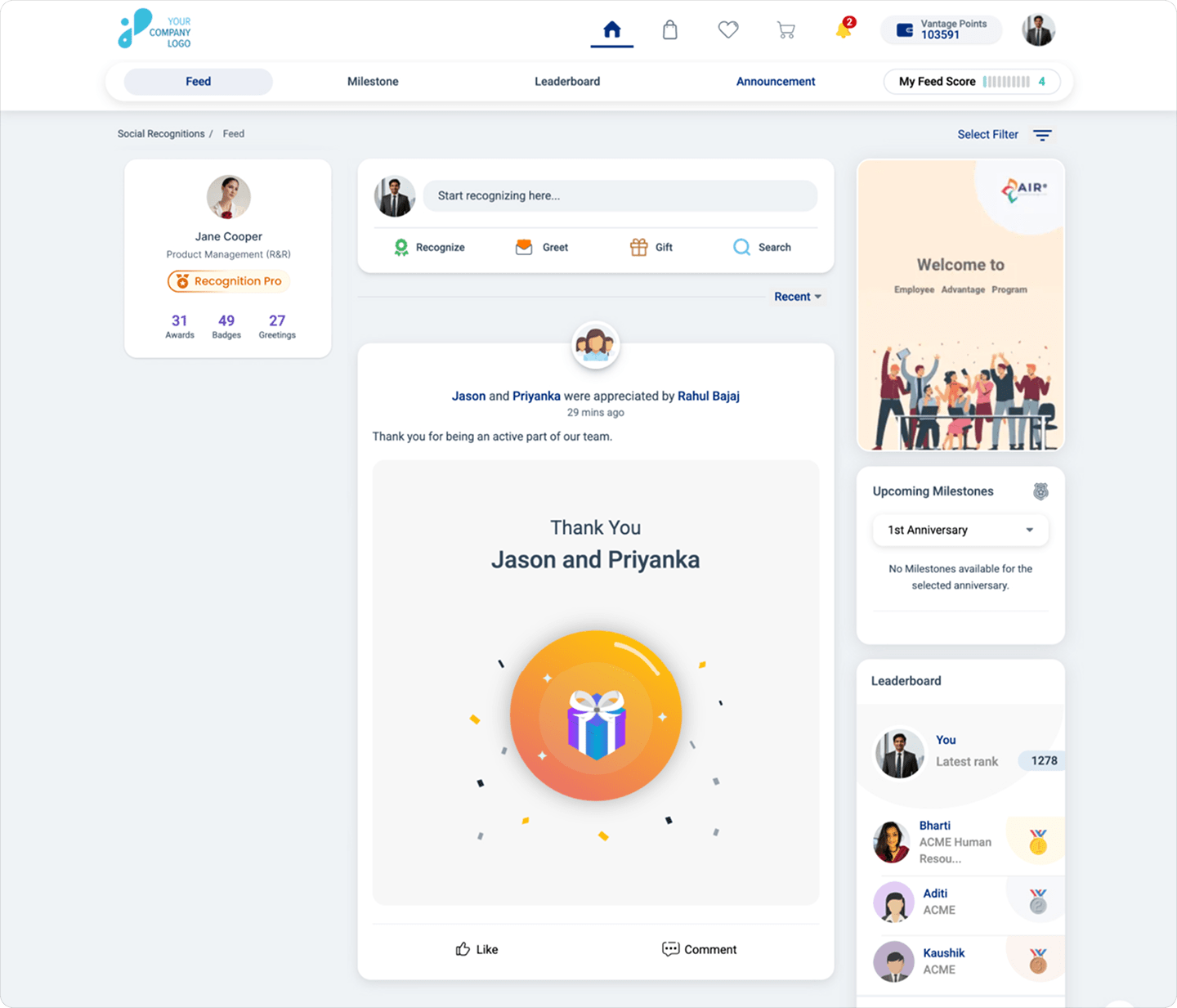
Peer-to-peer recognition is the fastest way to build that foundation. When recognition does not have to wait for a manager to initiate it, the volume of recognition moments multiplies from the first week. A social recognition feed, where everyone in the organization can see appreciation happening in real time, turns individual moments into a visible cultural signal. That visibility is what builds momentum in a new program.
Choosing a Program Structure That Matches Your Company's Size
The right structure for a 40-person startup is not the same as the right structure for a 2,000-person ITES company. The fork is straightforward: smaller organizations benefit from a peer-to-peer-first model because everyone knows each other and the culture is flat enough for recognition to flow organically. Larger organizations, especially those with hierarchical structures and distributed teams across cities, usually need a hybrid where manager recognition anchors the program while peer recognition is layered in progressively.
| Company Size | Recommended Starting Structure | First Categories to Launch |
|---|---|---|
| Under 200 employees | Peer-to-peer first, manager recognition secondary | Core Values, Peer Appreciation, Work Anniversary |
| 200–1,000 employees | Hybrid: manager-led monetary + peer non-monetary | Core Values, Manager Awards, Long Service |
| 1,000+ employees (ITES, Manufacturing) | Manager-led with structured peer recognition campaigns | Core Values, Department Awards, Peer Recognition, Long Service |
One category that every company size can switch on immediately: Long Service Awards. It requires no design work, no new criteria, and no change management. Your HRIS already has the tenure data. Automating service milestones from day one gives the program visible activity while you are still building peer recognition habits across the organization.
Related: Why Incomplete Recognition Frameworks Fail: The Missing Pillars
Budgeting for Your First Recognition Program in India
The most common budgeting mistake first-timers make is setting an annual number without thinking through where it goes. A budget is not just a total spend figure. It is an allocation across monetary rewards, non-monetary recognition infrastructure, and program administration. Getting that split wrong in year one is what creates the second-year budget crisis. For a deeper breakdown of how to structure recognition spend, see our guide to employee recognition budgets and how to calculate recognition ROI.
Here is a realistic starting range for Indian companies, by size:
| Company Size | Suggested Annual Budget Range (INR per employee) |
|---|---|
| Under 200 employees | INR 500 – 1,200 per employee per year |
| 200–1,000 employees | INR 800 – 1,800 per employee per year |
| 1,000+ employees | INR 1,000 – 2,500 per employee per year |
These ranges assume a mix of monetary and non-monetary recognition. If your entire budget goes into cash awards, you will run through it in two quarters and have nothing left for the moments that matter most: work anniversaries, peer shout-outs, values-aligned recognition that does not require a bank transfer.
The retention case for this spend: recognition-driven cultures show 92% employee retention versus 76% in low-recognition environments (AIRe Report, Vantage Circle × Mercer). A 16-point retention gap is the number to put in front of leadership when the budget conversation feels hard.
Note: Before finalizing your rewards budget, confirm how non-cash gifts are treated under Indian tax regulations with your finance team or tax advisor.
If your awards budget feels constrained in year one, a discount-based perks layer is a lower-cost way to keep recognition meaningful. Employees can access brand discounts, cashback offers, and vouchers without requiring additional monetary reward spend from the program budget every month.
Choosing the Right Time to Launch Your Recognition Program
In most global recognition guides, launch timing means picking a quarter. The broader principle is universal: launch when employee attention and organizational momentum are naturally high. For some organizations, that may be year-end reviews, company anniversaries, or quarterly kickoffs.
For Indian organizations
In India, launch timing means picking a season. The festival calendar does a significant portion of the change management for you, because it creates a cultural environment that is already oriented toward appreciation.
Two launch windows consistently outperform everything else for first-time programs in India:
Pre-Diwali (September to October). Diwali is the most natural moment of collective appreciation in the Indian workplace. Employees already expect acknowledgment around this period. Launching a recognition program in the weeks before Diwali means your first recognition moments happen when people are already paying attention to who contributed what. Adoption rates in this window tend to run noticeably higher than a January cold-start, because you are working with the cultural rhythm rather than against it.
Post-Holi, early Q1 (March to April). The post-Holi period marks a natural reset for many teams. Launching here gives the program a full financial year to build participation data before the next budget cycle, which matters when you need to justify renewal spend in your first annual review.
Avoid launching between June and August if your workforce has significant leave concentration in those months. A recognition program that launches to 60% attendance will never build the momentum it needs in the first 90 days, and that early window is the hardest to recover from.
6 Mistakes First-Time Recognition Programs Make
The pattern is consistent. First-time programs fail not because the technology does not work or because employees do not care. They fail because of structural decisions made before the first recognition ever happens.
Mistake 1: Launching without a values or criteria framework. If employees do not know what gets recognized, the program defaults to whoever is most visible. That is not a recognition culture. That is a visibility contest. Before you launch, tie recognition to two or three specific company values. A platform that enables Core Values Alignment gives a first-time program instant, defensible structure instead of leaving criteria open to individual interpretation.
Mistake 2: Making it manager-only from day one. Manager-only recognition is the slowest way to build momentum because it depends on a small number of people remembering to initiate. Opening peer-to-peer recognition from launch day spreads that responsibility across the whole organization. In India specifically, where employee-initiated recognition is still relatively rare in most workplaces, this also begins shifting a cultural default that most programs never directly challenge.
Mistake 3: No budget set aside beyond year one. First-year budgets are relatively easy to get approved on the strength of the idea. The second year is where most programs quietly die because the case for renewal was never built while the program was running. Layering in a discount-based perks component gives the program a lower-cost way to stay meaningful without needing a larger cash budget approved every year.
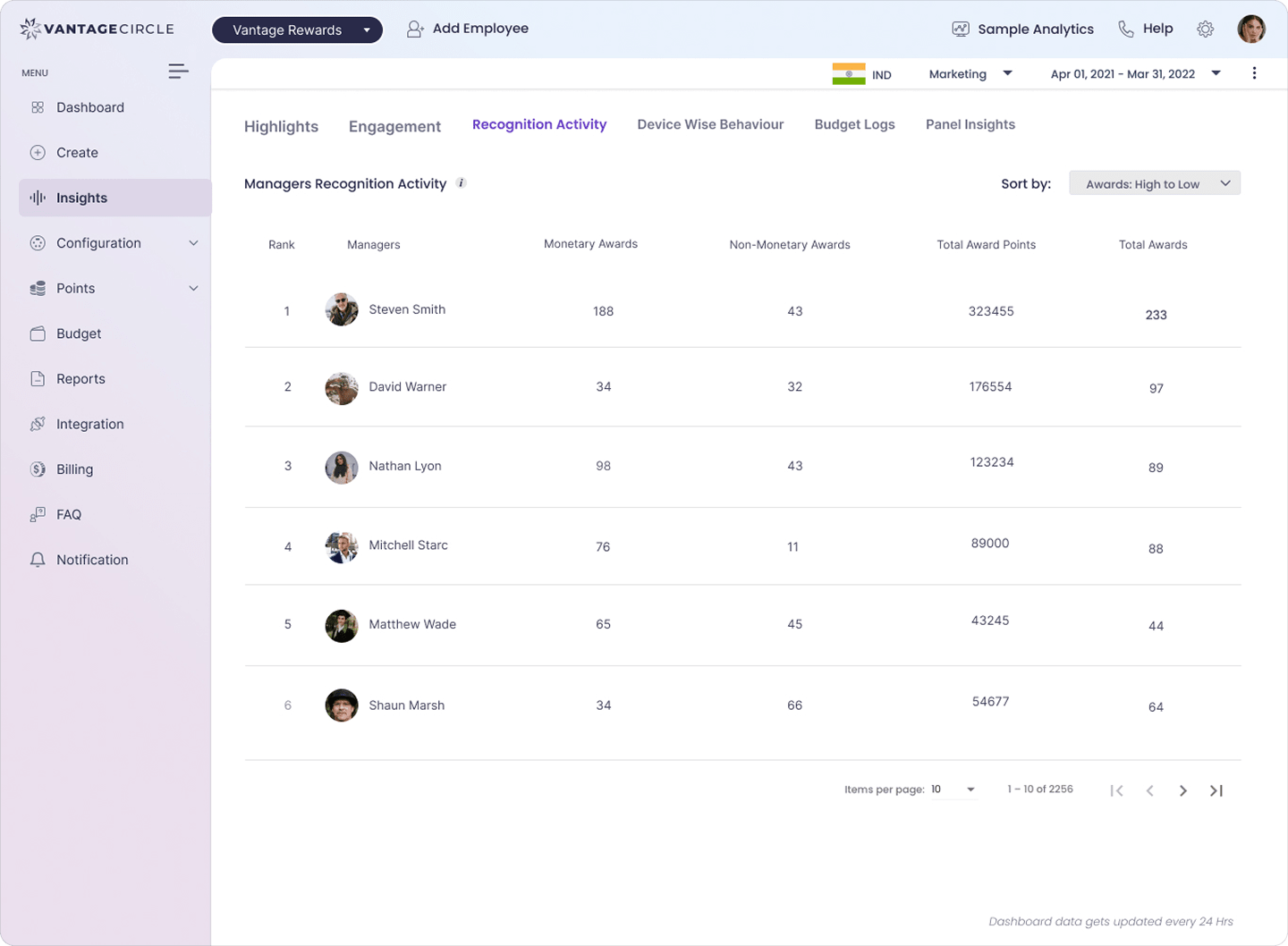
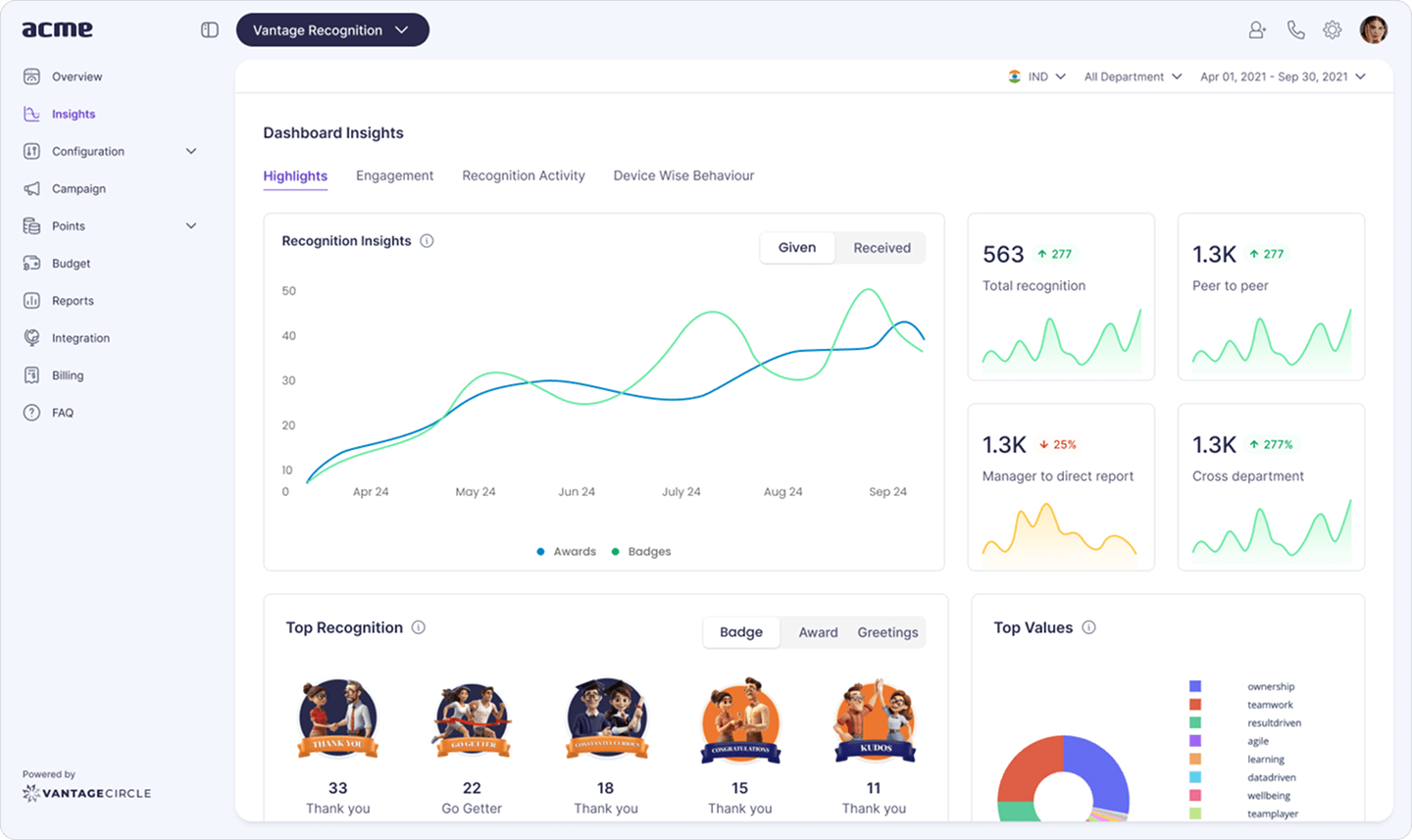
Mistake 4: No way to measure whether it is working. Without a baseline, the next budget conversation has no foundation. An eNPS pulse through Vantage Pulse before launch gives you a starting point to compare against at six months. The metric to track first is not overall engagement score. It is recognition participation rate: what percentage of your employees gave recognition last month, and what percentage received it.
Mistake 5: Announcing it once and never again. Recognition habits do not form from a single launch email. The drop-off between month one and month three is where most first-time programs lose people. Scheduled nudge campaigns, prompts that remind managers and employees during key windows, are what sustain participation through the period when habits are not yet formed. This is not about sending reminders for the sake of it. It is the difference between a program that runs and one that requires constant manual pushing to stay alive.
Mistake 6: Designing it only for your corporate floor employees. This is the concern India sales teams raise most consistently. Recognition programs are frequently designed for desk employees with laptop access and a corporate login. If your workforce includes manufacturing, logistics, or field teams, a program that requires a browser session is not a recognition program for your whole organization. Design for your most constrained employee first. The office employees will adapt. The shop floor workers will not, and they will disengage quietly.
What Comes After Setup?
Once your program has a shape, a category structure, a budget, and early participation data, the question shifts from "does it exist" to "is it working." That is a different conversation and it requires a different framework.
The next step is connecting recognition to business outcomes: tying what your program tracks to the metrics leadership actually measures, attrition rate, productivity, eNPS, quality scores. Recognition analytics gives you the participation data to begin making that case before the next review cycle. Without it, recognition remains a line item that is easy to cut when budgets tighten.
The step after that is rolling out the program organization-wide, which is where change management becomes the real work. Recognition adoption follows a predictable curve: high activity in month one, a visible drop in months two and three, and a rebuild if the program was designed with that curve in mind from the start. Most first-time programs are not, which is why the adoption phase deserves its own planning. LTTS achieved 93% employee participation in their ROAR program — a number that reflects how deeply recognition was embedded into daily work, not just launched into it.
When you are ready to evaluate platforms and vendors, the evaluation criteria matter as much as the program design.
Before you choose a platform
The Complete Buyer's Guide to Recognition
What to look for, what questions to ask, and what to avoid when evaluating a recognition platform for the first time — so the software you choose actually supports the program you are trying to build.
Related: Recognition Program Adoption: A 6-Month Roadmap for HR
Frequently Asked Questions
How do you launch an employee recognition program?
Start with structure before software. Define two or three recognition categories tied to company values, set a per-employee annual budget, and decide who can give recognition from day one. Then choose a platform, run a short pilot with one team or one department, and use the first 90 days to build participation habits before scaling company-wide. Do not wait until everything is perfect. A simple program running is worth more than a comprehensive program still in design.
How do you announce an employee recognition program?
Announce it at a moment when attention is already high: a town hall, a leadership all-hands, or a pre-Diwali gathering for Indian companies. The announcement should answer three questions for every employee: what gets recognized, who can give recognition, and what happens when you receive it. One email is not enough. Plan at least three visible touchpoints in the first two weeks, including a message from a senior leader, a team-level briefing from managers, and a follow-up that shares the first recognition moments publicly.
Are employee recognition gifts taxable in India?
Yes, non-cash gifts from employers are treated as perquisites under Indian income tax law, with an annual exemption threshold. Tax treatment can affect how you structure your rewards budget. Confirm the current threshold with your finance team or tax advisor before finalizing your program design.
What is a realistic first-year budget for a company with under 200 employees in India?
A starting range of INR 500 to 1,200 per employee per year covers a workable mix of monetary rewards and non-monetary recognition for a smaller organization. That is enough to make the program feel real and run a full year of data collection. Use year-one participation numbers to justify a more specific allocation in year two rather than guessing upward from the start.
Before You Launch
The first employee recognition program does not need to be complete. It needs to be real.
Start with two categories. Set a 90-day goal. Add complexity only after you have earned it with participation data that shows the foundation is working.

This article is written by Supriya Gupta. Supriya Gupta is a Content Marketing Lead at Vantage Circle, driving content strategy and thought leadership. She builds narratives that drive engagement and align brand purpose with impact.
Connect with Supriya on LinkedIn.