Work anniversaries are among the most predictable moments in the employee lifecycle. They arrive every year, for every person, on a known date. What decides whether that moment builds loyalty or quietly confirms indifference is not the size of the budget - it is what happens on the day.
Employees who receive high-quality recognition are 65% less likely to be actively looking for another job, according to Gallup, 2024. That gap does not shrink at scale. It widens when organizations treat employee service awards as a compliance activity rather than a retention strategy.
Also called long service awards or years of service recognition, a service award program is a structured system for marking employee tenure milestones - typically 1, 5, 10, and 20 years - with intentional recognition. It is one of the highest-leverage elements of any employee recognition program. At Vantage Circle, we track what separates programs that move retention numbers from those that don't, across thousands of organizations through our annual State of Recognition & Rewards Report. The finding that consistently surprises HR teams: 84% of the highest-effectiveness programs spend under $100 per employee per year. The differentiator is design, not spend.
What follows covers what works in 2026 and why, four things that no longer do, a milestone-by-milestone playbook from Year 1 to Year 25, ready-to-use wording for every anniversary, and answers to the tax question that comes up at every planning meeting.
What Is a Service Award Program?
A service award program is a formal recognition system that marks employee tenure milestones with structured, intentional rewards. Most programs cover 1, 3, 5, 10, 15, 20, and 25-year anniversaries, though the specific milestones vary by organization.
The distinction between a program and a plaque matters. A plaque is a transaction. A program is an experience that tells an employee their decade of work meant something to the people around them, not just to the HR system. That difference determines whether a service award deepens loyalty or quietly signals the company went through the motions.
Pair your service award program with a broader work anniversary strategy to cover every tenure moment, not just the milestone years with round numbers.
Why Service Award Programs Still Matter in 2026
The business case in 4 stats
- Replacing one mid-level employee costs 50 to 200% of their annual salary (SHRM).
- Well-recognized employees are 45% less likely to have turned over two years later (Gallup and Workhuman, 2024).
- Employees receiving high-quality recognition are 65% less likely to be actively looking for another job (Gallup, 2024).
- 84% of high-effectiveness recognition programs spend under $100 per employee per year, proving impact is about design, not budget (Vantage Circle, State of Recognition & Rewards 2025).
Tenure milestones are one of the highest-leverage moments in the employee lifecycle. Most employees go years without recognition beyond a performance review. Service awards create structured moments where recognition is guaranteed, visible, and tied directly to the relationship between the employee and the organization.
The employee retention case is simple: keeping a 10-year employee costs a fraction of replacing one. Service award programs are the most underused retention tool in most HR teams' stacks, and the easiest to modernize.
The Recognition Effect: What Great Workplaces Do Differently
Discover how recognition shapes workplace culture — insights from a joint study with Great Place To Work® on what sets top employers apart.
Download the ReportWhat Makes a Service Award Program Work in 2026
The gap between programs that retain people and programs that quietly signal indifference comes down to four things.
Giving Employees a Choice of Reward
Fixed gifts fail because they assume everyone wants the same thing. A 25-year-old new hire and a 50-year-old operations director do not want the same recognition gift, and treating them identically signals that the company didn't think about either of them.
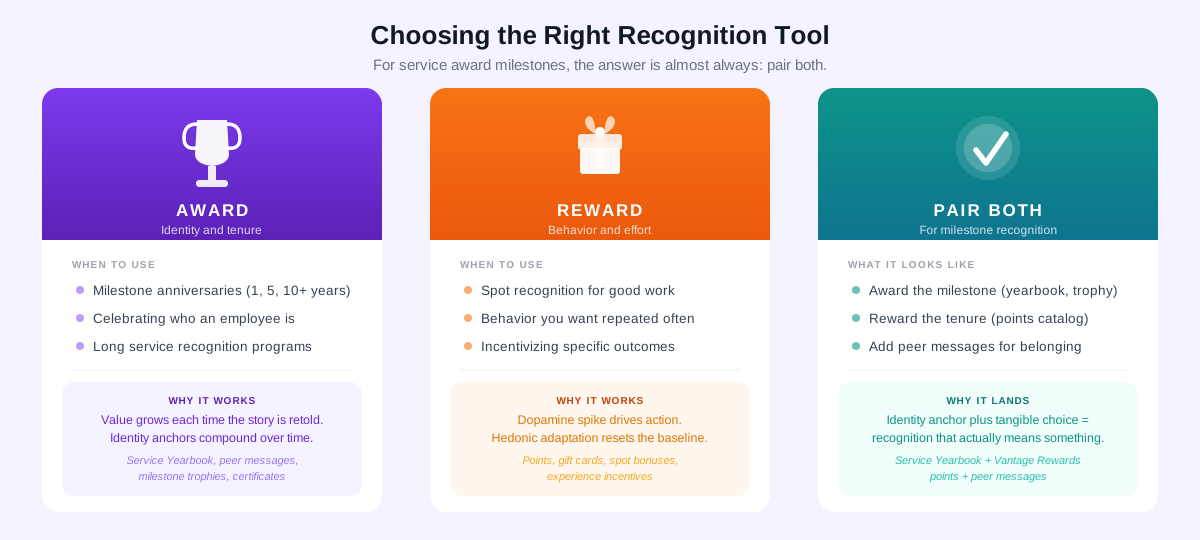
The fastest way to make a milestone feel personal is to let the employee choose. High-effectiveness recognition programs are 3× more likely to use emotionally resonant rewards (experiences, mementos, and learning opportunities) over generic gifts (Vantage Circle, State of Recognition & Rewards 2025). A points-based reward turns a fixed trophy into a catalog of options the person actually wants. Vantage Recognition drops points at each milestone so a 10-year employee can pick an experience, gift card, or charitable donation that means something to them. The choice itself is the recognition.
Adding Peer Messages and Shared Memories
A plaque says the company noticed. A wall of peer messages says the team did. Those are not the same thing.
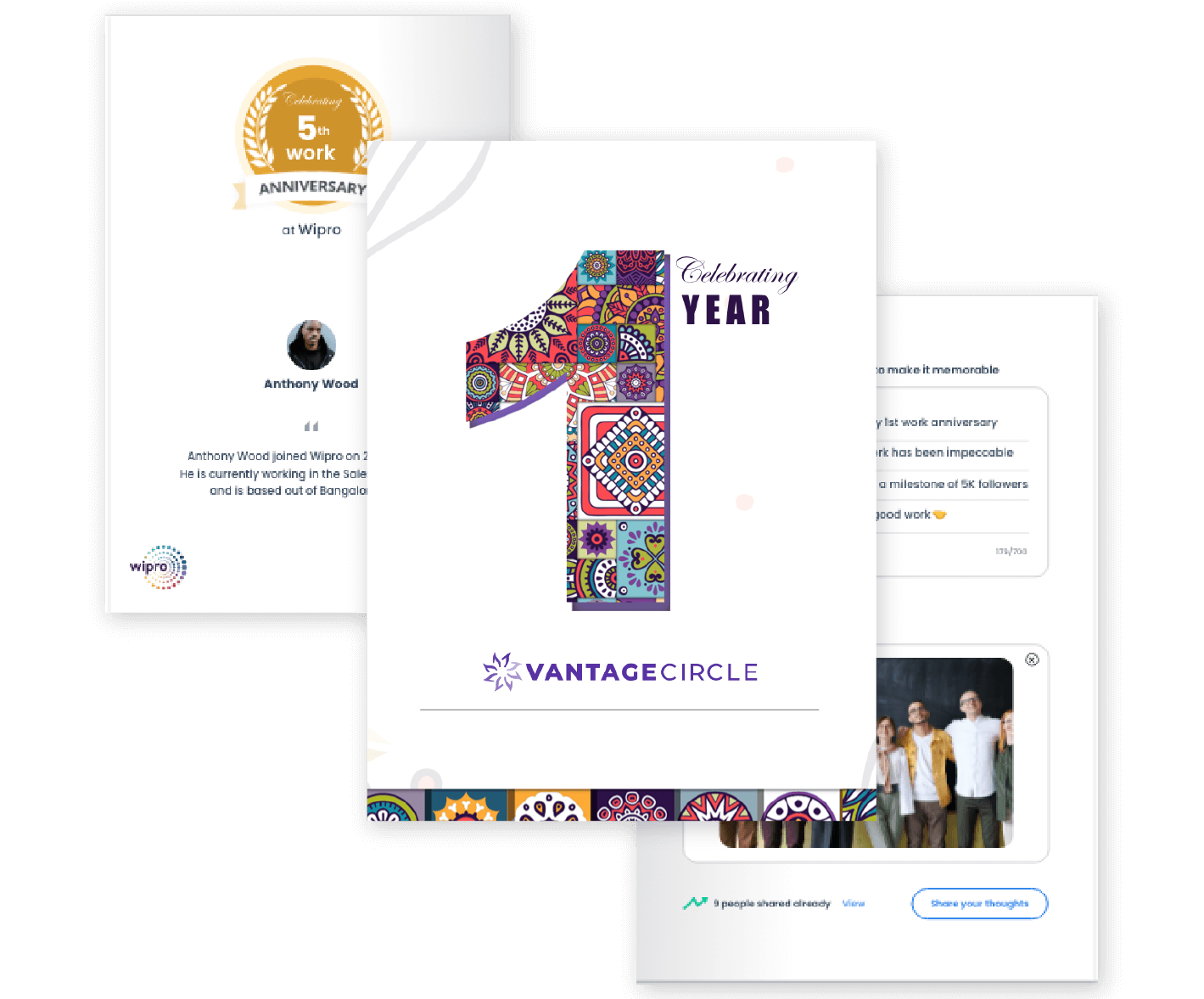
Collecting notes and memories from colleagues turns a milestone into a genuine moment of belonging. Vantage Recognition's Service Yearbook gathers messages, photos, and well-wishes from teammates into a digital keepsake the employee keeps permanently. An employee who receives 30 personal messages on their 10-year anniversary remembers that moment decades later. An employee who receives a crystal trophy does not.
For peer recognition to fuel milestone moments, the habit has to exist year-round. Read more on peer-to-peer recognition to build those habits before milestones arrive.
Recognizing Contribution, Not Just Tenure
Time served is a proxy for loyalty. It is not a measure of impact. Rewarding tenure alone sends a clear message to high performers: effort is optional as long as you stay long enough.
Programs that work in 2026 tie each milestone to the values an employee lived during their tenure. Research shows that high-effectiveness programs are 2–3× more likely to recognize specific behaviors rather than outcomes alone, making recognition more real and repeatable (Vantage Circle, State of Recognition & Rewards 2025). Vantage Recognition links each service award to a core value, so a 5-year milestone celebrates how someone worked, not only how long. That distinction matters most for your top performers, who are the ones most likely to leave when they feel their contribution is invisible.
Marking Milestones in the Moment, Publicly
Service awards fail most often not because the gift was wrong, but because the moment was invisible. An email sent three days late, a certificate mailed weeks after the date, or a private message no one else sees turns a milestone into an afterthought.
Automating milestone tracking means no anniversary slips through and recognition lands on the exact day it matters. Vantage Recognition triggers long service awards automatically so HR never misses a date, managers are prompted to add a personal message, and the social recognition feed makes the milestone visible company-wide. A 5-year anniversary becomes something the whole team participates in.
When recognition is late, impersonal, or invisible, it communicates the opposite of what it intends to. The mechanics of delivery (timing, visibility, personalization) are not operational details; they determine whether recognition lands as appreciation or lands as noise.
In practice: Wipro
Wipro - 230,000+ employees across 66 countries - identified missed and delayed service milestone awards as one of its core recognition failures. Delivering personalized awards to thousands of employees reaching tenure milestones simultaneously, across time zones and business units, was operationally broken. After implementing automated milestone tracking through Vantage Recognition, peer recognition increased by 97.5%. Read the full Wipro case study.
Service Award Mistakes to Drop in 2026
Red flags your service awards have gone stale
Plaques are stored in drawers, not displayed. Employees joke about what they'll receive at 10 years. Managers learn about a milestone from HR, not from knowing their own team's tenure. Recognition arrives late or in a generic auto-email. New hires ask whether the company actually celebrates anniversaries.
Generic Plaques and Trophies Nobody Asked For
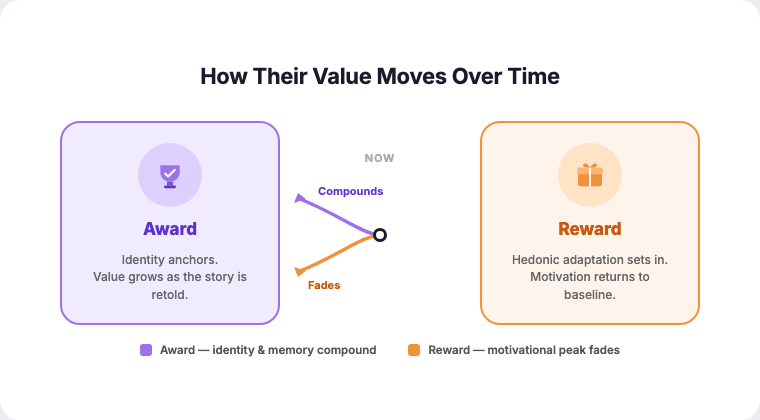
The crystal trophy market exists because HR departments have been ordering from the same catalog for decades. Most employees display them for a week, then move them to a drawer or leave them in the office when they resign. Recognition that ends up in a drawer is not recognition; it's a receipt.
The problem is not the format. The problem is that a fixed, uniform gift signals the company bought the cheapest defensible item and called it appreciation. Employees know the difference between something chosen for them and something processed in bulk.
Tenure-Only Recognition That Ignores Performance
A 10-year employee who checked out at year three is not the same as a 10-year employee who drove a product launch in year eight. Treating both identically, with the same trophy, the same certificate, the same ceremony, tells your best people exactly what their effort is worth.
Tenure-only awards also fail high-impact employees who joined late in their careers. A VP who delivers real results in their first two years receives nothing under a tenure-only model while a long-tenured underperformer collects the watch at year five. That is not a recognition culture; it is a tenure culture.
Impersonal, Automated Recognition With No Human Touch
Automation is infrastructure, not recognition. An auto-email with a name merged in does not constitute acknowledgment. Neither does a gift card sent without a note explaining why it was given or what the person's contribution actually meant.
The automation that works handles logistics: triggering the award on the right date, sending manager prompts, notifying the team. The human element must still come from the manager who writes a specific, personal message about what that employee's tenure actually meant to the organization and the people around them.
One-Size Milestones for Every Employee
A 1-year milestone and a 25-year milestone are not the same moment. Neither is a milestone for a remote employee the same as one for someone who works in a shared office daily. Applying the same certificate template and gift value to every milestone tells employees that the program was designed for compliance, not for people.
Programs that work scale intentionality with tenure. A 1-year milestone gets a public acknowledgment and a meaningful first reward. A 25-year milestone gets an experience, a substantial financial award, a team celebration, and a record of the employee's full journey within the organization.

The Service Award Milestone Playbook
| Milestone | What Works | What to Avoid |
|---|---|---|
| 1 year | Public shoutout on the social recognition feed + points toward a personal reward | Generic "welcome to the family" email with no reward attached |
| 3 years | Points-based reward + peer messages on the recognition feed | Skipping this milestone entirely; early tenure is when loyalty is still forming |
| 5 years | Choice reward + Service Yearbook with peer messages + personalized manager message | Crystal trophy or certificate the employee never requested |
| 10 years | Meaningful financial reward ($200-$400) + experience option + team acknowledgment + values-tied recognition | A private email and a standard certificate |
| 15 years | Premium experience (travel, dinner, event) + personalized message from leadership + company-wide announcement | Scaling the 10-year gift by a fixed percentage with no added intention |
| 20 years | High-value reward ($400+) + executive recognition + company-wide announcement + digital legacy keepsake | Any automated, non-personalized recognition; this milestone requires deliberate human effort |
| 25 years | Premium reward + personalized reflection on the employee's career journey + peer tribute compilation + leadership event | Standard HR process with no differentiation for a near-career commitment |
Service Award Ideas That Employees Actually Want
| Idea | Why It Lands |
|---|---|
| Points-based reward catalog | Choice signals respect; the employee picks what is meaningful to them, not the company |
| Service Yearbook (peer message collection) | Makes the milestone feel witnessed by the people who worked alongside them every day |
| Experience reward (dinner, travel, event tickets) | Creates a lasting memory rather than an object that gathers dust |
| Extra paid time off | Immediately and tangibly valuable; works for every role and life stage |
| Personalized video message from senior leadership | Rare, high-signal, and memorable when it names specific contributions |
| Charitable donation in the employee's name | Resonates with values-driven employees and creates meaning that outlasts the milestone |
| Vantage Perks milestone add-on (employee discounts) | Practical everyday value that extends well beyond the anniversary date |
| Custom digital memory album or career timeline | Documents the actual relationships and milestones built across their tenure |
Vantage Perks pairs milestone recognition with real spending power on brands employees already use, giving a service award practical staying power beyond the day it arrives.
Service Award Wording and Messages
Wording is where most managers fail, not because they don't care, but because they don't have a starting point. Without guidance, "thank you for your service" becomes the default. That phrase is not recognition; it is a placeholder.
1-year message: "One year in, and [Name] has already [specific contribution]. Thank you for bringing [specific quality] to this team every day."
5-year message: "Five years of [Name] means five years of [team or project contribution]. Your work on [specific area] shaped how we do things here. Thank you for the consistency and care you've brought to this team."
10-year message: "A decade with [Name] on this team is something worth stopping for. In 10 years, [Name] has [key contributions]. The team you've helped build and the results you've driven make this milestone mean something."
20-year message: "Twenty years is not just tenure. It is thousands of decisions made in this company's interest, relationships built across the organization, and a standard of work that shaped what this place became. [Name], we are genuinely grateful."
25-year message: "Twenty-five years is a career within a career. [Name] has seen this organization change, helped shape how it works today, and made a choice, over and over, to stay. That kind of loyalty is not just valuable; it is rare. Thank you for being the kind of person who builds things and stays long enough to see what they become."
If your program currently runs on spreadsheets and email reminders, Vantage Recognition handles the full milestone workflow: tracking anniversaries, prompting managers before each date, collecting peer messages, and delivering the reward - so HR can focus on the moments rather than the mechanics.
How to Measure if Your Program Works
A service award program that cannot be measured cannot be improved. In the recognition programs we track across industries, the most common failure point is not reward quality - it is milestone completion rate: anniversaries missed or recognized late because there is no automated trigger. Track three metrics consistently.
Participation rate. What percentage of eligible employees receive their milestone recognition on time? If a meaningful portion of milestones are being missed or delayed, the logistics are failing before recognition even lands.
Platform engagement. Are managers adding personal messages, or is the system sending automated defaults? Track message open rates, peer participation in Service Yearbooks, and social feed interactions on milestone posts. Low engagement here is a signal that recognition is happening in name only. High-effectiveness programs are 2× more likely to use platforms to track participation and integrate recognition into performance systems (Vantage Circle, State of Recognition & Rewards 2025).
eNPS movement. Employee Net Promoter Score (eNPS) is a single-question survey that measures loyalty: "How likely are you to recommend this company as a place to work?" Run eNPS surveys before and after milestone recognition cycles. A lift among employees who recently hit a milestone signals the program is working. Vantage Pulse tracks eNPS continuously so you can isolate whether milestone recognition is actually moving loyalty scores, not just surface-level goodwill.
Frequently Asked Questions
What is a years of service award?
A years of service award is recognition given when an employee reaches a tenure milestone, typically at 1, 5, 10, 15, 20, or 25 years with a company. The best service awards combine a meaningful reward the employee chose with peer messages and a public acknowledgment of their contribution to the team.
What is 25 years of service called?
A 25-year milestone is often called a silver anniversary award or career milestone recognition. Some organizations use terms like "quarter-century recognition" or assign it a dedicated award tier. The naming matters less than the intention: a 25-year milestone warrants a premium, highly personalized recognition that reflects the weight of a near-career commitment to one organization.
How do you say congratulations for 20 years of service?
Make it specific. "Congratulations on 20 years" without context is not recognition. Lead with a specific contribution or team impact: "Twenty years of [Name] means twenty years of [quality or contribution]. Thank you for choosing to build your career here and for everything you brought to this team along the way."
What do employees get for 20 years of service?
At 20 years, employees should receive a high-value reward in the $400 to $600 range, an experience option such as travel or a dinner event, a peer message compilation, a personalized acknowledgment from leadership, and a company-wide announcement. A plaque or certificate alone is not appropriate recognition for a two-decade commitment.
How do you set up a service award program?
Start with your milestone schedule and per-tier budget. Define which anniversaries you will recognize (most programs start with 1, 5, and 10 years), set a reward value for each tier, choose a delivery mechanism (points platform, experience options, or gift catalog), and build in a manager notification process. The most common failure is not the reward itself but the delivery: milestones missed because there is no automated trigger. A platform like Vantage Recognition automates the milestone calendar so HR and managers are prompted before each date rather than after. Once the system is in place, layer in peer message collection and public recognition to move the program from transactional to genuinely felt.
Are service awards taxable?
In the US, the IRS allows years-of-service awards to be excluded from an employee's taxable income up to $400 for non-qualified plans and $1,600 for qualified written plans, provided the award is tangible property (not cash or gift cards). Awards that exceed these thresholds, or that are given in cash or cash equivalents, are treated as taxable wages. In the UK, HMRC exempts long service awards from income tax if the award is a non-cash item, the employee has at least 20 years of service, no similar award has been given in the past 10 years, and the value does not exceed £50 per year of service. Tax rules change and thresholds vary by country, so HR teams should verify current figures with their tax advisor before finalizing reward amounts for any milestone tier.
To Wrap It Up
Service award programs work when they reflect the actual person, not just the number on a contract. In 2026, the gap between a program that retains your best people and one that quietly signals you don't notice them is wider than it has ever been.
Start with the milestone playbook. Audit one section of "what doesn't work" against your current program this quarter. Measure eNPS before and after your next milestone cycle. The data will tell you whether recognition is landing, or just being processed.
Vantage Recognition handles milestone tracking, peer message collection, and choice-based rewards, so every tenure anniversary lands as recognition, not a calendar reminder HR had to chase.

Lupamudra is a content marketing specialist at Vantage Circle, where she has written 50+ articles on employee recognition, rewards, and workplace culture, alongside employee engagement, diversity and inclusion, and HR compliance topics, including how India's tax rules apply to recognition and rewards programs.
Connect with Lupamudra on LinkedIn.