
You have probably heard that paying people to do something kills their desire to do it.
It is one of the most repeated ideas in management writing. It is also, in workplace settings, much weaker than most people think.
In a 40-year meta-analysis published in Psychological Bulletin, Cerasoli, Nicklin and Ford pooled 183 studies across school, work and sport, covering 212,468 people. They concluded that, with respect to performance, incentives and intrinsic motivation "are not necessarily antagonistic and are best considered simultaneously."
That does not mean rewards are harmless. It means the useful question is not whether to use extrinsic motivation. Nearly every organization already does, starting with salary. The useful question is which form to use, for which work, and how to attach it.
This article covers 12 extrinsic motivation examples you will recognize from your own workplace, what the evidence says about each, and the one design decision that separates an incentive that works from one that quietly does damage. For the wider picture of what drives people at work, start with employee motivation.
Key Takeaways
- What extrinsic motivation is, in one sentence
- 12 extrinsic motivation examples, with when each works and when it fails
- The difference between autonomous and controlled motivation, which matters more than intrinsic vs extrinsic
- What 40 years of research actually found about rewards
- The direct vs indirect rule for attaching incentives
What is Extrinsic Motivation?
Extrinsic motivation is when someone acts because of an outcome outside the task itself, such as pay, recognition, a promotion, or avoiding a consequence. Intrinsic motivation is when the task is its own reward.
That is the whole distinction. A developer who refactors messy code because bad code irritates them is intrinsically motivated. A developer who refactors it because it is on the sprint board and their bonus depends on closing the sprint is extrinsically motivated.
Most work involves both at once, which is why treating them as opposites causes so much confusion.
Vantage Influencers Podcast
"Extrinsic motivation is the money and rewards. Intrinsic motivation is you buy into the organization and you want to work there."
— Tim Ringo, Award-winning Author, Keynote Speaker, and Board Advisor on HR and Human Capital
Listen to the EpisodeSalary is the largest extrinsic motivator in almost every organization. Any argument that extrinsic motivation should be avoided has to explain why payroll exists.
Where It Comes From
The idea sits on behavioral psychology. Operant conditioning holds that behavior followed by a reward tends to repeat, and behavior followed by a penalty tends to stop. Incentive theory builds on that, arguing people are pulled toward outcomes they value.
Both are useful and both are incomplete. Neither explains why the same bonus energizes one employee and insults another. The research section below gets to that.
12 Extrinsic Motivation Examples in the Workplace
These are the twelve extrinsic motivators most organizations actually run, from salary at one end to the threat of dismissal at the other. All are genuinely extrinsic. What separates them is how well each holds up over time.
1. Base Salary
The foundation. Salary does not make people work harder day to day, but getting it wrong makes everything else irrelevant. Someone who believes they are underpaid will discount the other motivators you offer.
Works when: it is competitive and perceived as fair. Backfires when: pay bands are opaque, so people fill the gap with rumor.
2. Performance Bonuses
Cash tied to hitting a defined target. The clearest, bluntest extrinsic motivator there is.
Works when: the target is measurable, controllable by the person, and the payout is meaningful. Backfires when: the metric can be gamed. Anything measured by volume alone eventually gets volume at the cost of everything else.
3. Sales Commission
A percentage of what the person sells. Probably the purest performance-contingent incentive in business.
Works when: output is genuinely individual and quality is easy to verify. Backfires when: it rewards closing over fit, filling the pipeline with customers who churn.
4. Promotion and Job Titles
Advancement as a reward for sustained performance.
Works when: the criteria are published and applied consistently. Backfires when: promotion is the only reward on offer, pushing strong specialists into management they never wanted.
5. Public Recognition
Naming someone's contribution where colleagues can see it. Peer and manager employee recognition is extrinsic, but it behaves unusually well compared with cash.
Works when: it is specific, prompt, and names the actual behavior. Backfires when: it is generic or rotates on a schedule, at which point people read it as a formality.
6. Employee of the Month Programs
The most common structured recognition format, and the one most often done badly.
Works when: selection criteria are transparent and the pool genuinely rotates on merit. Backfires when: it becomes a turn-taking exercise, or the same three people win all year.
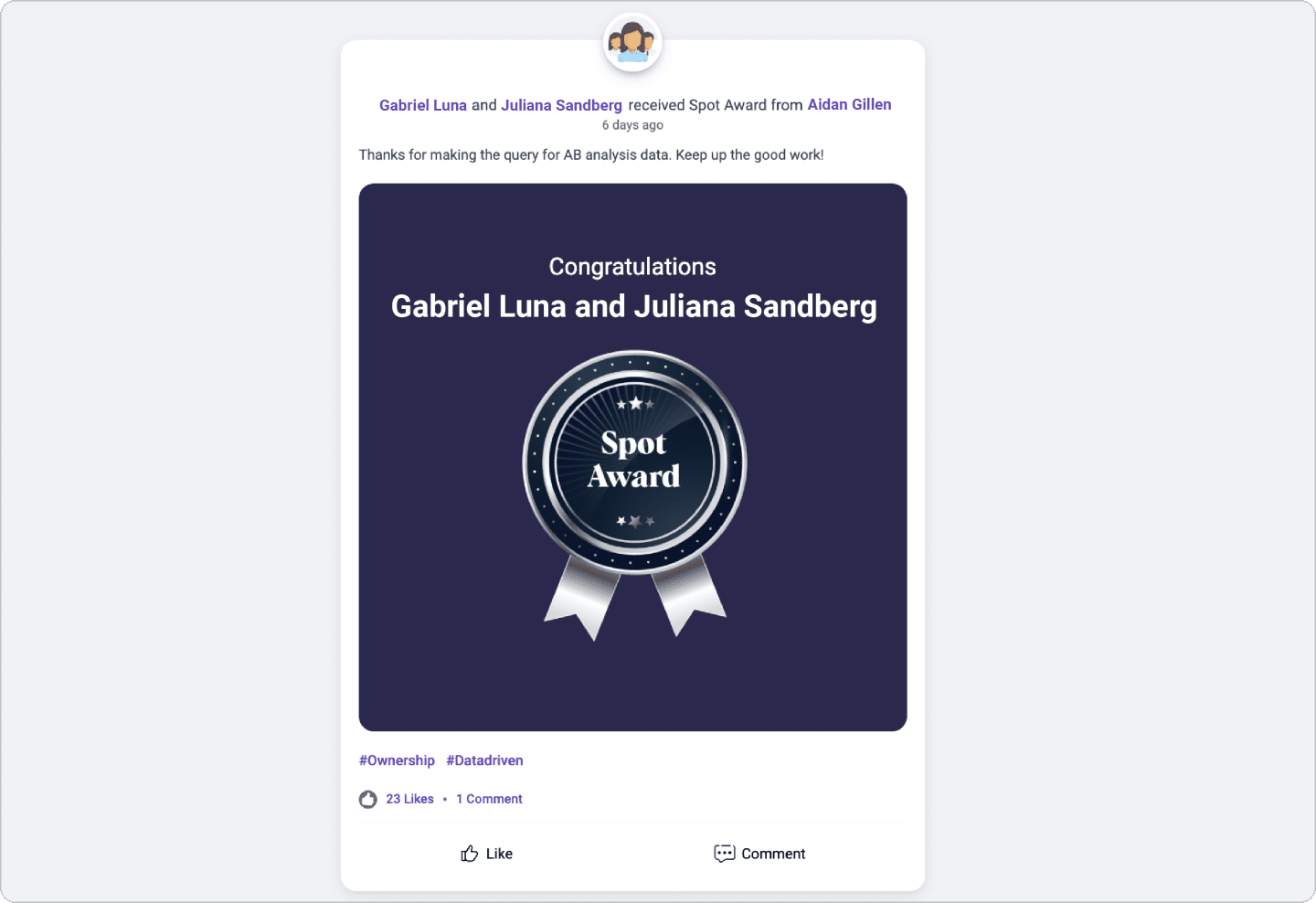
7. Spot Awards
Small, immediate rewards given close to the moment. Points, vouchers, or a modest cash amount.
Works when: the gap between the work and the reward is short. Speed matters more than size here. Backfires when: approval takes six weeks, by which time nobody remembers what it was for.
8. Non-Monetary Perks
Extra leave, equipment budgets, conference tickets, wellness allowances. Non-monetary incentives often outperform their cash equivalent because they feel chosen rather than transactional.
Works when: people can pick what they actually want. Backfires when: the same perk is issued to everyone regardless of what they value.
9. Profit Sharing and Equity
A stake in the organization's results.
Works when: the horizon matches how long people intend to stay. Backfires when: the link between individual effort and company outcome is too remote to feel real.
10. Benefits and Security
Health cover, retirement contributions, insurance. These rarely motivate extra effort, but their absence actively demotivates.
Works when: treated as a floor, not a lever. Backfires when: an organization expects gratitude for them.
11. Flexible Work Arrangements
Remote options, compressed weeks, control over hours. Increasingly the reward people rank highest.
Works when: applied by role and consistently. Backfires when: flexibility is granted informally, which reliably means granted unevenly.
12. Avoiding Negative Consequences
Performance warnings, penalties, the prospect of dismissal. This is extrinsic motivation too, and pretending otherwise is dishonest.
Works when: expectations were clear beforehand and the process is consistent. Backfires when: it becomes the primary mechanism. Fear produces compliance, and compliance is the minimum output a person can deliver without being fired.
Eleven of these twelve are things you are probably already doing. The question is not whether to use extrinsic motivation. It is whether yours is designed or inherited.
For a fuller breakdown of the reward formats themselves rather than the motivation behind them, see extrinsic rewards.
Autonomous vs Controlled: The Distinction That Matters More
Here is where most articles on this topic stop, and where the actual research starts.
Self-Determination Theory, developed by Edward Deci and Richard Ryan, no longer treats extrinsic motivation as a single thing. It splits it by how much the person has internalized the reason for acting:
| Type | What it sounds like | Quality |
|---|---|---|
| External regulation | "I do it because I get paid to." | Controlled |
| Introjected | "I do it so I don't look bad." | Controlled |
| Identified | "I do it because it matters to me." | Autonomous |
| Integrated | "I do it because it's who I am." | Autonomous |
All four are extrinsic. The person is still acting for a reason beyond the task. But the bottom two behave far more like intrinsic motivation than like a bonus.
That reframes the practical job. You are not choosing between intrinsic and extrinsic. You are trying to move people from controlled toward autonomous, which is a question of how a reward is framed and explained rather than whether you offer one.
A nurse who takes an extra shift because the rota demands it is externally regulated. A nurse who takes it because the ward will be unsafe without her is identified. Same shift. Same pay. Completely different motivation, and completely different durability.
What 40 Years of Research Actually Found
The claim that rewards destroy intrinsic motivation traces to lab studies from the 1970s. Two large pieces of work have since complicated it considerably.
The meta-analysis. Cerasoli, Nicklin and Ford's 40-year meta-analysis in Psychological Bulletin, cited above, pooled 183 studies covering 212,468 people. Three findings matter for HR:
- Intrinsic motivation predicted performance whether or not incentives were present.
- Incentives predicted the quantity of performance. Intrinsic motivation predicted the quality.
- Crowding out was real, but conditional. Intrinsic motivation mattered less when incentives were tied directly to performance, and more when they were tied indirectly.
The workplace review. In the Annual Review of Organizational Psychology and Organizational Behavior, Barry Gerhart of the University of Wisconsin-Madison and Meiyu Fang assessed the evidence behind the harm argument and concluded that support for those claims, specifically in workplace settings, "is lacking."
The gap between the lab and the office is the point. Many of the classic undermining studies paid people once for a puzzle they already enjoyed. That is not what a compensation system is.
The Rule This Gives You
The directly versus indirectly tied distinction is the most useful thing in the literature, and almost nobody applies it.
- Directly tied: "Close 20 deals and get $5,000." The reward is the reason. Effective for volume, and it does crowd out intrinsic interest.
- Indirectly tied: "We reward people who exemplify craftsmanship, and here is what that looked like this quarter." The reward acknowledges the work rather than purchasing it.
So match the attachment to the work. Routine, countable output can take a direct incentive. Judgment work, creative work and anything where quality matters more than volume should be rewarded indirectly, or you risk getting more of it done worse.
Where Extrinsic Motivation Does Go Wrong
The research softens the undermining claim. It does not erase it.
The overjustification effect is real at the margins. Someone who mentors because they care about it, then starts receiving a gift card for every session, can end up mentoring for the gift card. Remove it and the mentoring stops. The risk is highest where intrinsic interest was already strong and the reward is direct and repeated.
Metrics get gamed. A reward attached to a number tends to produce the number. Support teams incentivized on ticket closure close tickets. Whether the customer's problem was solved is a separate question.
Rewards lose potency. What felt generous last year is the baseline this year. Cash escalates worst, which is one reason types of rewards that carry meaning tend to age better than those carrying only value.
Unfairness does more damage than absence. An employee who receives nothing is disappointed. An employee who watches a less deserving colleague get rewarded is something worse. Perceived unfairness in a reward system is more corrosive than having no system.
How to Use Both Together
The organizations that get this right are not choosing a side.
Pay fairly, then stop using pay as the lever. Salary buys attendance and baseline effort. Once it is right, further motivation has to come from elsewhere.
Make recognition frequent and specific. Recognition is the one extrinsic motivator that reads as autonomous when done well, because it names the person's judgment rather than their output.
Explain the why behind the reward. The same bonus lands differently depending on whether people understand what behavior it is reinforcing. That explanation is what moves someone from external regulation toward identified motivation.
Protect the intrinsic parts. Autonomy over how work gets done, and visible progress, do not need funding. They need managers not to interfere.
Data from The Recognition Effect, a study Vantage Circle ran with Great Place to Work India across more than 2,000 organizations representing 5.7 million employees, shows the gap this opens up. In high-recognition cultures, 91% of employees reported feeling motivated. In organizations with emerging recognition cultures, that figure was 73%.
That is an 18-point gap. The comparison is correlational rather than causal, since high-recognition cultures differ in other ways too. But it sits awkwardly beside a blanket claim that external recognition suppresses motivation.
How to Tell If Your Rewards Are Working
Most organizations measure whether a reward was delivered. Almost none measure whether it did anything. Four checks are worth running.
The withdrawal test. Pause a reward for one quarter and watch what happens to the behavior it was attached to. If output falls immediately, you have built controlled motivation and you are now paying rent on it. If it holds, something more durable is carrying the work. This is uncomfortable to run, which is why it tells you the most.
Track quality alongside quantity. If the research finding above holds in your organization, introducing a direct incentive should lift volume. Watch whether error rates, rework, or customer outcomes move in the opposite direction at the same time. A bonus that raises throughput by 10% and defects by 15% is not working, and a quantity-only dashboard will report it as a success.
Count givers, not just receivers. In a recognition program, the number of people who received something tells you about distribution. The number who gave something tells you whether the behavior is actually spreading. A program where recognition flows only downward from managers is an administrative process wearing a culture costume.
Ask why, not whether. Engagement surveys usually ask whether people feel recognized. Ask instead what they think the reward was for. If they cannot name the behavior, the reward taught them nothing, whatever the satisfaction score says.
Summing It Up
Extrinsic motivation is not the cheap alternative to real motivation. It is most of what an organization actually controls.
The evidence does not say avoid rewards. It says attach them carefully. Direct incentives buy volume. Indirect ones protect quality. Recognition behaves better than cash because it acknowledges rather than purchases.
Look at the twelve examples above and pick the one your organization runs worst. It is usually spot awards arriving too late, or an Employee of the Month the team quietly understands is a rota. Fixing one badly designed reward beats adding a new one.
FAQ
What is extrinsic motivation?
Extrinsic motivation is doing something for an outcome outside the task itself, such as pay, a bonus, recognition, a promotion, or avoiding a penalty. It contrasts with intrinsic motivation, where the activity is its own reward.
What is an example of extrinsic motivation?
A sales commission is the clearest example. The salesperson is motivated by the payout rather than the act of selling. Other common examples are performance bonuses, promotions, public recognition, extra leave, and avoiding a performance warning.
Is extrinsic motivation bad?
No, though it can be badly designed. A 40-year meta-analysis found that, for performance, incentives and intrinsic motivation are not necessarily antagonistic. Problems arise when rewards are tied directly to a gameable metric, applied unfairly, or used as the only motivator.
What is the difference between intrinsic and extrinsic motivation?
Intrinsic motivation comes from the task being satisfying in itself. Extrinsic motivation comes from an outcome attached to the task. Most work involves both, and Self-Determination Theory now treats some extrinsic motivation as functioning much like intrinsic motivation once the person has internalized the reason.
Does extrinsic motivation reduce intrinsic motivation?
Sometimes, under specific conditions. The effect is strongest where someone already enjoys the task and the reward is directly tied to doing it repeatedly. Where rewards are tied indirectly, such as recognizing a standard of work rather than paying per unit, intrinsic motivation holds up.
Which is better for performance, intrinsic or extrinsic motivation?
They predict different things. Research found extrinsic incentives are a better predictor of the quantity of performance, while intrinsic motivation is a better predictor of quality. Match the motivator to whichever one the role actually needs.
What are the types of extrinsic motivation?
Self-Determination Theory identifies four: external regulation, introjected, identified, and integrated. The first two are controlled and depend on the reward continuing. The last two are autonomous and behave much more like intrinsic motivation.

Nilotpal M Saharia is an Assistant Manager, Content Marketing at Vantage Circle and a recognition-and-rewards (R&R) strategist with 9 years of experience spanning Marketing, HR, and content strategy. He helps HR leaders turn employee recognition and leadership research into practical workplace programs.
Connect with Nilotpal on LinkedIn.