
This is a feedforward example bank: 25+ before-and-after lines organized by 6 workplace scenarios, the difference between positive and constructive feedforward, and the exercise that makes it a habit. For how it stacks up against traditional feedback, see our full feedback vs feedforward comparison.
Key Takeaways
- Feedforward swaps a backward-looking critique for a specific, future-focused suggestion, an idea coined by executive coach Marshall Goldsmith in 2002.
- The core move is simple: replace the verdict about the past with a plan for the next time.
- 25+ before-and-after examples span 6 workplace scenarios: performance, communication, collaboration, time management, leadership, and onboarding.
- Positive feedforward reinforces a forward-looking behavior; constructive feedforward redirects one that is holding someone back.
- The 5-step feedforward exercise, paired with in-the-moment recognition, is what turns the shift into a lasting habit.
So, let's get into it.
What is Feedforward? A Quick Definition and Example
Feedforward is future-focused input: instead of judging what someone did, you tell them what to try next time. Feedback looks back at a performance that is already over. Feedforward looks ahead to the next one, where the person can still do something about it.
The concept was coined by executive coach Marshall Goldsmith in 2002, whose argument was simple: you can change the future, but you cannot change the past. So a conversation aimed at the future is almost always more useful than one that relitigates a mistake.
Here is the shift in one line. Feedback says, "You lost the room in that presentation." Feedforward says, "In the next presentation, open with the one number that matters most, and the room will be with you from the start." Same observation, but one is a verdict and the other is a plan.
25+ Feedforward Examples by Workplace Scenario
The 25+ examples below span 6 workplace scenarios, from performance to onboarding. Each pairs the backward-looking version with the feedforward rewrite, so you can see the shift and copy the line that fits. The "instead of" lines lean corrective, so if you need the full redirecting toolkit, our constructive feedback examples go deeper.
| Scenario | Feedback (before) | Feedforward (after) |
|---|---|---|
| Performance | "You fell short of the goal." | "Let's pick the two levers that close the gap next quarter." |
| Communication | "Your updates are hard to follow." | "Start the next update with the headline and the ask." |
| Collaboration | "You don't loop people in." | "Post a short update in the shared channel at each milestone." |
| Time management | "You were late again." | "Flag blockers by Wednesday so we can adjust early." |
| Leadership | "You're too passive." | "Pick one process to improve this month and bring me the plan." |
| Onboarding | "You should ask for help sooner." | "Ping me the moment you're stuck for more than 15 minutes." |
Performance and Results
Use these when a result missed the mark, and you want the next one to land.
- Missed a target. Instead of "you fell short this quarter," try "let's pick the two levers that would close the gap next quarter and focus there first."
- Error-prone deliverable. Instead of "this report had too many mistakes," try "next time, run it through the checklist before sending, and the quality will speak for itself."
- Underprepared for a review. Instead of "you seemed unprepared in there," try "for the next review, block 20 minutes beforehand to pull the key numbers, so you can lead with them."
- Output has dipped. Instead of "your output has dropped," try "what would help you get back to the pace you set earlier? Let's remove one blocker this week."
- Over-polished and late. Instead of "you spent too long on this," try "on the next one, let's set a time box up front so good-and-on-time beats perfect-and-late."
Communication
Use these to sharpen how someone shares information or shows up in a room.
- Rambling updates. Instead of "your updates are hard to follow," try "start your next update with the headline and the ask, then add detail below. It will get you faster answers."
- Holds back in meetings. Instead of "you never speak up," try "in the next planning call, share the caching idea you mentioned to me. The group needs to hear it."
- Talks over others. Instead of "you dominate discussions," try "next brainstorm, ask two of the quieter folks for their take before you give yours."
- Blunt written tone. Instead of "your messages come across harsh," try "before you send the tough ones, add a line of context up top so the intent reads the way you mean it."
Collaboration and Teamwork
Use these to strengthen how someone works with the people around them.
- Works in a silo. Instead of "you don't loop people in," try "on the next project, post a short update in the shared channel at each milestone so the team stays with you."
- Incomplete handoffs. Instead of "your handoffs leave gaps," try "for the next release, add your test notes to the ticket before handing off. It keeps the whole chain moving."
- Takes solo credit. Instead of "you didn't mention the team," try "in the next recap, name who helped. It builds the kind of trust that makes people want to work with you again."
- Avoids friction. Instead of "you let that issue slide," try "next time a concern comes up, raise it early and directly. Your read on these is usually right."
Time Management and Deadlines
Use these when deadlines slip or priorities get tangled.
- Missed a deadline. Instead of "you were late again," try "for the next sprint, let's break the work into smaller checkpoints, so a delay shows up early enough to correct instead of at the deadline."
- Overcommits. Instead of "you took on too much," try "next planning round, let's agree what to protect and what to push back on before you say yes."
- Buries the priority. Instead of "you're working on the wrong thing," try "let's rank this week's tasks together on Monday so the highest-impact one moves first."
- Silent on slippage. Instead of "you didn't tell me it would slip," try "next time you see a risk to the date, give me a heads-up early so I can help before it becomes a problem."
Leadership and Initiative
Use these to help someone step up and own more.
- Waits to be told. Instead of "you're too passive," try "this month, pick one process you would improve and bring me the plan. I will back it."
- Under-communicates the why. Instead of "the team seems confused," try "next time priorities shift, share the reasoning in the same message. It helps people make better calls on their own."
- Saves feedback for reviews. Instead of "you only give feedback at review time," try "try one small in-the-moment note this week, close to when it happens. It lands better while it is fresh."
- Stuck in the details. Instead of "you micromanage," try "on the next project, set the expectations up front, then step back. It frees you and signals trust."
Onboarding and New Hires
Use these early, so a new hire builds the right habits from week one.
- Slow to ask for help. Instead of "you should ask sooner," try "in your first weeks, ping me the moment you are stuck for more than 15 minutes. Asking early is how you ramp fast."
- Slow to connect with the team. Instead of "you should get to know people more," try "set up a couple of 15-minute intro chats this week. Knowing who to ask for what speeds up everything else."
- Unsure of the process. Instead of "you are not following the workflow," try "let's walk through the release checklist together once, then you will have it for every ticket after."
- Trying to learn everything at once. Instead of "you are spreading yourself thin," try "for now, go deep on the one system you will use daily. You can pick up the rest as it comes up."
Positive vs. Constructive Feedforward
Feedforward comes in two flavors: positive feedforward reinforces a forward-looking behavior worth repeating, while constructive feedforward redirects one that is holding someone back. Both point at the future, not the past.
Positive feedforward builds on a strength. It says, "keep going, and here is how to do even more of it." For example: "Your habit of writing a one-line summary at the top of every doc is working. Do that on the client-facing ones too, and they will read faster." It is close to praise, but it always adds a next step.
Constructive feedforward redirects a habit without dwelling on the miss. It says, "here is a better way for next time." For example: "On the next handoff, add your test notes to the ticket first. It saves the back-and-forth we hit this time." No blame, just a plan.
The two are easy to mix in one conversation, and often should be. Reinforce what is working, then suggest one thing to try. For ready-made phrasing on the reinforcing side, our positive feedback examples collect dozens more.
How to Give Feedforward: The 5-Step Exercise
Give feedforward in five steps: pick one behavior, frame it as a future suggestion, offer two concrete things to try, invite their read, and follow up when you see the effort. It is a practical version of the exercise Marshall Goldsmith uses to teach the skill.
Goldsmith's original is a pair exercise. Two people take turns: each picks one behavior they want to improve, asks the other for two suggestions for the future, and listens and takes notes without judging or defending, responding only with "thank you." Then they switch. The rule that makes it work is that you cannot critique the suggestions. You just collect them.
Adapted for a manager giving feedforward in a one-on-one, the same idea becomes five steps:
- Pick one behavior, not five. Choose the single change that would most help going forward. A long list is just feedback in disguise.
- Frame it as a suggestion, not a verdict. Aim the sentence at the next time, so it reads as coaching rather than a grade.
- Offer two things to try. Concrete options give the person somewhere to start instead of a problem to sit with.
- Invite their read. Ask how it lands and whether there is a constraint you are missing. Feedforward is a dialogue, not a monologue, which is where effective feedback and feedforward agree.
- Follow up and recognize the effort. Close the loop in the next one-on-one, and name it when you see them trying the new approach.
Feedforward is not only a manager's job either. Peer-to-peer recognition lets teammates offer forward-looking suggestions and celebrate each other's progress, which spreads the habit across a team faster than any top-down rollout.
Feedforward and Recognition: Suggest the Future, Recognize the Progress
The fastest way to make feedforward land is to pair it with recognition: suggest the future, then recognize the progress when it shows up. A suggestion tells someone what to try. Recognition tells them the attempt mattered. Together, the guidance reads as investment, not correction.
In the recognition programs I have watched up close, the managers whose feedforward actually sticks are the ones who close the loop out loud. They do not just suggest a change and move on. They notice when the person tries it, and they say so. That single acknowledgment is what turns a one-off suggestion into a repeated behavior.
The pairing rule. Every feedforward suggestion lands better when the last win was recognized first. Praise the progress you asked for last time, and the next suggestion is heard as support rather than a running list of fixes.
This is where a recognition habit and a feedforward habit reinforce each other. Manager recognition gives the suggestion a foundation of trust, and a social recognition feed keeps forward momentum visible, so the whole team sees that acting on guidance gets noticed. If you want the bigger picture, our guide to employee recognition covers how to build that culture.
When Feedforward Works Best (and When to Use Feedback Instead)
Feedforward works best when a behavior can still change: coaching, development, and any situation where the next attempt is what matters. Feedback still has its place for things that need an accurate record, like documenting a serious issue or confirming what actually happened. The simple rule: use feedback to close the past, use feedforward to shape what comes next. Most day-to-day coaching should lean feedforward.
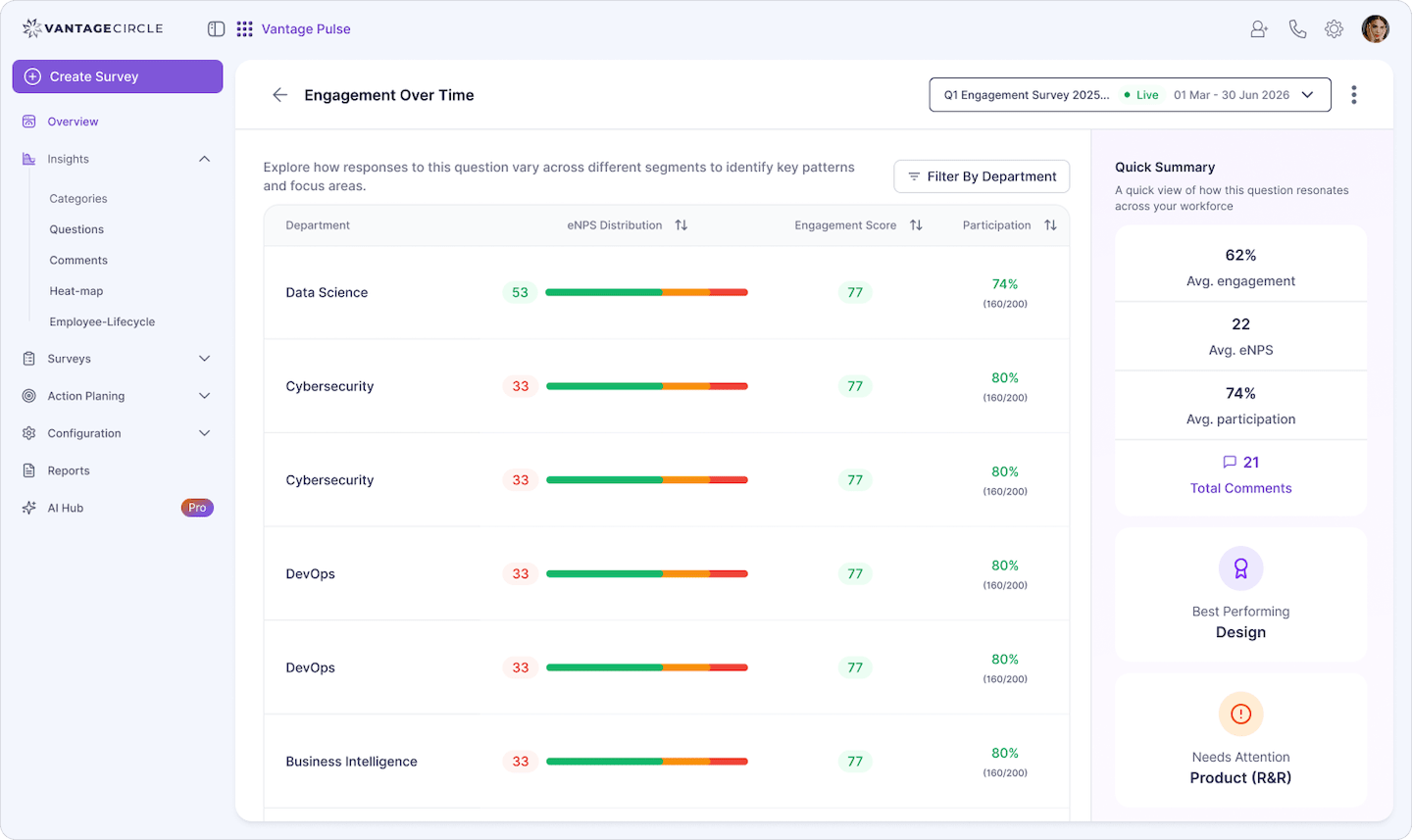
A shift toward feedforward should show up in how people feel about feedback, not just in the words managers use. Sentiment tracking confirms whether future-focused conversations are actually lifting morale or only changing the vocabulary.
In The End
Feedforward is a small change in wording with a large change in effect. Swap the verdict about the past for a specific suggestion about the next time, keep it to one or two behaviors, and recognize the effort when you see it. Do that consistently and feedback stops being something people brace for. It becomes how your team gets a little better every week.
Want to see how recognition and forward-focused conversations move engagement? Book a demo with Vantage Circle, and link the shift to the outcomes leaders actually track.
Frequently Asked Questions
What is an example of feedforward?
A feedforward example is a future-focused suggestion that replaces a backward-looking critique, such as "next time, send the meeting agenda a day ahead so people arrive ready to decide." Instead of naming what went wrong, it names what to try next, which gives the person something they can actually act on.
What does it mean to feedforward?
To feedforward means to give someone specific, forward-looking guidance about what to do next rather than judging what they already did. Coined by Marshall Goldsmith, the idea rests on a simple truth: you can change the future, but not the past. So the conversation aims at the next opportunity, where change is still possible.
What are positive feedforward examples?
Positive feedforward reinforces a behavior worth repeating and adds a next step, such as "your habit of asking one clarifying question before you start saves everyone rework, so bring it into the bigger projects too." It reads like praise but always points forward, telling the person how to do more of what is already going well.
What are constructive feedforward examples?
Constructive feedforward redirects a habit without dwelling on the miss, such as "next time, reply to client emails within the day, even just to say you're on it, so nothing feels dropped." It names a better approach for next time instead of assigning blame for last time, which keeps the person open rather than defensive.

Nilotpal M Saharia is an Assistant Manager, Content Marketing at Vantage Circle and a recognition-and-rewards (R&R) strategist with 9 years of experience spanning Marketing, HR, and content strategy. He helps HR leaders turn employee recognition and leadership research into practical workplace programs.
Connect with Nilotpal on LinkedIn.