
"Any feedback for me?" It's one of the most common questions at work and one of the least effective.
Not because people don't have feedback to give. They do. But broad questions force them to search through months of interactions, and the easiest response is often the safest: "You're doing great."
After years of watching performance reviews and coaching conversations, one truth has remained constant: the quality of the feedback you receive depends less on the other person and more on the question you ask.
Effective feedback isn't pulled from thin air. It's prompted. Ask about one recent piece of work, one specific skill, and one moment in time. Specific questions make it easier for people to be honest, detailed, and genuinely helpful.
In this blog, you'll learn a simple five-step framework, ready-to-use scripts, and practical ways to turn vague feedback into advice you can actually use.
Why Asking for Feedback Is Harder Than Giving It
Most people think asking for feedback is an act of confidence. In reality, it's an act of trust.
The moment you ask, you're placing another person in an uncomfortable position. They have to decide whether to tell you what they really think or protect the relationship. Most people choose the relationship.
That's why feedback conversations so often end with reassuring phrases like "You're doing great" or "Nothing comes to mind." Not because there isn't anything to say, but because honesty carries a social cost. Nobody wants to be the person who turns a routine conversation into an uncomfortable one.
The challenge becomes even greater when there's a difference in seniority. Ask a direct reportee to critique a manager, and they're not just searching for examples. They're quietly calculating the risk. Will this be taken the wrong way? Could it change how I'm seen? Is this really a safe conversation? Those questions are often answered long before the feedback itself.
Only 42% of U.S. employees say they've had the chance to formally give feedback to their manager.
Source: Gallup, 2024
How to Ask for Feedback in 5 Steps
Most people assume asking for feedback is a single question. It isn't. It's a sequence.
Miss one step, and the conversation becomes polite instead of useful. Get all five right, and you'll hear things people were already thinking but didn't know how to say.
Here's the framework:
Step 1: Pick One Piece of Work, Not Your Performance
One of the quickest ways to end a feedback conversation is to ask, "How am I doing?"
You're asking someone to compress weeks or even months of observations into a single answer. Faced with that impossible task, most people reach for the safest response: "You're doing well."
Instead, shrink the conversation.
Point to a presentation, a call, a document, a decision, or a meeting. The more specific the moment, the more specific the feedback. People don't remember your performance nearly as well as they remember what happened on Tuesday's client call.
Step 2: Name the Dimension You Want Assessed
Once you've chosen the moment, narrow it even further. State which quality you want judged.
For instance, you want feedback on your meeting. Ask if your message is clear? Did you answer the objections well? Was the presentation too detailed? Did your tone land the way you intended?
A specific dimension gives them permission to focus instead of searching for everything that might be worth mentioning.
Step 3: Ask While the Work is Still Recent
Feedback has an expiration date. The sooner you have the conversation, the more useful it becomes.
Ask someone a day or two after a meeting, and they'll remember the question you handled well, the slide that confused people, or the moment the discussion lost energy.
But if you wait until the quarterly review, you're no longer asking for observations. You're asking for memories.
And memories are surprisingly generous. They smooth over details, soften criticism, and replace specific examples with broad impressions.
More than half the workforce wants regular, immediate feedback, and employees are 3.6x more likely to be motivated when feedback is frequent and specific rather than annual and general (Gallup).
Step 4: Give Them an Easy Way to Say No
Ironically, the more pressure people feel to answer, the less honest they're likely to be.
Saying "No pressure if now isn't a good time, we can talk later," costs nothing, and removes the feeling that they have to produce the perfect answer on the spot.
This creates space for thoughts instead of obligation. And thoughtful feedback is almost always better feedback.
Step 5: Close the Loop and Tell Them What Changed
This is the step almost everyone skips. After someone gives you feedback, tell them what you changed. A quick follow-up shows you listened and valued their input.
When people see that their honesty leads to change, they're much more likely to be honest again. And that's how a real feedback culture takes shape. Not through grand initiatives, but through small conversations that build trust.
What to Ask Instead of "How Am I Doing?"
Skip the broad question, "How am I doing?" Instead, ask about a specific piece of work and one area you want feedback on. It gives people a clear starting point and makes useful feedback much easier to give.
| Weak question | Stronger question | What it unlocks |
|---|---|---|
| "How am I doing?" | "What's one thing about the Q3 rollout I could do better?" | Names a project, not a lifetime |
| "Do you have any feedback for me?" | "What's one thing I could have done differently in yesterday's stand-up?" | Permission to name one thing |
| "Is everything okay?" | "Was yesterday's update clear, or did any part need more context?" | Bounds it to one dimension: clarity |
| "What do you think of my work?" | "How did the client react to the proposal I sent Tuesday?" | Names the artifact and timeframe |
| "Any thoughts?" | "What's one change that would make this deck stronger?" | One actionable point, not a reaction |
| "How was that?" | "What's the one thing that would make today's presentation land better?" | Immediate and bounded |
| "Do you have feedback on my leadership?" | "What's one thing I could do differently in how I ran this week's stand-up?" | Narrows a trait to one behavior |
Open questions are structurally unanswerable. A bounded question gives them a draft to agree with, correct, or sharpen instead.
Our 360-degree feedback questions library organizes this same approach by competency, for anyone building a full review process.
Feedback Request Scripts by Relationship
The way you ask for feedback should change with the relationship. Asking your manager is different from asking a peer, and asking a direct report requires even more care because they're giving feedback to the person who evaluates them.
Asking Your Manager
Keep the ask narrow and low-stakes.
"Do you have five minutes? I'd like your take on how I handled the [project name] proposal, specifically whether the structure worked."
"I'm deciding what to focus on next quarter. What's the one skill that would open the most doors for me here?"
"Before we move on, can I ask one thing? How did the client take my part of Tuesday's call?"
Asking a Peer or Colleague
Peer relationships carry less risk.
"Now that [project name] has wrapped, I'd like your honest read on my part of it. What's one thing I could have done better?"
"You know this space better than I do. Did my proposal miss anything a [their function] person would catch?"
"I don't usually get your perspective, and I'd value it. From what you've seen of [project name], what's one thing worth flagging?"
Recommended Read: 50 Peer Feedback Examples for Every Situation (and 10 to Stop Using)
Asking Your Direct Reportee
"I want to run our stand-ups better. What's one thing about this week's I should change?"
"No need to reply live: if there's one thing I could do differently to make your week easier, drop it in a message whenever's convenient."
"I changed the deadline without much notice. Did that land badly? I'd rather know now than guess."
Asking in a Skip-Level or Cross-Functional Conversation
Name your own uncertainty upfront.
"Since I don't get much visibility a level up, is there anything about my work this quarter that stood out, for better or worse?"
"From your side of the process, was there a point in [project name] where my team's handoff could have been cleaner?"
🎙 Vantage Influencers Podcast
Building A Culture Of Continuous Conversation In The Workplace
Jason Lauritsen on why continuous conversations, not annual reviews, build the habit of honest feedback.
Listen to the Episode →How to Ask for Feedback in an Email
A feedback request email works when it is short, names one piece of work, and gives a deadline. Three sentences is usually enough.
After a project wraps +
Subject: Quick question on the [project name] rollout
"Hi [name], now that [project name] has shipped, could I get your honest take on the rollout plan? A line or two by Friday would help. Thanks either way."
Following up once, no reply yet +
Subject: Re: Quick question on [project name]
"No worries if this got buried; still keen to hear your take if you have two minutes this week. Happy to let it go if the timing's off."
Requesting async written feedback across time zones +
Subject: Async feedback on [project name], no rush
"Since our hours barely overlap, I'd rather ask in writing than chase a live slot. What's one thing about my part of [project name] you'd flag? Whenever suits you this week."
Requesting from a skip-level over email +
Subject: A question on [project name], whenever you have a moment
"I don't often get your view on my work directly, and I'd value it. If anything stood out from [project name], good or bad, I'd rather hear it than not."
Quarterly async check-in +
Subject: [project name]: one quick thing before it closes out
"Before we wrap this quarter, is there one thing about how I handled [project name] that's worth flagging? Happy to take it in a line or two, whenever works."
| Situation | Subject line | Body template |
|---|---|---|
| Right after a project wraps | Quick question on [project name] | One question, same-week deadline |
| No reply after the first ask | Re: Quick question on [project name] | Restates once, easy out |
| Requesting from a skip-level | A question on [project name], when you have a moment | Narrow, optional |
| Quarterly async check-in | [project name]: one quick thing before it closes out | Natural milestone |
Recommended Read: Written Feedback Examples for Work: Emails, Messages, and Notes That Land
When the Feedback Comes Back Vague
A vague answer usually means the person did not have a specific moment in mind, or did not feel safe naming one. Both are fixable with a follow-up question that supplies the specificity the first question was missing.
| Vague answer | What it actually signals | Your re-ask |
|---|---|---|
| "You're doing great." | No specific moment came to mind, or the safe answer won | "Is there one thing from this week worth knowing?" |
| "No complaints." | The bar for raising something is set too high | "Even something minor helps. Was there a moment that gave you pause?" |
| "Let's discuss at the review." | Wrong moment or channel | "Could you jot a line beforehand so we're not starting from scratch?" |
| Silence | Answering felt riskier than staying quiet | Switch channels: ask in writing, or offer an anonymous route |
None of the four mean nothing to say.
Vantage Pulse's sentiment analysis reads open-text responses across a team, so a manager can see whether "everything's fine" is consistent or just what one person said once.
How to Ask for Feedback After a Job Rejection or Interview
Ask within 24 to 48 hours of the rejection, keep it to three sentences, and ask about one thing rather than the whole application.
"Thank you for letting me know, and for your time throughout the process. If you have a moment, I'd value knowing the one area that stood out as a gap so I can work on it going forward."
"Thanks again for the conversation. If there's anything that felt like a gap on my end, I'd genuinely rather hear it now than wonder about it later."
Making It Safe for People to Answer Honestly
The biggest barrier to honest feedback isn't a lack of courage. It's a lack of safety.
Every employee, regardless of role or tenure, performs the same calculation before offering candid feedback: Is it safe to say this? Will it help? Or will I regret it?
That calculation happens in seconds, but it determines whether the conversation is honest or merely polite.
The mistake many organizations make is treating candor as an individual responsibility. They tell employees to "speak up" without changing the conditions that make speaking up feel risky. Honest feedback isn't powered by personality. It's built into the culture.
Over the years, we've found that organizations consistently strengthen three conditions.
Make It Easy to Speak
Anonymous pulse surveys can surface concerns people aren't yet comfortable raising face-to-face. But anonymity should be the starting point, not the destination. The goal is to build enough trust that people eventually feel comfortable attaching their names to their ideas.
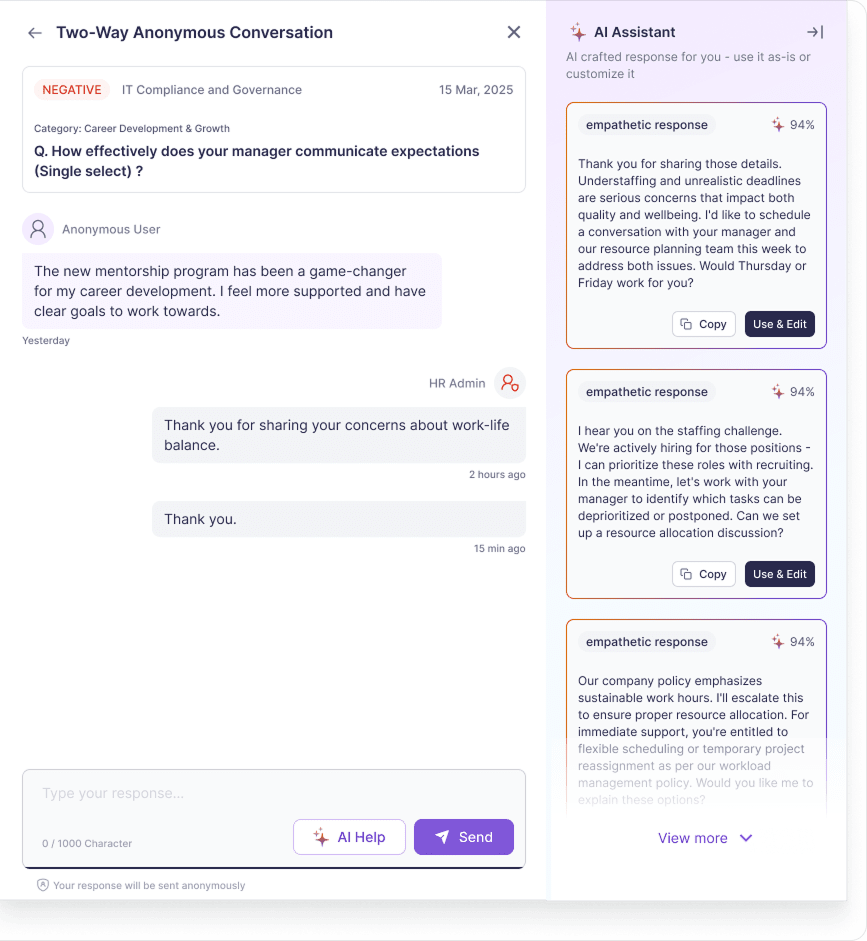
Make Feedback a Habit, Not an Event
When feedback is reserved for annual reviews, every conversation feels high stakes. Regular pulse surveys, manager check-ins, and one-on-ones normalize the practice of listening.
Over time, people stop wondering whether they'll be asked and start believing their voice genuinely matters. Pulse Surveys help leaders spot patterns across these conversations instead of relying on isolated snapshots.

Prove That Feedback Changes Something
Nothing erodes trust faster than asking for input and doing nothing with it. Every time employees see a concern acknowledged, an idea implemented, or a process improved because someone spoke up, they become a little more willing to speak up themselves.
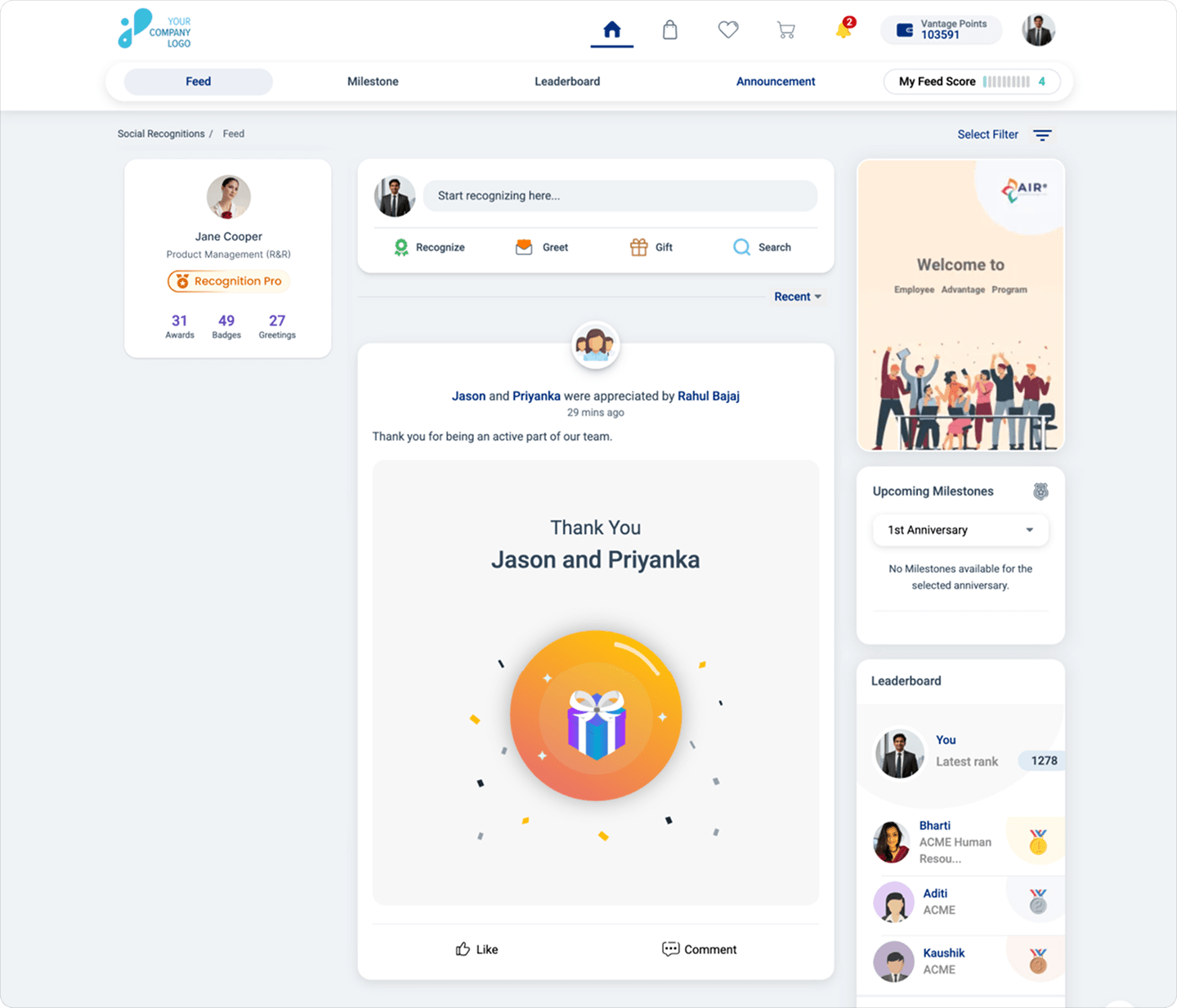
This is where recognition plays a quiet but powerful role. Publicly recognize employees who challenge assumptions, raise thoughtful concerns, or improve the way work gets done. This sends a clear message that honesty is welcomed and valued in the organization.
A social recognition feed makes those moments visible, turning isolated acts of candor into cultural norms.
Organizations with strong recognition cultures hold 92% retention, against 76% without one (The Recognition Effect, Great Place to Work and Vantage Circle, 2025). Feedback and recognition are the same question asked two ways: who is seen, and who is missed. Building a feedback culture is, in practice, the same work as building a recognition culture.
Conclusion
The quality of the feedback you receive is rarely determined by how willing people are to help. More often, it's determined by how easy you make it for them to be honest.
The best feedback conversations don't happen by chance. They happen because someone asked a thoughtful question, listened without becoming defensive, and showed that the answer led to action. That's the real goal.
FAQs
How do You Politely Ask for Feedback?
Be specific about what you want feedback on instead of asking broad questions like, "How am I doing?" For example, ask, "Could you share one thing I could improve in yesterday's presentation?" This makes it easier for people to give honest, useful feedback.
How to Formally Ask For Feedback?
In a formal setting, mention the work you're referring to, explain why you're asking, and invite constructive suggestions. For example: "I'd appreciate your feedback on my project proposal, particularly on its clarity and structure."
What is a Good Sentence For Feedback?
A good feedback request is clear, focused, and easy to answer. For example: "What's one thing I could improve in my communication during today's meeting?"
How do You Ask Someone to Give You Feedback?
Ask soon after the work is completed while the details are still fresh. Keep your request focused on one task or behavior, and make it clear that you value honest, constructive feedback.

Shikha Gogoi is a Content Marketing Specialist focused on SEO-driven content around employee engagement, recognition, and workplace culture, helping build people-first workplaces.
Connect with Shikha on LinkedIn.