Most innovation at work doesn't look like a product launch. It looks like a support agent rewriting a confusing reply template, an analyst automating a report she used to build by hand every Monday, or a nurse reorganizing a supply cart so the shift runs faster. Nobody calls it innovation when it happens.
Innovation in the workplace is turning new and useful ideas into practical changes in how a team works, serves customers, or builds products. It differs from creativity, which only generates ideas: innovation means the idea actually gets used. Most workplace innovation is small, like a faster process, a clearer handoff, or a better tool.
It also pays off. BCG's 20-year analysis of its annual Most Innovative Companies lists found that top innovators outperformed the broader market by 2.4 percentage points a year in total shareholder return (BCG, June 2025). This guide covers what workplace innovation is, the main types, real examples by team, and 8 ways to encourage it.
What Is Innovation in the Workplace?
Innovation in the workplace is any new idea that is also useful and actually gets put into practice. Harvard Business School Online defines innovation as "a product, service, business model, or strategy that's both novel and useful," and notes it can be as simple as an upgrade to customer service or a feature added to an existing product (Harvard Business School Online, 2022).
Innovation vs. Creativity
Creativity is coming up with the idea, and innovation is getting it adopted. A team can be wildly creative and never innovate if no idea leaves the whiteboard.
Creativity is the raw material and innovation is the finished change. The guide to creativity at work covers the first half. This guide is about the second.
Why Innovation in the Workplace Matters
Innovation pays off, and the research points to people as much as technology. BCG found the top innovators' shareholder-return advantage widest during the Great Recession and COVID-19, and that R&D spending alone doesn't ensure success. What set leaders apart was investing in the right capabilities and turning uncertainty into opportunity (BCG, 2025).
On the people side, the most detailed study is Great Place To Work's original research, which it still cites in 2025. It analyzed roughly 500,000 employee survey responses from about 800 organizations and found that the companies with the strongest Innovation By All cultures, which it calls "Accelerated," had 5.5 times the revenue growth of their less inclusive peers. They also reported 32% improved productivity, 21% higher discretionary effort, 14% less risk of turnover, and 33% more adaptability (Great Place To Work, Innovation By All, 2018; the 5.5x figure is repeated in its June 2025 article).
Newer data shows the same pattern. In June 2025, Great Place To Work reported that 87% of individual contributors at the Best Workplaces trust that their ideas for improvement are valued, compared with only about half at typical companies (Great Place To Work, June 2025).
Types of Innovation in the Workplace
Innovation can be sorted by how new the idea is and what it changes, and a widely cited framework gives four types: routine, disruptive, radical, and architectural.
Gary Pisano of Harvard Business School describes them in his HBR article "You Need an Innovation Strategy" (Harvard Business Review, June 2015). Here is how each type looks at the team level.
| Type | What it changes | Workplace example |
|---|---|---|
| Routine | Builds on existing skills and the existing business model | A support team rewrites its most-used reply templates and cuts handling time |
| Disruptive | Needs a new business model, not necessarily new technology | A training team moves from one annual workshop to short monthly sessions that managers can run themselves |
| Radical | A technological breakthrough inside the existing business model | A quality team adopts image recognition to flag defects that people used to check by eye |
| Architectural | Changes both the technology and the business model | A services team replaces custom projects with a self-serve, subscription-based product |
The examples are illustrative scenarios, not case studies.
A finer-grained framework is Doblin's Ten Types of Innovation (Keeley, Walters, Pikkel, and Quinn, Wiley, 2013), listed in the FAQ below. Only 2 of the 10 are about products, so process, service, and customer engagement are open to people in every function.
Examples of Innovation in the Workplace
Most workplace innovation is a small process change made by someone close to the work, not a famous product launch.
The table below shows seven documented cases, from a new process to a new tool.
| Function | Innovation example | What changed |
|---|---|---|
| Airport operations | Southwest Airlines set up "Innovation Stations" at airports, where employees identify challenges and find solutions themselves (Southwest Airlines, 2023) | Frontline staff help shape fixes |
| Customer service | Zappos launched "Customer Service for Anything," where anyone can contact its service team about anything, not just orders. The idea came from Zappos employees responding to an abrupt change in the world around them (Zendesk, 2021) | The service team's role widened beyond orders |
| Sales | LinkedIn built Account Prioritizer, a machine learning tool inside its sales CRM that recommends which accounts reps should focus on. In an A/B test it produced an 8.08% increase in renewal bookings (Jena, Yang, and Tan, arXiv, 2023) | Reps focus on accounts most likely to renew |
| HR | IBM built AskHR, an internal virtual agent that now answers common HR questions for employees and managers. IBM reports a 94% containment rate on common questions and a 75% reduction in support tickets since 2016 (IBM case study) | HR time goes to work that needs a person |
| Engineering | Atlassian gives employees 24 hours at a time, in an event called ShipIt, to work on any project they choose, and Jira Service Desk began as one of them (Atlassian) | Any employee's idea gets a protected window |
| Finance and legal | JPMorgan Chase built COIN, software that reviews commercial loan agreements, replacing work that took 360,000 hours a year from lawyers and loan officers (ABA Journal, 2017) | Routine review moved to software |
| Manufacturing | Toyota started its Creative Idea Suggestion System in 1951, and by 1972 it was adopting 76% of suggestions, up from 29% in 1956 (Toyota Motor Corporation, 1973) | Most ideas get acted on |
The pattern is similar across these cases: a clear channel, a little time, and a path from idea to use. At Toyota, the number that matters is not how many ideas came in but how many were acted on. For ideas specific to people teams, see the guide to HR innovations.
8 Ways to Encourage Innovation in the Workplace
The most reliable ways to encourage innovation are to give people a voice, time, safety, credit, and an owner for each good idea.
1. Give Every Employee a Channel for Ideas
People can't share ideas if they don't know where to send them, so give everyone one clear, low-effort place to do it. That might be an idea board, an open forum, or a short pulse survey.
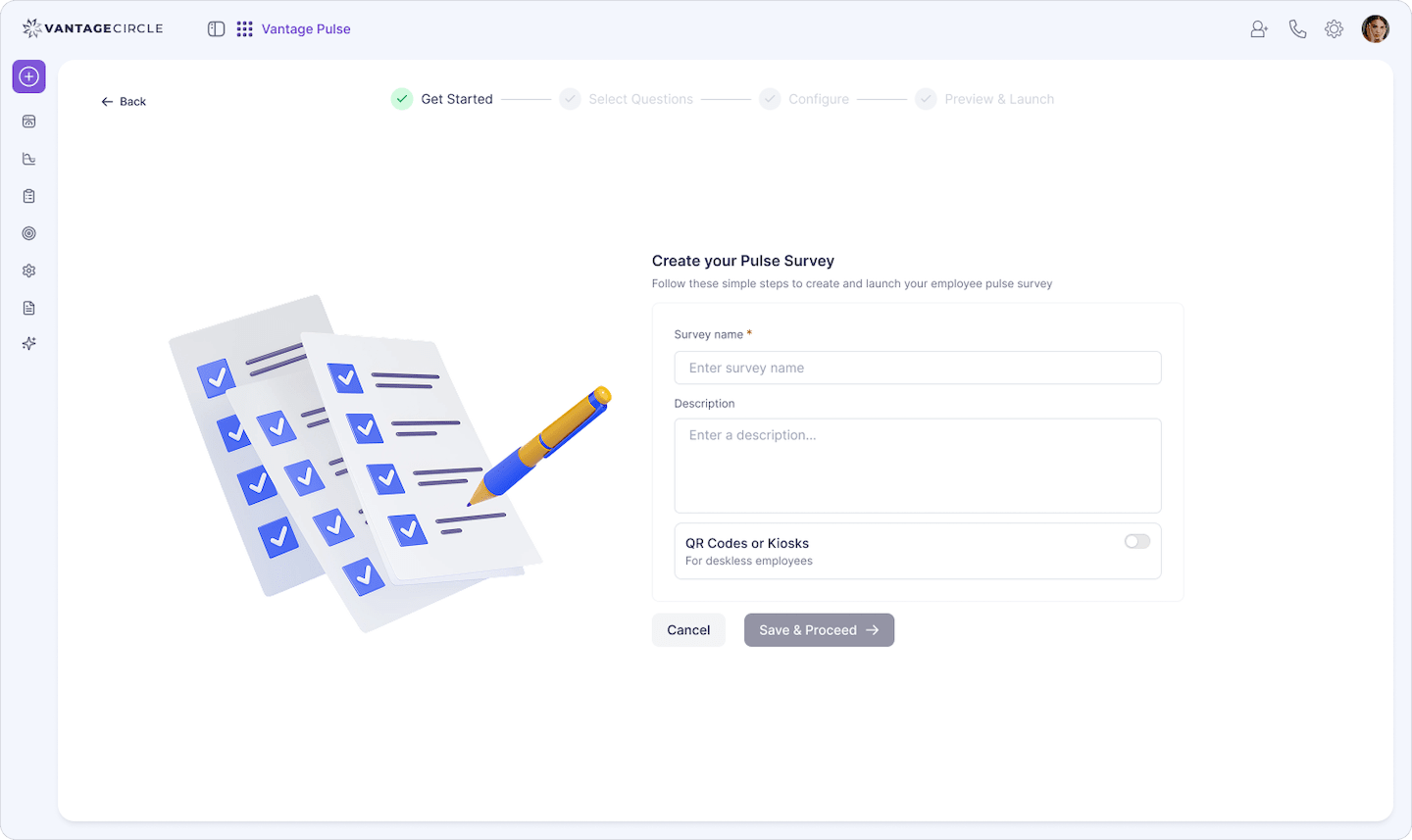
Some of the best ideas imply a criticism of how things work today, and not everyone will say that in a meeting. An anonymous option helps. With Vantage Pulse, you can add an open question such as "What is one thing we could do better?" and let people answer without a name attached. Word cloud analysis then surfaces the improvement themes that keep coming up.
2. Make Time and Budget for Experiments
Ideas need a little protected time and a small budget, or they lose to the daily workload. A few hours a quarter for pilots, hackathons, or side projects is enough to start.
A time-boxed idea challenge works well, with a clear question, a deadline, and visible recognition for entries. Campaign Management in Vantage Recognition lets you run it as a campaign so entries and appreciation sit in one place.
For the organization-wide system, see the guide on how to build an innovation culture.
3. Make It Safe to Fail Usefully
People will only try new things if a failed attempt won't cost them. A useful failure is one where the team learned something specific and shared it.
Great Place To Work lists celebrating innovative efforts "regardless of the outcome" as one of four leadership behaviors that drive innovation, and found that nearly nine in ten employees at the Best Workplaces say their organization celebrates people who try new and better ways of doing things (Great Place To Work, June 2025). In practice, that means a short review after an experiment that asks what we learned, not who is to blame. The foundation is psychological safety, the shared belief that speaking up or trying something new won't lead to punishment.
4. Mix People Across Functions
Ideas often come from the edges between teams, so put people from different functions on the same problem. A rotating problem-solving group, a shared project, or a short job swap is often enough. It also builds stronger collaboration in the workplace, since people who have solved a problem together trust each other's ideas more.
5. Recognize Ideas and Smart Attempts, Not Only Wins
If you only celebrate ideas that worked, people stop trying anything uncertain. Recognizing the effort and the lesson from a smart attempt keeps ideas coming.
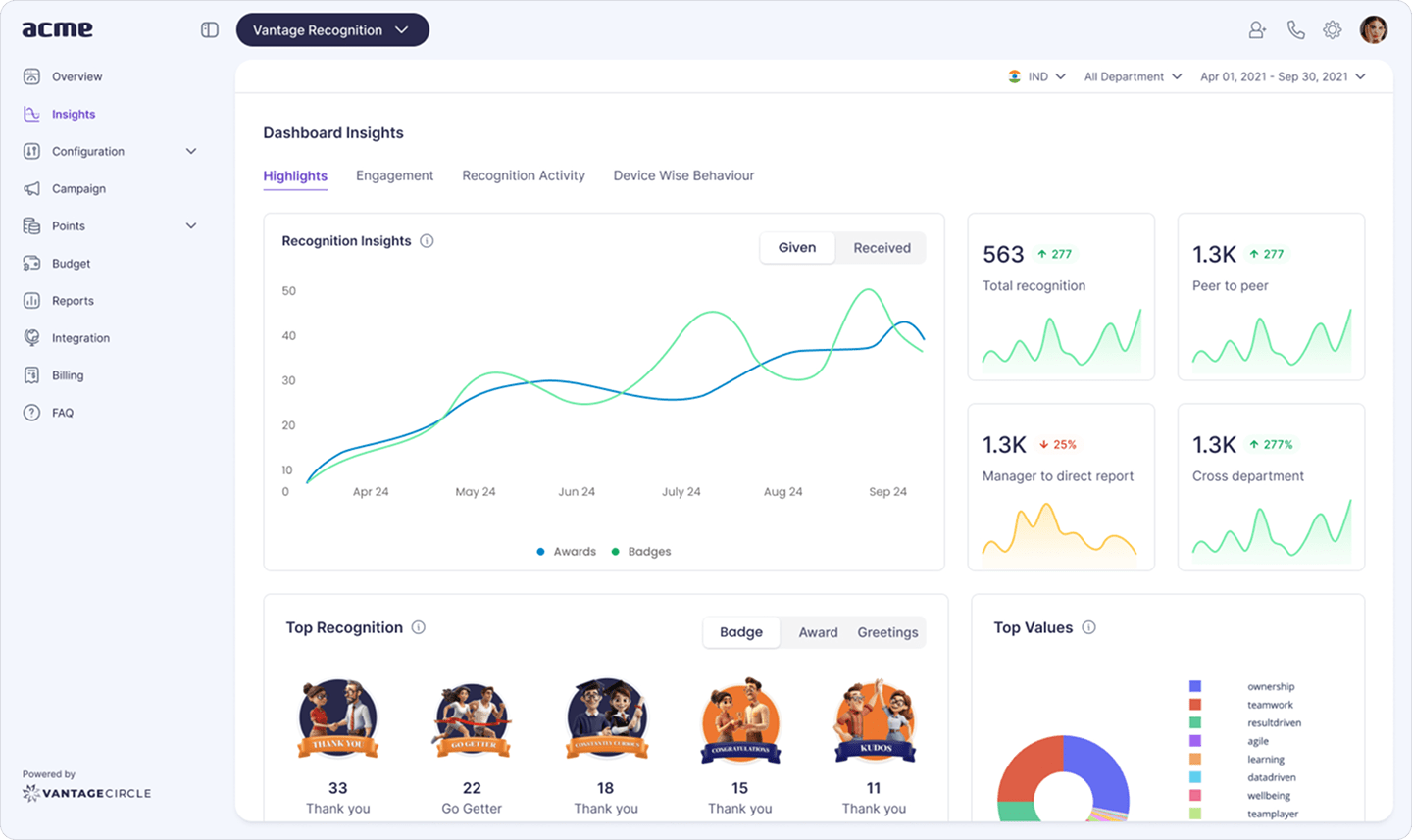
Many ideas never reach a manager's desk, but the colleague who benefited saw them. Peer-to-peer recognition lets people credit improvements as they happen, and manager recognition signals that leaders value smart attempts. If "innovation" is one of your company values, tagging recognition to that value builds a running library of real examples, from a faster handoff to a smarter template, so everyone can see what the value looks like in practice.
Vantage Recognition does this through core values alignment and a social recognition feed, which spreads recognized ideas across the company so other teams can reuse them. Recognition analytics then show whether innovation recognition is spread across teams or concentrated in a few, so leaders can tell whether innovation is everyone's job or only a few people's.
For more ways to put this into practice, see the list of rewards and recognition ideas.
6. Run Structured Brainstorming That Ends in a Decision
Brainstorming works when it ends with a decision about what to try next, not just a long list of ideas.
Set a clear question beforehand, let people think alone for a few minutes, then group the ideas and vote on a few to test. End with one idea, one owner, and one date.
7. Fund Learning That Brings in New Ideas
New ideas often come from skills the team didn't have last year, so a learning budget is also an innovation budget.
Let employees direct a share of that budget themselves, then ask them to share what they learned. Learning benefits in Vantage Perks can be one way to fund this.
8. Turn Ideas Into Execution With an Owner and a Deadline
An idea becomes an innovation only when someone owns it and a date is attached.
When an idea is chosen, name one person responsible, set a small first step, and agree on how you will know whether it worked. Report back on every idea, including the ones you drop, and say why. People stop sharing ideas when they never hear what happened to the last one.
How AI Is Changing Who Can Innovate
AI lowers the skill barrier for innovation, so people without a technical background can now build, automate, and test ideas that used to need a developer.
Microsoft's 2026 Work Trend Index, a survey of 20,000 workers across 10 markets, found that 58% of AI users say they are producing work they couldn't have produced a year ago, rising to 80% among its most advanced users. The report's own summary is that AI is expanding who can do high-value work (Microsoft Work Trend Index, 2026).
The tools are only half of it. The same Microsoft research found that organizational factors account for more than twice the reported AI impact of individual effort. Gallup's 2026 State of the Global Workplace report points the same way: in its Q1 2026 U.S. workforce survey, employees who strongly agree their manager actively supports their team's use of AI were 8.7 times as likely to strongly agree that AI has transformed how work gets done (Gallup, 2026).
So the practices below matter more with AI, not less. Give people approved tools, time to experiment, clear data-privacy rules, and a place to share what worked, then recognize whoever builds something useful.
How to Show Innovation at Work
You show innovation at work by spotting a real problem, trying a small fix, measuring what happened, and sharing the result so others can use it.
You don't need a big idea or a formal title to do this. Start with something that slows you down every week, and test a small change on a single task. Write down what you tried and what changed, with a number if you have one, then share it with your team or manager. A short write-up of a small win says more about your ability to innovate than any claim in an interview, and it makes it easy for a manager to give you credit.
Frequently Asked Questions
What are examples of innovation in the workplace?
Documented examples include Southwest Airlines' airport Innovation Stations, Atlassian's ShipIt events, JPMorgan's COIN contract-review software, and Toyota's employee suggestion system. Smaller ones include rewriting a confusing support template or replacing a manual weekly report with an automated one. The examples table above covers seven real cases.
What are the four types of innovation with examples?
The four types in Gary Pisano's framework (Harvard Business Review, 2015) are routine, disruptive, radical, and architectural. Routine builds on existing skills and the business model, such as improving reply templates. Disruptive needs a new business model. Radical is a technology breakthrough, such as image recognition for quality checks. Architectural changes both.
How can you show innovation at work?
Spot a real problem, test a small fix, note what changed, and share the result with your team or manager.
What are 10 types of innovation?
The ten types come from Doblin's Ten Types of Innovation framework (Keeley, Walters, Pikkel, and Quinn, Wiley, 2013): profit model, network, structure, process, product performance, product system, service, channel, brand, and customer engagement.
Conclusion
Innovation at work is mostly small, specific, and close to the work. The teams that do it well are the ones where people have somewhere to send an idea, time to test it, safety to get it wrong, and someone who says thank you either way.
Start with one thing from the list above, then do it again next month.

Lupamudra is a content marketing specialist at Vantage Circle, where she has written 50+ articles on employee recognition, rewards, and workplace culture, alongside employee engagement, diversity and inclusion, and HR compliance topics, including how India's tax rules apply to recognition and rewards programs.
Connect with Lupamudra on LinkedIn.