
You owe three peer reviews by Friday. Everything you've typed so far says "great team player." Delete it! Your colleague can't do anything with that sentence.
That's the problem with most peer feedback: it's vague enough to feel safe and useless enough to be forgotten by Monday. Effective peer feedback names one specific situation, the behavior you observed, and the impact it had on the team, nothing more, nothing less.
Below are 50 curated examples, organized by competency and by the situations that make peer feedback genuinely hard to write -the awkward ones, the "how do I say this nicely" ones, the ones you're avoiding right now.
Keep reading!
Key Takeaways
- What peer feedback is and the channels it runs through
- The SBI (Situation-Behavior-Impact) rule and 3 rules that make feedback land
- 50 ready-to-use examples, organized by competency and by the situations that make feedback hard
- 10 weak comments rewritten, with the failure pattern named in each
- When to make peer feedback anonymous, and the trade-off between candor and accountability
What Is Peer Feedback?

Peer feedback is the input colleagues at a similar level give each other about specific work behaviors, based on direct experience of working together. It runs through 2 formal channels, peer review cycles and 360 degree feedback, and 1 informal one: the everyday comments teammates trade between cycles. It can be named or anonymous; that choice decides how honest it gets.
Peers see what managers never do.
Only 25% of employees strongly agree they receive valuable feedback from the people they work with, but those who do are five times as likely to be engaged.
Formal reviews happen once or twice a year but the skill behind them is built daily.
How to Write Peer Feedback That Lands (the SBI Rule)
Effective peer feedback names one specific situation, describes the observed behavior, and states its impact on the team, which is why the SBI (Situation-Behavior-Impact) model is the default structure for peer reviews. Most of us are out of practice: only 23% of employees strongly agree they received meaningful feedback in the past week.
The fix is 3 actionable rules.
Rule 1: One behavior per comment
Cover two behaviors and the receiver remembers neither. Split them.
Rule 2: Evidence, not adjectives
"Detail-oriented" is a verdict. "Your test cases caught the edge case we all missed" is evidence.
Rule 3: Say the impact out loud
"The release went out clean" tells your colleague exactly why the behavior is worth repeating.
Positive Peer Feedback Examples
Positive peer feedback works best when it names the exact behavior a colleague should repeat, not just that they did well.
Peer recognition is uncommon in most workplaces. Just 15% of employees receive weekly recognition from peers, versus 29% from managers.
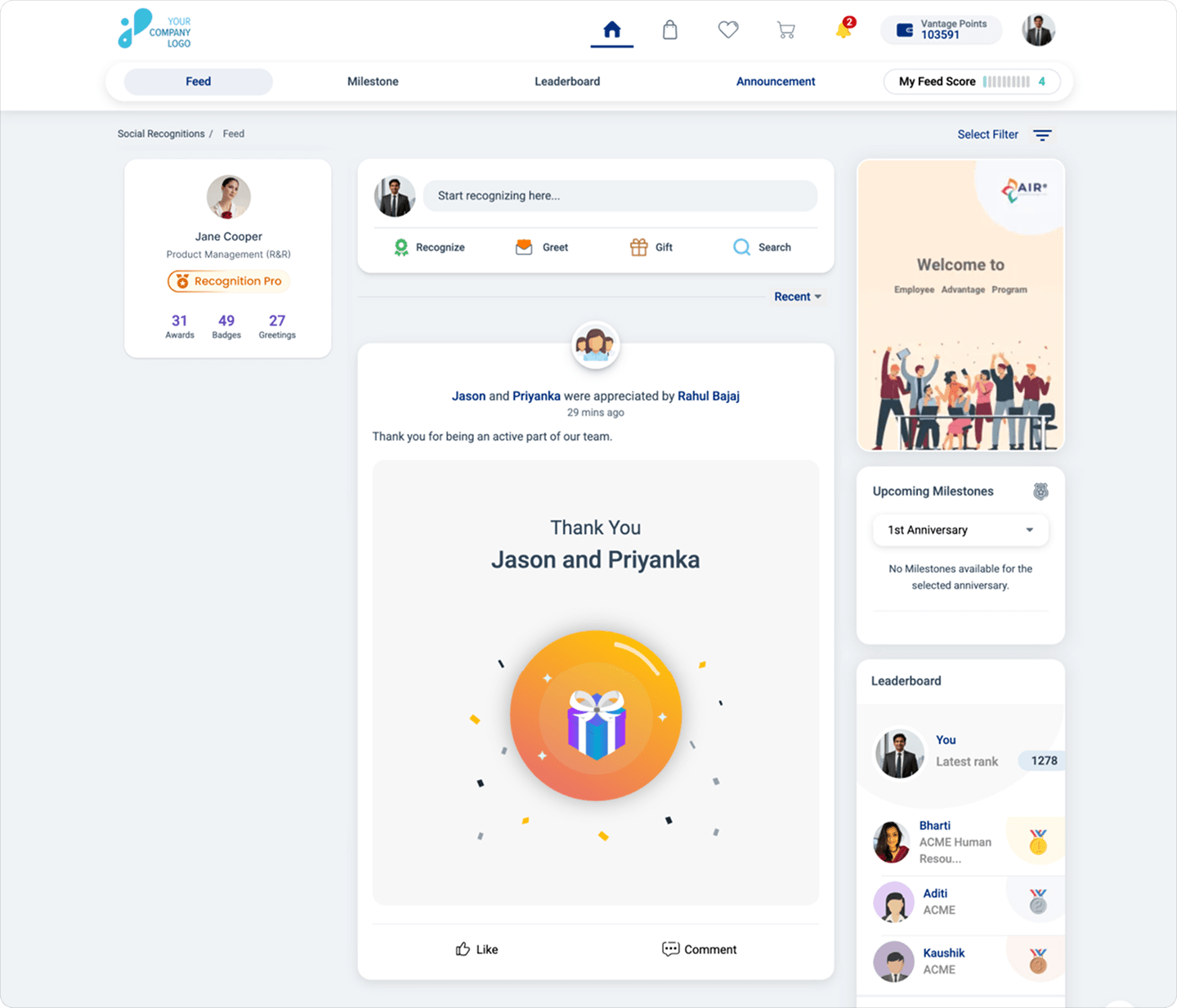
Sharing praise publicly adds another benefit: it sets a visible example. On a social recognition feed like Vantage Recognition's, one specific comment can show the whole team what good work actually looks like.
(Source: Vantage Recognition)
These 18 examples double as feedback for colleagues examples for any teammate.
Communication and Collaboration
These 6 examples reward clarity that saved someone time.
- "Your API walkthrough in Tuesday's standup saved me a day of reverse-engineering the docs."
- "You caught marketing and product using different launch dates. That flag prevented a missed deadline."
- "Your summary of both sides of the pricing debate let us decide in one meeting."
- "You asked the question everyone was avoiding on the client call, and the answer improved our scope."
- "Your meeting notes are the only ones I never double-check. The action items always match."
- "When the handoff got messy, you picked up the phone. The issue closed that afternoon."
Reliability and Quality of Work
These 6 examples name the dependable behaviors peers notice first.
- "Every file you sent this quarter was final-draft quality. I stopped budgeting review time for them."
- "You delivered a day early, giving QA a full extra day. The release went out clean."
- "Your test cases caught the edge case we all missed. That bug would have reached customers."
- "You flagged the contract risk before signing. Legal confirmed it would have cost us the exit clause."
- "Your dashboard answers the three questions leadership asks every Monday. Nobody chases those numbers anymore."
- "You kept the migration checklist current, so the night shift resumed exactly where we stopped. Zero rework."
Supporting Teammates and Culture
These 6 examples recognize the work that holds a team together.
- "You stayed late to rehearse the demo with me. The client raised half the objections we expected."
- "Your onboarding doc cut the new analyst's ramp-up from three weeks to one."
- "You credited the intern's idea by name to leadership. She has spoken up ever since."
- "During the 6 pm outage, you ran the incident channel so the on-call engineer could focus."
- "You check workloads before assigning, not after. Nobody on this project burned out during crunch."
- "Your code review questions teach rather than gatekeep. Juniors learn more from them than from the style guide."
Constructive Peer Feedback Examples
Constructive peer feedback is harder to write than praise because it risks damaging the relationship. The fix is structure- pair one observed behavior with a forward-looking suggestion, so the message reads as help rather than a verdict.
The 17 examples below follow that structure, addressing real problems without putting a colleague on trial.
If you need feedback language for situations beyond peer reviews, our constructive feedback examples hub covers every other workplace scenario.
Communication Habits
These 6 examples redirect how a colleague shares information.
- "Your updates surface only when asked. A two-line Friday status would keep dependencies from stalling."
- "Your emails put the request in the last paragraph. Leading with the ask would get faster answers."
- "In Tuesday's workshop you talked over Priya twice. Letting her land the point would sharpen the debate."
- "You raise disagreements in direct messages after meetings. Raising them in the room lets us fix things together."
- "Your client summaries need translating before they can be forwarded. Plainer wording would go straight out."
- "Decisions made in your threads rarely reach the tracker. Logging them would save the recap meetings."
Deadlines, Ownership, and Follow-Through
These 6 examples address slipped commitments without assigning motives.
- "The copy deck ran late twice, and design absorbed both delays. Earlier heads-ups would let us reshuffle."
- "The last two commitments slipped because you take on too much. Saying no earlier protects what you own."
- "Friday's bug handoff had no reproduction steps and bounced back. A complete ticket costs five minutes, saves a day."
- "You mark tasks done before the stakeholder confirms. Closing that loop first would stop the reopened tickets."
- "The client heard the doubled estimate from the project manager, not you. Owning that call keeps their trust."
- "Your launch runbook lives in your head. Writing it down frees the next launch from your calendar."
Strengths and Weaknesses Balance in Peer Reviews
These 5 examples pair a genuine strength with one growth edge, the balance formal peer reviews ask for.
- "Your analysis is the team's most rigorous. A directional answer Wednesday often beats a perfect one next week."
- "Everyone trusts you in a crisis. The same energy pointed at prevention would halve the fires you fight."
- "Your design instincts are strong and well defended. Inviting critique earlier would turn stakeholders into co-defenders."
- "You help everyone, sometimes at your own deliverables' cost. Two protected focus hours daily would serve both."
- "Your product knowledge runs deepest here. Documenting even a tenth would make it a team strength."
Peer Feedback Examples for Hard Situations
The hardest peer feedback is shaped by the relationship, not the competency.
These 15 examples cover the 5 moments peers actually search for help with. For scenarios beyond peers, browse the employee feedback examples library.
Giving Feedback to a Work Friend
Name the friendship first, so honesty does not read as distance.
- "As your friend I can say it straight: the retro sarcasm reads as dismissive to our newer teammates."
- "Because we are friends I waited too long to say it: your late Mondays keep landing on me."
- "Friendship makes this easier to say: yesterday's presentation undersold your work. The hardest part got one slide."
Giving Feedback to a Senior Colleague
Offer the ground-level view seniority cannot see.
- "A view from the front row: when decisions change after review with no note why, the team reruns old debates."
- "Yesterday's feedback was this quarter's most useful. One ask: before the deadline next time, so I can apply it."
- "The room goes quiet after your first take. Going last would show you what the team really thinks."
After a Disagreement or Conflict
Repair the relationship and reopen the question separately.
- "We disagreed hard on the rollout plan, and your staging concern was right. I have added it to the checklist."
- "Tuesday's debate got personal and I own my half. The pricing question still stands; can we restart Thursday?"
- "I quoted your number to the client before we agreed. That was on me; next time I confirm first."
For a Remote Teammate You Rarely See
Distance hides effort and friction; name both.
- "Your async updates are so complete I never said it: they are why our cross-time-zone handoffs work."
- "You multitask on mute in video calls, and twice I re-asked decisions you missed. I need your attention."
- "I see your work only in final form, so the late draft gave no warning. A quick flag lets me adjust."
For a Cross-Functional Partner
Anchor the comment in the shared outcome, not your function's preferences.
- "Your legal review caught real risks after the campaign was built. At brief stage it would shape, not rework."
- "Your feature demo wins deals. The setup assumes knowledge our reps lack; a five-minute intro version would multiply its use."
- "Your team absorbs added scope silently until the sprint breaks. Naming the real cost up front helps us ask for less."
10 Weak Peer Feedback Examples, Rewritten
A weak peer feedback comment fails in one of 3 ways: adjective-only praise, personality critique, or a vague "keep it up" that teaches nothing.
Here are 10 rewritten with the SBI structure, each failure named.
| Weak example | Why it fails | Rewritten with SBI |
|---|---|---|
| "Great team player!" | Adjective-only praise | "You took Friday's client escalation so our new hire could finish her first release." |
| "You're a poor communicator." | Personality critique, not behavior | "The last two status updates skipped blockers, so the delay surprised us. Early flags let us help." |
| "Keep up the good work!" | Names no work | "Your Friday summaries keep the whole pod aligned. Keep sending them." |
| "Be more proactive." | A trait, not a situation | "When the vendor slipped, we waited three days to escalate. Next time, raise it the same day." |
| "Always a pleasure to work with." | Politeness posing as feedback | "You turned my rough brief into a prototype in two days, and your questions fixed its scope." |
| "Your attitude in meetings is a problem." | Judges intent | "In Monday's planning call you sighed and closed your laptop during estimates. It shut the conversation down." |
| "You're so smart!" | Praises the person, not the work | "Your root-cause analysis found the caching bug in one afternoon. That saved the sprint." |
| "Communication could be better." | No situation, no direction | "Design changes reach me through the feed, not from you. A direct ping would save rework." |
| "You did great this quarter." | Too broad to act on | "You closed 9 of 11 escalations, and the two you handed off included full context." |
| "Try to be more of a team player." | Vague accusation as advice | "You declined three review requests without offering another slot. Suggesting a time keeps reviews moving." |
Weak example: "Great team player!"
Why it fails: Adjective-only praise
Rewritten with SBI: "You took Friday's client escalation so our new hire could finish her first release."
Weak example: "You're a poor communicator."
Why it fails: Personality critique, not behavior
Rewritten with SBI: "The last two status updates skipped blockers, so the delay surprised us. Early flags let us help."
Weak example: "Keep up the good work!"
Why it fails: Names no work
Rewritten with SBI: "Your Friday summaries keep the whole pod aligned. Keep sending them."
Weak example: "Be more proactive."
Why it fails: A trait, not a situation
Rewritten with SBI: "When the vendor slipped, we waited three days to escalate. Next time, raise it the same day."
Weak example: "Always a pleasure to work with."
Why it fails: Politeness posing as feedback
Rewritten with SBI: "You turned my rough brief into a prototype in two days, and your questions fixed its scope."
Weak example: "Your attitude in meetings is a problem."
Why it fails: Judges intent
Rewritten with SBI: "In Monday's planning call you sighed and closed your laptop during estimates. It shut the conversation down."
Weak example: "You're so smart!"
Why it fails: Praises the person, not the work
Rewritten with SBI: "Your root-cause analysis found the caching bug in one afternoon. That saved the sprint."
Weak example: "Communication could be better."
Why it fails: No situation, no direction
Rewritten with SBI: "Design changes reach me through the feed, not from you. A direct ping would save rework."
Weak example: "You did great this quarter."
Why it fails: Too broad to act on
Rewritten with SBI: "You closed 9 of 11 escalations, and the two you handed off included full context."
Weak example: "Try to be more of a team player."
Why it fails: Vague accusation as advice
Rewritten with SBI: "You declined three review requests without offering another slot. Suggesting a time keeps reviews moving."
Scan for the 3 failure patterns: adjective-only praise, personality critique, and the vague "keep it up." All three vanish once you add a situation and an impact.
Named or Anonymous? Making Peer Feedback Honest
Anonymity is a design decision that trades accountability for candor, so use it deliberately, not by default.
Employees are split for good reason:
62% believe anonymous feedback encourages honesty, yet 79% suspect colleagues of using feedback to settle personal grudges (LiveCareer, 2025).
Both instincts are right.
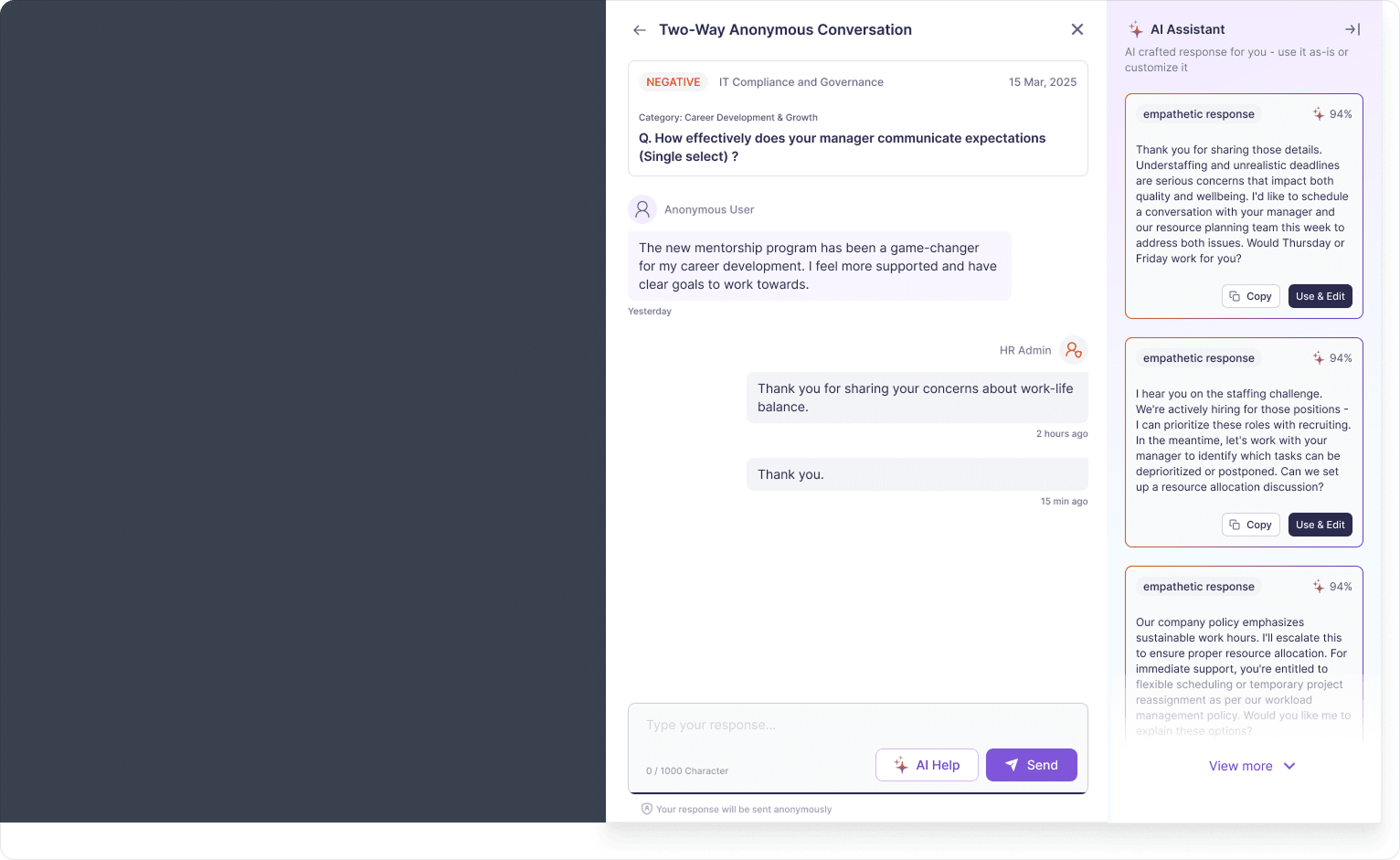
The working rule from Vantage Recognition deployments: keep appreciation named and public, where a peer-to-peer recognition feed does its work, and give sensitive input a protected channel. In Vantage Pulse, that protection is enforced by the platform, not by policy. Results for any team or segment stay hidden until enough responses arrive, 5 by default and never fewer than 3, so no answer is traceable to a person. Small groups simply see "insufficient responses."
Anonymity's side effect is volume. Hundreds of open-text comments are unreadable by hand, so an employee survey tool that sorts comments into positive, neutral, or negative and clusters themes turns the pile into patterns a manager can act on.
(Source: Vantage Pulse)

Frequently Asked Questions
Q1. What is a peer feedback example?
A peer feedback example is a short, specific comment one colleague gives another about a work behavior: "Your walkthrough of the API changes saved me a day of rework." Strong examples name the situation, behavior, and impact.
Q2. What are some examples of positive feedback for peers?
Positive peer feedback names a behavior worth repeating: "Your test cases caught the bug we all missed," or "Your onboarding doc cut the new analyst's ramp-up from three weeks to one."
Q3. What are examples of peer review?
Peer review examples include strengths ("your analysis is the most rigorous on the team"), growth areas ("an earlier heads-up on delays would let us reshuffle"), and balanced comments that pair both.
Q4. What are three examples of positive feedback?
Three quick examples: "You delivered a day early, giving QA an extra day." "You credited the intern's idea by name in the leadership review." "Your meeting notes always match what we agreed."
Q5. What is an example of a good peer review comment?
A good peer review comment covers one behavior and its impact: "Your updates surface only when asked. A short Friday status would keep dependencies from stalling."
Q6. What are three positive feedback examples?
"Your call summary locked in next steps and saved a follow-up meeting." "You ran the incident channel so the on-call engineer could focus." "Your code review questions teach rather than gatekeep."
Conclusion
Peer feedback improves fastest on teams where commenting on each other's work is already normal. Among employees who receive feedback and recognition from their manager at least weekly, 61% are engaged.
All you've to do is, start small, and start before review season. Pick one colleague, one specific behavior, and write the two sentences the SBI rule asks for. The 50 examples above are yours to adapt.

Sanjeevani Saikia is a Senior Content Strategist at Vantage Circle, where she leads end-to-end content strategy across SEO, thought leadership, brand storytelling, podcasts, and video. She is also the host of the Vantage Influencers Podcast, where she brings conversations with HR and business leaders from top global organisations, including Fortune 500 companies.
Connect with Sanjeevani on LinkedIn.