Employee Engagement Vs Employee Experience: What's The Difference?
Episode Overview
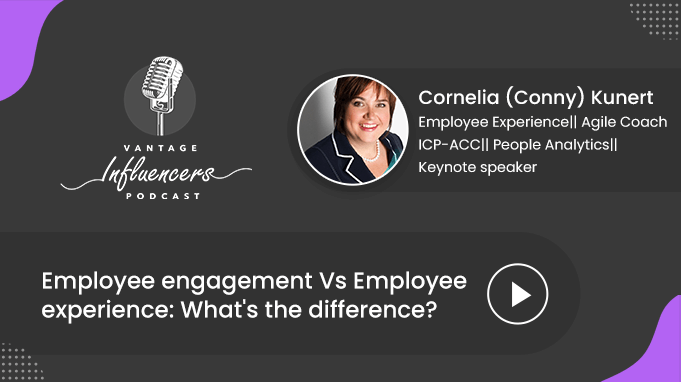
Cornelia Kunert argues that employee engagement is not a separate initiative from employee experience: it is the outcome of it. In this conversation, she unpacks why so many organizations still treat the two as interchangeable, and lays out a broader definition of employee experience that goes well beyond the traditional hire to retire lifecycle to include employer branding and how a company is perceived in the wider talent market. She traces her own career from running an annual engagement survey to building out people analytics and continuous listening programs, and explains how that progression mirrors the shift most HR functions are now going through.
Conny also digs into what she calls "moments that matter," the specific encounters, like a new hire's first week or an early interaction with a line manager, that disproportionately shape how connected an employee feels to an organization. She makes the case that effective leadership during a crisis requires a mix of visible strength and honest vulnerability, and that engagement strategies built only for long-term, full-time staff leave a growing population of freelancers and gig workers underserved. She closes with a pointed critique of tying recognition too tightly to performance ratings and bonuses, arguing the practice does more harm than good to a healthy culture.
Episode Highlights
- Employee engagement is the outcome of employee experience, not a separate discipline: a genuine improvement in engagement has to start with fixing the underlying experience.
- Employee experience extends well beyond the hire to retire lifecycle to include employer branding and how a company is perceived by talent outside the organization.
- Moments that matter, such as a new hire's first week or a first interaction with a line manager, carry outsized influence over how engaged an employee becomes.
- Effective leadership during a crisis requires balancing visible strength with honest vulnerability, rather than projecting only confidence.
- Freelancers and short-term workers need the same sense of belonging as full-time staff, and their experience matters more, not less, because they talk about it in the market.
- Recognition tied too closely to performance ratings and bonuses can work against a healthy, growth-oriented culture; ongoing career development conversations matter more in the long run.
About the Guest
Cornelia Kunert, People and Organizational Development Executive
Cornelia (Conny) Kunert is a People and Organizational Development Executive with over 25 years of experience across diverse workplace environments, cultures, and geographies, including Fortune 500 companies. Her career spans engagement survey management, people analytics, continuous listening, and employee experience design, including a decade-long tenure at Zurich Insurance Company. She now works as an independent freelancer and consultant, helping organizations build out their employee experience strategy alongside related HR practices such as feedback and performance management. She holds the title of Business Economist in Switzerland and is known for developing practical strategies that align employee experience, employee engagement, and people analytics with broader business goals.
Connect with Conny on LinkedIn
Host
Susmita Sarma, Vantage Influencers Podcast Host
What You Will Learn
- How to distinguish employee experience from employee engagement, and why one is the outcome of the other.
- Why employer branding and external market perception are part of employee experience, not separate from it.
- How to identify and prioritize the "moments that matter" that shape an employee's sense of belonging.
- What leaders can do differently to sustain engagement during a crisis or major disruption.
- Why freelancers and gig workers require a distinct, intentional approach to engagement.
- Why tying recognition and rewards too closely to performance ratings can undermine growth and development.
Key Topics & Timestamps
| Timestamp | Topic |
|---|---|
| 01:40 | Conny's HR journey, from engagement surveys to people analytics and employee experience |
| 03:07 | Defining the real difference between employee engagement and employee experience |
| 05:15 | The role of leadership in sustaining engagement and experience during a crisis |
| 08:03 | Why engagement and experience efforts matter even in a freelancer-dominated world |
| 09:53 | Practical ideas for engaging gig workers and short-term employees |
| 10:52 | The Maya Angelou quote and identifying "moments that matter" |
| 14:39 | How effective rewards and recognition are for engagement and experience |
| 16:35 | Conny's top suggestions for HR listeners |
| 17:47 | The HR books and leaders Conny follows |
| 20:55 | How listeners can connect with Conny |
Full Transcript
Click to read the full episode transcript
Welcome to the Vantage HR Influencers Podcast. This podcast is sponsored by Vantage Circle, the leading employee benefits and engagement platform. All the words employee engagement and employee experience may sound similar, but they are actually very different. Employers across the globe strive to ensure that their employees are satisfied and engaged with their job. But here we need to understand that while engaged employees are satisfied with their jobs, satisfied employees are not necessarily engaged in their respective jobs. Yes, this is a bit confusing, and that is why HRs must be mindful of the distinctions between the two terms: employee engagement and employee experience.
Susmita Sarma: Hi everyone, this is your host from the Vantage HR Influencers Podcast, and in today's episode we'll learn the differences between employee engagement and employee experience. For the same, we have with us our guest speaker, Conny Kunert.
Conny is an accomplished People and Organizational Development Executive with over 25 years of experience in diverse workplace environments, cultures, and geographies, including Fortune 500 companies. She is passionate about people, the way we want to work, and getting companies ready for the challenges they face to be attractive for top talents. She is known as a trusted mentor, someone with the ability to create and implement effective strategies, processes, and programs designed to develop organizational capabilities and improve operational effectiveness. She empowers companies to implement successful strategies for employee experience, employee engagement, people analytics, and aligning businesses with people. She has earned the title of Business Economist in Switzerland. Welcome to the show, Conny.
Cornelia Kunert: Hello.
Susmita Sarma: Okay, so before we start with the topic, please tell us more about your journey in the corporate world, especially your HR journey in the corporate world.
Cornelia Kunert: Sure, absolutely. My HR journey started in, I would say, 2010, so it's quite a while. I started with the Zurich Insurance Company, where I was a project manager for employee engagement. By that time, employee engagement was just about an annual survey, understanding what people were saying. But over time, we discovered interesting topics and started analyzing the data deeper, understanding that there's a linkage between engagement data and other data. That's when we started working on people analytics as well, and continuous listening, understanding what is behind the feedback from our people. That's the journey, then, going from a simple engagement survey over to people analytics and continuous listening, and then, at the end, employee experience. I spent over ten years there. After different reorganizations, I started to become a freelancer and a consultant, and now I support other companies in developing their journey in employee experience, or other HR approaches around feedback, performance management, and so on.
Susmita Sarma: Okay, great, amazing. So Conny, let's start with the topic: what is the difference between employee experience and employee engagement? Over the last few decades, there has been a rising focus on employee engagement and a growing understanding of the value of employee experience. We know that both of them are intrinsically tied, and without a positive employee experience, engagement is highly improbable. Again, engagement is the outcome of a positive experience. So Conny, where is the real difference between employee engagement and employee experience?
Cornelia Kunert: You actually mentioned it already: employee engagement is the outcome of employee experience. So with that, you need to understand what employee experience is. For me, employee experience is not just the employee life cycle, in terms of recruitment, onboarding, then your whole journey, performance management, your career development, your learning, and then at some stage you're leaving the company, becoming an alumni. That's not the only part of employee experience. For me, employee experience is a whole bigger picture, and things like employer branding: how do you perform as a company, how are you seen as a company outside on the employer market. These things are essential as well. You want to attract the best people, people who believe in you as an employer, who believe in what you're doing, who believe in your culture and your values. That's also very key to employee experience.
So employee engagement: if you have a great employee experience, in how you have been treated, how you have the ability to develop over time with your career and your learning, how you can grow, how you can experience the relationship between your line manager or other leaders and yourself, all of these experiences are so key and important. That's the difference here. Experience is what is happening within your organization and outside your organization, and that is what then drives how engaged you are, how motivated you are, how satisfied you are, and how much you believe in the culture and values of your employer.
Susmita Sarma: Right. So Conny, I believe you'll agree that both of them are essential, employee engagement and experience. Now, when organizations are constantly faced with the challenge of how to deal with both of these fields, particularly in the face of a global pandemic and social and racial unrest, putting people first has to stay a priority. Leaders, especially, must demonstrate that commitment and expertise are top priorities through words and deeds. So how would you like to highlight the role of leadership in maintaining higher levels of engagement or experience?
Cornelia Kunert: In general, the role of a leader shouldn't have changed drastically. Of course, the normal day to day work is different now than it was in the past, with the pandemic. But in general, as a leader, you should engage your people, you should support them, you should help them grow, and you should be there for them. I think the biggest difference now, between pre-pandemic and pandemic, and also for the future, is being a leader who shares his or her vulnerability. On one side, you need to demonstrate your strength: you're here, you help your team, you help them grow, you help them overcome this pandemic situation. But on the other side, you're also going through this pandemic as a leader, so you can admit you have difficult times too. You are vulnerable, you are challenged as well, with families, with homeschooling, with working from home, with social distancing. That's also part of your daily business as a leader, and you can demonstrate and share your own experience, so you're a bit closer to your people. It's not that you need to sit there and appear weak; you have your strengths as well, because you're the leader. But this combination, demonstrating your challenges while also saying "together we can support the company, we can support each other to overcome this situation," I think that is key at the moment. On one side, leaders need to listen to their people, continue listening to their people, and keep an open door and an open ear. On the other side, showing his or her vulnerability and strength: I think that is key at the moment, in this situation.
Susmita Sarma: Right, well, amazing. Again, employee engagement and experience, as you said, leaders were responsible before, and even now they're responsible. These engagement and experience efforts need time to be fruitful. So does focusing on employee engagement or employee experience even make sense in a world supposedly dominated by freelancers and short-term employees?
Cornelia Kunert: Absolutely. I think it's even more essential to focus on this, because freelancers and short-term employees also have an experience with you as an employer. Don't forget, all of your employees, future, current, and past, are your influencers. They are out in the market, and they talk about you. Now, with all the platforms and social media, it's even more key to focus on the experience: how you treat people, how you help them, how you support them. All of these different moments that are key for your people are even more critical for those who move on much faster than your long-term employees, because they will have had the experience and they will share it outside, in the market. They'll talk about it with families, friends, on social media, and so on. So I think that's key. Freelancers and short-term employees have different experiences and different requirements, whether that's tools, technology, or performance management; different setups are needed, so you need to focus on these parts as well. It's not just about your long-term, fixed employees; these other employees turn over much faster, they move to other companies, to your competitors, and they will talk. So it's key to support them and help them with a positive employee experience as well.
Susmita Sarma: So would you like to share some ideas for how to engage gig workers?
Cornelia Kunert: Absolutely. The way you onboard them, the way you integrate them into your team, I think that's key. You have to treat them equally to your other people, because if you don't give them a feeling of belonging, how are they able to deliver their best? If they don't feel like they belong, like they're part of the team, even though they're only there for a short term, that's a problem. If you give them the feeling that they're part of the team, that they're equally important, that you listen to them, that they matter to you as well, and that you value their thoughts and their work, I think that is key. Integrate them so they feel part of your team; I think that's the best way you can treat them.
Susmita Sarma: Right, okay. So here I have a quote from Maya Angelou, the American poet and civil rights activist. She famously said that people will forget what you said, people will forget what you did, but they'll never forget how you made them feel. Employees' perceptions of their employers are primarily shaped by how businesses make them feel. These vital moments, also known as "moments that matter," are the crucial encounters that decide whether or not an employee can remain involved with the organization. So what are some of these moments that organizations can leverage to deliver a superlative employee experience?
Cornelia Kunert: Wow, where to start? There are so many moments that matter that are key, but I think it's essential to understand the needs of your people, to listen to your people. Of course, some moments that matter are fairly fixed: your recruitment process, your onboarding process, these are all moments that matter, but you only have a minimum of influence over them because, due to tools and technology, they're somewhat fixed. But then, on the other side, moments that matter include how you treat people from a cultural perspective, how you onboard them: a great welcome day, what the first day is like, what the first week is like. These are things you have influence over. Research shows that if you have a great experience right at the beginning, when you start with a company, you're much more likely to have a more positive and higher level of engagement within the company, especially from the start, compared to those who are left alone, who don't know whom to talk to, haven't met their line manager, and so on. So starting with these little moments, and understanding what is key to your people, I think that's essential, because moments that matter are so different across companies, locations, and cultures. There are so many moments that matter that might be relevant in one location but not in another. So it's key to understand where you're coming from. And then, if you have these moments that matter identified, you also need to show commitment: if you've identified them and don't do anything about it, why should employees support you and help you? There has to be commitment of time, money, or effort to actually improve these moments that matter. That's key as well.
If you want an exceptional employee experience, you need to understand your people, understand what is key to them, and understand your business strategy versus your people strategy. If your business strategy says you need to focus on growth and development, so you're ready for the future and your people have the right skills, that's part of your people strategy. But if you don't focus on that, moments that matter like "how is my learning experience" or "how can I develop my career and learn the skills needed for a future position" get neglected, and your learning experience within the organization becomes very poor. There's a discrepancy. So there's something you can actually do to help create a much better employee experience through the moments that matter that are key to your organization as well as to your people. That's what you need to focus on.
Susmita Sarma: Right. So one more thing I would like to know from you, Conny: what do you think about rewards and recognition? How effective is rewards and recognition when it comes to employee experience or engagement?
Cornelia Kunert: Yes, absolutely. Rewards and recognition is an absolutely essential part here. It depends on your organization, and it depends on what you stand for. I think in the long run, it's not always about monetary rewards and recognition. There's a lot about how you recognize a person, how you recognize people within the organization, what kind of feedback culture you have: do you support your people, do you support them in developing and growing? So there's a part of recognition and rewards where you support people from a training and career development perspective and help them grow. It's not necessarily about getting a bonus tied to a performance rating. Performance ratings are outdated, and this was actually one of my last projects: we removed ratings within the organization, because rating linked to a monetary bonus is so toxic to healthy growth, to a healthy organization that wants to support people in growing and developing. If you're always focusing on a number linked to a bonus, how can you actually focus on the person and on helping them grow and develop, because it's a completely different focus? Having regular check-ins to understand how people are doing within the organization, how they feel, and how their career development and growth is going, I think that is more important for rewards and recognition than a bonus at the end of the day. Yes, a bonus is nice to have, but in the long run you won't remember the bonus.
Susmita Sarma: Okay, so any suggestions you'd like to give to our HR listeners?
Cornelia Kunert: Well, I have a quote I usually think of when getting started: stop starting, start finishing, and start where you are. Sometimes HR overthinks its processes, or says we can't start this because of that, or we can only do this because of that. Sometimes we overthink many things. The second part is: listen to your people. It's not about HR, it's not about HR systems and processes, it's about the people. It's not about how HR thinks people should develop, should learn, should do whatever. It's about knowing, listening to, and hearing what your people say, and then meeting their needs and making changes to your processes and development accordingly. A lot of the time, HR forgets that it's not about HR, it's about the people, and that is key.
Susmita Sarma: Yeah, it's about the team.
Cornelia Kunert: Yes, absolutely.
Susmita Sarma: Okay, so any HR book or HR leader you follow?
Cornelia Kunert: From an employee experience perspective, and in general, I follow an HR researcher who does a lot of analysis around what is happening in the market at the moment, especially linking it with different companies, and he does a lot of research as well. For me, he's a big resource for understanding what's out there in the market. I'm also following another HR thought leader whose point of view on how to treat people, how to work with people, and how to look at culture I find very interesting.
Currently, I'm reading two books. One of them is actually a book that is helping me during this crisis to focus on more positive things, because every day you're surrounded by negativity, negative news, catastrophes. Sometimes you need something a bit more positive, and that's a book called Factfulness, written by Hans Rosling. What I like about this book, and the reason I like it, is that I'm a very analytical person, very much focused on facts, and this book shows a lot about the reality of the world and links it to the positive side as well. It's not that we haven't developed over the years, or that there isn't still so much war, disrespect for human rights, and a lack of female development out there, but the book compares it to past years and shows how things have developed. There is development, there is positivity. It's not that we are where we should be, but this positive development is something I think is key at the moment: to see that it's not all about everything being broken. There are things that have evolved into a better situation, but there are also things we still need to work on. Sometimes it puts us back into reality and helps us look at things in a different way, and I think that helps me.
The other book I'm reading at the moment discusses the idea of nudges, and nudges are key if you want to change a culture or behavior. If you're going through an organizational transformation and you want to change a culture, you need to help your people, and nudges actually help you do that. A lot of people misunderstand nudges and compare them to email reminders or similar prompts. A nudge is something that helps you develop. Those are the two books I'm currently reading, and I'm really enjoying them.
Susmita Sarma: Okay, great. So finally, Conny, how can listeners reach out to you?
Cornelia Kunert: They can reach out to me via LinkedIn. You can find me on LinkedIn as Conny Kunert, and I'm very responsive on LinkedIn as well, so if anybody would like to learn more or connect with me, I'm here.
Susmita Sarma: Okay, that was a great conversation. Conny, thanks a lot for joining me and the Vantage HR Influencers podcast.
Cornelia Kunert: Thank you very much. It was really nice talking to you.
Thanks for listening to the Vantage HR Influencers podcast, where we engage with HR influencers about human resources. Please do subscribe to the Vantage HR Influencers podcast on Apple Podcasts and Spotify for new episodes.
FAQ
What is the real difference between employee engagement and employee experience, according to Conny Kunert?
Conny Kunert argues that employee engagement is the outcome of employee experience, not a parallel initiative. Employee experience is the entire picture of how people are treated inside and outside the organization, spanning the employee lifecycle as well as employer branding, while engagement, motivation, and satisfaction are the downstream results of that experience.
Why does Conny Kunert say leaders need to show vulnerability?
She explains that the pandemic put leaders through the same disruptions their teams faced, including homeschooling, remote work, and social distancing, and that leaders who honestly acknowledge those challenges while still demonstrating strength and support build closer, more trusting relationships with their people than leaders who project only confidence.
Do employee engagement and experience strategies matter for freelancers and gig workers?
Yes. Conny Kunert says it matters even more for this group, since freelancers and short-term employees still form an experience with the employer and often move between companies faster than permanent staff, spreading that experience through their networks. She recommends integrating them into teams the same way as full-time employees, and building HR processes, tools, and technology suited to shorter-term arrangements.
What does Conny Kunert think about linking rewards and recognition to performance ratings?
She is critical of the practice, describing performance ratings as outdated and warning that tying recognition too tightly to a monetary bonus is toxic to healthy growth. She argues that ongoing career development conversations and regular check-ins do more to support genuine growth than an annual bonus tied to a number.
Related Reading
Also listen on