A consultant finishes a six-month client engagement. The project delivered. The client renewed. By the time the internal review happens three weeks later, nobody on the delivery team has heard a word.
This is the everyday reality in IT services companies: consulting firms, engineering services providers, and technology outsourcing organizations where the best work happens at client sites, in distributed teams, and across time zones. The people doing the work are rarely in the same room as the people who have the authority to recognize them.
Most employee recognition programs weren't built for how tech teams actually work. The annual award, the manager nomination, the gift card that shows up weeks later. All designed for someone sitting in a head office where their manager sees them every day. Not for a delivery manager juggling three client projects at once, or a platform engineer on overnight on-call, or a data consultant whose work quietly improved a client's numbers behind the scenes.
In North America, where IT services companies are competing for the same pool of skilled engineers and consultants — and where 59% of HR leaders say attracting digital talent is their single biggest challenge — the cost of getting recognition wrong shows up directly in attrition. The companies getting this right recognize their teams in the language of the actual work: on-call responses, code reviews, client deliveries, knowledge sharing. This post breaks down 7 of those patterns and gives you a role-by-role framework covering engineers, PMs, designers, SREs, security engineers, and data teams.
Why Generic Employee Recognition Fails in IT Services Companies
Only 1 in 4 employees strongly agrees they received recognition for doing good work in the past week, according to Gallup. In technology companies, where the most valuable contributions are often invisible to anyone outside the immediate team, that number skews lower.
In IT services, where demand for skilled engineers and consultants consistently outpaces supply, recognition is not a culture initiative. It is a retention strategy.
Here are the 4 specific ways generic programs backfire in IT services organizations:
1. Employee of the Month feels arbitrary when tech output is hard to measure. Shipping a critical security patch, a design system that cuts delivery time in half, a product decision that saved a quarter: none of these appear in a manager's nomination unless the manager was close enough to see the work. In IT services, most managers are not.
2. Manager-only recognition misses the peer-acknowledgment loop tech teams actually trust. In IT services, a manager may oversee 10+ engineers spread across time zones and client sites. They rarely see the late-night debug session, the code review that caught a critical flaw, or the junior engineer someone quietly mentored through a difficult sprint. When recognition only flows from the top down, most of the actual work goes unacknowledged.
3. Generic gift cards feel disconnected from the work. Tech professionals remember the specific thing that was recognized, not the dollar amount attached to it. Recognition that fails to name the work is not recognition for the work.
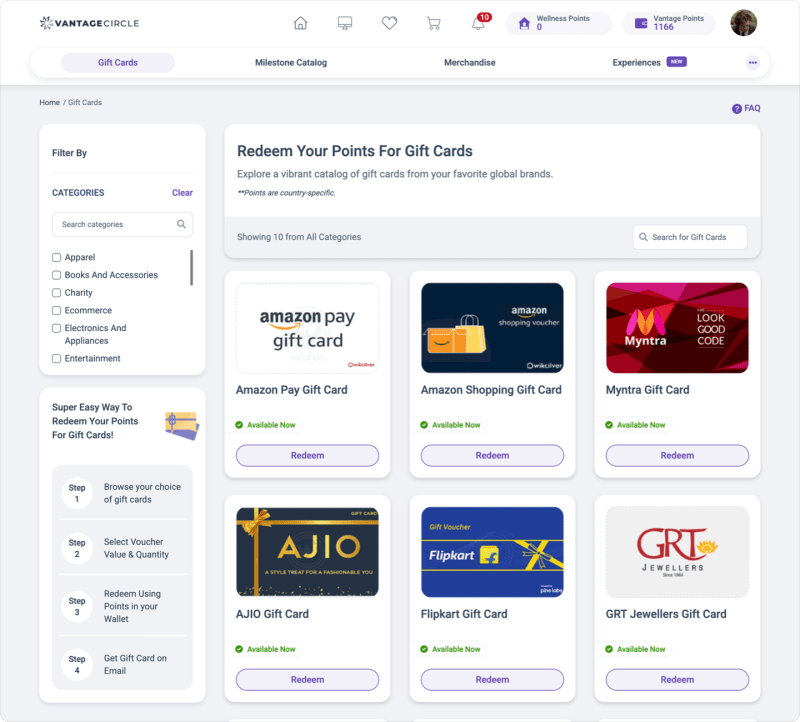
(Screenshot: Vantage Perks — Gift Card Redemption)
4. Annual programs miss the sprint rhythm. IT services teams ship on short, fixed cadences. Annual or quarterly recognition acknowledges work that most of the team no longer remembers. By the time the award arrives, the moment is gone.
These gaps add up. A Gallup analysis of business units found that high-recognition teams show significantly lower burnout and higher retention. In the 2024 Stack Overflow Developer Survey, burnout and lack of meaningful work rank among the top 3 reasons developers consider leaving. And 45% of developers now use AI tools at work, adding new pressure on what good work even looks like. Recognition is one of the few levers that moves retention, reduces burnout, and signals what the team actually values.
The 7 Recognition Patterns That Actually Work for Tech Teams
These 7 patterns are named in the vocabulary of the actual work. They map to the moments where tech contributions happen, not performance review season.
1. PR-Merge Celebration (Sprint-Rhythm Recognition)
Tech teams work in short delivery cycles and measure their output in what they ship. When a developer completes a significant piece of work, a Slack or Teams bot immediately posts a social recognition shoutout tagging them and anyone who helped review it. The feedback loop closes the same day, not six months later when the moment is long gone.
2. Code-Review Shoutouts (Peer Craft Acknowledgment)
The reviewer who writes a five-paragraph comment that catches an architectural flaw, mentors a junior developer, and prevents a production incident gets nothing in most recognition programs. Code-review shoutouts fix that: a team member who receives a particularly valuable review nominates the reviewer in the recognition channel, citing the specific feedback. It takes 30 seconds. The signal it sends outlasts the sprint.
Lipika Verma, VP Rewards and Performance Innovation at Schneider Electric, said this on the Vantage HR Influencers Podcast episode New Age Recognition In The Workplace:
Wipro's Winners' Circle program saw a 97.5% increase in non-monetary peer-to-peer recognition over two years, a direct result of shifting from manager-only nominations to an open peer-to-peer recognition model.
3. On-Call Hero Recognition (Operational Excellence)
Within 48 hours of an incident resolution, the on-call engineer gets a formal shoutout from the team lead citing the specific incident, response time, and resolution steps. Google's SRE culture, documented in the Google SRE Book, treats on-call burden as a first-class retention metric for exactly this reason: engineers who feel their operational sacrifice goes unacknowledged burn out and leave. Recognizing the 2am fix — specifically, with the incident named — is what changes that.
4. Postmortem-Blameless Hero Recognition (Learning Culture)
At every postmortem or retrospective, add one recognition category: "biggest learning shared." The nomination goes to the person who most clearly articulated what went wrong and what the team should change going forward. Recognition that rewards honest disclosure rather than mistake avoidance accelerates learning cycles. It also sends every engineer a message: transparency here is the career-safe choice, not the risky one.
5. Demo Day Spotlight (Visible Impact)
Bi-weekly or monthly demo days with a peer-voted "ship of the week" bring invisible work into view for the people who never see it. The engineer doing infrastructure work, the designer whose system saved a sprint, the PM who killed a bad feature before it shipped. All of them finally get a moment in front of the team.
6. Hackathon and Innovation Honors (Side-Project Validation)
Quarterly hackathons with peer-nominated awards for impact, ingenuity, and technical depth tell engineers that curiosity is valued, not just output. Atlassian's ShipIt (formerly FedEx Days) is the best-known model: employees get 24 hours to build anything — a product fix, a tool, a prototype — then present it to the team. Peer vote determines the winners, who get visibility and dedicated sprint time in the next quarter to take their idea further. Several Atlassian product features trace their origin to ShipIt submissions.
7. Principles-Tagged Recognition (Culture Reinforcement)
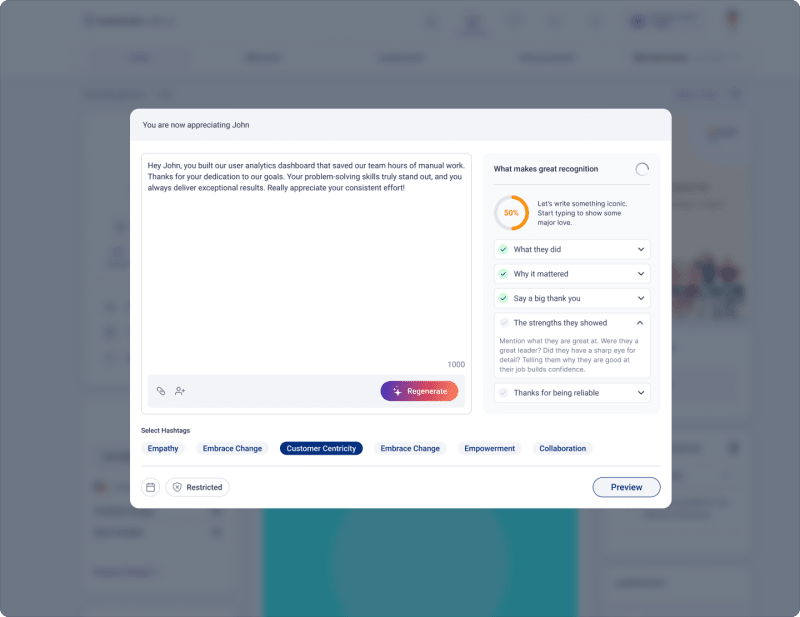
(Screenshot: Vantage Rewards — Recognition Composer)
Add a mandatory "principles tag" to every recognition (peer-to-peer, manager-driven, or campaign-based) drawn from your company's engineering principles. "Ship fast and learn." "Blameless culture." "Document everything." The tag turns a generic "great job" into something specific enough to mean something. When engineers consistently see colleagues recognized for living a specific principle, that principle becomes a behavioral norm rather than a wall poster.
Recognition Framework by Tech Role (6 Disciplines)
Tech is not a monolith. An SRE, a product manager, and a designer have almost nothing in common when it comes to what recognition feels meaningful, and what makes it land wrong. The same shoutout that resonates with an engineer can feel generic to a PM and invisible to a security engineer.
| Role | What They Value Most | Worst Recognition Mistake |
|---|---|---|
| Software Engineer | Peer craft acknowledgment; specific naming of the technical decision that mattered | "Employee of the Month" style awards that feel arbitrary and detached from the sprint cycle |
| Product Manager | Outcome-tied recognition: metrics moved, not just launches shipped | Generic "great launch" comments that ignore whether the feature solved the user problem |
| Designer | Craft visibility and portfolio-level acknowledgment | Being recognized only when engineers ship, not when design decisions protect user experience |
| SRE / Platform Engineer | Incident response recognition and acknowledgment of the work that creates the absence of failure | Being forgotten because nothing broke: operational excellence that goes unrecognized because it is invisible |
| Security Engineer | Discreet acknowledgment that does not create public exposure | Public recognition that identifies them as the person who found a specific vulnerability or blocked a specific threat |
| Data / ML Engineer | Model-impact metrics and experiment elegance, not just model accuracy | Generic "good model" recognition without business context; missing the connection between the model output and the outcome it enabled |
Recognition in the AI-Augmented Engineering Era
As AI tools become standard in tech workflows, the recognition gap widens. Managers already struggle to see the best work. AI-assisted output makes individual contributions even harder to attribute.
This is where tooling matters. Vantage Rewards surfaces who's being missed: AI-powered manager nudges alert managers when a team member hasn't been recognized in a set window (default 30 days), so recognition doesn't default to whoever is loudest. The M365 Copilot integration keeps it in Microsoft Teams, where engineering teams already work.
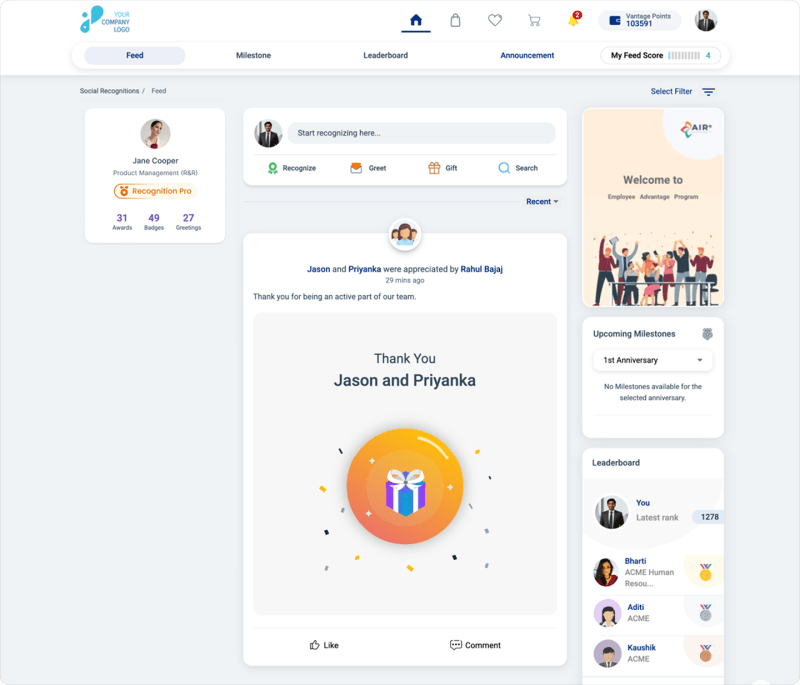
(Screenshot: Vantage Rewards — Social Recognition Feed)
The people most likely to be overlooked in AI-augmented teams — the SRE who resolved the 2am incident, the data engineer whose model quietly moved a metric, the security engineer who can't be publicly named — are exactly who these nudges are designed to catch.
How to Roll Out a Tech-Specific Recognition Program
Most recognition programs in IT services fail not in design but in execution. Here is a five-step rollout that maps to how engineering teams actually work.
Step 1: Audit current recognition through the engineer lens. Ask one question: does your current program feel patronizing to engineers? If "Employee of the Month" is your primary mechanism, the answer is yes. Identify which of the 7 patterns above are already happening informally in Slack or retro conversations. Those are your starting points.
Step 2: Pick 2 patterns and start there. Do not deploy all 7 at once. Start with on-call hero recognition (immediate impact, low complexity) and peer code-review shoutouts (builds peer-to-peer muscle without requiring budget). Run both for one quarter before adding more.
Step 3: Integrate with where engineers already live. Recognition that requires logging into a separate portal will not happen. Connect recognition to Slack, Microsoft Teams, or wherever your team's daily standups and code reviews happen. When it lives in the same tools engineers already use, nobody has to remember to use it.
Step 4: Tag every recognition to an engineering principle or company value. A shoutout without a principles tag is noise. A shoutout that says "this is what blameless culture looks like in practice" is culture-building. Make the tag mandatory, keep the list short (5 to 7 principles), and watch which principles get recognized most. That is your real culture signal.
Step 5: Measure recognition coverage by role, not just volume. Total recognition count is a vanity metric. What matters is whether your SREs are getting recognized at the same rate as your product engineers, and whether your security team is getting any recognition at all. Track coverage by role quarterly and tie it to retention data by the six-month mark.
What Recognition Looks Like When It Works
Wipro achieved 57% recognition coverage in a single fiscal year, with recognition happening every 1.2 minutes across a 230,000-person workforce. L&T Infotech, a global technology consulting company with operations in 32 countries, built their recognition program on Vantage Circle to make recognition work across geographies, not just headquarters.
The cost of not doing this is documented. According to Gallup, replacing an employee costs between one-half and two times their annual salary. For senior engineers and consultants in North America, preventing two or three departures a year more than covers the cost of running a recognition program.
Research from the Vantage Circle AIRe Whitepaper found that organizations with strong recognition cultures see 31% lower voluntary turnover and 12% higher productivity compared to those relying on annual feedback cycles alone.
Is a Recognition Program Worth the Investment?
The four concerns that come up most often, and why they look different once you do the math.
1. "We don't have the budget."
You're already spending it. Every engineer who leaves costs between half and twice their annual salary to replace (Gallup's conservative estimate). A recognition program runs at 1 to 2% of payroll. The question is not whether to spend, but whether to spend on recognition or on replacement.
2. "We have too many other priorities."
Retention is the priority. With 59% of HR leaders saying attracting digital talent is their top challenge, and burnout ranking among the top reasons engineers quit, recognition is not competing with other initiatives. It is the one initiative that directly addresses both.
3. "We tried something like this before and it didn't work."
Most programs fail for the same reason: they were built for the HR team, not the engineering team. A nomination portal nobody logs into, an award that arrives six weeks after the work happened, a process that needs manager sign-off before anyone hears a word. Fix the delivery, not the concept.
4. "Is this actually simple to run?"
Vantage Rewards is configured entirely by HR, no IT involvement needed. Budgets, approval workflows, values tagging, and HRIS sync are all managed from the admin portal. It lives inside Slack and Microsoft Teams, so engineers never have to switch tools to give or receive recognition.
Bottom Line
Generic recognition programs were not built for tech teams, and tech professionals know it within seconds of receiving one. The companies in this post got results because they built recognition around the actual cadence of the work, not the performance review calendar. The 7 patterns and the role framework give you the same starting point.
Book a Vantage Rewards demo to see how the platform maps to the engineering tool stack your team already uses.
Frequently Asked Questions
1. Why is employee recognition important in tech companies?
The most valuable tech contributions — code reviews, on-call responses, architecture decisions — are invisible to anyone outside the immediate team. Without deliberate recognition, those contributions go unacknowledged and the people behind them start looking elsewhere. In IT services, where engineers and consultants are in high demand, recognition is one of the most cost-effective retention levers available.
2. How do tech companies recognize their employees?
The most effective tech companies use recognition mechanisms tied to the actual work: peer shoutouts after code reviews, on-call hero recognition within 48 hours of an incident, demo day spotlights for invisible infrastructure work, and hackathon honors for innovation. The common thread is specificity and timing — recognition that names the work and arrives close to when it happened.
3. What is the best recognition for software engineers?
Specific, peer-driven, and tied to the sprint cadence. Generic praise ("great work this quarter") lands poorly; specific craft acknowledgment ("your code review caught a critical bug before it reached production") lands well. On-call hero recognition within 48 hours and postmortem shoutouts for honest learning are the two highest-impact moments to prioritize.
4. What companies have the best employee recognition programs in tech?
Google's Peer Bonus program allows any employee to nominate a colleague for a cash bonus, reviewed by the recipient's manager. Atlassian's ShipIt runs quarterly 24-hour hackathons with peer-voted winners receiving dedicated sprint time.
5. How often should engineering teams give recognition?
At minimum, once per sprint cycle, and immediately after high-impact moments like incident resolution or a significant delivery. Annual cycles are too slow for teams measuring output in short sprints. The goal is recognition that arrives close enough to the work that the connection is still obvious.
6. Why does generic recognition fail for engineers and consultants?
Because their most valuable contributions are invisible to anyone not standing next to them when the work happened. The bug caught in code review, the architecture decision that prevented a future incident, the client escalation handled before it became a problem — none of these appear in a manager's nomination unless the manager was there. Generic programs were built for visible output. Engineering and consulting work is mostly invisible.
7. How does AI change employee recognition in tech?
When AI tools handle first drafts, productivity volume stops being a reliable signal of individual contribution. The engineers adding the most value are those reviewing AI-generated suggestions critically, documenting architectural decisions, and sharing knowledge that makes the whole team more effective. Recognition programs need to catch up — rewarding judgment and knowledge sharing, not just output count.

Susmita Sarma is a Digital Marketer at Vantage Circle, making employee recognition less of a checkbox and more meaningful - helping organizations say we value our people and truly mean it.
Connect with Susmita on LinkedIn.