High-Impact HR In A Fast Changing World
Episode Overview
Ratnanjali Arora opens this episode by pushing back on how loosely the phrase "high-impact HR" gets used inside organizations. Everyone wants HR to be strategic and influential, but those words can mean very different things depending on the room you are in. Her answer is a picture, not a definition: think of a Formula One pit crew, fast, precise, and proactive, changing the tires without ever stopping the car. That single image reframes what impact looks like day to day. HR's job, in her view, is to stop being the brakes on a business and start becoming the traction that lets it move faster with confidence.
The conversation then moves from definition to practice. Ratnanjali argues that most HR teams stay stuck in daily operations because they try to fix everything at once. Her advice is narrower and more disciplined: pick one visible business problem, such as attrition at scale, slow hiring, or uneven performance, and win it, then let that result build credibility for the next one. She applies the same discipline to technology. AI, data, and automation only create real impact when guardrails, transparency, and human review come first, especially around hiring, pay, and performance. She closes with a mindset she calls "the and": HR leaders need speed and care, data and empathy, automation and humanity, all held together at once. Part strategist, part scientist, part coach is how she sums up where the profession is headed.
Episode Highlights
- High-impact HR looks like a Formula One pit crew: fast, precise, and proactive, changing the tires without stopping the car.
- The real mindset shift is moving from being busy to being useful at speed, so HR becomes traction instead of the brakes on the business.
- Meaningful change starts by picking one visible business problem, such as attrition or slow hiring, solving it, and quantifying the outcome before scaling the playbook.
- Credibility comes from one solved pain point, not from a stack of slide decks.
- AI, data, and automation only add value when guardrails come first: transparency, data privacy, bias checks, and human review, especially in hiring, pay, and performance.
- The leaders who stand out master "the and": moving with speed and care, using data and empathy, and combining strategist, scientist, and coach instincts at once.
About the Guest
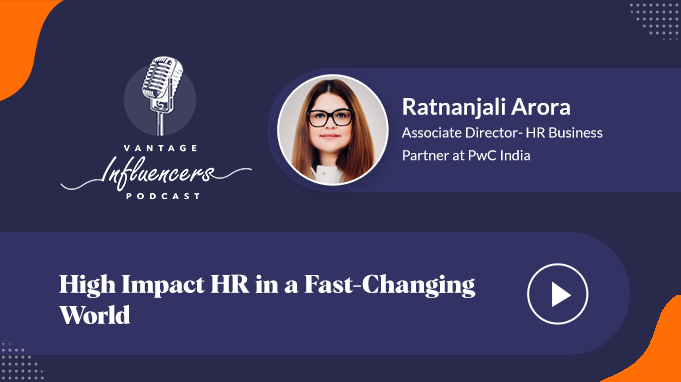
Ratnanjali Arora, Associate Director, HRBP at PwC India
Ratnanjali Arora is a people and culture strategist with over 15 years of experience in consulting, known for architecting human-centered change across business functions. As Associate Director at PwC India, she serves as Business Partner for Human Capital, leading people strategy for more than 4,000 professionals in the India Tax practice and directly shaping the growth and experience of over 2,000 colleagues nationwide. She is an ODA-certified professional and an executive coach certified by Erickson International, with expertise spanning Employee Relations, People Experience, Performance Management, Total Rewards and Wellness, and Diversity and Inclusion. Outside work, she pursues singing and classical dance, speaks regularly at industry forums, facilitates leadership workshops, and supports community impact through the PwC Foundation's CSR team.
Connect with Ratnanjali on LinkedIn
Host
Sanjeevani Saikia, Vantage Influencers Podcast Host
What You Will Learn
- How to reframe HR's role using the Formula One pit crew mindset: fast, precise, and proactive without stopping business momentum.
- Why picking and solving one visible business problem builds more credibility than broad initiatives or slide decks.
- How to introduce AI and automation into HR responsibly, with guardrails around transparency, privacy, and bias.
- Why trust, not technology, is the real currency that determines whether new HR tools succeed.
- How to shift from a "predict and monitor" mindset to a "prevent and support" approach with employee data.
- What "mastering the and" means for the next generation of high-impact HR leaders.
Key Topics & Timestamps
| Timestamp | Topic |
|---|---|
| 00:00 | Cold open and episode introduction |
| 01:10 | Ratnanjali's corporate journey and current role |
| 01:57 | Defining what a high-impact HR function looks like today |
| 03:52 | Moving HR teams from daily operations to driving real change |
| 05:46 | Using AI, data, and automation without adding noise |
| 07:18 | The mindset and skills that define future HR leaders |
| 09:17 | Closing message: "master the and" |
Full Transcript
Click to read the full episode transcript
Welcome to the Vantage Influencers podcast. This podcast is sponsored by Vantage Circle, the simple and effective recognition platform for employee engagement.
Sanjeevani Saikia: Lately, it feels like HR is being asked to do more than ever. Move faster, think bigger, quicker, and still stay deeply human. And somewhere in the middle of all of this, we keep using this phrase every now and then: high-impact HR. But the question is, what do we mean by this? And most importantly, do we mean the same thing when we say this? That's something I would like to unpack in this particular episode. I'm really glad to be joined by Ratnanjali Arora, Associate Director, HRBP at PwC India. She brings a very grounded, hands-on understanding of what it takes to create an impact on HR today. So hi, Ratnanjali. Thanks for joining us today.
Ratnanjali Arora: Thank you, Sanjeevani, for having me. Let me introduce myself to the audience. I'm Ratnanjali Arora, Associate Director with one of the consulting firms, with about 15 years of experience. What do I do? I help teams move at a business speed, be more useful, humane, and trusted, so that HR becomes traction, not the brakes. That's what I do.
Ratnanjali Arora: Amazing. Thank you so much, Sanjeevani.
Sanjeevani Saikia: Yes. Thank you so much for joining us today once again, Ratnanjali, and Happy New Year to you.
Ratnanjali Arora: Yes, Happy New Year to you as well, and everyone who's listening to us today.
Sanjeevani Saikia: Perfect. So with your permission, I'd like to delve into today's conversation straight away.
Ratnanjali Arora: Sure, sure, sure.
Sanjeevani Saikia: So to begin with, when everything is moving so quickly, impact can become a bit of a buzzword. Everyone wants HR to be strategic and influential, but those words can mean very different things depending on the context and the organization as well. So before we talk about how HR delivers impact, I think it probably makes sense to first clarify what that impact really looks like today. So let me start here. When everything's moving so fast, what does being a high-impact HR function really look like today, according to you, Ratnanjali?
Ratnanjali Arora: That's a very good question, Sanjeevani. Picture a Formula One pit crew. That's high-impact HR today: fast, precise, and proactive. The business is racing. HR's job is to change the tires without stopping the car. In HR language, let me say capabilities, organizational design, leadership moves, skills, all while staying safe and compliant. The mindset shift matters. We are not trying here to be busy. We are trying here to be useful at a speed. If we can deliver with clarity and momentum in the moments that matter, the function becomes a competitive advantage, and not the cost center. I love this line, Sanjeevani, and every single time I go back to my team I always say, let's not be the brakes here. We have to become the traction, so that the ease of doing business becomes a little more seamless and more effective in business terms.
Sanjeevani Saikia: Yes. So let's not be the brakes, but the traction. I think it's something you keep reminding your team of, so that's a wonderful thing to share with us as well. Once you start defining impact that way, reality sets in pretty quickly. Most HR teams are still deeply involved in everyday work: approvals, processes, constant requests, and that doesn't leave much space to step back and shape change for real. So with that in mind, how do HR teams move from just operating day to day to actually driving meaningful change?
Ratnanjali Arora: Yeah. So Sanjeevani, driving meaningful change will always create an impact when we're working with the teams. I always say, pick one business problem and then win it. Start by winning one visible business problem, let's say attrition at scale, slow hiring, uneven performance, weak manager capability. Pick one problem, fix it, and quantify the outcome. When you show a result, leaders can feel it: time to hire down, retention up, productivity up. HR stops being a back-office function and becomes a lever for growth in that case. Solve one pain point and then scale the playbook up. In my various discussions, I keep telling my team about the other close functions we collaborate very closely with, because HR is not the only function. You tend to collaborate with other functions and CoEs in order to become successful. So I always tell them that credibility comes from one solved pain point, and not ten slide decks.
Sanjeevani Saikia: Yeah, that was again well said. This is usually the point now, kind of shifting gears. This is usually the point where technology enters the conversation. AI, data, and automation are often seen as the levers that can help HR scale its impact, though in practice they don't always simplify things. Now, that's according to me. But from your perspective, how can HR use tools like AI, data, and automation to create real impact instead of just adding to the noise?
Ratnanjali Arora: I would say guardrails first. Trust and ethics go hand in hand. I'll start with what most people skip: guardrails. Start with guardrails, transparency, data privacy, bias checks, human review, especially for hiring, pay, and performance. Trust is the currency. If employees don't trust the system, the tech won't matter. Instead of predict and monitor, design for prevent and support. Use data to improve manager check-ins, workload signals, and career conversations, with decisions that stay human and explainable. Let AI do the repetitive tasks, and let humans do the responsible work. If the system is not explainable and fair, it won't scale.
Sanjeevani Saikia: I want to zoom out for a moment. We've talked about impact, the operational realities, the role of technology, and the need to stay human. Now, when you put all of that together, it becomes clear that systems alone can't hold this balance. Someone has to make the deliberate choices about priorities, about behaviors, and the trade-offs. With that bigger picture in mind, what mindset or skills do you think will separate truly high-impact HR leaders from the rest?
Ratnanjali Arora: The edge is the "and" mindset. Let me call it out very clearly for the listeners: A, N, D, the "and" mindset. High-impact HR leaders will move with speed and care, use data and empathy, scale automation and protect humanity, deliver business outcomes and sustain employee trust. They will make trade-offs explicit, keep systems explainable and fair, and anchor credibility in measurable wins. Think of them as part strategist, part scientist, and part coach, able to hold two truths at once while keeping culture visible in the process. I always say that's what mindset or skills will separate high-impact HR leaders. The future HR leader is part strategist, Sanjeevani, part scientist, and part coach.
Sanjeevani Saikia: So that's, I think, a great takeaway for our listeners. As you've mentioned, part scientist, part... would you like to recap that for us?
Ratnanjali Arora: The future HR leader is part strategist, part scientist, and part coach.
Sanjeevani Saikia: Wonderful. So yes, I think that's going to be a wonderful takeaway for all our listeners. Ratnanjali, thank you so much for joining all of us today. Is there anything you'd like to share, any message for our listeners before you leave?
Ratnanjali Arora: Specifically for the listeners and the HR professionals, I would say: master the and. Move fast, stay fair, measure what matters, and make trust your operating system. Master the and.
Sanjeevani Saikia: Great. Thank you so much, Ratnanjali. Thank you so much for joining us today, and have a great year ahead.
Ratnanjali Arora: Thank you for having me, Sanjeevani, and wishing you the same. Have a great day ahead.
Thanks for listening to Vantage Influencers podcast. Be sure to subscribe on Apple Podcasts, Spotify, and our Vantage Circle YouTube channel for the latest episodes.
FAQ
What does "high-impact HR" actually mean?
According to Ratnanjali Arora, it means being like a Formula One pit crew: fast, precise, and proactive, helping the business move without ever stopping it. It is less about being busy and more about being useful at speed, so HR becomes traction for the business rather than a brake on it.
How can HR teams move from daily operations to real strategic change?
Ratnanjali recommends narrowing focus rather than widening it. Pick one visible, well-defined business problem, such as attrition at scale, slow hiring, uneven performance, or weak manager capability, and solve it. Quantifying that single result builds credibility faster than a stack of slide decks and creates a playbook that can scale to other problems.
What guardrails should HR put in place before adopting AI and automation?
Transparency, data privacy, bias checks, and human review, especially in decisions around hiring, pay, and performance. Ratnanjali stresses that trust is the real currency that determines whether new technology gets adopted: if employees don't trust the system, the technology itself won't matter.
What mindset separates high-impact HR leaders from the rest?
What Ratnanjali calls "the and" mindset: moving with speed and care, using data and empathy, scaling automation while protecting humanity, and delivering business outcomes while sustaining employee trust. She describes the future HR leader as part strategist, part scientist, and part coach.
Related Reading
Also listen on