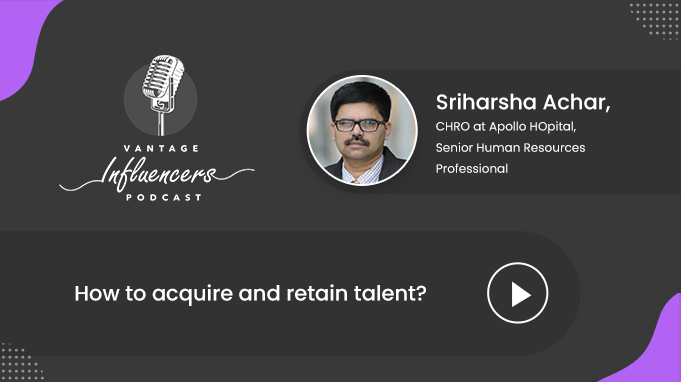
How to acquire and retain talent?
Episode Overview
Dr. Sriharsha Achar opens this episode with a blunt observation: healthcare hiring plays by a different set of rules than nearly every other industry. Doctors take the better part of a decade to become fully productive, nurses face a constant pull toward hospitals abroad, and the entire talent pool available to any hospital group is a fraction of what a technology company can draw from. He unpacks why that scarcity changes the calculus on hiring. Healthcare organizations cannot out-recruit their way to a stable workforce; they have to out-retain everyone else chasing the same small pool of doctors, nurses, and technicians.
He also gets specific about what that retention work looks like in practice: hospitals adopting technology slower than other sectors but catching up fast on resume scouting tools and mobile-first training, reward structures built around long service benefits and free annual preventive health screenings rather than pay hikes alone, and a hiring philosophy that prizes attitude over academic pedigree. Dr. Sriharsha also shares how he manages a generation that wants to finish in five hours what used to take five days, and closes with pointed advice for young HR professionals: self-respect and integrity are the only non-negotiables.
Episode Highlights
- Healthcare hiring runs on scarcity: doctors need nearly a decade of training before they're fully productive, and hospitals across the country compete for the same limited talent pool.
- Nurses are highly mobile, and hospitals lose a meaningful share of them to opportunities abroad, making retention a bigger lever than recruitment.
- Hospitals have been slower than other industries to adopt technology, but are now moving toward shared services, mobile-first learning, and resume-scouting tools.
- Rewards and recognition at Apollo Hospitals center on long service benefits and free annual preventive health screenings rather than compensation alone.
- Managing millennials means understanding that they're more informed, more impatient, and driven by a stronger sense of purpose than earlier generations.
- Dr. Sriharsha's hiring philosophy is simple: hire for attitude, train for skills, and don't let a formal degree be the deciding factor.
About the Guest
Dr. Sriharsha Achar, CHRO, Apollo Hospitals
Dr. Sriharsha Achar leads HR for Apollo Hospitals, one of India's largest healthcare networks, overseeing hospitals, pharmacies, and clinics across the country. He is an alumnus of Goa University and holds a Ph.D. from Canterbury University, and has previously worked with organizations including Apollo Munich and America Online.
Connect with Sriharsha on LinkedIn
Host
Rohit, Vantage Influencers Podcast Host
What You Will Learn
- Why healthcare hiring depends more on retention than recruitment
- How Apollo Hospitals is using technology to modernize hiring and training
- What rewards and recognition look like inside a large hospital network
- How to manage and retain millennial talent in a traditional industry
- Why Dr. Sriharsha hires for attitude over academic qualifications
- What young HR professionals should prioritize early in their careers
Key Topics & Timestamps
| Timestamp | Topic |
|---|---|
| 00:00 | Introduction to Dr. Sriharsha Achar |
| 01:53 | HR challenges shaping the healthcare industry |
| 06:30 | Talent acquisition practices in healthcare |
| 10:36 | How technology is influencing hospital hiring |
| 14:40 | Rewards and recognition at Apollo Hospitals |
| 19:13 | Candidate qualities Apollo Hospitals looks for |
| 20:36 | How leaders can effectively manage millennials |
| 25:46 | Advice for talent acquisition professionals |
Full Transcript
Click to read the full episode transcript
Welcome to the Vantage HR Influencers Podcast. This podcast is sponsored by Vantage Circle, the leading employee benefits and engagement platform.
Rohit: Hi, everyone. This is Rohit from Vantage HR Influencers Partners. And today, I'm going to talk to Dr. Sriharsha Achar, who's the CHRO at Apollo Hospitals. Dr. Sriharsha is an alumnus of Goa University and has done his Ph.D. from Canterbury University, and has worked with companies like Apollo Munich and America Online. Welcome to the show, Dr. Achar.
Dr. Sriharsha Achar: Thank you very much. Pleasure to be here.
Rohit: Awesome. So, how did you get into HR?
Dr. Sriharsha Achar: Interesting question. Machines never interested me. I always felt I was drawn towards people, and the cliched answer is that I like being with people, so I went into HR. But that's not really what brought me into HR. At that point in time, the personnel function was becoming its own thing, and I was lucky to have certain mentors in my life who motivated me enough to try something I'd never tried before.
Actually, I didn't get into HR first. I got into training, and that's where I met a lot of people. From training, the role evolved into personnel management and then into human resources over six or seven years. I used to teach at a Goa engineering college in the late 80s, and it was in the early 1990s that I began my training career. It was only by '94 or '95 that I actually moved into HR.
Today, when people tell me they like being with people and therefore want to be in HR, I tell them it's okay to be nice, but if you want to be in HR, you need to be fair. Fairness is the mantra I follow in everything I do, and that's what truly works in HR.
Rohit: Dr. Achar, being in the healthcare industry, you've been part of the Apollo group for over a decade. What are the HR challenges shaping the healthcare industry?
Dr. Sriharsha Achar: Let me specifically talk about the role I've picked up over the last 13 to 14 months at Apollo Hospitals. Healthcare is an industry that's fragmented and not organized as well as others. If you look at the number of large groups, you can count them on one hand. Apollo is the biggest by far, with close to 10,000 people across the country, around 72 hospitals, roughly 3,500 pharmacies, plus clinics, and about 4,000 doctors performing state-of-the-art surgeries and providing care to people every single day.
Other groups tend to be more regional. One of the bigger ones operates in the northern part of the country, and if you go to Bombay, you'll find groups that stand alone locally. Medical talent is genuinely difficult to find because the number of doctors coming out of medical colleges is low, there's a lot of brain drain to other countries, and many people go on to do postgraduate studies abroad. So keeping that talent in-house is tough.
Even beyond doctors, while the economics of a hospital are driven by the number of doctors on board, you need a substantial number of nurses too. In one of our larger units alone we have around 36,000 people, roughly a third of them nurses, and a similarly large group in support roles covering security, housekeeping, and technical services. Nurses are very tough to retain because there's a lot of brain drain from nursing toward the UK and the US, and technicians also get lucrative offers from those countries. Doctors are difficult for a different reason. It takes a long time to become one and even longer to become productive. If you look at the lifecycle of a doctor, he finishes his basic degree around 24 or 25, because it's a five-and-a-half to six-year course. Then he goes for his postgraduate and super-specialization, so by the time he actually has the skills, he's around 30, and he only starts becoming truly productive by 35. His growth then continues until 65 or 70, and some push on to 75 or 80.
So talent crunch is a real issue. It becomes circular: you want to hire good people, you don't find them easily, so you go into the market and end up hiring from the same limited pool. Like any other industry, people move between hospitals. So is there a way of bringing in more talent? This year the government increased the number of medical school and postgraduate seats, which is a step in the right direction, though the current ratio between undergraduate and postgraduate medical seats is still the reverse of what it should be. Talent is difficult to find, so you have to keep what you have.
Rohit: Interesting. And what are the different talent acquisition practices in your industry? If you look at the IT industry, a lot of millennials and the new generation have gone into industries with exponential growth. What does talent acquisition look like in healthcare?
Dr. Sriharsha Achar: The majority of our hiring focuses on nursing, and then hiring of doctors. From an HR perspective, HR isn't very heavily involved in hiring doctors, because HR doesn't always understand the specific requirements, and you'll find very few doctors who want to do an MBA in HR and be the front end of hiring. Hiring doctors is also location-sensitive. You generally don't hire a doctor from Delhi for Chennai, unless the person has roots there, because doctors prefer to stay where they've already built their patient base, and what a hospital looks for is how much of that base the doctor can bring with them.
Nursing talent, on the other hand, is mobile, so we recruit from around 200 nursing colleges across the country. The northeast and Kerala are the two regions that produce the maximum number of nurses in the country, roughly 40% from Kerala and 25 to 30% from the northeast, with the rest coming from local colleges. So in our Chennai hospitals, for example, roughly half the nurses come from Kerala, another 15 to 20% from the northeast, and the rest are local hires. From a nursing perspective, there's a set of written tests and interviews that we run right at the college, then we bring selected candidates in for international-standard training before putting them on the job. Technicians go through a similar process, though their mobility is much lower, so attrition among technicians is lower too. Nurses, on the other hand, do have meaningful attrition, close to 30%, though very few of them move to other hospitals in the country. Most of that movement is abroad.
Doctor hiring is a different exercise altogether. Medical directors, CEOs, and operating heads get directly involved. The rest of our hiring, whether it's materials, accounts, HR, or marketing, follows a fairly usual process, with multiple rounds of interviews so that everyone involved gets aligned before an offer goes out. It takes a little longer, but it means there's no second-guessing once the person is on board. At senior levels, we've only recently started actively hiring new talent from outside, because historically our retention at that level has been very high. In fact, at my previous company, we lost only two people from the senior leadership team over ten years. Some of that comes down to a culture that's been built painstakingly over decades. Our first hospital was established in 1982, and some of the people associated with this hospital chain go all the way back to before it started, having returned from the US to build this practice. That speaks volumes.
Rohit: Do you think technology has influenced hiring strategy over the last couple of years?
Dr. Sriharsha Achar: Hospitals have been slower in adapting to technology overall. One of our earlier moves into technology was around basic administrative systems; spreadsheets were the norm for much of the organization. But over the last six or seven years, there's been a focused push toward digitization, largely to move toward a shared services model so that a single system can serve the organization across the country. We're moving toward more efficient workforce management systems because the modern workforce expects that level of digital maturity. We've also just rolled out an attendance management system that we're now taking across all our units over the next six months.
On the training side, we're trying to do as much as possible through our learning management system, built on Oracle, because training today has to happen at the employee's own place and pace, which means it has to be mobile-friendly. We believe training should include both instructor-led and online formats, since a fully online approach without any instructor involvement still meets some hesitation in terms of acceptance.
Recruitment also benefits from technology, particularly in scouting resumes using the right keywords to filter candidates. But at the end of the day, the final decision still has to be made by a person. Some things can be outsourced, but not everything. Someone gave me an example recently of a car company that uses AI to interview its drivers, asking a set of standard questions. But a machine still can't fully interpret the answers. Asking questions is easy; interpreting what to do with the answers is where you need human judgment. A face-to-face interview will probably never go out of fashion, because body language tells you a lot.
We're trying to bring more of this into our systems. Where the number of open positions is small, a manual process still works fine. But if you're hiring at scale, across hundreds of positions and locations, technology becomes far more useful, even though human intervention can never be fully ruled out. We're also seeing this shift more broadly in healthcare IT. We just had a conference recently on the future of IT in healthcare, and it's remarkable to see what's coming, from cyber-knife technology to tele-radiology and tele-consulting. The direction now is toward building a single marketplace where a patient can access everything they need, from before admission to after discharge to home-based care.
Rohit: You mentioned how difficult it is to retain talent. So what is the hospital doing around rewards and recognition? How are you rewarding and recognizing your people?
Dr. Sriharsha Achar: From a compensation perspective, attrition at the lower rungs isn't particularly high. The one category where we do see movement is junior doctors, because they leave for their postgraduate studies, and there's only so much you can do to retain a nurse who wants to go abroad; it's rarely about compensation for them. What we've observed, though, is that when people take a foreign assignment for a couple of years, the first thing many of them do when they're ready to return is check whether there's an opportunity to come back to us, often at a more senior level with international exposure.
On rewards and recognition more broadly, we invest heavily in training, because I'd rather listen to the argument that if you don't train people, they'll stay and hold the organization back, than the argument that if you train them, they'll leave. It's good to keep people employable, but training and learning have to be self-led too; the organization can only do so much. People who spend time with us go through management and leadership training, medical training, conference attendance, and support to present their own papers.
Our benefits are also fairly strong. Anyone who completes 20 years of service gets a long service benefit that's genuinely valued, because spending 20 years in the same organization is meaningful. Beyond that, our chairman is very passionate about preventive care: the idea that we should prevent what's preventable, because conditions like cancer, obesity, diabetes, strokes, and respiratory illness are on the rise and are collectively responsible for a large share of deaths globally. So we've pushed hard internally on annual preventive health screenings for every employee. The first year we ran this, only about 3% of employees participated; this year that number has gone up to around 21%, though our chairman's target is closer to 90%. He often points out that people run marathons and track how fast they can cover a certain distance, but still don't actually know what's happening inside their bodies, which is really the point of a screening like this.
We're also an equal opportunity employer. We don't discriminate, and we're open to hiring across the LGBTQ+ community as long as people are qualified for the role.
Rohit: I want to come back to hiring. Apart from the qualities we've discussed, what do you look for in a candidate to know they'll fit into your culture?
Dr. Sriharsha Achar: In today's context: being digitally savvy, being flexible, and having the ability to build good working relationships and keep learning. You come in with a certain way of thinking that will likely be completely different from what's needed here, so you have to be willing to unlearn what you learned in the classroom and relearn on the job. That applies to everyone coming into healthcare especially, because this industry needs people who have a genuine sense of purpose, and that purpose needs to match the organization's purpose. In my case, it matched well, because our chairman talks about touching real lives, and making a difference to people's lives is exactly the purpose I've been chasing too.
Rohit: Before the call, we talked about millennials and what they bring to the table, and Gen Z entering the workforce too. When you talk about managing millennials and younger employees, what are they looking for, and how can a leader manage them well?
Dr. Sriharsha Achar: Today's younger employees are very practical about life. They're well informed, and they've grown up with a phone or a computer in their hands, always connected. That doesn't mean they're a completely different species, but there is a lot to understand about this generation. As a father to two daughters spanning different generations, I can see a real difference in how they think, behave, and interact even within the same household. My older daughter is a healthcare analyst and thinks in a more measured way; my younger one is more practical, more confident, sometimes more impulsive, and far more comfortable navigating unfamiliar situations on her own, whether that's traveling alone or figuring things out as she goes.
They're also extremely well informed. They know exactly what to expect from a website, what to buy from which retailer, what to wear, almost before information becomes mainstream. They get bored quickly, and one thing I've noticed across this generation is that almost everyone has a larger sense of purpose. It took me twenty years into my career to find my own sense of purpose; this generation seems to know early on what they want to be in twenty years. My generation thought about retiring closer to 60. Millennials are thinking about retiring earlier than that, and the generation after them seems to be thinking earlier still, essentially finishing education, working for about twenty years, and retiring young.
There's also a shift in ownership patterns; a lot of younger people aren't buying cars the way previous generations did, because ride-hailing apps make that unnecessary in most cities. Their value system is different from the previous generation's, so there has to be alignment between a manager and this generation within the organization, otherwise you'll see high attrition, because they get bored with a job quickly. Something that might take you or me five days to finish, they want to do in five hours, and if it's taking five hours, they want it done in five minutes. So they're a little impatient, and that energy needs to be channeled the right way. They also want a strong sense of purpose reinforced at work. My younger daughter, for instance, is already involved with multiple NGOs in her spare time, working on causes ranging from clothing and food distribution to elder care, including an idea to get restaurants to release surplus food earlier so it can reach people before it spoils.
Rohit: From your experience, what advice would you give to professionals in talent acquisition, or even to founders and CEOs who want to acquire high-quality talent?
Dr. Sriharsha Achar: Hire for attitude, train for skills. That's it. I'm glad that today, some organizations are recognizing that a formal college degree isn't always required. In my career, I've always said, don't go strictly by qualification, look at whether the person can actually do the job. If they can do the job, there may be some limitations on how far they can grow without a formal qualification, but organizations today can't take the position that a degree alone determines readiness, because development is largely self-led. You don't need an MBA to be good at sales; an ordinary graduate can do it well if they're good at selling, and that's what genuinely helps the organization. A degree is desirable, not essential.
A lot of companies, including several in IT, have moved away from requiring a specific degree. I see this even outside of formal roles. The household staff and drivers I work with are often more comfortable navigating a smartphone than people who consider themselves tech-savvy. We might be carrying the latest phone, but we barely use it beyond calls, while they navigate it with real ease. So qualification really doesn't determine competence. Hire for attitude, train for the skills.
Rohit: And what's one piece of advice you'd give to young HR professionals?
Dr. Sriharsha Achar: Self-respect and integrity should never be compromised.
Rohit: Do you have a favorite HR leader or mentor?
Dr. Sriharsha Achar: Tough question, but if I have to give credit for where I am today, I'd point to two people who shaped my career early on, including one of the first HR managers I worked under, who's no longer with us, and a CEO I worked with for a number of years. If I had to name two people, it would be those two.
Rohit: Do you have a favorite business book, fiction or non-fiction?
Dr. Sriharsha Achar: I enjoy novels set in the banking sector, and I've read most of what's out there in that space. I'm also a fan of a particular author whose work many readers find divisive, but I've read all of his books and genuinely appreciate his writing.
Rohit: What's the best way for people to reach out to you?
Dr. Sriharsha Achar: LinkedIn, Facebook, or email.
Rohit: Thank you so much, Dr. Achar. It was a pleasure talking to you.
Dr. Sriharsha Achar: Thank you so much for having me.
Thanks for listening to the Vantage HR Influencers Podcast. Please subscribe to the Vantage HR Influencers Podcast on Apple Podcasts and Spotify for new episodes.
FAQ
Why is retention more important than recruitment in healthcare hiring?
Because the talent pool for doctors, nurses, and technicians is far smaller than in most industries, and doctors alone take the better part of a decade to become fully productive. Hospitals that lose experienced people can't simply replace them from the open market at the same pace, so retaining talent matters more than winning it away from competitors.
How does Apollo Hospitals use technology in hiring and training?
Apollo Hospitals uses resume-scouting tools to help filter high-volume applications, has moved toward a shared services model for HR systems, and delivers training through a mobile-friendly learning management system. Human judgment, especially face-to-face interviews, still plays a central role in senior and clinical hiring.
What does Apollo Hospitals do for rewards and recognition?
Apollo Hospitals invests heavily in ongoing training and leadership development, offers a meaningful long service benefit after 20 years, and runs an annual preventive health screening program for employees, an initiative championed by its chairman as part of a broader focus on preventing non-communicable diseases.
What hiring philosophy does Dr. Sriharsha Achar recommend?
He recommends hiring for attitude and training for skills rather than filtering candidates by formal qualifications. In his view, a person's ability to actually do the job matters more than a degree, and organizations today need to invest in developing people rather than relying on credentials alone.
Related Reading
Also listen on