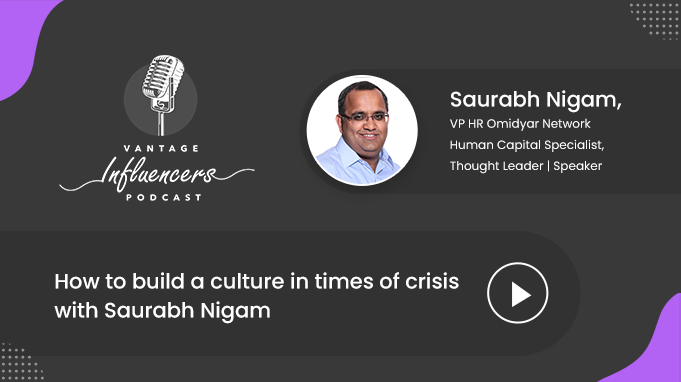
How to build a culture in times of crisis with Saurabh Nigam, VP HR Omidyar Network
Episode Overview
In this episode, Saurabh Nigam pushes back on a common instinct among leaders in a crisis: the urge to rewrite company values on the fly. He argues that if a crisis makes you question your values, something was already broken before the crisis hit, because values exist precisely to guide decisions when things get hard. Rather than refining values, he says leaders should reinforce them, using the crisis as proof of what the organization actually stands for. He walks through a real example from his own workplace: a rapid funding response launched early in the pandemic that channelled close to ten and a half crore rupees toward COVID-19 relief work, a decision he traces directly back to specific values rather than a generic mission statement.
The conversation moves from values to execution: how do you actually keep a culture alive when everyone is suddenly working from home? Saurabh says the starting point is accepting that teams are no longer homogeneous. A single employee and a parent juggling a toddler are facing very different realities, and priorities have to be reset accordingly. He talks about spotting informal culture ambassadors who reinforce values without being told to, and about why open, honest feedback over Zoom and Slack is only possible if a culture of trust already exists, since remote work exposes weak trust rather than causing it. He also weighs the real upsides and downsides of extended work from home, shares how he keeps a pulse on team morale without an office to walk around in, and closes with blunt advice for HR professionals who want to keep growing in their careers.
Episode Highlights
- Saurabh Nigam argues that needing to "refine" your values during a crisis is a sign something was already wrong with them; values should reinforce decisions, not get rewritten under pressure.
- He points to a real example: a rapid funding initiative that earmarked close to 10.5 crore rupees for COVID-19 relief, driven directly by the values of boldness and empathy.
- Culture building has to be a top-three priority from the moment a founder hires their second employee, not something addressed after the "real" business problems are solved.
- Remote teams are not homogeneous. A single employee and a parent managing young kids at home face very different realities, and leaders need to reset priorities accordingly.
- Open, honest feedback over WhatsApp, Slack, or Zoom only works if a culture of trust was already built before the crisis; remote work exposes weak trust, it doesn't cause it.
- His advice for young HR professionals: know your subject, but more importantly, stay curious and don't be afraid to challenge the status quo, because what worked five years ago won't automatically work today.
About the Guest
Saurabh Nigam, VP HR, Omidyar Network India
Saurabh Nigam holds a post-graduate degree in personnel management and industrial relations from XLRI, Jamshedpur, and is a regular speaker at national and international HR conferences. He started his career as a software engineer, spending about three years writing code before an internal move into a training role introduced him to HR and reshaped the rest of his career. Since then he has built more than a decade of HR experience across early-stage, high-growth sectors including retail, BFSI, e-commerce, and KPO, before joining Omidyar Network India, where he has spent close to three years working with the organization's portfolio on human capital needs and challenges.
Connect with Saurabh on LinkedIn
Host
Rohit, Vantage Influencers Podcast Host
What You Will Learn
- Why leaders should resist "refining" their values in a crisis and instead lean on them harder.
- How to identify and empower informal culture ambassadors who reinforce values without top-down enforcement.
- How to reset priorities and goalposts for a workforce with very different circumstances at home.
- Why authenticity and trust, not new tools, are the real prerequisites for honest remote feedback.
- The genuine upsides and downsides of extended work from home, and what determines whether it becomes permanent.
- What simple, low-tech ways exist to keep a pulse on remote employee engagement without heavy survey tools.
Key Topics & Timestamps
| Timestamp | Topic |
|---|---|
| 00:09 | Introduction and Saurabh's path from software engineering into HR |
| 02:25 | Why leaders should reinforce, not refine, values during a crisis |
| 05:16 | Building a culture from scratch: what founders should prioritize |
| 07:33 | Communicating company culture to employees during a crisis |
| 10:21 | Setting priorities for employees with different home circumstances |
| 13:46 | Building the trust needed for open feedback in a remote environment |
| 16:16 | The upsides and downsides of extended work from home |
| 22:08 | Tools and habits for measuring remote employee engagement |
| 26:47 | Staying calm as a leader during stressful, uncertain times |
| 30:12 | Saurabh's advice for young HR professionals |
Full Transcript
Click to read the full episode transcript
Welcome to the Vantage HR Influencers Podcast. This podcast is sponsored by Vantage Circle, the leading employee benefits and engagement platform.
Rohit: Hi everyone, this is Rohit from Vantage HR Influencers Podcast and today I'm excited to have Saurabh Nigam, who holds a post-graduate degree in personnel management and industrial relations from XLRI, Jamshedpur, India. Saurabh is VP HR for Omidyar Network, India and is a regular speaker at various national and international conferences. Welcome to the show, Saurabh.
Saurabh Nigam: Thanks, thanks, it's a pleasure to be here.
Rohit: So how did you get into the role of HR and how did you make your way into Omidyar Network?
Saurabh Nigam: So I'm an engineer by background for my bachelor's degree, and just like many, many folks of my age group, I started my career as a software coder. I did coding for about three years, and then there was an internal job posting in my first organization, Canway, for a trainer on the software application on which I used to code. I somehow went for it, got selected, and in my last six to eight months in that job, I was a subject matter expert trainer on the application I used to code on. That was my first experience or exposure to training, stroke HR, as a function, and I just got interested in the kind of impact you were able to create in the organization, on the people of the organization, and that's how I really got interested in this domain itself. So I ended up doing an MBA from Acceleri with a specialization in HR, and since then it's been a little over 13 years of HR experience, mostly in early stage, high growth industries: retail, BFSI, e-commerce, KPO. My current organization, Omidyar Network, I've been with Omidyar Network for about three years now, and the reason this role attracted me is because I get to work with our portfolio organizations on their various human capital needs and challenges. What really attracted me about this opportunity was the fact that it allows me to leverage my experience of the last 13, 14 years working across different early stage organizations, and use that to contribute my bit towards organizations which are looking to create a positive impact on the lives of people. So it's really a win-win, in that sense.
Rohit: Interesting journey from coding to HR, that's the first one I've heard. But during such times of crisis, or as we're recording this podcast when the COVID-19 situation is still ongoing, how do you refine company values during such a crisis?
Saurabh Nigam: Sure. So to be absolutely candid, I feel if you need to refine your values in a time of crisis like this, then there's something fundamentally wrong with your values themselves. The reason I say that is because values are supposed to be a guiding light in times of crisis. They should assist you in decision making when the going gets tough. So if there's a question mark on your values just because we're in a crisis, then I think what you've defined as your values all this while itself needs to be questioned. So if you really ask me, the way I look at it, in times of crisis, instead of refining your values, you should actually look to reinforce them by using them in your planning to respond to the crisis.
An example I can quote is from my own organization, Omidyar Network. We have five cultural attributes: accountability, boldness, diversity, empathy, and trust. As the COVID-19 crisis unfolded in India starting mid to late March, we very soon realized that the real need of the hour was to figure out how we could contribute as an organization towards mitigating the crisis that had come up in the lives of people. That's how we came up with our new initiative called the Rapid Response Funding Initiative. We earmarked a sum of close to 10.5 crore, which was put together to provide funding to organizations working on solutions or relief work related to COVID-19.
Now, a key driver for us to come up with this initiative was really our values of boldness and empathy. We very quickly pivoted and said that while we're in the space of impact investment, we needed to come up with an initiative driven towards the need of the hour, which is basically responding to this crisis. So that's really how boldness came in, and empathy was really about the fact that this is the need of the hour for the people of the country. And the last bit which really pushed us to come up with this initiative was the fact that we've always wanted to make sure we're accountable to the mission of the organization, which is really to create impact on the lives of people.
So the point I'm trying to make here is that it's really the values which should drive your decision making in good times and in bad times, and in times of crisis. There's no question of refining your company values, and if you're pushed to do that, then there's something fundamentally wrong there.
Rohit: How about founders or leaders trying to build a new organization? Are there any top three or four things needed to build a culture, from the leadership perspective?
Saurabh Nigam: Absolutely. So my fundamental belief is that when you're starting an organization, there are possibly a hundred different things you're looking to do, starting from fundraising, to getting your product-market fit right, to getting your team in place, and so on and so forth. But figuring out what your culture, or ways of working, is going to be in your organization has got to be in your top three to five priorities. The reason I say that is because culture building really starts from the day you decide to bring in the second person after you into the organization. Unless you focus on it, it becomes that much more difficult.
So how do you go about doing it? I think the number one thing is that you've got to be authentic about what you're thinking of or trying to define as your ways of working, or as we call it, the culture of the organization. Because if you're not authentic, it will show. You can't build a culture, or values, in an organization that you don't believe in yourself as a leader. So being authentic is absolutely critical.
Also, it's almost a cliche to say this, but leading from the front when it comes to defining culture and values in your organization is absolutely critical, more so in times like these when you're in a crisis. And then, while it's again almost a cliche to say that culture gets driven from the top, I think how open you are as a leader to feedback, and to doing post-mortems even in the case of defining culture and values for your organization, is very, very important. And finally, as they all say, you've got to walk the talk as a leader. It's one thing to articulate and define your values and culture, but as a leader, if you're not walking that path, there's no way you're going to have that culture take root in your organization.
Rohit: And during such times, how would you communicate the company's culture to employees? They could be job cards or salary cards. How do you maintain that sort of positivity with employees?
Saurabh Nigam: Sure. So as I said a little while earlier, your values and your culture are really your ways of working. They're your guiding light, your principles which define your decision making, and how you react to a situation as an individual, as a team, and as an organization. That's why a lot of thought has to go into figuring out what those values or culture are for you.
Now, in times of crisis like these, I think one of the most important things you need to do is make sure you're using every possible opportunity, whether you're conveying good news or bad news, whether there are celebrations, meetings, all-hands, trainings, engagement activities, whatever the case may be, to reiterate and re-emphasize how you've used your culture or values to arrive at your decision making, and how that played out in each of these scenarios. I think that's very, very important, because otherwise there will be a disconnect between what you've defined as your ways of working and what you're actually doing day to day. So every single time you're interacting with your team or your organization, making sure you're talking about and re-emphasizing your values is important.
Similarly, while as a leader you've got to lead from the front, it's also important to spot your change agents, or as I call them, culture ambassadors, to ensure they're the ones reinforcing your culture and values in the organization. The reason I say that is because as you grow as an organization, doing this all by yourself as an individual becomes practically impossible. So, as an example, at Omidyar Network we have what we call a culture crew. It's made up of six or seven individuals pulled in from different teams and verticals, and they're really the drivers of culture and values in the organization. That's very important.
And finally, as far as communication channels are concerned, again almost a cliche, but you've got to use every possible channel, whether it's email, company newsletters, memos, or press releases, to reinforce and reiterate your values and how you've used them in your decision making, your strategy, and your way forward. Those are some of the things you can use to communicate the company's culture to employees in an environment like this.
Rohit: Interesting. And what happens in organizations is that there are people who are bachelors, and other people who are married with kids. How do you define priorities in a situation where there are different people with different backgrounds, and they have to work together while working from home?
Saurabh Nigam: Sure. So I think, first and foremost, there's been a realization for us as well, over the last six to eight weeks, that we're no longer in business-as-usual mode. It's extraordinary circumstances, which means that as an organization, one of the first things you need to figure out is what the goalpost is that you're going to be chasing, because your circumstances have changed. We're not in a BAU mode. There has to be a redefinition of what you're going to chase as an organization, which we sometimes call the goalpost.
So I think it starts from there. As a leadership team, it's absolutely imperative for you to go back to your discussion mode and figure out what you're going to prioritize and deprioritize at an organization level. That's, I think, the number one step. One of the inputs as you do that is to recognize, as you rightly said, that within the organization, your team members are no longer in a homogeneous state. When you're in an office setup, it's the same for everybody, the timings, the environment, the ways of working, everybody, everything is the same. It's homogeneous. But when you're working remotely, all of us, it goes far beyond just the fact that we moved from office to home and are now all working together in the same environment. It's not that simple. The environment changes for everyone depending on the life phase they're in. How a bachelor works in a work-from-home environment, and the challenges they face, is going to be very different compared to somebody who's got, say, two kids, or one young kid, at home.
So keeping that in mind, while you figure out what your revised goalpost for the organization is, it's absolutely important, simply because that will tell you what capacity or capability exists within your team right now. It's not just a question of a hundred people who were working in the office now working from home, with everything else staying the same. So once you define your goalpost, then it's a question of making sure that every single person in the organization understands what that revised goalpost is, and then using that to redefine what the expectations are from every single individual. That's bound to change, it has to change. And the fact that you've recognized that every individual is in a different state will also allow you to redefine their body of work, which will ultimately contribute towards the organization reaching that revised goalpost. So I think it goes hand in hand, but it has to start with the organization figuring out where it wants to land, or where it's expected to land, given the crisis we're in.
Rohit: Correct. And since employees are not physically present in a room or in a physical place, how can we encourage an environment of open feedback and communication, since most of the communication is happening through WhatsApp, Slack, or Zoom?
Saurabh Nigam: So I think open feedback or communication really comes down to how authentic you are in your conversations with individuals, and authenticity in conversation comes with trust. So it really boils down to how much you've invested in building a culture of trust in your organization, which ultimately leads to authentic conversations happening in your organization. And authentic conversation isn't just about feedback.
Given that we're in this crisis, it's going to test the degree of trust that exists in the organization. If you have a high trust culture and you've invested in building that kind of culture, you won't find it difficult to have those honest conversations, even though you're sitting remotely. On the contrary, if your culture hasn't developed to the extent that there's enough trust in the environment, trust between individuals, peer to peer, peer to manager, then it's going to be extremely difficult to drive home those conversations, including feedback, simply because you're sitting in a remote environment.
So I think it really boils down to the time invested in building a culture of trust. If you haven't, then the time is now to start doing that. And how do you build a culture of trust? It actually starts with you. Your willingness, as a leader, to trust others, to trust your team members, will drive trust from their side towards you as well. If you haven't invested enough in doing that, then you need to do that in order to have those authentic conversations going forward. Otherwise, it's not going to happen.
Rohit: No, interesting, because you pointed out that it's important to trust others and your team members, and also keep communication open at all times.
Saurabh Nigam: Absolutely. It starts with that. There's no way I can expect you to trust me unless I exhibit my trust in you. Unless you feel confident that I trust you, there's no way you're going to trust me.
Rohit: Correct. Do you think there are any downsides or upsides to remote working, and after the COVID-19 situation, is remote work going to become a permanent thing among organizations? What are your thoughts on that?
Saurabh Nigam: Sure. So there are different upsides. We've heard about this for many years now, this whole concept of flexible work schedules and giving team members the opportunity to work out of their homes. A few of the upsides I can immediately think of: if you're working in big cities like Bombay, Delhi, or Bangalore, you're obviously saving time spent on commute, which frankly is unproductive and unhealthy as well. So that's one of the biggest upsides of working from home, you're saving a lot of time for yourself.
Also, working from home means it won't be a normal office setup, so you have the flexibility to work from your favorite corner, room, or balcony, things that aren't possible in an office setup. You have better control over your schedule and can plan your home responsibilities far more efficiently than when you're in the office. If managed well, meetings can be more fun. Virtual meetings, where everybody's sitting at home, can actually be quite fun, you can use virtual backgrounds and have fun moments while sitting at home, so meetings can be a lot more fun than stressful. And in many ways, you can expect better work-life balance, especially if you're living with family, not just your spouse and kids but also parents, because it allows you more face time with the people you love, which is always good for relationships.
But there are downsides too, and we're all realizing that extended work from home does have real challenges. For one, you can feel isolated and disconnected from your colleagues. Your ability to go and have a coffee break and chit-chat with your colleagues just goes away, and that personal connect disappearing can be very disturbing, especially if you're living alone. Similarly, if you're living with family, it can be more stressful, if you have young kids, there can be a lot of distractions. Work from home also makes you much more reliant on technology, your laptop, your Wi-Fi, your phone, because otherwise you're completely cut off, which isn't so much the case in an office setup where there are backups and redundancies. I also feel that when you're doing extended work from home, unplugging from work and keeping the demarcation between your professional and personal life can sometimes be very challenging, which also means people end up working much longer hours than they possibly would in an office setup. And if you're working across multiple time zones, that can be very difficult too while working from home.
So there are different downsides as well. Where the world moves is anybody's guess. I know there's a lot of talk about companies extending work from home till the end of the year, or even into next year. It saves organizations a lot of costs from a real estate perspective, there's absolutely no doubt about that, and there are different upsides for individuals too, as I mentioned. Whether it's going to become the norm or not, given the downsides and challenges, I'm not very sure. What I am a hundred percent sure of is that the acceptance towards giving people the flexibility to work from home whenever they want to, something that's been a hot topic of discussion for years, is going to be much higher from organizations going forward. Whether we'll move the majority of our workforce to work from home permanently, that's anybody's guess, I really can't say.
Rohit: And do you think a lot of women would also come back into the workforce, women who had to take a break because of their children? Because I think once you're working remotely, it becomes easier for them to take care of their children as well as work.
Saurabh Nigam: I hope so, and I definitely believe it would. But for that to happen, there will need to be a mindset shift in the way organizations look at work and define the body of work. As I said, work from home, and extended work from home, isn't just a question of moving your people from the office to home. There has to be a redefinition of what you're going to chase, how you're going to chase it, how you'll operate, and an understanding that at home, different people will be facing different challenges. Having that in mind, and the ability to account for it while you define work, will be very important in order for me to see a real shift in women who've taken breaks from their careers coming back. But I'm certainly very, very positive about that.
Rohit: Correct. Are there any tools which employers can use to measure employee engagement among remote team workers?
Saurabh Nigam: So I think the simplest and easiest thing to do, to get a real-time pulse, is having conversations with your team members. And obviously, as I said, that requires a high degree of trust in your culture and environment for people to open up to leaders and share candidly how they're feeling, how motivated they are, and what the morale is like. If you don't have that culture, these direct conversations won't give you meaningful insight into the real pulse of the organization. But I definitely feel that in times like these, maintaining that personal connect is extremely important to ensure you have a pulse on your organization. Obviously it's easier to do in smaller organizations, as you grow it becomes that much more difficult.
So what do you do next? One obvious thing is coming up with a tool, or a small survey, that's easy for employees or your team to take, focusing on the health and well-being of employees and their families, professional motivation, and overall morale. That's something you should look to do, especially once your organization is beyond the size where one-on-one connects with everybody on a regular basis aren't really possible. And finally, there are many good survey tools available in the market that let you roll out these surveys across multiple geographies and give you a lot more insight into what the pulse of the organization really is. My only caveat is that you should look to use these tools only once your organization has reached a scale that no longer allows for those personal connects or your own small surveys. Before that, I'd advise you to keep doing the personal, direct route. But there are many good tools available.
Rohit: And what's happening now in organizations is that you find Gen Z's and millennials moving up into leadership positions, and they have very different priorities from boomers and older generations. What's the best way to make sure that the careers and goals of Gen Z's and millennials can align with the goals of the company?
Saurabh Nigam: Yeah, I think that's a pretty broad question, and very relevant. The fact of the matter is, in any decision you make, or the body of work you create, the interest of the organization has to be at the core. You're employing people because there's a mission to be achieved, there's something to be achieved, which is really what your organization's goalposts are. So I think it starts from there. And recognizing that people from different generations come in with different expectations, aspirations, and styles of working is extremely important. Having a strong understanding of how you define your body of work, and aligning that with the expectations and aspirations of individuals from different generations, will allow you to define your ways of working accordingly.
So the two things have to happen in parallel: figuring out how you're going to define different bodies of work within the organization by understanding the different needs and aspirations of individuals, leveraging the strengths of someone coming from a particular generation, and then marrying the two. I think that's really the way to go forward. Easier said than done, I definitely understand, but I think the way that gets solved is also when you have a very strong culture driving this forward, and that culture really needs to address the fact that, ultimately, what matters is that when all of us come together from different organizations, backgrounds, and generations, we're taking the interest of the organization forward. So if your culture is able to drive that, then pulling together people from different generations isn't that difficult.
Rohit: And do you have any suggestions for team leaders or startup founders on how to remain calm in such stressful situations?
Saurabh Nigam: I think the first and foremost thing for any leader, or any founder, is to recognize that this is a new normal. Recognizing and accepting that we've gotten into this extraordinary set of circumstances, which has kind of forced us to define a new normal, is the starting point. You cannot be in denial of that. That's the starting point, because until you recognize and accept it, you won't move to the next step, which is figuring out what you need to prioritize, and more importantly, what you need to deprioritize, since we're no longer in the same world or environment that existed three months back. That should force you to prioritize and deprioritize, at an organization level and at an individual level too.
Once you do that, you need to communicate and over-communicate with your leaders, your team members, and the organization at large, so everybody understands two things: one, that we're in a new normal as an organization, and therefore what exactly the priorities are, because that lends itself to what I, at an individual level, need to focus on. And finally, making sure you stay connected with people, using different tools and techniques to stay connected. It's easier when everybody's in an office setup, even if geographically spread out, you can go to offices and meet people, and that connect is a very different kind of connect. So given that all of us are working remotely, and are going to stay in this remote working mode for some time, figuring out ways and means of staying connected with your team is super, super critical.
Rohit: Correct. I quickly want to go through the top three things. What's your favorite business book?
Saurabh Nigam: There's one book I really, really recommend and advise pretty much everybody to read, it's called Crucial Conversations, by Joseph Grady. The reason I love this book is because of the premise it starts with: it talks about the fact that if you look at any problem, any issue, between two individuals, two teams, organizations, or even between countries, and trace it back, you'll invariably find that you're in that problem, or that situation, because somewhere, a conversation that was critical, that was important, did not happen the way it should have. That's the premise it starts with. It then talks about how you can enable and equip yourself to have crucial conversations the way they should be had, instead of messing them up or avoiding them altogether, because that leads to various kinds of problems in your personal and professional life. So to me, it's one of the best books I've read, and I really try to follow it.
Rohit: We'll put that in the show notes. Do you have any favorite HR leader or CEO whom you follow?
Saurabh Nigam: So I do follow a lot of HR leaders on various platforms and LinkedIn. A few names that come to mind immediately are Prabhir Jha, S.V. Naath, and Abhijit Bhadre, these are some of the HR leaders I follow.
Rohit: Do you have any piece of advice for young HR leaders who want to move up in the organization?
Saurabh Nigam: Absolutely. So keeping aside the fact that you should know your subject, which is a given, I'd say you've got to be curious, and not be afraid of challenging the status quo. I'll elaborate on why I say that. The sheer fact that, as HR professionals, you're entrusted with the responsibility of being the custodian of people practices, understanding the pulse of the organization, and coming up with practices that will resonate, whether around org design, compensation structures, performance systems, culture, or engagement, means you need to continuously evolve and innovate with the changing needs and aspirations of people, while balancing your priorities.
So what worked five to ten years back in any stream of people practices doesn't necessarily work in today's environment. A really good example is the circumstances we're in right now. COVID-19, no one thought we'd be in a situation like this, where every single individual is working remotely. As an HR professional, if you're not curious, if you're not figuring out new ways of engaging with people, communicating with people, defining culture, as we've talked about, you're going to be found wanting in your job. You won't be true to your job. So being curious, and not being afraid to challenge the status quo, is super, super important for an HR professional to be successful.
Rohit: So what's the best way people can reach out to you and know more about you?
Saurabh Nigam: I'm fairly active on LinkedIn, and fairly active on Twitter as well. My Twitter handle is @szlega, and it's the same for my LinkedIn page as well, @szlega.
Rohit: Thank you so much for taking the time and speaking with us. I really enjoyed speaking with you.
Saurabh Nigam: Great, likewise. Thanks a lot for having me here.
Thanks for listening to the Vantage HR Influencers podcast. Please do subscribe to Vantage HR Influencers podcast on Apple Podcast and Spotify for new episodes.
FAQ
Why does Saurabh Nigam say leaders shouldn't try to "refine" their values during a crisis?
Saurabh argues that values exist to guide decision making when things get hard, so needing to change them in a crisis is really a sign something was wrong with them from the start. His advice is to reinforce existing values by using them to shape the response to a crisis, not to rewrite them under pressure.
What is the Rapid Response Funding Initiative Saurabh Nigam describes?
It is an initiative Omidyar Network India launched as the COVID-19 crisis unfolded in India, earmarking close to 10.5 crore rupees to fund organizations working on relief and solutions related to the pandemic. Saurabh traces the decision directly to the values of boldness, empathy, and accountability to the organization's mission.
How does Saurabh Nigam say leaders can build trust for honest feedback in a remote team?
He says trust has to be built before the crisis hits, not during it. A leader's willingness to trust their team first is what earns trust in return. Where that culture of trust already exists, honest conversations happen naturally over tools like WhatsApp, Slack, or Zoom. Where it doesn't, remote work makes those conversations far harder.
What does Saurabh Nigam see as the biggest risk of extended work from home?
He points to isolation and the blurred line between work and personal life. Employees can feel disconnected from colleagues, become overly dependent on personal technology while working without office backups, and end up working longer hours because there's no natural cutoff between the workday and home life.
Related Reading
Also listen on