How To Design A Fearless Workplace Culture?
Episode Overview
Gustavo Razzetti argues that companies rarely fail because they lack ideas, talent, or resources. They fail because their culture punishes the people who try to bring new ideas forward. In this episode, he argues that a fearless culture isn't about removing fear from the workplace at all. It's about giving people the conditions to lead from courage despite their fear, so they can speak honestly, challenge decisions, and share half-formed ideas without expecting to be judged or punished for it.
That framing runs through the rest of the conversation. Gustavo walks through the bystander effect, the reason employees watch a problem unfold and assume someone else will raise it, and connects it to a three-level psychological safety ladder that starts with belonging, moves through cognitive diversity, and only then reaches innovation. He also gets specific about hybrid work, where the loudest voice in the room usually wins unless a team deliberately builds in turn-taking and asynchronous defaults. He closes with a warning against copying admired companies' culture playbooks, arguing that the gap between the culture a company markets and the one it actually delivers is what drives new hires to quit within months.
Episode Highlights
- Gustavo traces most organizational stagnation not to a shortage of ideas or talent, but to a culture that punishes new thinking.
- He reframes "fearless" as leading from courage while fear is present, not eliminating fear altogether.
- The bystander effect explains why employees see problems and stay quiet, assuming someone else will raise the flag.
- A three-rung psychological safety ladder, belonging, cognitive diversity, then innovation, shows why teams stall before they ever get creative.
- Hybrid meetings amplify existing culture problems; deliberate turn-taking and asynchronous defaults protect quieter voices.
- His closing advice to HR leaders: stop imitating admired companies and build a culture that matches who you actually are.
About the Guest
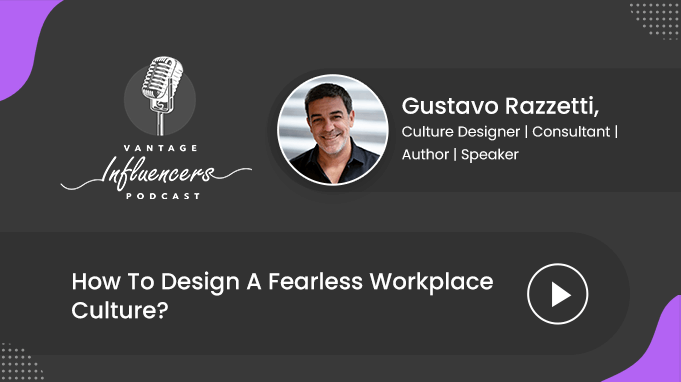
Gustavo Razzetti, CEO of Fearless Culture
Gustavo Razzetti leads Fearless Culture, a culture design consultancy that helps organizations build purpose-driven, innovative, and agile cultures. He has spent close to three decades studying and transforming human behavior at the intersection of neuroscience, design thinking, mindfulness, and creativity, and has facilitated hundreds of change workshops across the US, Europe, and Latin America. He is the author of Stretch for Change, Stretch Your Mind, and Stretch Your Team, and has advised leadership teams from startups to Fortune 500 companies including Comcast, P&G, Coca-Cola, General Motors, Allstate, BBVA, and Nestle.
Connect with Gustavo on LinkedIn
Host
Susmita Sarma, Vantage Influencers Podcast Host
What You Will Learn
- Why culture, not a shortage of ideas or talent, is usually the biggest barrier to innovation
- What a fearless culture actually means, and why it isn't about removing fear from the workplace
- The bystander effect, and why employees stay silent even when they see something going wrong
- The three-rung psychological safety ladder: belonging, cognitive diversity, and innovation
- How to protect psychological safety in hybrid and remote meetings
- Why copying admired companies' culture playbooks backfires, and what to do instead
Key Topics & Timestamps
| Timestamp | Topic |
|---|---|
| 00:53 | Gustavo's journey through three decades of consulting on innovation and culture |
| 01:48 | The inception of Fearless Culture and its approach to mapping and designing culture |
| 03:17 | Why a fearless workplace culture matters, especially in a crisis |
| 04:50 | The signs of a fear-based work culture |
| 07:44 | How fear affects productivity, collaboration, and innovation |
| 09:38 | The top moves for a leader building a fearless organization |
| 11:08 | The challenges leaders face when shifting toward a fearless culture |
| 13:46 | What psychological safety looks like in a hybrid workplace |
| 17:00 | Real-life examples of organizations getting it right |
| 19:39 | Gustavo's closing advice for HR leaders |
Full Transcript
Click to read the full episode transcript
Welcome to the Vantage HR Influencers Podcast. This podcast is sponsored by Vantage Circle, the simple and AI-powered rewards and recognition platform for employee engagement.
Susmita Sarma: Hi everyone. I'm Susmita from the Vantage HR Influencers Podcast. In this episode, we'll talk about a fearless culture, the science of a fear-based work culture, its effects, together with some brilliant examples of organizations who are doing it the right way. For the same, I have with me our guest speaker, Gustavo Razzetti, the CEO of Fearless Culture, a culture design services consultancy that helps organizations build purpose-driven, innovative, and agile cultures. Welcome to the show, Gustavo.
Gustavo Razzetti: Thank you. I'm glad to be here.
Susmita Sarma: Same here. Okay, so before we start with the topic today, it would be great if you could let us know about your journey in the corporate world.
Gustavo Razzetti: Sure. Well, I've been working as a consultant for about three decades now, and most of my career has been in the ideas space, basically helping organizations become more innovative in marketing and, of course, innovation. One of the things I realized throughout my path is that most companies don't lack ideas, talent, or resources. Actually, the biggest hurdle is their culture, whether their culture is conducive toward innovation and promotes new creativity and new ideas, or whether it doesn't. So in the past few years I've been exploring and focusing more on helping organizations develop a more human, purpose-driven, innovative kind of culture.
Susmita Sarma: Right. So tell us about the inception of Fearless Culture, as well as how you support teams and companies in developing purpose-driven, agile, and innovative culture.
Gustavo Razzetti: I think as you mentioned, I've researched the culture of different teams. A fearless culture is definitely one part of that; I've continuously researched it. Basically, what we try to do is uncover the key elements of culture. In most cases, people think of company culture as having a purpose, a set of core values, and that's it. Through our research and working with different organizations, we uncovered a more comprehensive framework to map, assess, and design the culture of different companies. It looks not just at the core, like purpose and core values and the behaviors we reward and punish, but also the emotional side of culture: psychological safety, feedback, and team cohesion. And on the other side, the functional culture: how we meet, how we work together, how we collaborate, how we make decisions, and the norms and rules that define expected behaviors.
Susmita Sarma: Right. So why do you think a fearless, work-based culture is so important, especially in times of a crisis?
Gustavo Razzetti: That's a good question. Everything you mentioned, like the crisis, like the pandemic, magnified everything. It's not that it created something new, but it amplified both the good and the bad within organizations. One of the biggest challenges we face, both as individuals and as part of a team or a larger company, is fear. Fear is a pervasive emotion. It's not that it's bad, because if we weren't afraid, we would get ourselves into trouble. Fear is a basic emotion that signals that something might go wrong. The problem is when fear becomes a barrier for people to speak up, to be honest, to bring their full selves to work, to speak their mind, and to share their ideas in the open. So when we talk about fearless cultures, we're not talking about removing fear, but about leading from a place of courage despite our fear. We're able to understand what's going on, confront our fears, and lead from that place.
Susmita Sarma: Right. Yeah. So we see that it's a typical issue in many businesses, that everyone knows something is wrong, but they expect someone else to fix it. What do you have to say about that? First, let's talk about the science: what are the signs of a fear-based work culture?
Gustavo Razzetti: Absolutely. You're tapping into something important, which is what's called the bystander mindset. There are lots of experiments in behavioral science that show that people observe a phenomenon; let's say a bathroom is leaking water and people can see it. What happens in a group setting is we always assume someone else is going to take care of it. There's a lot of research showing this. Rather than jumping into action and taking things into our own hands, we assume someone else is going to fix it. This happens with simple things, like the example I shared, all the way to much worse scenarios. Let's say you have a leader who is a bully; no one steps up because they assume someone else will. Research shows that three out of four people have experienced issues at work, such as seeing something that's about to go wrong, like a decision or sales results not going in the right direction, but they feel unable to raise a concern with their bosses, even when the issue is important. So we have this kind of silence problem where people see things that aren't good, or that might go even worse, but they don't speak up. What drives this is the fear of retaliation: if I speak up, will I be ignored? Will people laugh at me? Will people criticize me? Or maybe I'll even be punished, like losing my job, which is the fear most people have.
Susmita Sarma: Yeah, I think that's a constant thing that goes on in the minds of employees. I'd say at least 90% of employees in every workplace feel this, right?
Gustavo Razzetti: It is. It was Amy Edmondson who coined the term psychological safety. She uncovered its importance: psychological safety is when a team feels safe to take interpersonal risks. That means I can speak my mind, I can challenge my boss, I can say whatever, and it's going to be all right. Ideas come out in the open when brainstorming. Many times we're running a brainstorm and people aren't sharing ideas because they're afraid that if they say something that looks off or isn't bright enough, they might be criticized by their bosses or colleagues.
Susmita Sarma: Yeah. We'd also love to hear about the effects of fear on workplace culture, Gustavo.
Gustavo Razzetti: The moment people don't participate or keep their ideas to themselves, that affects everyone. It affects productivity, it affects collaboration, and it affects innovation. When we talk about psychological safety, we have what we call the psychological safety ladder, which is a continuum. It's not that you have it or you don't; it's about the degree of psychological safety you have, and the more you have, the higher you can go as a team. On the lower level, it's about creating belonging, when people feel they'll be accepted by the team and welcomed as who they are, so they can bring their whole selves to work. The next level, cognitive diversity, is about being encouraged and rewarded for thinking differently. This is one of the most important benefits in any team setting, regardless of industry or level: we want people to bring their unique perspectives and viewpoints. Without psychological safety, people tend to think alike, in a kind of groupthink, or repeat and agree with whatever the boss or manager says. The last level of psychological safety is innovation. When people feel they belong to a team and feel safe to think differently, that's where innovation happens. Without these elements, productivity, engagement, collaboration, and innovation all go down.
Susmita Sarma: I really love the way you explain that, Gustavo. Now let's discuss the solution. What does it take to become a fearless organization? What are the top moves for a leader to initiate a fearless culture?
Gustavo Razzetti: The first thing has to do with understanding that leading isn't an easy task or role, and most importantly, that leading isn't just about one person, but a collective of people. In the past, we put too much emphasis on leaders as individuals, the person playing that role. But today we need to focus more on leadership as a verb, as an action: leading. A fearless culture encourages everyone to lead, not just the most senior executives, the ones with a formal title. It's about leading from the inside out, distributing authority so people can make decisions, which takes a lot of trust that employees will make the right calls. It's about being purpose-driven: we all have a shared mission, and what's the impact we want to create? Then we give people the freedom and space to make the right decisions to get us there; we don't tell them how to get there.
Susmita Sarma: But having said that, Gustavo, there's always a need to draw a line on workplace habits, between being fearless and being fearful in a workplace role. So what are the challenges that people face while building a fearless culture, and how do they deal with them?
Gustavo Razzetti: The challenge is like with any transition. When people are used to working at companies where roles and responsibilities are much more defined and limited, and you give them more freedom and accountability to make decisions, there's a transition. First, when you invite people to change and go in a different direction, they're going to be hesitant. They want to test the waters before diving in: is my leader being honest? Are they really going to give us all that freedom and responsibility, or not? So they're going to test you as a leader. How committed are you? They're going to push and see if you're really going in the direction you're encouraging your team toward. Not every leader and not every employee is great for a fearless culture. It requires more innovation, more risk-taking, more accountability, and a freer setting. There are some people who thrive in cultures where everything is more defined and structured, with clear marching orders. So if you're moving your organization toward a fearless culture, which you should, it's important to understand what the right people are that you want to bring in. Another element of building a fearless culture: when organizations try to transform culture, they tend to focus on what's not working, what's wrong, what needs to be fixed. Our approach is different. It's about leveraging what's already working and using that as a foundation to build a more progressive and modern culture. It's not about starting from scratch if you're a company that's been in business for 10 or 20 years and already has a defined culture. Where are the key things within the company that are working, that are good, and how can we build from there?
Susmita Sarma: Right. So it sounds easy, a fearless culture, but I think there are a lot of challenges that leaders face for that.
Gustavo Razzetti: Indeed. It's not necessarily harder than people think, but it's not easy either.
Susmita Sarma: Right, right. So coming to a very common topic today, the hybrid workplace: people have the choice to come to their workplace, and sometimes if they want to work from home or remotely, they can. So how do you think psychological safety looks in this kind of format of working?
Gustavo Razzetti: It's even more critical, because as I mentioned earlier, it's not that the pandemic made companies worse, it made things more visible. The issues that were affecting many companies who were and are really bad at managing meetings became clearer. We end up with a lot of meetings that are ineffective, unnecessary, or take too much time, and they're not designed for participation. They follow a process, but they're not about how we can get to a better outcome and make sure everyone participates in an interesting discussion. So psychological safety is critical. In a remote or hybrid environment, two things happen. First, people who need to think before they talk, and people who are interested, feel left out of conversations because the people who talk too much take over all the airspace. When it comes to distributed teams, what happens, and I've seen this facilitating events with clients, is that people in the room, no matter how much we remind them that there are people on camera, tend to forget. They speak up, they write on a wall, and forget to switch the camera so remote participants can see. They forget to make sure everyone is included. I'm not saying we should treat people who aren't in the physical room differently, but we need to make sure they get certain privileges, like being the first to speak up or the first to be asked how they're doing, before the people in the room take over. Research also shows there's usually a preference for those in the same room, a location bias, and when it comes to promotions or raises, people who are physically in the office have better chances than those who aren't. So in a hybrid workplace, psychological safety is critical to make sure we can have these conversations when someone feels they're not being treated fairly or feels excluded, and also to encourage even participation.
Susmita Sarma: Right, so inclusion plays a major role here, right?
Gustavo Razzetti: Absolutely. You want to make sure everyone has a say. Conversational turn-taking is critical: giving every person their turn to speak, ask questions, share feedback, and share ideas. It's important to make sure the loudest voices or the most senior people go last, so introverts, women, and people from minority groups can speak first.
Susmita Sarma: Would you like to give some real-life examples of any organization that's doing this well today?
Gustavo Razzetti: Yes. One example is an Australian software company that does a great job of keeping hybrid workplace culture alive. As I mentioned, this idea of turn-taking is something they implemented even before the pandemic; whoever is facilitating the meeting asks one person at a time for their contribution, starting with women, then minority voices, then more junior people, and leaving the loudest voices for last. Another example is a company known for being one of the pioneers of hybrid work, and it defaults to asynchronous collaboration. Most organizations are used to working synchronously, with people in the same place at the same time. That's a big shift, because in a hybrid workplace, most collaboration doesn't happen in the same place, and for sure it doesn't happen at the same time; it happens asynchronously. Teams and team members can choose when they want to reply, instead of being expected to answer a Slack message or an email instantly. We know people need deep-work time, and they'll get back to us whenever they have a chance, which requires a lot of trust. Another thing this company does well is documentation. Instead of having people ask around for the last decision made on something, there's very detailed documentation about everything the team does, defines, and decides. Any team member can access those documents at any time to see what's going on: the latest agreements, how things are done, what the processes are, and the progress on different projects, without having to talk to people, which makes things far more efficient. It also allows everyone to participate, because those documents, which capture how the team works, are built through everyone's contribution.
Susmita Sarma: Okay, so finally, Gustavo, is there any suggestion you'd love to give to our HR listeners today?
Gustavo Razzetti: I think the most important thing about anything related to culture is being genuine. Many companies try to copy what other companies are doing, and that's a problem. They want to be like Google, Apple, Amazon, or whichever admired company they choose, and they lose relevancy. First, because they try to be someone they're not, and also because they usually try to tell a story that looks good for recruiting new people. But then when people get hired and start working at the company, they feel like this isn't the company they signed up for. So there's a gap. My first piece of advice is: be authentic, be who you are, don't try to fool people, and don't try to fool yourself. Another important thing when talking about culture: leaders often confuse the culture they want to build, the ideal culture, with their current culture. That's a huge mistake. It's good to know what type of culture you want to build, but it's also important to understand where you are today, because that helps you assess the elements that aren't working and build a realistic path toward improving your culture, rather than starting from an idealized point.
Susmita Sarma: Thank you so much for all the insights, Gustavo. I'd love to know how our listeners can reach out to you if they want to.
Gustavo Razzetti: Absolutely. You can find me on LinkedIn under Gustavo Razzetti, or at Fearless Culture, and you'll be able to find me there. You can also go to our website, fearlessculture.design, and my email is gustavo@fearlessculture.design; you can reach out to me anytime. If you're looking for information, tips, advice, or want to see how we can help your team or organization, those are the main places to find it. We also have a blog on our website with over 600 articles on culture, leadership, and team building, along with lots of free tools. You'll be able to get the latest content and download plenty of tools on psychological safety, high-performing teams, and more.
Susmita Sarma: I really hope it will be very helpful to all our listeners, and I'll also go through the website. It was very nice to connect with you, Gustavo, and thanks a lot for joining me on the Vantage HR Influencers Podcast.
Gustavo Razzetti: Absolutely, it's really a pleasure. Anytime, and I hope your audience finds this conversation useful. Thank you for the invitation; it was an honor.
Susmita Sarma: It's a pleasure. Take care.
FAQ
What does a "fearless culture" actually mean?
A fearless culture is not about eliminating fear from the workplace. According to Gustavo Razzetti, it's about creating the conditions for people to lead from a place of courage despite their fear, so they can speak up, be honest, and bring their full selves to work without worrying about being judged or punished.
What is the bystander effect, and how does it show up at work?
The bystander effect describes what happens when people notice a problem but assume someone else will address it. Razzetti points to research showing that three out of four employees have seen something going wrong at work, like a bad decision or declining results, but stayed silent out of fear of retaliation, being ignored, or even losing their job.
What are the three levels of the psychological safety ladder?
Razzetti describes psychological safety as a continuum with three levels: belonging, where people feel accepted and welcome as who they are; cognitive diversity, where people are encouraged and rewarded for thinking differently; and innovation, which only becomes possible once the first two levels are in place.
How does psychological safety change in a hybrid workplace?
In hybrid settings, the loudest voices in the room tend to dominate while remote participants get left out of the conversation. Razzetti recommends deliberate practices like conversational turn-taking, starting with quieter or more junior voices, and defaulting to asynchronous collaboration and documentation so no one is disadvantaged by location.
Related Reading
Also listen on