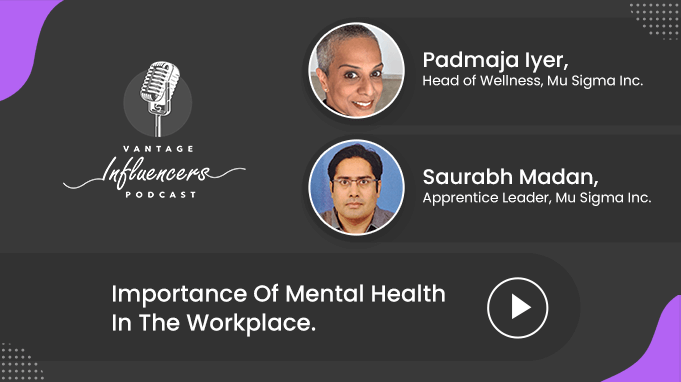
Importance Of Mental Health In The Workplace
Episode Overview
Padmajaa Iyer and Saurabh Madan spent this conversation making the case that workplace wellness is bigger than crisis response. Padmajaa argued that most organizations only start talking about mental health once a situation has already spiraled, when the real opportunity is to treat wellness as an everyday practice across the physical, emotional, and social dimensions of life. She traced how the pandemic did not create these needs but simply forced people to confront things they had been taking for granted, from social connection to a basic sense of security, and why that resistance to sudden change is what fuels so much anxiety and stress. Saurabh added a structural lens, pointing out that awareness alone means little without an organization willing to invest in real expertise rather than borrowing off a generic checklist of programs.
Both speakers walked through what it actually takes to build a program employees trust. Padmajaa described how having an in-house, dedicated person build relationships with employees, rather than routing them to a distant counseling hotline, is what gets people past the fear of being judged for asking for help; she pointed to how mentoring session numbers grew more than tenfold once people felt the space was genuinely safe. Saurabh framed policy creation as the other half of the equation, suggesting regular forums where employees can openly discuss both technical topics and wellness so that visibility itself signals organizational acceptance. Together they outlined a four-pillar approach, physical, mental, emotional, and social well-being, as a foundation any company can build from, regardless of where it starts.
Episode Highlights
- Padmajaa Iyer traced her personal recovery from a serious illness to the mindfulness and meditation practices that eventually shaped the wellness program she helped build.
- She argued that wellness is a broader, everyday process of building a fulfilling life, not just crisis intervention once mental health has already declined.
- Saurabh Madan pointed to Maslow's hierarchy of needs to explain why emotional and social needs surface more sharply once basic physical needs are met.
- Both guests agreed the pandemic did not create new needs, it simply forced people to confront things like social connection and security they had been taking for granted.
- Padmajaa described how building trust through a dedicated, in-house wellness contact helped mentoring session numbers grow more than tenfold within a year.
- Saurabh outlined a four-pillar wellness model, physical, mental, emotional, and social, that any organization can adapt regardless of where it starts.
About the Guest
Padmajaa Iyer, Conscious Living Coach and Head of Wellness, Mu Sigma Business Solutions
Padmajaa Iyer is a Conscious Living Coach and the Head of Wellness at Mu Sigma Business Solutions, one of India's first home-grown Unicorns. She has over two decades of experience in her practice and has trained extensively under the tutelage of some of the luminaries in the field of Conscious Living. She is the founding member of the Wellness Program at Mu Sigma.
Connect with Padmajaa on LinkedIn.
Saurabh Madan, Wellness Team, Mu Sigma
Saurabh Madan is a Computer Engineer by training and worked in the industry for 14 years for companies including Microsoft Corporation and Salesforce.com. In 2015, he transitioned into teaching courses on ethical goal setting and mindfulness. Since 2019, he has been an Apprentice Leader on the Wellness Team at Mu Sigma Inc. and teaches courses on mindfulness and leadership development.
Connect with Saurabh on LinkedIn.
Host
Rohit, Vantage Influencers Podcast Host
What You Will Learn
- Why wellness should be treated as an everyday, four-pillar practice rather than a reaction to a crisis.
- How the pandemic surfaced pre-existing emotional and social needs rather than creating new ones.
- What it takes to build employee trust in a wellness program, and why a dedicated in-house contact matters more than a hotline.
- How to destigmatize mental health conversations through policy, communication, and visible forums.
- Why investing in real wellness expertise matters more than borrowing a generic checklist of programs.
- How to structure a wellness program around the four pillars of physical, mental, emotional, and social well-being.
Key Topics & Timestamps
| Timestamp | Topic |
|---|---|
| 00:11 | Introduction to the guests and the episode topic |
| 01:04 | What sparked Padmajaa's interest in wellness |
| 05:03 | Causes of mental health issues and COVID-19's impact |
| 08:52 | Incentives companies should offer to address wellness |
| 12:17 | Destigmatizing mental health and policy creation |
| 18:04 | How to set up a wellness program |
| 22:36 | Favorite business books |
| 24:14 | HR leaders they admire |
| 26:24 | Advice for young HR leaders |
| 28:25 | Preview of the upcoming wellness webinar |
Full Transcript
Click to read the full episode transcript
Welcome to the Vantage HR Influencers Podcast. This podcast is sponsored by Vantage Circle, the leading employee benefits and engagement platform.
Rohit: Hi everyone, this is Rohit from the Vantage Influencers Podcast. Today I'm excited to have two guests who are subject matter experts on wellness. We have Padmajaa Iyer, who is the Head of Wellness at Mu Sigma Business Solutions. She built the wellness program there over a period of three years and now also works independently, consulting on setting up corporate wellness programs. We also have Saurabh Madan, who trained as a computer engineer and worked in the industry for 14 years for companies including Microsoft and Salesforce. In 2015, he transitioned into teaching courses on ethical goal setting and mindfulness, and since 2019 he has been a member of the Wellness Team at Mu Sigma, focusing on teaching mindfulness to teams at the company. In this session, we'll talk about the importance of mental wellness in the workplace. Welcome to the show, Saurabh and Padmajaa, it's a pleasure to have you.
Saurabh Madan: Thank you, Rohit.
Padmajaa Iyer: Thank you.
Rohit: So, what got you excited about wellness, and what drew you into this particular field?
Padmajaa Iyer: I was living in a beautiful valley for about 19 years, and that was a defining time in my life when I went through a lot of ups and downs. There was a point when nothing was working in my life, and I was also diagnosed with a degenerative disease. The doctors told me I didn't have much time left, and I had two little children to take care of at that point, around 22 years ago. That was a wake-up call for me, and I decided I had to make things happen. I just couldn't give up so easily. Ever since then, my life has been a series of what I'd call miracles, though they don't feel like miracles anymore because our days are full of them. If you look at the dictionary, a miracle is defined as an unusual, mysterious event thought to be caused by something beyond the usual laws of nature. That is exactly what happened in my life. Once I decided I was not going to give up, I was presented with situations, people, and opportunities that brought me to the point where I'm now completely free of that illness. I recently went for a checkup, and the doctors could find no trace of the disease in me. That happened because of everything I went through, not just physical health, yoga, and nutrition, but also meditation and mindfulness practices that addressed the root causes of the problems I was facing, many of which were tied to belief systems we develop since childhood. All of this together created what felt like a completely new me, and I thought that if this could happen to me, it was something I had to share with people. Before I came to Bangalore, I worked as a freelancer, conducting sessions for people across different segments of life and all ages, school children, college students, professionals, business owners, older adults, and people navigating relationships. I saw that the teachings I had received from my own teachers were making a real difference in people's lives. That was around the time the CEO of Mu Sigma reached out to me, three years ago, and asked if I would come teach the employees of his organization about mindfulness and how to apply it. The population at Mu Sigma is largely in the 22 to 27 age group, and he felt it would be wonderful to introduce them to these practices, especially since he himself practices mindfulness and yoga and had experienced his own transformation because of it. That's how I ended up in the corporate world, and it's been a beautiful journey ever since, getting to experiment with everything I had learned.
Rohit: That's a very interesting insight. Wellness has become especially important in the post-COVID world. What do you think are the causes of mental health issues, and why does this need to be addressed now?
Saurabh Madan: It's always been important, but COVID accelerated something that was already going to happen. If you look at the trends, and we'll share some of what we saw in our own company around openness on these topics, it was coming regardless. I grew up in the 80s and 90s, we didn't have cell phones until I was a teenager, and the internet wasn't as ubiquitous. We also had more physical challenges back then, transport systems and infrastructure weren't what they are now. As those physical challenges have eased in our environment, and if you look at Maslow's hierarchy of needs, once physical needs are met, emotional needs naturally come into focus as you move up the hierarchy. That's why these issues have become especially important for younger generations. What COVID did was intensify needs that already existed. Any major shift in people's lives brings these things to the surface, and the shift caused by lockdowns did exactly that. It's not that the need wasn't there before, Mu Sigma, being a fairly forward-looking company and India's first unicorn, had that foresight already, which is how Padmajaa came in and got this started. What do you think, Padmajaa?
Padmajaa Iyer: Absolutely. People tend to talk about mental health only in the context of wellness, but wellness is actually a much broader subject. It isn't just about addressing a situation once it's already spiraled downward. Wellness is an active process of becoming aware and making choices toward a healthy, fulfilling life across many aspects of life. It's more than the absence of illness, it's a dynamic process of growth and change toward complete physical, mental, and social well-being, not merely the absence of disease. COVID came as a shock to many people because their focus had never really been on overall well-being, just on exercising, eating, and performing at work. We took our social connections for granted, we took having a roof over our heads for granted, we took the things we should be grateful for, for granted. So many aspects of life were being ignored, and this period forced people to confront them. That's part of why there's a resistance to change, and that resistance is what's driving a lot of the anxiety and stress we're seeing. Wellness, at its core, is about introducing a completely new way of looking at life.
Rohit: So what incentives should companies offer to address this, especially during COVID? We've had a lot of guests talk about different incentives, but what should a long-term approach look like so the issue doesn't spiral further?
Padmajaa Iyer: What I think is missing from this whole equation is empathy. Companies are trying their best, offering work from home, support systems, and so on. Speaking for Mu Sigma specifically, we gave people access to extra counseling, connected them to resources, and created programs around team building, team bonding, and fun activities. But the real long-term step is not waiting for a crisis to take action, it's building these practices into the foundation of the organization as part of the wellness or employee assistance program from the start. Organizations should recognize that a human being is capable of being far more productive for the company when given the space to take care of everything else going on in their life. People spend most of their day at work, but they may be struggling in their relationships, their health, or with a loved one, and these things often go unspoken because of the fear of being judged. Creating a safe space, a safety net, so employees feel comfortable being open about these issues allows the company to actually help them, so they can be at their best and contribute the way the organization needs them to.
Saurabh Madan: I'd add one thing here. Where companies really need to invest is in expertise. You can do a Google search and find a list of programs, but knowing what actually applies, how much to do, when to stop, how to build it up, that's sophisticated. If you want a real return on the effort, you need an expert, internal or external, who knows how to do this in a way that actually benefits people.
Padmajaa Iyer: That's exactly something companies should be paying close attention to.
Rohit: That's very well put. There's also been a recent, high-profile incident in the entertainment industry that's brought attention to this. What have you seen over the last five years around mental health issues catching up, especially in corporate India, where both spouses are often working and nuclear families are more common? What can an HR manager do around policy creation, communication, and training resources to help destigmatize these issues, and what does early intervention for employees look like?
Padmajaa Iyer: When I joined the company, I saw this was an area with a huge gap, so I started building connections with employees. That's why it's important for an expert to be present in an organization, as Saurabh mentioned, someone dedicated to that space who builds a real connection with people so they feel free to come talk. Just having an employee assistance program on paper doesn't mean people will use it, because there's a fear of being judged, a fear that their performance will somehow be evaluated based on whether they visit a counselor. But when there's an in-house expert who's part of the organization, building relationships through regular interactions, sitting in on meetings, listening to people, I could notice, for example, someone brilliant who was struggling with public speaking, and reach out, hold their hand, and walk them through it in an empathetic way that builds their confidence. Letting them know I'm interested in them, not just the numbers, is what matters most to me.
Rohit: To address the two things you both touched on, destigmatization and policy creation, let's talk about destigmatization first. I won't comment on the specific entertainment industry case since the full story is still unclear, but in terms of destigmatization, what have you seen at your company?
Saurabh Madan: Our company has a fairly young demographic, employees around their mid-20s, and they're actually quite open, even willing to talk about these things in team meetings. To give you some numbers we'll also cover in the webinar, the first year Padmajaa started these mentoring sessions was around late 2017, we had about 40 or 50 sessions. But as people realized this was a safe space to express themselves, and once Padmajaa was introduced by the company's CEO, the next year we had more than a thousand sessions. That shows people lost their fear. What matters here is that the role of an expert is to build a relationship, not a transactional one where you just book a session through a portal. When there's an ongoing presence, it's not about talking to a counselor, it's about talking to Padmajaa, someone who's been there for two or three years and has built the expertise to know when workload is high and what kind of support a person needs. People do check in and ask if it's really anonymous, and once that trust builds, that openness starts to spread through the organization. On policy creation, in addition to having someone in a role like Padmajaa's, it doesn't have to be a formal head of wellness position, it could be someone respected in the learning and development function. You want to create forums where people, especially younger employees, can express themselves. We have two such forums, one is a Friday learning hour that's generally skewed toward technical topics, people present things like what they've learned about artificial intelligence, and it's well attended. We also started a Wednesday wellness workshop that covers wellness topics including mental health. Creating these forums on a regular cadence brings visibility to the organization's openness and commitment to doing right by this space. Those are some examples, though it will vary by organization.
Rohit: How should a company go about setting up a wellness program for their employees?
Padmajaa Iyer: We can describe this briefly, though people who attend the webinar will get the full plan. The basic thing is that the organization has to be genuinely interested in the well-being of its employees. If they want the company to grow, attrition to drop, productivity to improve, and absenteeism to go down, they need to recognize that there's more to a human being than their contribution to the company, there's family, health, and many other aspects of life, and the organization needs to be able to say, I see you, and I'm here for you. That intent matters most. Next is identifying someone in the organization who can take on that role, someone who can build relationships and has a genuine interest in people's well-being, whether from leadership, learning and development, or anywhere else, someone who can build rapport so employees feel comfortable connecting with them. Then it's about implementing the program step by step, starting with the basics, creating awareness first, because in most corporate environments the thinking tends to be very logical, people want to see that two plus two equals four. But with these practices, a lot happens that isn't immediately visible, the results show up over time. So you create awareness of why it matters to invest a few minutes each day in your physical, mental, emotional, and social well-being, then build it out team by team, spreading it through networking and other initiatives, and gradually scale up the programs. To give you a glimpse of our approach, our program is based on four pillars, physical, mental, emotional, and social well-being, with programs addressing each of those areas.
Saurabh Madan: Building on what Padmajaa said, maybe your organization isn't ready yet for a full wellness engagement, but most organizations today have already opened up to at least one of these four pillars. You might have a gym membership, or if mental health is already accepted, that's a strong foundation. There are leadership development programs that touch on emotional well-being, not as deep as what a dedicated wellness practitioner would run, but still valuable, and almost every organization runs social events. If you can teach teams how to build a good social fabric, which drives productivity, your organization likely already has some expertise or openness somewhere, and that's the place to start. As you build influence within your organization, you can expand from there.
Rohit: What's your favorite business book?
Padmajaa Iyer: My favorite business book is Tribe of Mentors, compiled by a well-known author who put together eleven questions and asked them of a wide range of people from different fields around the world. I love the way it's collated, because these are genuinely important questions people can ask themselves. I've actually used these questions across our organization, and it opened up the minds of our younger employees to think more deeply about these points. I'd highly recommend it.
Saurabh Madan: One book I read recently was Phil Knight's memoir about building Nike. It's easy to look at a hugely successful company like Nike and assume they had it all figured out from the start, with all the right advertising and strategy. But this was such a real, honest story, the kind that gives you goosebumps. This is a guy who stored shoes in his parents' house for more than a year, and you see the real story of entrepreneurship behind it. It builds a lot of empathy for even the biggest corporations. I really loved that book.
Rohit: I'll put both of those in the show notes. Do you follow any HR leaders or CEOs that listeners should also follow?
Padmajaa Iyer: I can't speak to too many exceptional HR leaders specifically, since my experience has been limited to a few companies. But I'm inspired by the founder of a well-known personal-growth organization, and I really admire the way he runs it. I've been part of some of his programs, not as an employee, and I've seen how he takes care of his people and the genuine bond he has with them, along with his core belief in building human-centered businesses. That empathy is very much alive in what he does, and I find him really inspiring.
Saurabh Madan: At our company, there are a few towering figures people often talk about for their various qualities. But personally, I have a lot of admiration for a former President of India, mainly because of his sense of mission. He and his team were behind a landmark scientific and engineering achievement for India back in the 1950s, and while the exact timeline is a separate discussion, the sheer accomplishment stands out. Look at India's space research organization, its engineers could easily be recruited anywhere in the world, even NASA could match those salaries, but somehow that organization built a culture where, decade after decade, it kept making the country proud, in both its successes and its failures. I really look up to him and the line of leaders who built that organization.
Rohit: Do you have any piece of advice for young HR leaders who are just graduating in a difficult time, or already stepping into the field and trying to become HR leaders?
Padmajaa Iyer: I could start with my own son, who's in the final year of his MBA in HR. What I'd tell him, and this generation of emerging HR leaders, is to let everything you do come from a place of genuine concern for the people in your organization. Don't let it be just about numbers and growth, remember that at the end of the day we're human beings with hearts, and the goal is to move decisions from the head to the heart.
Saurabh Madan: We have some very bright, idealistic people at our company who genuinely want to do good, especially this newer generation, and I'd tell them that these things take time. It's like turning a large ship, it doesn't happen overnight. Just because you're not immediately able to make your organization the most idealistic company on earth doesn't mean you're failing, take small wins, protect your idealism, and build influence gradually until you're in a position to really shift things. Be patient, it takes time to grow. Ultimately, look at your work as a mission, not just a series of tasks, something you'll keep doing throughout your life if you're genuinely passionate about this field.
Rohit: That's really nicely put. Before we wrap up, can you share a bit more about the upcoming webinar on the 27th of August, and what people can expect?
Padmajaa Iyer: It'll be a deeper dive into some of the things we touched on here. We'll talk about our respective journeys, how the program was built out in our ecosystem, share some numbers on how things grew, go through the four pillars we briefly mentioned, and talk about how to use data and research to help convince people. We'll also do at least one live exercise, something that tends to convince people immediately in my experience. My hope is that since this is still a relatively new idea in my part of the world, even though I know the wellness space is much further along internationally in other regions, the sooner companies here catch on, the better the return on investment will be. If we can offer some expertise and starting steps, I think that's a meaningful contribution.
Saurabh Madan: We'll also share some visuals during the program, along with an exercise that gives an instant sense of how these practices can improve focus and productivity.
Rohit: We'll put the webinar link in the show notes. Looking forward to hosting both of you at the webinar on August 27th. How can people reach out to you both?
Padmajaa Iyer: They can get in touch with me through my website, padmajaa.com.
Saurabh Madan: You can connect with me on LinkedIn, just search for my name along with Mu Sigma and you should be able to find me. I'll share all these links in the show notes.
Rohit: Thank you so much for taking the time to speak with us.
Saurabh Madan: Thanks a lot, Rohit, great questions, and good luck.
Padmajaa Iyer: Thank you, Rohit.
Thanks for listening to the Vantage HR Influencers Podcast. Subscribe to the Vantage HR Influencers Podcast on Apple Podcasts and Spotify for new episodes.
FAQ
What is workplace wellness, according to Padmajaa Iyer and Saurabh Madan?
They describe wellness as an active, everyday process of becoming aware and making choices toward a healthy, fulfilling life across physical, mental, emotional, and social dimensions, not just an intervention that kicks in once a mental health issue has already spiraled.
Why did mental health become a bigger workplace priority during COVID-19?
The pandemic did not create new needs, it accelerated ones that already existed. Any major disruption in people's lives brings emotional and social needs, which sit above basic physical needs on Maslow's hierarchy, into sharper focus, and lockdowns forced people to confront things like social connection and security they had previously taken for granted.
How can companies destigmatize mental health conversations at work?
Both guests point to building trust through a dedicated, in-house wellness contact rather than a distant hotline, and to creating regular, visible forums where employees, especially younger ones, feel safe discussing wellness openly alongside other workplace topics.
What are the four pillars of a workplace wellness program?
Physical, mental, emotional, and social well-being. The guests recommend starting small, building awareness team by team, and scaling gradually rather than trying to launch a full program all at once.
Related Reading
Also listen on