Internal Employer Branding and Employee Engagement
Episode Overview
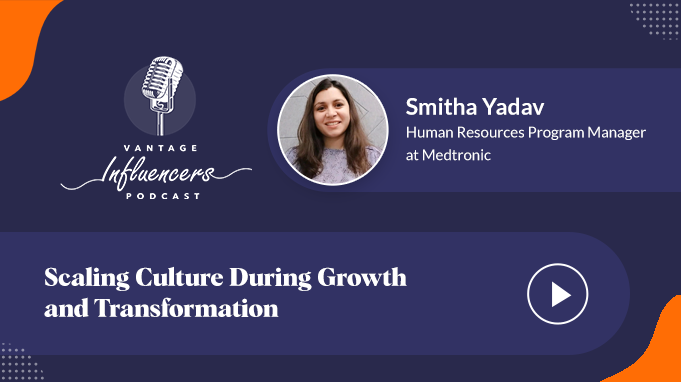
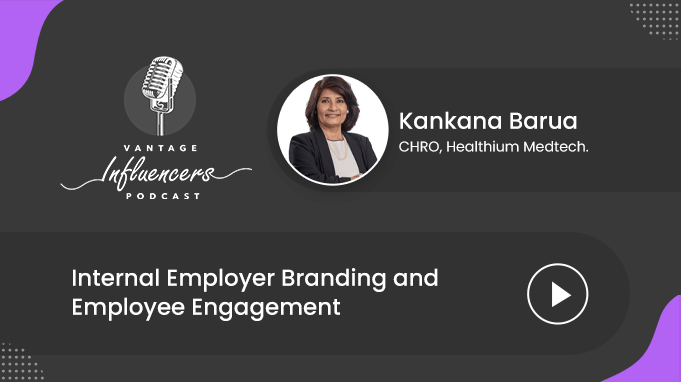
In this episode of the Vantage HR Influencers Podcast, host Susmita Sarma talks with Kankana Barua about what it actually took to keep a medical device manufacturing workforce engaged through the most uncertain months of the pandemic. Kankana describes standing up a dedicated task force staffed by in-house doctors, who became informal counselors not just for employees but for their families and even their friends, walking anxious callers through basics like oxygen saturation readings and when a symptom warranted a hospital visit. She recounts how manufacturing floor workers kept showing up in person because the mission felt urgent and personal, and how the sales team, among the first to walk back into hospitals once lockdowns lifted, built in new rituals like an immediate shower and separate laundry before anyone came near their families at home.
Kankana also gets candid about vaccine hesitancy, explaining that the messaging that worked was never about points or prizes; it worked because it centered on protecting spouses, children, and entire villages back home. From there, the conversation turns to what she expects from employer branding in the year ahead. She argues that flexibility has stopped being a perk and become a baseline expectation, forcing leaders to build a genuine culture of trust rather than a policy of surveillance, and that organizations need to invest as much in employees' emotional and social resilience as in their technical skills. She is especially pointed about a blind spot in her own field: job postings that quietly exclude candidates over 40 or without a degree from a handful of elite institutes, which she calls a failure of diversity and inclusion that has nothing to do with gender.
Episode Highlights
- Kankana Barua describes building a COVID task force staffed by in-house doctors, who became informal counselors for employees, their families, and even their friends outside the company.
- Sales representatives kept visiting hospitals in person throughout the pandemic, and leadership added rituals like an immediate shower and separate laundry to protect their families once they got home.
- Vaccine hesitancy eased once the messaging shifted from points and incentives to protecting employees' families, friends, and entire villages back home.
- She traces the roots of the Great Resignation to a generational shift where flexibility is no longer a perk but a baseline expectation, pushing companies to build a real culture of trust.
- Kankana argues that 2022's employer branding trends center on strengthening employees' emotional, social, and adversity quotients, not just their technical skills.
- She calls out hiring practices that filter out candidates over 40 or without degrees from elite institutes, calling it a blind spot in diversity and inclusion that has nothing to do with gender.
About the Guest
Kankana Barua, CHRO, Healthium Medtech
Kankana Barua leads HR at Healthium Medtech, where she has driven a culture of diversity, equity, and inclusion and guided the company through the cultural integration of three acquisitions in 2021. She founded the Women's Alliance for Voluntary Engagement (WAVE) to improve gender diversity ratios within the organization. During the pandemic, she led the HR function in keeping manufacturing facilities safely operational under strict safety protocols and stood up a dedicated COVID task force to support employees' physical, mental, and financial well-being. Before joining Healthium, she was Chief People Officer at Tally Solutions. She holds degrees in law and human resources and is an Associate Member of the Institute of Company Secretaries of India.
Connect with Kankana on LinkedIn
Host
Susmita Sarma, Vantage Influencers Podcast Host
What You Will Learn
- How a COVID task force staffed with in-house doctors can extend support to employees, their families, and their wider community during a health crisis.
- Why frontline and manufacturing workers who kept showing up in person needed more than gratitude, they needed rituals that protected their families too.
- How to address vaccine hesitancy by appealing to family and community safety rather than transactional incentives.
- Why flexibility has shifted from a workplace perk to a baseline expectation since the Great Resignation.
- How strengthening employees' emotional, social, and adversity quotients builds a stronger connection to the organization.
- Why age and educational pedigree requirements in job postings can undermine a company's diversity and inclusion goals.
Key Topics & Timestamps
| Timestamp | Topic |
|---|---|
| 00:12 | Podcast introduction and sponsor message |
| 00:53 | Introducing guest Kankana Barua |
| 01:05 | Kankana's career journey and what keeps her motivated |
| 03:31 | Leading HR through a mission-driven medical device manufacturer |
| 03:40 | Keeping hospitals supplied with essential devices during COVID |
| 07:10 | Employee engagement challenges during the COVID-19 pandemic |
| 16:20 | Employer branding trends for 2022 |
| 23:57 | Kankana's closing thoughts on staying prepared |
| 26:28 | How to connect with Kankana |
Full Transcript
Click to read the full episode transcript
Welcome to the Vantage HR Influencers Podcast. This podcast is sponsored by Vantage Circle, the simple and AI powered rewards and recognition platform for employee engagement.
Susmita Sarma: Hi everyone, I'm Susmita, your host for the show, welcoming you back to a brand new episode. Because there is a certain level of unclarity and doubt about what internal employer branding is and how it promotes employee engagement, we thought it was the right moment to go back to the roots of employer branding. So this episode of the Vantage HR Influencers Podcast is dedicated to HR directors and HR managers who wish to understand the relevance of employer branding, and it's likely to explain to us why it makes sense to own a great internal employer branding strategy. For the same, please help me welcome Kankana Barua, the CHRO at Healthium Medtech. Hi Kankana, welcome to the show.
Kankana Barua: Thank you, thank you, Susmita. Thank you so much for having me today.
Susmita Sarma: And we'd like to know a bit about you and what keeps you motivated these days.
Kankana Barua: So, as the name says, I'm Kankana Barua. I come from the Northeast, and that's why I was very excited to be talking with someone from the Northeast as well, especially since one of your co-founders has roots in Guwahati. My own roots are strong there too, I was born and brought up in the Northeast, and my intent is to go back there eventually, after my active corporate life. It feels good to see that Vantage Circle carries that connection to Guwahati. It only signifies that the Northeast is speeding up and gearing up alongside the rest of the country, and I'm very proud of that.
So briefly about me: by qualification, I'm a company secretary and a law graduate. However, I chose to be an HR professional, and I've led HR functions at several companies, starting with Jubilant, then as Chief People Officer at Tally, and finally at Healthium Medtech as the group CHRO. The reason I joined Healthium is that its vision is something very close to my heart: getting precise medical devices to patients globally. That vision motivated me to move into a manufacturing setup, and it has been a complete package of opportunity for a CHRO. I've been here for three years now, and it's been a wonderful journey.
That's briefly about my professional career. Personally, I'm married with two kids. One of them works abroad, and the other is currently a medical student.
Susmita Sarma: During the COVID era, when it was at its peak, you were with Healthium, right?
Kankana Barua: Yes, yes, very much.
Susmita Sarma: So please tell us more about Healthium and how you've been constantly improving hospital experiences with world-class products.
Kankana Barua: So to start with, March 2020 was a period where the whole world saw a drastic change. What motivated us, and I feel very proud looking back, is how we came through as a company in the medical device space. We were considered an essential commodity because we support hospitals for any kind of surgery, be it implants, sutures, or needles. When we fall sick, we need a hospital to take care of us when we can't take care of ourselves at home.
So COVID was a massive challenge for us at that point, not knowing what was going to happen. After the first fourteen-day lockdown, we had to ensure people came back to their workplaces. When the whole world was literally shut, we started working again within about two weeks of that first lockdown. It was a huge task to get people to come forward and show that we could keep manufacturing what hospitals required, and to help people combat the fear of the unknown that all of us had.
I think our people turned out to be brave COVID warriors, even though they weren't at the hospitals themselves. The fact that they came to work every single day, from the shop floor up to the CEO, speaks to the kind of dedication, ecosystem, and value system in our company's vision that carried all of us through that unknown situation, and through the fear for our own lives. As a leader and as a company, I can't thank enough every person who worked with us during that time, and their families, for supporting us.
Susmita Sarma: Honestly, Kankana, without you and organizations like yours, this whole struggle with COVID would have been so much harder. Thank you, and salute to all of you.
Kankana Barua: Thank you very much. We did nothing extraordinary, but that thanks definitely goes to every person associated with us, whether a contractual worker or a permanent one, all the way up to our manufacturing teams and our sales teams. A big salute to the sales team especially, they were the first to reach out to hospitals, without fear for their own lives. They went out and did whatever was required. So yes, we've definitely done our bit for the country and for the world at large.
Susmita Sarma: Moving to today's topic, Kankana, most managers in the healthcare sector would say enhancing patient engagement is the top priority, but they forget about employee engagement, which is linked to factors like employee satisfaction, turnover, and absenteeism, and these matter just as much in the medical sector as in any other. So during the COVID-19 pandemic, what employee engagement challenges did you face, or are you still facing, as CHRO at Healthium?
Kankana Barua: I'll answer this in two parts, because the challenges associated with the manufacturing setup, where people actually come to the plants, are slightly different from the challenges in the corporate office and the sales force.
Let me start with manufacturing. During COVID, people had to come to the plant, from the plant head to the manufacturing supervisors to the workers, and the biggest challenge was the fear of the unknown and getting them motivated to come to work every day. The one thing we kept telling them was to remember that we were trying to save patients, that they were COVID warriors too. You don't have to be a doctor or a nurse to be a COVID warrior. Framing it that way, and connecting it back to our vision statement, to how we were contributing to patients' welfare across the world, kept motivating people. That constant touch, motivation, and connection with each individual was the biggest challenge, and also the biggest opportunity.
One of the best things we did, and I wouldn't even call it employer branding in a strategic sense, it came from a purely humanitarian standpoint, was setting up a COVID task force. This was a team of doctors working alongside HR and all our leaders to figure out what we needed to do to ensure safety, and to make sure people weren't skeptical or worried about what would happen if something went wrong. So on top of the practical comfort of things like term insurance and enhanced medical coverage, this task force of doctors also became informal counselors, supporting all our employees mentally, and we didn't restrict that to employees alone. We opened it up to their families too, and even friends. I personally connected friends to the task force so they'd understand things like when to seek hospital attention, or how to read an oxygen saturation reading, these were all new concepts for people at the time. Having that come from an actual team of doctors was probably one of the best things we did. It gave people confidence and comfort, and that emotional support for employees and their extended families is what got us through.
On the sales side, our sales force was the first group who actually had to go to hospitals. I can only imagine how it felt to walk into hospitals, deliver the supplies doctors needed, and do that every single day, then come home to their families. Our sales leadership reinforced daily habits with them: things as basic as taking a shower and washing their clothes immediately, and double masking, before doing anything else once they got home. That constant reinforcement, for a sales team moving across the entire country to hospitals, including some of our more remote locations, was one of the real challenges, but we managed it well. It wasn't easy, because everything was unknown: getting an emergency pass just to go into the office, figuring out which authorities to coordinate with, then social distancing on top of that. It's fantastic looking back on it now, and honestly, just talking about it brings all those memories flooding back.
Susmita Sarma: Very true, I can feel that too.
Kankana Barua: Yes, things like going to the police station to get passes for people, sanitizing those passes morning and evening, so many things happened, and it feels good that we've come this far, and that the world is slowly returning to normal.
The next challenge after that was convincing people to take the vaccine, because not everyone was ready to. We wanted to encourage it, but not by offering points or some kind of recognition for getting vaccinated, the way I heard some companies were doing. What we did instead was center the conversation on their families, their villages, the places where our plants are, and how vaccination would protect not just them, but their families, friends, and the wider community. That was another initiative we took very seriously, with a lot of collective effort.
Susmita Sarma: Brilliant. Kankana, all of this comes with real fear for your own life and your family's. That deserves a lot of applause.
Kankana Barua: I have to say, those of us in the corporate office, myself included, were in some ways protected, because our roles allowed us to work from home. But we always carried a bit of guilt about that, knowing the rest of our people were going in to work. So as much as possible, our COVID task force doctors identified risk factors too. I couldn't risk sending my CEO or CFO into work, since they needed to keep running the company. So we made sure our top leadership worked from home, while the task force doctors themselves went out, visited every plant, and spoke to everyone in person. I can't take away credit for the bravery shown by the people in our organization.
Susmita Sarma: Right. And Kankana, now that the COVID curve isn't rising the way it was, do you see any new employer branding trends for 2022, especially while dealing with these unforeseen circumstances?
Kankana Barua: Yes. 2021 was what people are calling the year of the Great Resignation, and honestly, the scale of resignations last year caught a lot of companies off guard. Speaking not just from a healthcare perspective but as an HR leader across sectors, whether IT or manufacturing, wherever you have a large Gen Z workforce, one of the challenges is that people are no longer willing to just come back to the office; they choose companies willing to give them flexibility.
So there's a huge shift in culture that companies have to adapt to if they want to retain the best talent: a culture of flexibility. And flexibility really comes down to a culture of trust. That trust has to be extremely high, because expecting people to be physically present in the office instead of offering them the flexibility to work from home is a big mindset shift leaders have to embrace going forward.
It's genuinely hard to predict every challenge we'll face through 2022, but building on the Great Resignation, flexibility to operate is going to be extremely important. And within that flexibility, the challenge becomes: how do we keep people connected? How do we keep them motivated, while still helping the business bring innovative products to patients? That's specific to Healthium, but I think it's a challenge the entire HR fraternity, and company leadership more broadly, is going to face.
Some of the trends I foresee for the coming year: enhancing the overall experience of people, whether they're working remote or from the office. Focusing more on emotional quotient and social quotient, and also on what people are calling adversity quotient. When you take up initiatives around these, particularly adversity quotient and emotional quotient, it naturally strengthens people's connection to the company. I think that emotional connect, giving people flexibility, giving them a good experience, is one big trend. And alongside that, working seriously on diversity and inclusion.
When I say diversity and inclusion, I don't just mean gender diversity, or including people who are differently abled. There's also a huge talent crunch right now, and to connect the dots, our approach to talent acquisition and recruitment needs a paradigm shift. We can no longer put out job requirements that say candidates should be under 40, or only from premier institutes. Honestly, I cringe when I see these kinds of requirements coming from our own HR fraternity. Why should that be a bar, when a person is capable, has a sharp mind, and the right experience? A premium institute helps when you're hiring someone early in their career, but once a person has real experience, once they've mastered a particular skill or technology, why draw that distinction? Personally, I would never put out a job description looking for someone with ten or twelve years of experience that also insists on a background from a top-tier institute. If we're serious about diversity and inclusion, let's start there. It's not just about gender, or disability, or people from a defense background; it's also about being inclusive of people from different age brackets, different levels of experience, and different educational backgrounds. I think that's going to be one of the bigger shifts in the coming months, because companies, especially in tech, are already struggling to find opportunities and are losing good talent as a result. Companies need initiatives here that also become an internal branding signal to their existing employees, showing that the company has moved past its traditional, narrow approach to hiring and looking after people. I've already seen several companies doing this. And going forward, alongside employee retention, focus on recruitment and talent acquisition is going to be one of the biggest priorities for CHROs everywhere.
Susmita Sarma: Thank you, Kankana, for everything you've shared today. Is there anything you'd like to add to close out this episode?
Kankana Barua: The pandemic isn't over. It's still here, and we don't know what turn it might take in the next six or seven months. But staying positive, as the virus continues to mutate, its strength should only weaken over time. At the same time, we still don't know exactly what's ahead of us from a pandemic standpoint, and that only reinforces that we need to be prepared for the unforeseen.
Right now, we need to build a culture of trust and a culture of flexibility, and figure out how to bring in innovation through digital and virtual connections, and in-person presence wherever possible, because no technology can fully replace the impact of a personal connection. At the same time, we have to work around that and enhance the human values that sit above and feed into a company's values. We need to be mindful about building a value system in the company where every prospective and current employee can connect their personal values with the company's values. That integration is incredibly important, and I think it's the mantra for all of us to succeed in the months and years ahead, until the pandemic truly ends.
Susmita Sarma: Indeed. Well, that's a perfect way to end this conversation, Kankana. I really enjoyed speaking with you. Would you like to share how our listeners can reach out to you? They might want to follow you on social media and learn more about your work.
Kankana Barua: I'm on LinkedIn and Facebook. I'm very active on social media, particularly LinkedIn, and I'm reachable anytime.
Susmita Sarma: I'll put the link to your profile in the show notes.
Kankana Barua: Absolutely, no problem. I'd be more than happy to share my experiences, or offer suggestions or help to anyone who needs it. I'm always open to that.
Susmita Sarma: As we wrap up, Kankana, thank you so much for joining me today and for your time. I'm sure our listeners will enjoy hearing about the work you've been doing. So thank you once again.
Kankana Barua: Thank you very much, and thank you to the entire team at Vantage for having me here. I really enjoyed being part of it, and once again, cheers to the Vantage team, especially coming from the Northeast. Thank you, and good luck to the Vantage team.
Susmita Sarma: Thank you, Kankana.
FAQ
What was the COVID task force that Kankana Barua describes in this episode?
Kankana explains that Healthium Medtech formed a COVID task force made up of in-house doctors working alongside HR and company leaders. The task force didn't just support employees, it extended to their families and even friends, offering guidance on things like recognizing when to seek hospital care and interpreting oxygen saturation readings.
How did Healthium Medtech address vaccine hesitancy among employees?
Rather than offering points or incentives for getting vaccinated, Kankana says the company centered its messaging on protecting employees' families, friends, and the wider communities around its plants. That framing, she explains, resonated more than any transactional reward could have.
What employer branding trends does Kankana Barua expect for 2022?
Kankana points to flexibility becoming a baseline expectation rather than a perk, a stronger focus on employees' emotional, social, and adversity quotients, and a broader definition of diversity and inclusion that goes beyond gender to include age and educational background.
Why does Kankana Barua criticize job postings that require candidates to be under 40 or from elite institutes?
She argues that filtering out experienced candidates based on age or educational pedigree contradicts a company's stated diversity and inclusion goals. In her view, capability and relevant experience should matter more than which institute someone graduated from or how long ago.
Related Reading
Also listen on