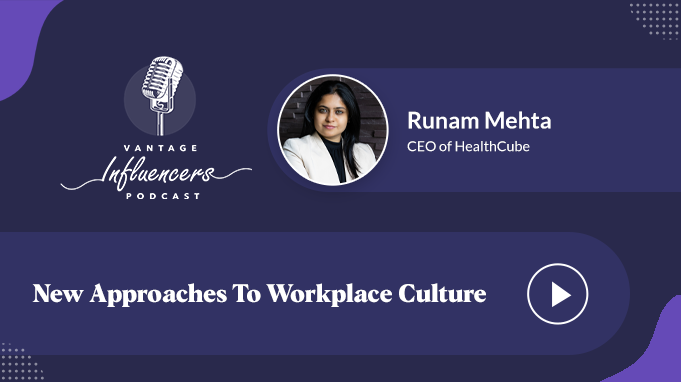
New Approaches To Workplace Culture
Episode Overview
In this episode of the Vantage Influencers Podcast, Runam Mehta joins host Susmita Sarma to unpack why workplace culture cannot be handed off to a single department. Runam pushes back on the idea that hiring a strong HR leader will fix a broken culture, arguing instead that culture is set at the top, by the small group of leaders who define what an organization actually stands for. She describes how her own team built its guiding values, integrity, respect and compassion, striving for excellence, accountability, and consistent innovation, through a full day workshop where every person in the company, including those working remotely, helped shape what those values would mean in practice. Runam also digs into what she calls cultural misfit risk in hiring: even a strong performer who clashes with an organization's values, she argues, will eventually create friction that outweighs their output, and a genuinely strong culture tends to surface that mismatch quickly.
The conversation then moves into the harder question of sustaining culture once teams stop sharing an office. Runam explains that people who show up regularly absorb culture almost by osmosis, simply by watching how leaders behave, while remote employees need it made explicit through consistent feedback, honest conversations about acceptable and unacceptable behavior, and visible vulnerability from leadership itself. She shares her own habit of openly telling her team when she is stepping away for a sick child or to recharge, and explains why that transparency builds the trust that lets employees be honest about their own needs in return. Looking ahead, she predicts workplaces will keep pushing toward deeper inclusivity, more women in senior roles, a more structured approach to hybrid work, and greater openness to employees pursuing passions or income streams outside their day job.
Episode Highlights
- Runam Mehta argues that workplace culture must be defined and modeled by an organization's top leaders, with HR acting as a custodian of culture rather than its owner.
- Her team of 45 people built their core values together in a single full day workshop, then anchored recognition and accountability directly to those values.
- A "cultural misfit," in her framing, is someone whose way of operating clashes with the organization's values badly enough that friction eventually outweighs even strong individual performance.
- Fully remote employees can't absorb culture just by watching leaders in person, so it has to be made explicit through regular feedback and clear signals about acceptable behavior.
- She credits her own openness about personal needs, like stepping away for a sick child, with building the trust that lets her team be honest about their own limits.
- Looking a decade out, she expects deeper inclusivity, more women in senior leadership, more structured hybrid work, and wider acceptance of employees pursuing passions outside their main job.
About the Guest
Runam Mehta, CEO, HealthCube
Runam Mehta is the CEO of HealthCube, a well-funded health-tech startup in the arena of diagnostic devices. She has spent over 13 years building businesses and new sales channels in the Indian healthcare industry. Before joining HealthCube as its Chief Growth Officer and later taking over as CEO within nine months, Runam spent close to seven years at Portea Medical, India's largest home healthcare company. Her first entrepreneurial venture was as a physiotherapist, when she started a company called Work Ergonomics to raise awareness about postural problems and repetitive stress injuries affecting the working population.
Connect with Runam on LinkedIn
Host
Susmita Sarma, Vantage Influencers Podcast Host
What You Will Learn
- Why workplace culture must be defined and modeled by top leadership rather than delegated to HR.
- How one team of 45 people built a shared set of core values through a single collaborative workshop.
- What "cultural fit" really protects against, and why misfits struggle to succeed long term even as strong performers.
- How to make culture tangible for full-time remote employees who don't get to observe leadership day to day.
- Why leader vulnerability and transparency about personal needs builds the trust that keeps teams engaged.
- What workplace trends Runam expects to see over the next decade, from inclusivity to hybrid work to side hustles.
Key Topics & Timestamps
| Timestamp | Topic |
|---|---|
| 01:08 | Introducing guest Runam Mehta, CEO of HealthCube |
| 01:31 | Runam's path from physiotherapist to founder to Portea to HealthCube |
| 03:36 | Inside HealthCube's portable, offline-capable diagnostic device |
| 06:11 | Whether the pandemic changed workplace culture for the better |
| 07:05 | How HealthCube's team defined its core values together |
| 08:42 | Why culture has to be set by leadership, not delegated to HR alone |
| 12:15 | Making culture real for full-time remote employees |
| 17:12 | Predictions for how workplaces will change over the next decade |
| 21:35 | Book recommendations on workplace culture |
Full Transcript
Click to read the full episode transcript
Welcome to the Vantage HR Influencers Podcast. This podcast is sponsored by Vantage Circle, the simple and AI-powered rewards and recognition platform for employee engagement. Cultural transformation is highly needed for firms aiming to become more agile and inventive. However, developing and maintaining the long-term effects that come with change is frequently the most difficult component of a cultural transformation, and clearly, it does not happen overnight. The problem is, people generally do not understand how their work fits into the organization's mission and vision. Only about 10% of HR leaders are sure that their organizations understand their culture in the first place. That is why there is a new interest in redefining or revisiting workplace culture, in order to develop a meaningful link for your people to the work they do and the organization for which they do it.
Susmita Sarma: Hi everyone, welcome to a brand new episode of the Vantage HR Influencers Podcast. I'm your host Susmita, and today I have with me guest speaker Runam Mehta, the CEO of HealthCube, a well-funded health tech startup in the arena of diagnostic devices. Welcome to the show, Runam.
Runam Mehta: Thanks, thanks Susmita.
Susmita Sarma: It's an absolute pleasure to have you on the show today, Runam. Would you like to introduce yourself and your background before we start with the topic today?
Runam Mehta: Of course, thank you Susmita for having me here. I'm actually a physiotherapist by education. I studied physiotherapy and graduated in 2007, and I started a small clinical practice in Bombay, but very quickly moved on to my first start-up without even realizing it was a start-up. I was basically a solo practitioner doing ergonomic workshops for corporate companies for a few years in Bombay. It kind of mushroomed out of control, became much bigger than I'd planned for it to be, and it was a thriving practice, but I had to move to Bangalore for management reasons. In Bangalore, I was teaching for a while to figure out what I would like to do differently. That's when I stumbled upon Portea. Portea today is India's largest home healthcare company, but at that time it was a fledgling start-up. They were out to disrupt the home healthcare industry, organize the segment, and hired me to look after their physiotherapy business and help it grow. I was with Portea for seven years. I worked in five different roles across almost all of their medical service verticals, including their B2B strategy, their diabetes program, their elder care program, and right at the end of my tenure with them, I was looking after the home isolation program for COVID patients. HealthCube kind of happened to me. They offered me a role heading growth when I joined the organization, and about nine months into the role, the board unanimously voted me in to take over as CEO and lead the organization. So that's where I am today. It's been about ten years since I moved to Bangalore, and the city has been extremely kind to me.
Susmita Sarma: So would you like to tell us more about your role as CEO at HealthCube? You've come through the pandemic as well, right?
Runam Mehta: Absolutely. I think I should start by talking to you about HealthCube and what it is that we do. We're basically a medical device company. We've designed a multi-parametric point of care diagnostic device. What does that mean? I'm sure you're aware of home BP monitors or glucometers. These are all point of care devices in the sense that they test a specific parameter and give you the reading wherever you are, without needing to be in a specific setting to access that service. Our device runs a wide range of tests and it's literally the size of a small set of blocks, about one and a half kilograms in weight. So it's very portable. It doesn't require electricity because it runs on a power bank, and it doesn't even require an active internet connection, because we designed it for remote and rural use. We're basically solving the problem of accessibility. In our country, millions of people are not in our metro cities or tier one cities. They're spread across the country, and they have difficulty accessing even basic diagnostic systems, for a variety of reasons: it could be geographic, it could be financial, it could just be a matter of distance, and so on. Our device enables a technician, not a medical doctor, to use it. So it enables a technician to meet a patient and report on up to thirty parameters in well under thirty minutes. That's the device we have. When I joined the organization about a year and a half ago, we were just coming off the first wave of COVID, and very soon after I joined, the second wave hit. So things were obviously slow at that point. But since then, we've been able to make great progress. We're working with public healthcare systems, governments, and telemedicine companies who are looking at our devices to make telemedicine more meaningful. We're working with big CSR projects, outreach clinics, and private clinics too, helping them digitize and take their operations up a notch. So that's where we are today.
Susmita Sarma: Okay, so now talking about workplace culture, I'm sure you've seen different changes in your workplace over the last two years, isn't it? We're all seeing big changes occurring in our organizations because of the pandemic. Some of the expected long lasting changes include hybrid and remote work, increased virtual communication, increased cybersecurity, and a greater emphasis on work-life balance. So do you believe the pandemic has changed our workplace culture for the better?
Runam Mehta: I think that's a very loaded question. I think it has changed the workplace forever. Whether it's for better or worse really depends on the specific organization and how they look at their own interactions with their teams. Let me take a minute to talk about what our values are. Our values are integrity, respect and compassion, striving for excellence, accountability, and being consistently innovative. Now, how we arrived at these values: back in December, we had our entire team, including people from remote locations, come into Bangalore, and we did a full day intensive workshop where we spoke about what values are close to our hearts as individuals. Then we broke it down to what values we'd like to see in our workplace, in our interactions with each other, and in our interactions with customers. As a team of 45 people, we arrived at these values together. Now we hold ourselves accountable to these values. Our rewards and recognition are centered around these values, and this extends well beyond just customer interactions. So when I say we have integrity and we have respect and compassion for each other, it means that if somebody tells me they need to work from home, I respect that, I have compassion for them, and I believe that they have the integrity to actually be working from home and aren't just taking the day off. We're accountable to ourselves, and we're accountable to the organization for how we've used our time. So this extends into our interactions with our teams, and it also extends into how the team interacts with the organization: what they expect from me as a leader, and what they need to give to the organization.
Susmita Sarma: So clearly, Runam, creating a great work culture isn't the duty of the HR team alone, is it? It definitely needs a bigger group effort. Runam, it would be great if you could share how we, as individuals and teams, can enable ourselves to create a workplace that is innovative, inclusive, and insightful.
Runam Mehta: Thank you so much for asking that question. I think you said it right. I remember about a year and a half ago, I was having an animated conversation with a friend of mine. She was actually looking to hire a very senior HR person, and her argument was that the culture in her workplace wasn't where she wanted it to be, so she needed a very senior HR person to drive that. My argument was that an HR head does not drive culture. I completely agree that HR, as a department, enables the organization to walk that culture, but really, the culture is set first by the people at the top. It's the leaders of the organization, the top four or five people, who first have to define what we stand for. That's what I just spoke to you about. Then everything we do, how we conduct ourselves, how we behave, whether we show up on time, whether we give people the freedom to structure their own work hours within reasonable constraints, all of that really defines the culture of the organization. The HR department becomes a custodian, making sure the culture is popularized and that the larger team is following it. But it has to come from the top. I don't think you can entrust a single department, or a single head of a department, with something as important as culture. In fact, I'd go far enough to say that if someone is a cultural misfit, and a cultural misfit of really epic proportions, it becomes really hard for that person to perform within the organization. And even if they're able to perform in a strictly numeric sense, it will lead to conflict, because their way of operating won't fit the value system of the organization. I'll give you an example. A while ago, I came across a situation where someone told me about a colleague who was essentially bullying some of the younger teammates. That wasn't the culture of the organization, and very quickly, even though this person wasn't in a very senior position, that behavior got called out and pointed out. The only option this person had was to either improve and align with the culture, which was one of respect, or go somewhere else, because if you have a strong culture, whatever it may be, it's hard for a cultural misfit to succeed for very long.
Susmita Sarma: And that's where cultural fit hiring comes in, right? It's a very important factor.
Runam Mehta: Absolutely.
Susmita Sarma: Also, Runam, nowadays a lot of our employees have been working as remote workers, some even as full-time remote workers. Under those circumstances, how important is maintaining and improving your workplace culture? Is it necessary to inject culture into people who are full-time remote workers?
Runam Mehta: I think it's more than necessary, in fact, to make sure that remote people understand the culture. See, people who turn up to the office with some regularity, I wouldn't say every day because very few people really come into the office every single day nowadays, but people who show up regularly, and who you see regularly, absorb culture almost like children watching their parents' behavior. You don't really have to spell it out to that team, because they see you, they see what you do, they see what you stand for, and it spreads. But for people who are sitting far away, it's harder for them to absorb the culture, because they're not seeing you every single day. I don't know if there's an easy answer to this, because no matter what you say over any number of workshops and Zoom calls, it's still just theory. I think it's important for leaders to organize a certain cadence of meetings, to be very prompt with feedback, and to talk to remote workers about how they would act in a certain scenario. For instance, let's say one of my team leaders is facing trouble with someone in her team. I would actually talk to her about how I would handle that situation in her shoes. That gives her a guideline on what's acceptable behavior versus what's unacceptable behavior. And sometimes it also requires action. If there's been unethical behavior or a breach of trust, how quickly and how decisively you act on it, whether it's calling it out or, depending on the offense, whether it's a fireable one, speaks a lot about the culture of the organization. Are you fair? Are you decisive? Are you overly harsh, or do you still help someone retain their dignity even if the offense was serious enough that they have to leave the organization? Those aspects help remote workers understand your stance on the company's culture. It's also very important to take the time to build trust, and sometimes that requires informal conversations, and sometimes it requires your own vulnerability. This is something I practice. If I have to leave early, for example, because my daughter needs me, or if I have to take time off because I'm dealing with a sick child, I make sure my team knows about it. I don't hide behind a vague personal issue. I'll say my daughter is unwell, so I'm going to take two days to be with her. What that does is make me human to my team. It also means they can come and tell me when they have medical issues or personal issues, real problems they want to deal with at home, and it helps me support them better. If someone has to take a parent to the hospital, I'm unlikely to call them. But if they're out shopping and something is a bit urgent, I might pick up the phone. So it helps me decide how hands-off to be in a specific situation, and whether I can lend support, make connections, or point them toward the right resource. If a colleague just wants a day for themselves, they can take it without having to lie about being sick or having a hospital visit. Absolutely, in fact I did that. I'm so glad you brought this up. I remember, a few months ago, we'd just been working really hard around the clock, and I was very overwhelmed. I wrote to the board and told them I was going to take three days to recharge. There was no specific reason, I just needed three days where I wasn't working, because I needed to slow down, recharge, think, and then come back. And I specifically make sure I'm very transparent about everything happening in my life with my family.
Susmita Sarma: Right, thank you Runam for explaining this so nicely. Moving forward, Runam, we'd like to know how do you see workplaces changing in the next 10 years?
Runam Mehta: Who knows what's going to happen in ten years, that's a tough one. I can talk about what I hope and what I think will happen. I think the number one change I'd hope to see, and I think we're taking small steps toward it, is a lot more inclusivity in all of our workplaces, in terms of both inclusivity and diversity. That means more women in the workplace, more ability to talk about what our families need, cultural diversity where different festivals and cultures are celebrated and openly spoken about, and diversity that includes inviting LGBTQ people into our workplaces and allowing them to be themselves. Hopefully we reach a point where no one really needs a wall between who they are at home and who they are in the workplace. That's what I really hope to see ten years down the line, and that's number one. Number two is seeing women not only in entry positions but also in leadership positions. Again, small steps are being taken; I recently saw a post that said about 30% of one of the IIM cohorts was female, which is great, and I'd love to see these women rise up and break the corporate glass ceilings. The third thing is remote work: I think hybrid work is the way to go, and each industry has to find its own balance. I'm a little old school myself, I like showing up to work. I still work from home occasionally, but that's only when I have a lot of solo work to do rather than teamwork. When I have any meeting that includes someone from the team, I show up in person, because I think there's no substitute for face to face conversation. But that's just me; different industries, different people, different leaders will all find their own cadence, and I think hybrid working will become more normalized and more structured than it was when COVID enforced it on us. The other thing I hope to see is side hustles or side businesses, people turning their talents or passions into a secondary stream of income, or even just taking their passions more seriously, becoming normalized. Today, at least in India, a lot of our employment contracts preclude us from doing absolutely anything else, and I think that's incorrect. Each of us is so much more than what we do in our work hours, and if we work on our passion or our talent, whether or not we monetize it is secondary. But being given the freedom to do more than just our jobs reflects very well on our jobs. For instance, I'm very passionate about mentoring young women, and I know for a fact that every time I meet someone and mentor them or learn about their business and give them input, it actually helps bring more clarity to myself and to my own business. So I'm hoping that's another change we see normalized over the next decade.
Susmita Sarma: Runam, I don't want to miss the chance to mention that here at Vantage Circle we're always encouraged and given the opportunity to train ourselves in whatever skills and techniques we want to learn, without limiting ourselves to our own job roles. I think it's a great thing to receive as an employee.
Runam Mehta: Yeah, absolutely.
Susmita Sarma: So any resources, Runam, that you'd want to suggest to our listeners to learn more about workplace culture and its future?
Runam Mehta: I have a couple of books on my list that I plan to read in the coming months. One of them is The Best Place to Work by Ron Friedman, and then there's one called The Culture Question, which I found very intriguing when I looked at it online, and I've just placed an order for it. But my favorite, which I read years ago, was Quiet by Susan Cain. It was actually gifted to me by a friend of mine who's an introvert; I'm an extrovert, and she's my best friend, so we've had lots of discussions between the two of us about how our personalities are different and how that means we respond to situations in the workplace in very different ways. When the book came out it resonated with both of us, so she shared it with me. I found it very thought-provoking because Susan talks about how American work culture became about hustle and being loud, and how that's also what led to men being disproportionately promoted over women, because men are often more comfortable drawing attention to themselves in a crowd. She also talks about how introverts often have valuable ideas but don't push to be the first to speak, so as a leader, it's our responsibility to call on all members of the team to share their input. Sometimes your best ideas will come from people who wouldn't have spoken up if you hadn't specifically asked them a question. This is something very hard for me to do, because I'm an extrovert; I speak up all the time, and traditionally I always expected people on my team who had an opinion to speak up. But after reading this book, I became mindful about it, and I started to look around the table and see who looked like they had something to add but weren't going to say it on their own, and specifically ask them to share their input. Or I end a lot of meetings by saying, let's think about this for another day, and follow up with your thoughts. I find a lot of team members who aren't comfortable talking in very large settings do come to me the next day, or send me an email with very structured, well-formed suggestions. I read this book maybe in 2014 or 2015, many years ago, and as I've practiced this, it's become second nature to me. So I think a lot of this is just about changing the way you look at your team and drawing out the best in them, and once you start doing it, it comes more naturally.
Susmita Sarma: Yeah, it's one of the most core leadership qualities one should have, I think: making others comfortable, talking to them in person, actively listening to them, and asking for their opinions and feedback on any matter.
Runam Mehta: Yes. One more added advantage, which I discovered after I started practicing this, is that people feel more valued, and I think it has an impact on how much they trust you and how long they stay with you, the whole employee retention thing. I did a post about this on LinkedIn once. I don't think employee retention is something you can orchestrate just by doing engagement activities; you should do those anyway, but that alone doesn't lead to retention. I think what really leads to retention is when people feel like they're part of the fabric of the organization. This specific behavior is something I've had to build very mindfully. I don't have any hard evidence to prove it, but my sense is that making people who otherwise aren't heard feel heard keeps them on board a lot longer than they might have stayed otherwise.
Susmita Sarma: Very true. So we're almost at the end of this podcast, Runam. Is there anything you'd like to add?
Runam Mehta: I think, honestly, you can't build a great place to work just because you want to. The first thing is you have to want to, but then you have to pair it with action. You have to walk the talk every single day. It gets built brick by brick; it doesn't get done just by wishing for it. So I'd urge all leaders, not just of organizations but also of smaller teams, to be very mindful about the culture they're building for their team, and to follow up on it consistently, every single day that they're at work.
Susmita Sarma: Great. So Runam, finally, we'd like to know how our listeners can reach out to you.
Runam Mehta: Thanks for asking that, Susmita. I'm very active on LinkedIn, they can look me up, my name is Runam Mehta, R-U-N-A-M, M-E-H-T-A. Or they can send me an email at runam@healthcube.com. Our website is also www.healthcube.com.
Susmita Sarma: Great, Runam. I appreciate your wisdom and insight on the topic today. Your perspective was quite interesting, and I truly appreciate how you explained it. Thank you for taking the time to talk to me today, and thank you for being a part of the Vantage HR Influencers podcast.
Runam Mehta: Of course. Thank you for having me, Susmita. Thank you.
FAQ
Who is responsible for building an organization's culture, according to Runam Mehta?
Runam argues culture must be defined and modeled by an organization's top leaders, not delegated to HR. She sees HR as a custodian that helps popularize and enforce culture, but the four or five people who set direction at the top are ultimately responsible for defining what the organization stands for.
What does Runam mean by a "cultural misfit"?
A cultural misfit, in Runam's framing, is someone whose way of working clashes with an organization's values badly enough to cause ongoing friction, even if they perform well by the numbers. She argues that in a genuinely strong culture, that mismatch tends to surface quickly, forcing the person to either adapt or move on.
How can leaders build culture with full-time remote employees?
Runam says remote employees can't absorb culture simply by watching leaders in person, so it has to be made explicit: through a regular cadence of feedback, clear signals about acceptable versus unacceptable behavior, and leaders being visibly vulnerable about their own limits and needs.
What workplace trends does Runam Mehta expect over the next decade?
She expects deeper inclusivity and diversity, more women rising into senior leadership roles, hybrid work becoming more structured and normalized industry by industry, and growing acceptance of employees pursuing passions or income streams outside their main job.
Related Reading
Also listen on