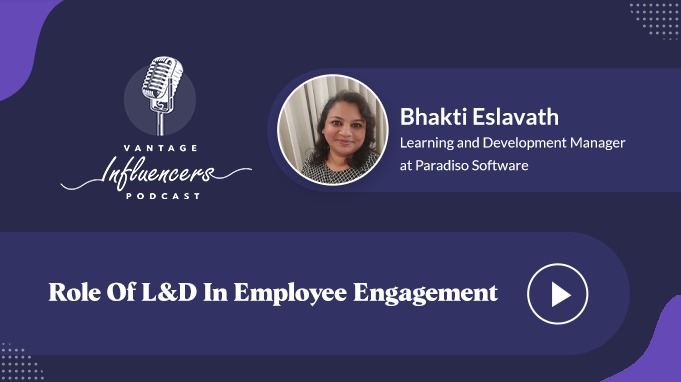
Role Of L&D In Employee Engagement
Episode Overview
Bhakti Eslavath joins this episode of the Vantage Influencers Podcast to unpack why corporate learning and development has felt stuck for years, and what actually breaks that stalemate. Her core argument is that L&D can no longer operate as a standalone function that designs and delivers training on its own schedule. It has to map every learning initiative directly to business goals, so growth plans for individual employees and the direction the organization is heading are always in sync. She walks through how the delivery model itself has evolved, moving from a top-down era of long, instructor-led sessions, to a bottom-up approach shaped by what employees say they want to learn next, to a newer middle-out model where subject matter experts create and share their own training content instead of waiting on a central team.
The conversation also digs into why technology and analytics have become non-negotiable for L&D. Skill-gap analysis, personalized learning paths, and micro-learning nuggets delivered through an LMS give teams visibility into what people are actually learning and where the gaps remain, replacing guesswork with data. Bhakti connects this to rewards and recognition, arguing that recognizing someone right after they learn something new is what turns a single training session into a lasting habit. She closes with a case for treating L&D as a strategic partner to the business rather than a support function, one that leadership brings into planning early so learning initiatives and business goals move together from the start.
Episode Highlights
- Bhakti traces her path from an application support role into learning and development, and explains how that hands-on operations background shapes the way she designs training programs today.
- L&D's mandate has shifted from running training in isolation to mapping learning initiatives directly to business goals, so that employee growth plans and organizational priorities move in the same direction.
- Shrinking attention spans and constant operational pressure make it harder for employees to carve out time to learn, and closing that gap starts with building a learning culture rather than scheduling one-off sessions.
- Corporate learning has moved through three distinct models: a top-down era of long, instructor-led sessions, a bottom-up approach driven by what employees say they want to learn, and a newer middle-out model where subject matter experts create and share their own training content.
- Learning platforms now support skill-gap analysis, personalized learning paths, and micro-learning nuggets, giving L&D teams the data to see what employees are learning and where they still need support.
- Recognizing people when they learn something new turns training into a habit, and building small competitions and recognition moments into the learning experience keeps that habit going.
About the Guest
Bhakti Eslavath, Learning and Development Manager, Paradiso
Bhakti is a Learning and Development professional with over 10 years of experience in coaching, training, and facilitation, plus more than four additional years in IT support roles. At Paradiso, she works across analysis, design, development, facilitation, and assessment of training programs aligned with business goals, and helps shape the company's approach to using technology and analytics to reinvent L&D at scale.
Connect with Bhakti on LinkedIn
Host
Susmita Sarma, Vantage Influencers Podcast Host
What You Will Learn
- How the role of L&D managers has shifted from training delivery to business-goal alignment
- Why shrinking attention spans make traditional day-long training sessions harder to run
- The difference between top-down, bottom-up, and middle-out learning models
- How LMS platforms use skill-gap analysis and micro-learning to personalize training
- Why rewards and recognition can turn one-time learning into a lasting habit
- What has to change for L&D to operate as a true business partner
Key Topics & Timestamps
| Timestamp | Topic |
|---|---|
| 00:39 | Introducing Bhakti and her role at Paradiso |
| 00:52 | Bhakti's career path from IT support into L&D |
| 01:51 | What L&D managers are expected to do inside an organization |
| 02:39 | Why corporate L&D feels stuck, and how teams can catch up |
| 07:28 | How L&D has evolved: top-down, bottom-up, and middle-out models |
| 09:49 | Using technology and analytics to drive L&D reinvention |
| 11:42 | What has to change in L&D to stay relevant going forward |
| 13:07 | How rewards and recognition reinforce learning habits |
Full Transcript
Click to read the full episode transcript
Welcome to the Vantage HR Influencers Podcast. This podcast is sponsored by Vantage Circle, the simple and AI-powered rewards and recognition platform for employee engagement. If you're interested in knowing about the current learning and development trends, the training delivery options, challenges, and the use of technology and analytics in L&D, and maybe you have already spent a lot of time trying to find out the greatest resources for information on these topics but in vain, then you must listen to this quick yet quite informational podcast.
Susmita Sarma: Hi everyone, welcome to the Vantage HR Influencers Podcast. I'm your host Susmita, and today I have with me Bhakti Eslavath, the learning and development manager at Paradiso. Welcome to the show, Bhakti.
Bhakti Eslavath: Thank you, Susmita. Thank you so much for joining me today in this Vantage HR Influencers Podcast.
Susmita Sarma: And would you like to brief us about your background a bit before we move on?
Bhakti Eslavath: Sure, absolutely. So my name is Bhakti Eslavath, as we all know, and I have been working in this industry for almost 10 plus years. However, I started my career as an application support executive, and I have worked through the L&D department, starting as a mentor and a coach for the team first, then in a middle role, and then into L&D. Currently with Paradiso, my role is not just being part of the L&D department, but also providing the L&D perspective for the application itself, and turning that application into not just a software, but more like a complete L&D solution provider.
Susmita Sarma: Right. Coming to the topic now, Bhakti, what exactly are L&D executives or managers today expected to do within their roles in any organization?
Bhakti Eslavath: Well, typically L&D executives and managers are into training analysis, evaluation of employees, filling learning gaps, and creating learning solutions. However, currently that role is changing into mapping, not just employee growth plans, but mapping these learning and training initiatives to achieve business goals and bridge that gap for employee growth plans as well, so that everybody is aligned with organization goals.
Susmita Sarma: Yeah. So we also see on social media, on LinkedIn especially, that we frequently agree, I don't know if it's a fact or a myth, that corporate L&D is stuck in some way. For instance, businesses are frequently caught in a compromising situation where they either lack the time or the resources to invest in L&D, that is, training. So how, in your opinion, can L&D teams catch up to the game? Is lack of planning and commitment the real hurdle? I've also come across studies that say getting employees ready for learning has been the biggest challenge for talent development teams.
Bhakti Eslavath: Well, that's the good part about learning and development, because everybody is involved, not just the business or the L&D department, but the employees as well. And of course, there are multiple challenges, so we'll talk about both here. One is that employees cannot make time for learning, and the second is how L&D can catch up to the game, or what the going-forward approach should be. So obviously, I truly agree that sometimes it's very difficult for employees to make time for learning. There is a lot going on. They have their operational goals, and so on.
Susmita Sarma: The constant pressure also.
Bhakti Eslavath: Exactly. And not just the pressure, but also, as you rightly mentioned, social media has made sure our attention span has now reduced to those 30-second reels. You don't really have time to sit and focus for half an hour, forget about an entire day-long training session. I can't even get you to sit with me for two hours sometimes. So that's a bigger challenge as well. It's obviously a trainer's, instructor's, or facilitator's job to make sure employees pay attention in the class. However, employees can only make time for learning when there is a culture within the organization that keeps that learning approach going all the time, giving them that time within the team. Managers can keep insisting that everyone make some time every day to learn something new, and that learning can come through anything. This is how the L&D team can catch up. We know employees are busy, so through the LMS or internal portals, and integration between the two, we can make sure the learning experience is infused with micro-learning nuggets, learning on the go. There's also a peer-to-peer learning feature within teams, because the manager knows the learning gap between team members and can guide them and give them space to improve. The effort has to come from both sides: employees have to be encouraged to take the initiative to start learning themselves, and L&D can use LMS platforms like Paradiso to build in learning on the go, micro-learning nuggets, and peer-to-peer learning. That's how we bridge that gap.
Susmita Sarma: Yeah. So those are some of the ways HR can offer learning opportunities that capture employees' interest and give them the skills they need to be successful.
Bhakti Eslavath: Absolutely. And obviously there is no one-size-fits-all approach.
Susmita Sarma: Exactly.
Bhakti Eslavath: Each department is different, each team is different, and at the individual level, each person is different too. We've seen this change coming through in HR as well. Nowadays, they also look for adaptation capabilities and the ability to accept change, when they talk about millennials and the newer generations entering the workforce.
Susmita Sarma: Yeah. So for all those newer generations, the one thing we want to know is how much curiosity they have.
Bhakti Eslavath: And when they have curiosity, it automatically becomes the seed for growth. Whatever opportunities HR offers will be absorbed by employees in terms of their growth plans, helping them understand what they are doing and what they're not. That's how HR can support the L&D department as well.
Susmita Sarma: Yeah. So would you like to elaborate on how L&D has changed over the past few years?
Bhakti Eslavath: Absolutely. The world has moved literally upside down in L&D. When I started working, about 10 or 12 years ago, the L&D department majorly had a top-down approach. We would design the programs and roll them out, continuously sharing knowledge. Sessions used to be five days, eight days, twenty days long. Sometimes we'd have shorter training sessions, but the approach was always top-down, sharing knowledge for employees to absorb. Now the current trend is bottom-up. We now find out, from employees at the ground level, what they want to learn next and where they want to grow, and that's how L&D now aligns learning sessions with business goals. There's also a newer approach helping organizations, called the middle-out approach. That means L&D is just part of the facilitation and guiding path, while subject matter experts and managers go out and use platforms like an LMS or LXP to share their knowledge through trainings and mentoring sessions. Because nobody has time to sit and do it live, they can record their sessions and upload them, and anyone interested can access that learning whenever they have time. Creating courses within departments and sharing that knowledge means employees don't have to wait for the L&D department to roll out a training before they learn a technology or skill. They can do it within their own team.
Susmita Sarma: So that's how much L&D has changed. And I'm sure technology and analytics play a huge role in driving that reinvention and having a bigger impact across the organization. Paradiso is such a good example when we talk about technology and analytics, I imagine.
Bhakti Eslavath: I think so, because technology and analytics haven't left any part of our lives untouched. Everyone needs access to knowledge, and that's what Paradiso believes in too. A workplace culture that promotes knowledge sharing is what fosters collaboration, idea exchange, and shared business goals. That's where technology and analytics play a huge part. LMS platforms can now help create learning paths where L&D gives employees a career growth path and lets them choose which course to take next. Similarly, we have skill-gap analysis, which we used to do manually. Now technology helps us do that through the LMS, where we can see how performance looks, what people are learning, how much they're learning, and where a person wants to grow. So I can make sure my entire workforce, not just one person, is well-educated, has the knowledge it needs, and stays updated. Analytics always helps with that. LMS platforms are a very important part of L&D now.
Susmita Sarma: Yeah. And what is that one aspect of the L&D function that has to change to stay relevant in the changing future? Maybe we can talk about just the year ahead.
Bhakti Eslavath: Right. So one thing we really want to see in the coming future is a change of mindset between business stakeholders and the L&D department, because L&D is no longer just learning and development. They are agents of transformation, literally the torchbearers, and they can bring transformation within people, processes, and business as we all look ahead. So the strategic alignment required in L&D can come through partnership between leadership and the L&D team. If both know where their business goals are, and align the strategy for business and L&D together, the change will be visible in terms of ROI, results, customer service, product quality, everything. And that change only comes when L&D is treated as an important part of business strategy.
Susmita Sarma: Yeah. And also, Bhakti, I think rewards and recognition can also enhance the very core of the learning and development function.
Bhakti Eslavath: Absolutely. Because as per psychology, every time you learn something, if you're given appreciation, a reward, or recognition for it, you tend to repeat that behavior and form it into a habit. That's what an LMS does nowadays. Paradiso has reward, recognition, and competition functionality built into the LMS itself. We can launch small competitions within a team, within a department, and at the organizational level. Constant reward and recognition keeps the learning wheel going, so everybody wants to keep learning something new, something next. That's how reward and recognition become a huge motivational factor in keeping employees engaged in making time for training.
Susmita Sarma: Yes, very well said, Bhakti. So finally, moving to the last question, any final thoughts after this conversation?
Bhakti Eslavath: Sure, absolutely. What I believe, in my personal opinion, is that every business is set to achieve certain business goals. First, there has to be a very clear path of action and plan, and leadership is always looking at business plans and business goals, and ROI matters a great deal to them too. If leadership involves the L&D team early on in these initiatives and business strategies, the L&D team in any organization can bring in change, transformation, and behavioral shifts. The LMS plays an equally important role as a tool for seeing those changes come through. So the L&D department is responsible for managing knowledge sharing and upskilling people, and ultimately this accelerates transformation, starting with people and moving toward the organization, helping it achieve its business goals faster and better than the competition in the market. So with that, I'll probably close this conversation today.
Susmita Sarma: Yeah, sure. Before we log out, I'd like to know how our listeners can reach out to you, Bhakti.
Bhakti Eslavath: My LinkedIn is always available. We also have Paradiso Learning forums on Facebook and LinkedIn, and listeners can reach out to me there. My name, again, loud and clear, is Bhakti Eslavath, and you can definitely reach out to me on LinkedIn.
Susmita Sarma: Sure, I'll link to your LinkedIn profile in the show notes, Bhakti. That was an amazing session, and we're honored to have had you on this podcast today. Thank you so much for your time and the expert knowledge you've shared. We hope to have you back again soon. Till then, take care and have a nice day ahead.
Bhakti Eslavath: Thank you. Thank you as well for inviting me. I really had a great time this morning, and I'm glad you have these initiatives where you do so many podcasts, which are helpful not just in one particular field, but by talking to industry leaders across the board.
Susmita Sarma: Yes, thank you. Thank you for the kind words, Bhakti.
Bhakti Eslavath: Thank you. Thanks for having me. Have a good day.
Thanks for listening to the Vantage HR Influencers Podcast. Please do subscribe to the Vantage HR Influencers Podcast on Apple Podcasts, Spotify, and our YouTube channel for new episodes.
FAQ
What are L&D managers expected to do inside an organization today?
Beyond training analysis, evaluation, and closing learning gaps, L&D managers now map every learning initiative to business goals so individual growth plans stay aligned with where the organization is headed.
Why does corporate L&D often feel stuck?
Employees rarely have uninterrupted time to learn because of daily operational pressure and shrinking attention spans. Closing that gap depends less on adding more training and more on building a consistent learning culture that gives teams space to learn a little every day.
How has the L&D delivery model changed over the past decade?
It has moved from a top-down model of long, instructor-led sessions to a bottom-up approach shaped by what employees want to learn next, and more recently to a middle-out model where subject matter experts create and share their own training content through an LMS or LXP.
How can rewards and recognition support L&D?
Recognizing someone right after they learn something new reinforces the behavior and turns a single training session into a repeatable habit, which is why some LMS platforms now build small competitions and recognition moments directly into the learning experience.
Related Reading
Also listen on