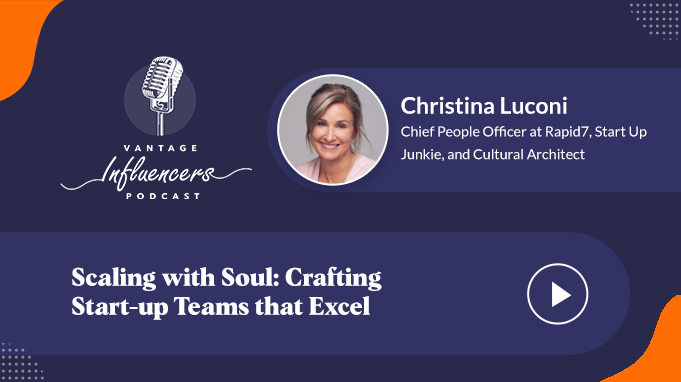
Scaling with Soul: Crafting Start-up Teams that Excel
Episode Overview
Christina Luconi believes company culture is the foundation everyone else treats as decoration. In this conversation, she unpacks "scaling with soul," her term for growing a business without letting its values erode as headcount multiplies. She argues that culture has to be established while a company is still small enough that everybody knows everybody, then woven into every stage of the employee lifecycle: how people are hired, developed, promoted, and even how they leave.
She also makes the case against traditional human resources language, arguing that treating people as "resources" misses the point entirely. Christina walks through how founders can attract the right early hires by looking beyond skills to shared belief systems, why rapid growth often exposes gaps in a founder's leadership skill set, and what leaders commonly get wrong when they try to scale a team without first getting clear on who they want to be as a company.
Episode Highlights
- Christina traces her path from a psychology degree to leading people strategy at high-growth startups, discovering early that culture and business strategy have to move together.
- She defines "scaling with soul" as building culture when a company is small, then intentionally carrying it through every phase of growth instead of assuming it will survive on its own.
- On hiring, she stresses looking past resumes and skill sets to whether a candidate is genuinely bought into the mission and comfortable with the uncertainty of startup life.
- She identifies a common leadership gap: founders with deep product expertise but little formal leadership experience, and the importance of complementing that gap with the right hires.
- Christina explains why she avoids the term "human resources," preferring language like "people strategy" that reflects a business-first, not order-taking, approach to the function.
- Her closing advice to founders is to define who they want to be as a company before they scale, since that clarity shapes every hiring and culture decision that follows.
About the Guest
Christina Luconi, People Strategy Executive, Rapid7
Christina Luconi has spent her career building and scaling people strategy functions inside small and start-up companies, including @stake (later acquired by Symantec) and Sapient, before joining Rapid7, where she has led the people function for close to 14 years and guided the company through major growth phases, including its IPO. Known for shunning the term "human resources," she believes that thinking of people as "resources" misses the point of the work entirely, and she was reportedly among the first professionals to hold the title of chief people officer.
Connect with Christina on LinkedIn
Host
Susmita Sarma, Vantage Influencers Podcast Host
What You Will Learn
- How to define and apply "scaling with soul" as a company grows from a handful of employees to thousands
- What to look for in early hires beyond skills, so culture holds up as headcount increases
- Why founders with strong product skills often need to build or borrow leadership skills separately
- How language like "human resources" versus "people strategy" shapes how a function operates
- What pitfalls to avoid when scaling a team without a clear sense of company identity first
Key Topics & Timestamps
| Timestamp | Topic |
|---|---|
| 01:44 | Christina's path from a psychology degree to leading people strategy |
| 08:10 | Defining "scaling with soul" and applying it as a company grows |
| 11:52 | What it takes to attract and retain top talent at a start-up |
| 16:09 | Common leadership challenges founders face during rapid growth |
| 18:49 | Why Christina avoids the term "human resources" |
| 22:43 | Common pitfalls to avoid when scaling a team with purpose |
Full Transcript
Click to read the full episode transcript
Welcome to the Vantage HR Influencers Podcast. This podcast is sponsored by Vantage Circle, the simple and AI-powered rewards and recognition platform for employee engagement. Welcome back to another exciting episode of the Vantage Influencers Podcast. Today we're diving deep into a concept that is becoming increasingly vital for leaders and organizations: scaling with soul. Have you heard about this term before? And what comes to your mind when you think of it? So at its core, scaling with soul is about growing your business while staying true to your values and culture. It's not about the numbers and the growth metrics. It's about fostering an environment where employees feel valued and connected to the mission of the company.
Susmita Sarma: Hello, this is Susmita, your host, and we are about to explore how leaders can apply the concept of scaling with soul in practical ways, ensuring that as teams grow, they do so in a way that fosters engagement, collaboration, and a shared purpose. We'll also discuss the strategies that have worked very well for our exclusive guest of the show, Christina Luconi, in building teams for high-growth companies while preserving the heart of their culture. Welcome to the show, Christina. It's a pleasure to have you with us today.
Christina Luconi: Thank you. I'm happy to be here.
Susmita Sarma: How are you doing?
Christina Luconi: I'm good, I'm good. It's a beautiful sunny morning in Boston and it feels like fall. So off to a great start.
Susmita Sarma: Yeah, and it's 6:30 pm here.
Christina Luconi: Oh, well.
Susmita Sarma: You can't control that. Yeah, so I'm really looking forward to our conversation, Christina, today. Let's jump right in.
Christina Luconi: Sure.
Susmita Sarma: So Christina, you have had a diverse and very impressive career, spending various roles in small and start-up companies. Would you like to share a bit about your journey and what drew you to the field of people strategy? How have your experiences shaped your current approach at Rapid7?
Christina Luconi: Sure. I probably don't have a very normal background for getting into this space. I had a psychology degree, and I thought I was going to go into some kind of clinical work after I graduated. Probably halfway through my degree, I thought, oh my gosh, I might not be able to sit and listen to people talk about their problems all day long. That makes me sound not very empathetic, and I'd like to think I have high empathy, but from a career standpoint, I thought that might be a hard thing for me. I like to get in there and solve problems, not just listen to them and help guide people through them. I'd like to be part of solving them.
So I had this existential life crisis halfway through my degree, and my dad, who had been a serial entrepreneur in the tech space, said, you know, there's this thing called human resources. This was back in the late 1980s, when I was still in college. And I thought, what the heck is that? He described it as the intersection of psychology and business. And I thought, okay, that could be interesting. I think what he was really trying to guide me towards was, kid, you're going to need a job after college.
So I started thinking about this, and before my junior year of school, I found a start-up in Cambridge, Massachusetts, which is part of the start-up ecosystem in the tech community here in greater Boston. It went public three weeks into my internship. And I thought, as only a 20-year-old could, this is an amazing thing. Not only do I get to work with really smart people, but if they have a great idea and everyone's rowing the boat in the same direction, working towards a common mission, you can build great businesses, and maybe people make some money along the way. Because it's that easy, right?
And yet, that's exactly what I tried to look for when I got out of college. I didn't end up at a start-up, but I ended up at a hyper-growth consulting firm. This was in 1990, and I think it's the kind of firm that many companies are trying to be today. There were women in leadership roles, there were people of color, there was a ton of diversity. That's what I grew up thinking was totally normal for business. And it allowed me the opportunity to ask questions like, why do we even call this field human resources? My printer is a resource, not a human being. And instead of saying, Christina, go back to your cubicle and do whatever it is you're supposed to do, they said, why don't you go think about that? How would you do it differently? What a gift to be given as a 22-year-old.
So I took advantage of that, and I think what I learned about myself was that I really liked human-centered work, because at the end of the day, it's not just about the business strategy. You can have a brilliant business strategy, you can have a fantastic product, but if everybody in the company isn't aligned to that mission, your chances of success drop significantly.
So I sort of rebranded the whole thing in my first job. Once I left that job after four years, I thought, okay, I know enough now that I can go run the show, which is a ridiculously arrogant thing to think at 25 or 26. I found a start-up in Boston that was being run by a bunch of people my age, which is a common thing today but sure wasn't then. I think the beauty of it was, my sales pitch to get hired was, hey, I don't see any people-focused person on your website, and I know you're growing, and if you want to take this thing public, you're going to need to be focused on those things. They took a bet on me, and it worked out. I've just been focused on the cultural elements of the people space ever since. I know enough standard HR fundamentals to get by, and I've been fortunate enough to build teams with people who have deep expertise in recruiting, compensation, and benefits.
But my area of real passion, and I guess at this point some expertise, is around culture, and how you build a company. If you think about building a company like you'd build a house, you can't build that house without a really solid foundation. You can always change the curtains, or remodel within the house, because businesses are constantly changing, but you have to have a pretty stable foundation. For me, culture is the foundation of the company. That was a really long-winded answer, but I hope that helps.
Susmita Sarma: No, it's very clear that each and every step of your journey has shaped your philosophy on people strategy and workplace culture, for sure.
Christina Luconi: Yeah, yeah, I think it helped.
Susmita Sarma: And as you say, building a culture in an organization is just like building a house or a home. So somewhere we can relate that to the actual topic we're talking about today, scaling with soul. That is, the soul of the people creates the culture of your company, isn't it? For our audience, Christina, would you like to describe what exactly the phrase "scaling with soul" means to you, and how you've applied this concept in your approach to building teams for high-growth companies?
Christina Luconi: Sure. It's a very personal thing to me. I think I came up with it probably 10 years ago. The way I think about it is, I had always been working in start-up companies, and to establish culture when the company is really small, then you can help it grow and thrive as the company continues to scale.
If you can build it when you still know every person in the company, then you can weave it into every element of the employee lifecycle. You tie the culture into how you recruit people, how you develop people, how you promote people, even how you part ways with people. It becomes so omnipresent in the company that there's no questioning what's valued within the organization.
But I always had this assumption that the larger the company gets, the more that's going to chip away. And I had this moment, I've been at Rapid7 now almost 14 years, which makes me a little embarrassed to admit, because it's four times longer than anywhere else I've ever been. When I joined the company, I said to Corey Thomas, our CEO, hey, I'm very excited to be part of this, and I think I'll stick around and help us get to an event, whether it's going public or we sell to someone or whatever. I'm on board for that journey, but then I'm going to leave, and I'll go do it somewhere else. That's what I'm really excited and passionate about.
True to my word, the day we filed to go public, I gave my notice, and he said exactly what you'd say to somebody like me, which was, nice job getting us here. Now help us get to a couple thousand people and have it still be an amazing place to be, and then you can claim victory and leave. And I thought, oh my god, okay. So now my new mission became, how do you scale the culture and not lose who you are in the process.
One thing I've become really proud of is that we've been on best-places-to-work lists for 13, 14 years in a row at this point. I know awards are important to attract candidates, but personally I don't really care about the awards. What I do care about is that we've consistently won them as we've scaled. It's not super hard to be a really amazing company when you're a hundred people and everybody knows each other and everybody's on the same mission. But the fact that we were able to get acknowledged when we were really small, and then as we went through some major growth phases, and now we're 2,500 people, we've managed to have everybody feel that our culture is the one thing that unites us, no matter where you sit in the world, what level you are, what role you play. That's the one common thread that connects all of us. That, for me, is scaling with soul.
Susmita Sarma: Rightly said. Even when a company is scaling rapidly, and not just for start-ups, it's a must for leaders to maintain their sense of culture while expanding the team.
Christina Luconi: Absolutely, I agree.
Susmita Sarma: Some great strategies in your opinion, Christina. So moving on, from your perspective, what are the key factors in attracting and retaining top talent, especially in start-ups in competitive industries?
Christina Luconi: Sure. I think you have to know exactly what you're looking for, and think about complementing skill sets. Oftentimes you'll see start-ups say, oh, I worked with this person before, or this was my college roommate, they're really smart. Just because you know people, and they have a great skill set, doesn't mean they're on board with the mission of the company you're trying to build.
So in the early stages of a company, finding talent that doesn't just have the skills to do the job, but has the right mindset, matters. Anyone who joins a start-up is a little bit, and I say this with love and put myself in this category, a little crazy. Who signs up for this? It sounds exciting, hey, we started a company and maybe this thing goes somewhere, but it's so much work to get something off the ground, and that's not for everybody. Especially in today's world, not everyone wants their entire life consumed by work.
So making sure you're really clear on what the mission of your company is, what you're looking for in people, going beyond the skills, and making sure they want to sign up for the journey. Hopefully they have complementary skill sets to what you already have. If you're a super analytical person and you need to hire someone else, hopefully that person complements you with more than good skills, maybe with an eye toward vision or strategy, to balance out the analytics.
So being really thoughtful about what you need, where you're going, and staying open-minded about where those skills come from is really important. But people have to be bought into the mission. You're playing for potential. It's not like joining a really established company where you get an amazing compensation package and all the benefits. You're joining something with a lot of potential, and that's not for everybody. Really making sure you're transparent with people about what this journey looks like, what the mission is, and getting them bought into that, makes a huge difference.
Susmita Sarma: And as you said, work-life balance is one of the top things candidates are looking for in a workplace today.
Christina Luconi: Yeah. I think especially since COVID, we've seen a lot of people want way more flexibility in their work, many people want more of a lifestyle-type job. And candidly, I think that makes it really hard for start-ups to find the right people, because if you're looking for a lifestyle job, a start-up is certainly not the right place to go.
I'm not suggesting you can't work at one and have a life. I've spent my whole career in start-ups, and I was a single mom, and that was a huge priority to me, and I figured out how to balance it. But it's not for the faint of heart. To think you're going to just do a nine-to-five job at a start-up is very unlikely.
So people have to be very honest with themselves about where they are in their life, whether they can take that risk, whether they want to work that hard to get something off the ground, and be really intellectually honest with themselves about what that might look and feel like.
Susmita Sarma: Thank you for those insightful points, Christina. Tell us one thing. You've closely worked with so many executives to help them identify their strengths and weaknesses. What are the most common leadership challenges you've encountered during periods of rapid growth?
Christina Luconi: Boy, that's a great question. I think oftentimes the biggest challenge I've seen is founders who have deep product knowledge but maybe not historical leadership skills. They might have been an unbelievable developer with an amazing idea to start a company, but they don't have traditional leadership skills, and being able to help them identify that they need a vision, they need to know how to hire, that they're becoming a true business mind in addition to their product-focused skills, matters.
That's a really hard thing for people to sometimes embrace, because they want to make it all about the product, and the product could be amazing, it could be a brilliant idea, but you either have to build those leadership skills yourself as the founder or CEO, or you have to complement yourself. So some really self-aware, phenomenal product leaders will often find somebody who can actually run the company day to day, while they stay deep in the technical weeds. I think that's probably the most common thing I've seen.
But the other piece is, you don't have to know everything. It's knowing what your company needs to accomplish and filling in the gaps with really talented people that you can go into battle with, people who have skills you don't, and respecting their different point of view. We spend so much time talking about diversity and inclusion broadly in the world today, but I think if we take away the basic meaning we all immediately jump to, a lot of it is being incredibly inclusive about different points of view and different mindsets. In my humble opinion, those come from very different walks of life. If you're only hiring people out of one type of background to run your business, they're going to think a particular way. Versus if you have people from different parts of the globe with different work experiences, you're going to bring different points of view to the table, and as long as everyone's working toward the same mission, you're going to come out with a much richer outcome, because you've embraced those different points of view.
Susmita Sarma: And Christina, you've mentioned a slight aversion to the term "human resources," because you think that if you're thinking of your people as resources, you're completely missing the point. How do you think this kind of a shift in perspective will influence the way teams are built and nurtured within an organization?
Christina Luconi: Yeah, for me, this sounds crazy, but I think I figured out very early in my career, going back to that first job when I even started asking about human resources and why we call it that, that the whole purpose for our field to make an impact is to understand whatever the business strategy is, and then work backwards to figure out what people strategy is going to motivate, incentivize, and inspire the people who actually have to execute against that business strategy. I don't think that's rocket science, I don't think that's a really inventive point of view, but I'm floored that a lot of people don't do it that way.
So I spend a lot of time focusing on thinking of myself as a business person first, who happens to major in people. That's a bit of a different point of view. I think for a lot of this field, oftentimes we're the order-takers, like, go hire these people, or go fire these people, and it's very reactive. I don't think it has to be reactive at all. I actually think it can be incredibly proactive and strategic if you're aligning it to the business. I don't always see it work that way, so that's sort of where my different point of view came from.
But a lot of it just came from calling it something different. It's just a starting place. In my second job, we changed it to people strategy, and I've avoided the term human resources ever since. In fact, I've been told I'm the first person who was ever called a chief people officer. I can't validate that, but for me it was really important. Like, do not call me a chief human resources officer, that doesn't compute for me. So it's very grounded in supporting the strategic mission of the company.
Susmita Sarma: So you prefer terms like people operations or people strategy, emphasizing the human aspect of the workforce and the importance of seeing employees as individuals rather than resources.
Christina Luconi: Yeah, I think so. I'll say "people ops" is a bit of a different thing. We have a people operations team within our global people strategy organization. But I think sometimes people try to be clever with whatever they call their groups, and those names mean something. If a team in a company calls itself people operations instead of human resources, that tells me they're incredibly operationally focused, not necessarily strategic. That's not necessarily a bad thing, maybe that really works for their organization. But I'm just saying, don't just get clever with words. Those words have to represent who you are, and how you approach the work matters a lot.
Susmita Sarma: It does. Yeah. So we're almost about to wrap up, but before that, for the start-up founders and leaders who are listening to us and looking to scale their teams, what are some common pitfalls you've observed, and what advice would you give to ensure they grow with purpose?
Christina Luconi: Sure. Let's make the assumption all these companies are getting off the ground because they have a great idea, some really passionate people behind it, and hopefully a little funding to get started. If all those things exist, then understanding who you are and who you aspire to be, as early as possible in the company's existence, is really important.
I know it feels like the touchy-feely stuff. I know companies just want to focus on the basics, product-market fit and all of that, and those are really important. But I'd argue understanding culturally who you want to be is so critical, because as you're hiring those first people, that's what you're looking for in them. Again, it's not just about the skill, but whether they have a similar belief system.
I'll give you one silly example. One of our core values is "impact together," which is our language for collaboration. I've never met somebody who says they don't want to be a team player, nobody will ever admit that. But if you're interviewing somebody and you realize they really love working independently, that they don't want to partner with other people, that they'd rather just drive their team to do what they think is best, they would likely hate this company, because so much of the work we do is based on creating impact for our customers together.
That doesn't mean you have to sell your idea to everyone in the company before you launch it. It does mean we believe one plus one equals three, meaning there's nothing I would ever roll out to the entire organization without getting points of view from all the different groups it's going to affect, to make sure whatever I've come up with is going to make sense and be well received by the majority of people. That's not 100%, but you'll come pretty close if you collaborate.
So understanding those things upfront, understanding what you value, is so critical, because that will help you hire the right team from the beginning. It will help you measure their performance based on whether people are not just getting stuff done, but doing so in a way that's cohesive and partnering together to get to the best end goal. Culture, for me, is probably one of the first things I would counsel founders and leaders to focus on.
Susmita Sarma: That's really valuable advice, Christina. Thank you so much for joining us today and sharing your invaluable insights on people strategy and culture. I know that organizations that truly prioritize their people is inspiring, and I know listeners will take away so much from this conversation. Really appreciate your time and the expertise you've brought to the table today, Christina.
Christina Luconi: Thank you. Thank you for having me. I really appreciate the conversation, and I'm looking forward to what's ahead for Rapid7.
Susmita Sarma: No, thank you. Thank you. Have a good day.
Christina Luconi: You too.
Thanks for listening to the Vantage HR Influencers Podcast. Please subscribe to the Vantage HR Influencers Podcast on Apple Podcasts, Spotify, and our YouTube channel for new episodes.
FAQ
What does "scaling with soul" mean?
It is Christina Luconi's term for growing a company without letting its values erode as it adds people. The idea is to build culture deliberately while a company is still small, then carry that same culture through every stage of growth, from how people are hired to how they eventually leave.
How can start-up founders build a strong culture from day one?
Founders should get clear on who they are and who they aspire to be as early as possible, before they start hiring. That clarity becomes the filter for early hiring decisions, performance expectations, and how the team collaborates as it scales.
What should start-ups look for in early hires beyond skills?
Beyond technical ability, founders should look for candidates who share the company's belief system and are genuinely comfortable with the uncertainty of start-up life. A skilled hire who is not bought into the mission or the collaborative way the team works can do more harm than good.
Why does Christina Luconi avoid the term "human resources"?
She sees the phrase as reducing people to interchangeable assets rather than the drivers of business strategy. She prefers language like "people strategy," which frames the function as starting from the business strategy and working backward to figure out what will motivate the people who have to execute it.
Related Reading
Also listen on