The Fundamentals Of Agile HR
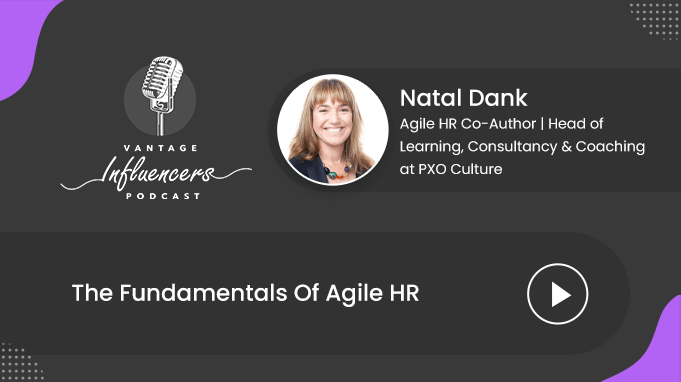
Episode Overview
Natal Dank built her HR career the unconventional way. She started out in financial services, discovered that the people side of a business mattered more to her than the numbers, and eventually became one of the earliest voices applying agile thinking to HR. As Head of Learning, Consultancy & Coaching at PXO Culture, she now works hands-on with HR teams and leaders who want to move away from slow, big-bang program rollouts. Her core argument is that organizations operate in a genuinely complex, fast-shifting world, something the pandemic made impossible to ignore, and the traditional waterfall approach to HR (planning everything up front, then delivering it all at once) simply cannot keep pace. Agile HR takes the iterative, evidence-based mindset that started in technology and applies it to people, culture, and organizational design.
Her sharpest, most concrete point in the conversation is that HR should stop trying to ship polished, fully-built programs and instead test small, then scale what actually works. She illustrates this with a story about a large company whose managers kept skipping a two-day, face-to-face training program despite genuinely wanting to develop. Design thinking research revealed that managers only wanted help at the exact moment they hit a real problem, before a hard conversation or a hiring decision, so the company replaced the old program with bite-sized, on-demand learning triggered at that moment. Usage jumped immediately, and the two-day program was retired for good. For Dank, that is agile HR in practice: define value from the employee's perspective, prototype small, and let evidence decide what gets built next.
Episode Highlights
- Agile HR applies technology's iterative, test-and-learn approach to people practices, replacing big upfront rollouts with smaller cycles built around evidence and quick feedback.
- Being customer-centric in HR means treating employees and leaders as the customer, defining what value looks like for them, and prioritizing ruthlessly around that value.
- Cross-functional collaboration matters more than functional silos: complex people problems get solved faster when reward, talent, and L&D specialists work together on one team.
- A global company redesigned manager development by offering bite-sized learning (a 90-minute session, a coach, a video) at the exact moment a manager faced a real problem, replacing an unused two-day training program with an on-demand model.
- Coaching from someone who has actually worked in HR, not a generic agile trainer, helps translate the mindset into HR's own language and problems.
- Letting go of the need for perfect, polished solutions and instead testing and validating ideas with employees before full rollout leads to better outcomes and lower risk.
About the Guest
Natal Dank, Head of Learning, Consultancy & Coaching, PXO Culture
Natal Dank is widely recognized as a pioneer of the Agile HR movement. She spent over a decade in senior HR, Talent, and Organisational Development roles before founding PXO Culture, where she now heads up learning, consultancy, and coaching. She works directly with HR leaders and teams, from fast-growing tech companies to global banks and not-for-profits, helping them apply an agile mindset to how they build people practices. In 2016, she launched the first Agile HR Meetup in London, a community that has since grown into a recurring event held around the world. In 2020, she published Agile HR: Delivering Value in a Changing World of Work, a practical toolkit for HR professionals who want to bring agility into their function, and through PXO Culture she continues to focus on building modern People Experience and Operations for the 21st century.
Connect with Natal on LinkedIn
Host
Susmita Sarma, Vantage Influencers Podcast Host
What You Will Learn
- How to apply agile's test-and-learn approach to HR programs instead of big-bang rollouts.
- How to define "value" for your employees and leaders and use it to prioritize your HR backlog.
- Why cross-functional teams outperform siloed reward, talent, and L&D functions when solving complex people problems.
- How one organization redesigned management training by delivering learning at the moment of need instead of in a fixed two-day program.
- What to look for in an agile coach or trainer so the mindset actually translates to HR's day-to-day work.
- How to let go of "perfect" solutions and start testing and validating ideas with your people before a full rollout.
Key Topics & Timestamps
| Timestamp | Topic |
|---|---|
| 03:50 | Defining what it means to be agile in the workplace |
| 06:05 | The story behind Natal's book, Agile HR: Delivering Value in a Changing World of Work |
| 07:30 | Five ways HR can evolve to become more agile |
| 09:56 | Skills, mindsets, and methodologies needed to succeed in agile HR |
| 14:30 | A real-world example of agile HR in manager development |
| 17:43 | The top three benefits of bringing agility to HR |
| 19:46 | Natal's advice for HR professionals starting their agile journey |
Full Transcript
Click to read the full episode transcript
Welcome to the Vantage HR Influencers Podcast. This podcast is sponsored by Vantage Circle, the simple and AI-powered rewards and recognition platform for employee engagement. It's become clear that one of the most pressing concerns among HR professionals is implementing agility in their workplaces. The concept of being agile is definitely sweeping the commercial world, and it's also transforming HR.
Susmita Sarma: Hi everyone, I'm your host Susmita, and to talk about how agility is transforming and modernizing the world of HR, today I am joined by the pioneer of the Agile HR movement, Natal Dank, who heads up learning, consultancy, and coaching at PXO Culture. Welcome to the show, Natal.
Natal Dank: Hi, thanks for having me, it's great to be here.
Susmita Sarma: Thanks for joining me in this conversation, Natal. How are you doing?
Natal Dank: Yeah, really well, really well. The weather is not so great here in Scotland today, but otherwise I'm very good.
Susmita Sarma: Okay, yeah. So we'll be talking about being agile in HR today, but before that, I'd like you to brief us about your background in HR, and I'd also like you to introduce PXO Culture to us today.
Natal Dank: Yeah, so PXO Culture is a place where we help HR leaders and teams build great places to work, and it's all about looking at modern, contemporary ways of working underpinned by the Agile mindset, which we're going to explore today. And my background, well, I was in the world of HR for many years, but before that I actually started in business roles in financial services, and after a while I discovered that for me it was much more about the people side of an organisation that made a business a success, rather than the numbers as such. So I started to follow that passion.
Susmita Sarma: So, before PXO Culture, you were in finance, right?
Natal Dank: No, no. So, okay, I'll just go over the history. I started in business roles in financial services, and I then went into the area of coaching and learning and development, but I actually sat in business roles for a long time before I moved into HR. And actually, when I first went into HR, I found that it seemed a bit too much about process rather than people, which sort of surprised me at the time. But then I really got into understanding how do you build a great culture, how do you build a successful business through people strategy, and that was the passion that I then followed.
Susmita Sarma: And I'd like to know more about PXO Culture, about all the work that you do. Which are the key areas?
Natal Dank: Sure. So at PXO Culture we work very hands-on with HR teams and leaders, and we look at how we start to revolutionise the way that HR works with their people and their business. So we help them apply agile techniques and understand the agile mindset, and this is all about working in a more evidence-based role. It's about understanding your customer, so your different customer segments in an organisation, building very human-centric solutions, and really starting to build an employee experience that's like a customer journey full of moments that matter. So we look at everything from how you start to apply these tools and techniques and evolve your operating model in the world of people, culture, and HR, and we also help people deliver projects, from performance through to reward, through to culture, diversity, equity, and inclusion, all those topics. We look at how to build great places to work through an agile mindset.
Susmita Sarma: Right, and since you're clearly passionate about this space and you've been championing agile HR, I'd like to know from you, what do we actually mean by being agile in the workplace?
Natal Dank: Yeah. Well, first of all, fundamentally there's a belief that we now live and work in a complex world, and that the way we've worked up until now isn't going to be relevant or get us the answers we seek, now that the world is very complex. And I always say there's nothing like a pandemic to demonstrate the complexity, the uncertainty, and the chaos that we can have in the business world. Prior to the pandemic, organisations were already looking at how do we become more customer-centric, how do we deliver value at speed to our customers, how do we become more responsive, how do we collaborate and innovate in new ways. And this was leading many organisations towards a more agile way of working. So agile HR is taking that concept into the world of HR itself, and there are two sides to that. One is that it can greatly revolutionise how we work, so it helps us co-create solutions. We build solutions with our people through a test-and-learn approach, through data, through evidence, and we build the solution with them rather than implementing it onto them. So it's a whole new way of building change in organisations.
Susmita Sarma: For sure. And COVID-19 has amplified the need for agility and collaboration.
Natal Dank: Yes. And so the other side is that we need to play a role in building modern organisations. And if you're wanting to build an organisation that's more collaborative, more team-based, more networked in how it's structured, then HR needs to understand the agile mindset, the tools and techniques, these ways of working, to really help enable that. So it's about actually changing our traditional processes to enable collaborative, team-based working in organisations.
Susmita Sarma: I'll ask about the tools, techniques, skills, and methods needed to succeed in agile HR, but before that, Natal, would you like to tell us about your book, Agile HR: Delivering Value in a Changing World of Work, and what actually inspired you to write it?
Natal Dank: Yeah, well, the reason we wrote the book was that we were just getting asked the questions that you're asking me today, which is, what is agile, how do you start to use it in the world of HR? You're probably aware, and many of the listeners too, that agile started in technology, and while it's now moving across all parts of business, some people struggle to understand how you take it out of the technical space and apply it in an area that's more about people and employee experience. So the book is a practical toolkit of how to do it, and it starts with explaining what's happening in the world, why lots of organisations and teams are using a more agile approach to how they work. So there's the ability to respond quickly to your customer needs, to innovate, to be flexible and adaptive in your organisational design. And then it looks at the two areas I talked about before. So one is how HR uses these techniques, from design thinking through to visualising your work and prioritising your work through value, and then it looks at HR's role in helping organisations become more agile, and how we build the products and services to help enable that.
Susmita Sarma: Yeah, so would you like to tell us about some of the ways in which HR can evolve to be more agile?
Natal Dank: Yeah, sure. So first of all, it's very much about understanding this mindset of people before process, the idea that we work in a complex world and therefore need to embrace a test-and-learn approach. So how do you build a solution through data and evidence? It's probably good to explain where agile comes from. It comes very much from saying, okay, in a complex environment, if you run a project in the more traditional waterfall way, which is planning everything up front, the budget, the processes, the documentation, the training, and then you start to design and then you implement, often months or even years later, and you implement in a big bang all at one time, what happens is, as the world starts to shift and evolve, your plans just can't hold that entirety. And when you implement, you need to make a lot of changes to that plan to ensure it's going to actually land and be what your customer needs. And this actually increases risk. So agile is a way of understanding whether what I'm going to deliver is the right thing for my customer, and how I get the data to prove that. So what you do is you actually work in smaller cycles or iterations, and you go, okay, out of all the things we need to do in this project, what is the most valuable thing to do first, and let's go and do that. Let's try to get something of value, something tangible to our customer, within a couple of weeks, maybe a month, and get some feedback. Does this work? Does it not? Are we going in the right direction? And then use that feedback to inform the next cycle of work. So you've probably heard concepts like minimal viable product, test-and-learn, prototyping. It's all about using those techniques to build a solution over time. It's very evidence-based and data-driven. So that's kind of the heart of what agile is. So for HR, it's understanding how you start to apply those methods within the world of people, culture, and organisational change.
Susmita Sarma: Yeah, so talking about this, what are the top skills and mindsets you think are a must to succeed in agile HR?
Natal Dank: Sure. So the first one is being customer-centric and understanding how to define value. Customers sit at the heart of everything you do in an agile way, and you're wanting to always know how you define value for your customers. And for HR, this will be your different employees, it will be leaders. But it's also understanding what we do as an organisation, and how we help people get the job done so they deliver value through to the end customer, which is the people who buy the products and services that the company sells or provides. So it's about understanding value, and using that value to prioritise your work. We often talk about ruthless prioritisation. And then there are tools and techniques to help you visualise your work, so how you constantly use a backlog, understand work in progress, to always be focused on the most important thing to do at any one point in time. This is crucial for HR people, because we always have this huge wish list. We also have very vague topics, like enriching the employee experience or delivering wellbeing. What does that really mean? Agile helps us break that down into very tangible deliveries and solutions. So it's about understanding value, understanding your customer, and then applying an experimental kind of framework or mindset. You need to be ready to test, and for things not to work, so you can quickly find out what does work. So it's about being willing to experiment, being willing to prototype, being willing to test, and doing that directly with your people. I think the other final one that's super important for HR is letting go of our traditional functional, topic-based construct. We've always worked as individuals looking after reward, or recruitment, or talent, but actually, to solve complex problems, we all need to work together. So in agile, we want to come together and deliver solutions as a multi-functional team. And this is a really powerful way for HR to work, because it means we have this much more holistic approach to how we build the employee experience. And this is all the things people keep telling me they want to be able to do when I go to conferences and speak to HR leaders and teams. So agile can really help us find the access to a lot of the challenges we have at the moment.
Susmita Sarma: Right. And is there any training or coaching that you've seen organisations taking up as part of this kind of education for agile HR?
Natal Dank: Yeah, well, definitely, that's why people come and work with PXO Culture, because that's what we specialise in. And I do think having a coach helps you get started to explore this mindset. In particular, what I've found is that HR needs to understand how to translate agile into our own context. So sometimes they may be introduced to agile through a more technical person, and often they don't understand the language, they don't connect with it. So what's really important is working with somebody who has done it before in the world of HR, because then they truly understand our roles, our problems, and how to actually apply it in our types of projects. So I think that's really important. The next thing, however, is you've really got to apply the mindset and the skills. So I can't encourage people enough: learning needs to be learning by doing. So definitely have a coach, definitely do some core learning and training, but very quickly you're wanting to choose a nice, juicy, complex problem, bring together a multi-functional team, and really give yourself, say, three months to apply the agile techniques and see how it works in action, and use that to learn. So agile is about working in cycles, reviewing how you've worked, and adapting your plan or your model. So by applying that agile cycle to your development, you very quickly upskill the team, and also start to really adapt and learn how best to deliver your project in an agile way. So truly embracing it like an agile experiment is the best way to actually learn agile itself.
Susmita Sarma: Right. So is there any story or example you'd like to share, where an organisation has seen the before-and-after benefits of bringing agility into HR, with the help of your work at PXO Culture?
Natal Dank: Yeah, yeah, for sure. There are lots of great stories out there, and I think one of the best ones I like to share is about a really big organisation that had the problem of lots of their managers, thousands of managers, really wanting to learn and develop and get better at being a manager, but never wanting to go on a two-day, face-to-face programme. They used to run these programmes, and managers would always say, "Oh, I don't have time, I can't go." So they were like, okay, we've got a problem here: people say they need development, we get feedback from employees that managers need development, but managers never have time to attend the training. So what's going on? So they used some design thinking to go and explore what's really happening for the customer, and they spent time with managers, and they discovered that managers don't see the need to go to training, but they have problems to solve on a day-to-day basis. So a manager might say, "Oh, I've got to hire someone tomorrow, and I don't know how to do it. I want to hire the best person for the team." Or, "Tomorrow I've got a really difficult conversation, and I'm not sure how to give this person feedback, and I really need to understand how to do that." So they started to use prototypes and testing. What if we could get learning to those managers at the time the manager thinks they have the problem? So, for example, when the manager had to go and give feedback, if they got a message saying, "Would you like to learn how to do that? Would you like to attend a 90-minute session? Would you like to talk to a coach? Would you like to watch a video? Would you like to read this information?" Then suddenly they would say, "Yes, yes, I definitely want to do that, because I need to fix this problem here and now." And what happened is they started to prototype and test all these small but very engaging ways to get learning to the manager when the manager thought they had the problem. They even linked it to systems such as their existing HR platform, so when a manager gets a message to do something, maybe the manager will want to learn how to do that. And they started to see this huge uplift in managers accessing learning. And over time they built this whole new on-demand management development approach. They never did a two-day, face-to-face programme again, and they had reinvented, in a very digital way, their whole learning suite for managers. And it's just a great example of how agile is all about understanding your customer, understanding the problems to solve, and then using a test-and-learn, prototyping technique to start to build the solution up over time, based on data and evidence of what works.
Susmita Sarma: It's a great story. Well, congratulations and all the best to you and the entire team at PXO Culture for the great work you've been doing around agile HR. And before wrapping up this conversation, if I asked you to point out three top benefits of agile HR, what would they be?
Natal Dank: So you'd like me to look at three benefits that agility brings to organisations. Is that the question?
Susmita Sarma: Right, okay, great.
Natal Dank: So the three benefits are: first of all, customer-centricity. By understanding your customer, you can deliver great value, and if you put that into the world of HR, that means understanding our people and delivering human-centric solutions, which makes work a great place to be. The other one is understanding how to prioritise our work through that value. We are all just faced with this huge demand, a huge wish list, a huge to-do list, and we can never get everything done. So we need to be much better at understanding where to spend our time, working in a more agile, value-driven way. It really helps us understand what to say yes to, where to spend our time, and what to actually put on the backlog for later, to understand if that's the right thing to do at a later stage. So it's about being customer-centric, value-driven. And what you start to do is co-create great solutions with your people, so you're no longer implementing solutions on people, you're actually building them with people. So if you do that in the organisation, you build an employee experience that everyone wants to be a part of. It's more personalised, it's more holistic, and it really enriches how people experience their work. And for me, that's the secret to business success. And if you then take that into how you deliver your customer products and services, what you put out onto the market, an organisation can be much more successful by truly co-creating products and services that people want to buy and be part of.
Susmita Sarma: True. Thank you so much for sharing that, Natal. Finally, is there any advice you want to give to HR professionals who are looking to become agile?
Natal Dank: Yeah, let go of the old traditional mindset that everything has to be shiny and perfect, and actually go out and embrace experimentation, and test and validate what works with your people before you implement it into the organisation. And you'll find that you'll just design much better solutions.
Susmita Sarma: Great. Thank you, Natal, for bringing your expertise and experience to this conversation today. Finally, I'd like to know how our listeners can reach out to you.
Natal Dank: Yeah, sure. Please contact me on LinkedIn, I love a chat, and I'm always available there. But also, please come over to PXO Culture, so pxoculture.com. We have a fantastic newsletter that everyone loves, full of lots of videos and great reads. But also, we do lots of free meetups that people can come along to and learn more about how to apply agile, how to develop your T-shaped team, and how to use things like design thinking in HR. So please come along, we generally do a meetup every month, and they're free to join.
Susmita Sarma: Great. So thank you, Natal, for your time and for this conversation, which has been full of relevant information about agile HR. I'm sure this will be genuinely helpful for our audience. So thank you once again.
Natal Dank: Great. Thank you for having me. It's been lovely. I'll see you soon again, and please take care of yourself.
Thanks for listening to the Vantage HR Influencers podcast. Please do subscribe to the Vantage HR Influencers podcast on Apple Podcasts, Spotify, and our YouTube channel for new episodes.
FAQ
What does it mean for HR to be "agile"?
According to Natal Dank, being agile in HR means moving away from big, upfront planning and instead working in smaller cycles, testing ideas with real data and evidence, and co-creating solutions with employees rather than rolling them out top-down. It borrows an iterative, evidence-based mindset from technology and applies it to how HR designs and delivers people programs.
What is the biggest mindset shift HR needs to make to become more agile?
Dank says the most important shift is putting people before process and becoming genuinely customer-centric, treating employees and leaders as the customers whose needs define value. She also emphasizes letting go of rigid functional silos, such as reward, talent, and recruitment, in favor of multi-functional teams that solve complex problems together.
How did one organization redesign manager training using agile HR?
Dank shares the example of a large company whose managers avoided a two-day, face-to-face training program despite needing development. Using design thinking, the company discovered managers only wanted help at the exact moment they faced a real problem, so it offered bite-sized learning (a coach, a video, a short session) triggered by that moment, eventually replacing the old program with an on-demand model that saw a sharp jump in usage.
What advice does Natal Dank give to HR professionals starting their agile journey?
Dank advises HR teams to stop chasing perfect, polished solutions and instead pick a real, complex problem, form a small multi-functional team, and give themselves a defined period, such as three months, to test and validate ideas directly with employees. Working with a coach who has hands-on HR experience, not just a generic agile trainer, helps translate the mindset into HR's own context.
Related Reading
Also listen on