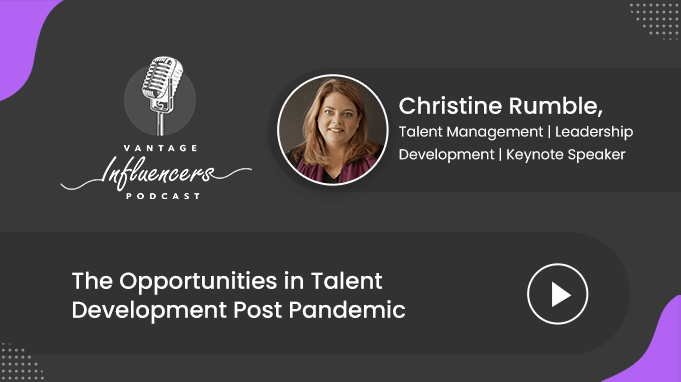
The Opportunities in Talent Development Post-Pandemic
Episode Overview
In this episode of the Vantage HR Influencers Podcast, host Susmita Sarma speaks with Christine Rumble, founder of Dawn Consulting Services, about what talent development needs to look like after the pandemic. Christine traces her nearly 30 year path through international hotel operations across Asia, the Pacific, Europe, and the Middle East, moving from activities manager and general manager roles into learning and development, and eventually into a senior HR post covering 23 countries, around 1,200 hotels, and roughly 140,000 employees, before that role was dissolved during the pandemic and she returned home to Western Australia to start her own consultancy. Her central argument is that talent development has to become a strategic activity built around skills rather than fixed job roles, since the organizations that survived the pandemic were the ones agile enough to redeploy people as the work itself changed.
The sharpest, most concrete point in the conversation is Christine's take on the multigenerational workforce: citing research that 60% of baby boomers believe they lack the skills to survive a layoff, compared with 49% of millennials, she argues that companies quietly discriminate against older employees by assuming they are too close to retirement to be worth developing. Her fix is practical rather than theoretical: ring fence a percentage of the L&D budget for every generation, and use reverse mentoring, pairing a millennial with a mature employee, so digital skills and institutional knowledge move in both directions at once. She closes by naming emotional intelligence as the one skill every post pandemic leader needs, since it is empathy, not information, that lets leaders understand how their decisions land across the whole organization.
Episode Highlights
- Talent development strategy works best when companies shift focus from job roles to job skills, which is what makes a workforce genuinely agile as the business changes.
- A statistic Christine cites shows 60% of baby boomers believe they lack the skills to survive a layoff, versus 49% of millennials, yet many companies still under invest in L&D for older staff who are assumed to be near retirement.
- Her reverse mentoring model pairs millennial employees with mature employees so each side trades something valuable: digital fluency moving one way, institutional experience moving the other.
- Christine names emotional intelligence as the single most important skill for post pandemic leaders, since empathy is what lets a leader see how decisions ripple across an entire organization.
- She argues for blended learning over pure e-learning: self assessments, instructor led sessions, workplace projects, and coaching all need to sit alongside digital courses, not replace them.
- On outside trainers versus internal ones, she recommends bringing in external voices for senior leadership to break silo thinking, while still building internal training capability for the long term.
About the Guest
Christine Rumble, Founder, Dawn Consulting Services
Christine Rumble spent close to three decades in international hotel operations across Asia, the Pacific, Europe, and the Middle East, moving from an activities manager into hotel operations, then into learning and development, and eventually into human resources leadership. She led regional learning and development for an international hotel company in Asia Pacific, helped roll out a global capability framework from the group's Paris office, and finished her corporate career as Chief Talent and Culture Officer for Asia Pacific, responsible for HR across 23 countries, around 1,200 hotels, and roughly 140,000 employees. When that role was dissolved during the pandemic, she returned home to Perth, Western Australia, and founded Dawn Consulting Services, which specializes in executive coaching, leadership development, and building the HR strategies that transform leaders and culture. Her work on inclusivity earned her the UN He for She Influencer Award in 2019, and she was named one of the Global Top 10 HR Professionals in the 2021 ONCON Awards; she is also a Fellow Certified HR Practitioner with AHRI and a Professional Member and WA Council Member of AITD.
Connect with Christine on LinkedIn
Host
Susmita Sarma, Vantage Influencers Podcast Host
What You Will Learn
- How shifting focus from job roles to job skills builds a genuinely agile, future ready workforce.
- Why generational assumptions about learning readiness can quietly turn into age discrimination in L&D budgets.
- How a reverse mentoring model can move digital skills and institutional knowledge across generations at the same time.
- Why emotional intelligence is emerging as the top leadership skill for the post pandemic workplace.
- What a truly blended learning approach looks like beyond just e-learning modules.
- How to decide when to bring in outside trainers versus developing skills internally.
Key Topics & Timestamps
| Timestamp | Topic |
|---|---|
| 00:55 | Introduction and welcome |
| 01:05 | Christine's 30 year journey from hospitality into HR leadership |
| 02:47 | Why talent development should be treated as a strategic activity |
| 04:18 | Whether traditional training still works in a post pandemic business |
| 06:15 | Three priority areas: workforce planning, wellness, and diversity and inclusion |
| 08:41 | External trainers versus building internal training capability |
| 10:45 | Moving beyond e-learning toward leaders becoming coaches |
| 11:34 | The multigenerational workforce and ageist L&D budgets |
| 13:39 | Emotional intelligence and the future of talent development trends |
| 16:05 | Recommended resources and closing advice |
Full Transcript
Click to read the full episode transcript
Welcome to the Vantage HR Influencers Podcast. This podcast is sponsored by Vantage Circle, the simple and AI powered rewards and recognition platform for employee engagement. It is said that the pandemic is changing the rules of talent development and management. Employers must be proactive in designing comprehensive strategies to determine which skills they require to remain competitive, and most importantly, how to acquire them, whether through new hires or reskilling and upskilling their current staff. Let's know more about the opportunities in talent development, post pandemic, with our guest speaker today, Christine Rumble. Christine is passionate about developing organizations through enabling leadership and lifelong learning. She is the founder and principal consultant at Dawn Consulting Services, which transforms leaders and culture. Welcome to the show, Christine.
Christine Rumble: Hi, welcome.
Susmita Sarma: Okay, so before we start with the topic today, that is the opportunities in talent development post pandemic, please tell us a brief about your journey in the corporate world.
Christine Rumble: So I started in the hospitality industry about 30 years ago, originally working in resorts as an activities manager, and then transitioning into hotel operations, where I worked all areas and a range of locations, including as front office manager, bars manager, and conference and catering manager, and eventually to general manager of a hotel. Then throughout my career I weaved in and out of learning and development, or training roles, and eventually that led my career into human resources. I was head of the regional learning academy for Asia Pacific when the company started to expand rapidly in Asia, and I was invited to move to Singapore in 2011 to set up the Asia Pacific Academy, the learning and development department for the company. That role then developed into learning and development and talent management, and then in 2016 I was seconded to a global office in Paris to help roll out a global capability framework, which we had developed in Asia. That became the framework for all of the hotels around the world. And while I was there, we acquired a group of luxury hotel brands, so I actually led the integration for the talent management team through that process. Then in 2017 I ended up back in Singapore, where I was Chief Talent and Culture Officer for Asia Pacific. In that role I was responsible for human resources for 23 countries, 1,200 hotels, and around 140,000 employees in total. Unfortunately, due to the pandemic, that role was dissolved as part of the Asia Pacific layer being dissolved in the company, and so I returned back to Western Australia, where I set up my own business.
Susmita Sarma: Okay, great. So let's start with the topic, that is the opportunities in talent development post pandemic. So Christine, our people are our most valuable asset, and it's a business phrase that has a lot of truth in it. The thing about assets, though, is that their worth is always decided by how much time and effort we put into them, and that's pretty much where the idea of talent development strategies has landed. So to begin with, would you like to highlight some of the most important talent development by-products?
Christine Rumble: Yeah, I think we know that when we have engaged employees, productivity and profitability increases, and talent development is a great way to keep our employees engaged. It demonstrates, as a business, that you value them. And it's important that when we do talent development, we don't just train for training's sake, that we actually look at each individual and design content or a program that's suitable for them. I think talent development needs to be seen as a strategic activity, and if we can identify the skills and talent for the future, not just right now, it actually provides us with a great pipeline for the future. We always talk about finding it difficult to get critical roles filled, but when we can do that internally, then we retain our talent more. So talent development is a great strategy to help with that.
Susmita Sarma: Right, okay. So for the past few months, we have been attempting to strike a balance between ensuring each employee's wellbeing while also implementing new tactics to help the entire business remain competitive and prepare for the future. So will traditional methods of training and development still be applicable in the post pandemic business sector, or will new approaches be required?
Christine Rumble: I think that there was actually a new era of training coming prior to the pandemic, and the pandemic has just accelerated that process a little bit more. More information is available on the internet, and millennials are able to search that information themselves, so to deliver training content, it needs to be more than just information, it really needs to be transformative. And therefore the way that we deliver that training needs to be different. I think the other part of this process is that employees are looking at not just companies that develop them for their work skills, but life skills as well. With wellbeing now being a really important part of the workplace, companies that offer things like photography lessons or arts and crafts, something they can access through their hobbies, really shows that they value the employee as an individual, rather than just as an employee. I think that's really important to help organizations be the best place to work, or the best choice for employees, if they can show that they are developing individuals beyond just the workplace.
Susmita Sarma: Right, so it's like bringing their personal values into their work values, right?
Christine Rumble: Yeah, that's right.
Susmita Sarma: So what are some of the most important areas of change to concentrate on right now?
Christine Rumble: I think there's a couple of areas that we need to look at. One is actual workforce planning in general. Workforce planning is looking at where, when, and how to secure your talent and skills for critical workflows. We need to reimagine new jobs of the future, and one thing the pandemic has shown us is that the companies that survive are the ones that are adaptable and agile. So in order to be agile, we need to not think about job roles but job skills. Only when we can start to think about skills rather than roles can we really build a multi skilled workforce, one that's agile and can shift as the business shifts. So I think a lot of companies now need to ask themselves, do they need to operate the same way as they did pre COVID? How has their business changed? How have their customers changed? How does their interaction with the customer look different, and what do they need to do to be able to service that, and what are the skills that they need in order to do that? The other area is around mental health and wellness that we talked about before. Forbes magazine said that over 47% of all adults are actually experiencing negative mental impacts as a result of the pandemic. Considering how much time is spent at work, we really need to encourage companies to look at the work environment and what we can do to minimize exposure to anxiety for our employees. So the whole culture that organizations have, and talent development is part of that culture, needs to be able to give new experiences to employees by looking at wellness and things like resilience programs, and what we can do to help employees adjust and be more agile when they're coping with stress and change, which is often happening at the moment, and will continue to happen post pandemic, because things will change the way we do things today. Sorry, the third area I want to touch on is diversity and inclusion, because we're hearing a lot about that in the media at the moment. It actually has a big part to play in talent development. It's looking at inclusivity, that when we're creating talent development programs, are we being inclusive of everyone, and what can we do to make sure that we're not missing out people in that process.
Susmita Sarma: Right, so Christine, you mentioned skills in the first point. So when we talk about skills in talent development, the advantages of skill training to improve your current crew is just what many businesses require right now. So what are the advantages of hiring an outside trainer over hiring one in house, or do you think otherwise?
Christine Rumble: I think this is a tough decision that each company has to make on their own, because in today's environment funding is often challenging, so it comes down to how much money you have to spend. If you have good quality internal trainers, highly skilled trainers, they can actually be very valuable to the organization, because they understand the company values and can be the custodian of the culture, making sure the right culture is filtered through every layer in the business, because the trainers are touching every layer of the business. But at the same time that can be very insular. So I'm a believer that for your senior executives, it's of value to have an external person come in and deliver some leadership training, because it gives new insights, new perspectives, and stops silo thinking. So I think in the ideal world, if companies can afford it, they should have some external input for the senior level, but also develop internal trainers on the inside.
Susmita Sarma: Right, okay. So my next question is a little long, but I'll continue with it. Most companies have a large library of learning products, ranging from workshops to films to whitepapers, but the most significant learning programs have always been given in person, the ones where everyone could gather in one location to learn from the facilitator as well as from each other. Due to the inability to conduct in person programs in this period of physical distancing, businesses must rely on their e-learning library to grow their employees professionally. So video learning, gamification, and social learning are also options, and ideally most companies already have this ready as part of their L&D now. Are these tools ideal in your opinion, or do you believe that at this critical juncture leaders should reconsider how they establish their personal brand with some unique innovation?
Christine Rumble: I think there's certainly a place for these tools, and they're beneficial to have in the L&D toolkit, but I think there's a huge opportunity for leaders to become leader coaches. Nothing can replace the personal development that one receives when they have the opportunity to learn directly from their leader. This could be formalized through a mentoring program, or it could be informal coaching sessions with their direct manager. I think coaching is actually one of the key leadership skills that a manager needs to have in this post pandemic world, and it's very important to add that to the L&D toolkit.
Susmita Sarma: Right, okay. So again, it's a multigenerational workplace, Christine, whether it be baby boomers, Generation X, Millennials, or Generation Z. So it's no coincidence that, on average, older professionals are less confident in their abilities than their younger counterparts. I have this piece of information from a piece of research, and I'll link to the source in the show notes, that says 60% of baby boomers believe that they lack the skills needed to withstand a potential layoff, while only 49% of millennials believe they do. So because they anticipate retiring soon, a number of companies do not invest in learning and development programs for senior employees. So isn't there a lot to think about here, considering that every generation deserves to learn and be a part of your talent development strategy?
Christine Rumble: I agree. Look, it's a difficult decision for companies to make, as there isn't an unlimited amount of money for learning and development, but that's where I think digital tools and libraries can be really beneficial. If you place a percentage of the budget on these to make it available to all talent regardless of their age, then that prevents that type of discrimination. And it's not just seniority, it could be certain segments within the business that might feel they're missing out on learning and development. So the company can then focus the rest of the L&D funds on resources that are more targeted towards high potential employees and develop that future pipeline. For example, at the company I worked for, we introduced a virtual learning program to help prepare employees for retirement, and this was well received and helped some of our older employees transition to the next chapter of their life. For other older or mature employees who were finding it difficult to use digital tools, we ran a co-mentoring program where we partnered a millennial with a mature employee, and they mentored and taught each other. The mature employee was able to give their experience and knowledge to the younger employee, and the younger employee was able to give them the digital knowledge to help them keep pace.
Susmita Sarma: Right, okay. So where does talent development go from here? What are the most important talent development trends we can expect to see in the coming years, and are there any specific skills that should be developed post pandemic?
Christine Rumble: Yeah, I think the number one skill that we need to develop post pandemic is emotional intelligence. I think that's critical for today's and future leaders, and it's really important as a leader that you have empathy, and we talk about being an empathetic leader, but it's a hard skill to actually quantify. I think that empathy allows leaders to genuinely understand the consequences of their decisions on everyone in the company, and it means leaders are able to inspire, encourage, and strategize in ways that will motivate employees across the board, which will then help with the engagement and productivity that we talked about earlier. In terms of learning styles and learning trends, I'm a strong believer in blended learning. I think with all the programs that companies develop, it's very easy to just flick to e-learning because it's an easy tool and it's available for everyone, but I think if they're really serious about developing people, then it should be part of the learning journey that people take. And that includes doing self assessments to bring out awareness of people's behaviors. It should have some self-paced learning, but also some instructor-led learning, whether that's a virtual program or face to face, depending on the COVID situation in the country they're operating in. I think there needs to be workplace projects to apply the learning. There needs to be opportunities to go and see other companies, how they operate, or to second within their own company to other departments to see how they operate. And of course coaching and mentoring should be part of that. So learning shouldn't be one dimensional, it shouldn't just be going to a training session and then expecting the person to apply that learning to the workplace. It's really important that there are a number of different methods, and that's been the case in the past, and I think it will continue to be the case in the future. But more of those hands-on experiences and that sort of thing will be important moving forward.
Susmita Sarma: Okay, so is there any talent development resource that you want to suggest to our listeners to go through?
Christine Rumble: So look, for that I'd say, on LinkedIn there's a lady called Stacey Ashley. If you're not linked up with her, have a look. She's an Australian leadership expert and thought leader in change management, and she's got three books available on Amazon at the moment, and her latest one is called Show Up. In terms of leadership development, it's a great book to refer to. It really talks about beginning with leading yourself before you can lead others. So definitely something I would recommend people look up.
Susmita Sarma: Okay, brilliant. So what are your suggestions to our listeners?
Christine Rumble: I think, you know, really look at the way that your company or your business is operating in terms of learning and development. Build your programs with long term thought in place, rather than just right here, right now. What are we looking at in five years' time? What are the skills that we need in five years' time? What do we need to do to retain our talent over that time period? There's going to be a talent shortage, more than there was before, because employees are looking for organizations that really looked after their employees over the pandemic period. So it's really important to look at what value you're giving employees, and how you can retain the ones you have, because it would be very difficult to get new talent, since there's going to be a talent shortage in the workplace. And we all know that if you can retain your talent, then you have better engagement with your customers, because customers want to deal with the same people, people who know them and know what they want. If you have high turnover, that has a direct impact on the service you're delivering to your customers. So I think it's really important to think from a talent development point of view, not only for now, but also for the next five years.
Susmita Sarma: Okay, so finally, how can listeners reach out to you?
Christine Rumble: So you can connect with me on LinkedIn, or email me directly at info@dawnconsultingservices.com. And check out my website as well, which is dawnconsultingservices.com.
Susmita Sarma: Great. It was an amazing conversation, Christine. Thanks a lot for joining me on the Vantage HR Influencers podcast.
Christine Rumble: Thank you.
Thanks for listening to the Vantage HR Influencers podcast. Please do subscribe to the Vantage HR Influencers podcast on Apple Podcasts, Spotify, and our YouTube channel for new episodes.
FAQ
What is the biggest shift Christine Rumble says companies need to make in talent development post pandemic?
Christine argues that companies need to stop thinking about job roles and start thinking about job skills. She explains that the businesses which survived the pandemic were the ones that stayed adaptable and agile, and that mindset only becomes possible when talent development is built around a multi skilled workforce rather than fixed positions.
Why does Christine Rumble say older employees are often left out of learning and development budgets?
She points to research showing that 60% of baby boomers believe they lack the skills to survive a layoff, compared with only 49% of millennials, yet many companies still skip L&D investment for senior staff because they assume those employees are close to retirement. Christine calls this a form of age discrimination and recommends allocating a fixed share of the L&D budget to every generation, including reverse mentoring programs that pair millennials with mature employees so both sides learn from each other.
What does Christine Rumble see as the single most important skill for post pandemic leaders?
Emotional intelligence. She says empathy is what allows a leader to understand how their decisions affect everyone in the company, and that this understanding is what lets leaders inspire, encourage, and strategize in ways that genuinely motivate employees, which in turn drives engagement and productivity.
Does Christine Rumble think digital learning tools like e-learning and gamification are enough on their own?
No. She sees value in e-learning, video learning, and gamification as part of the toolkit, but insists real development requires blended learning: self assessments, instructor led sessions, workplace projects, secondments to other departments, and direct coaching or mentoring from a leader. She also argues there is a big opportunity for leaders to become "leader coaches" rather than relying only on digital libraries.
Related Reading
Also listen on